The industrial landscape is changing. Generation after generation, the goal of maintenance was simple: keep the machines running to maximize output. This goal has changed today. The pressure on plant heads and facility managers has increased even more due to the Environmental, Social, and Governance (ESG) targets. Lessening the carbon footprint is not merely PR; it is a regulatory requirement and a financial requirement.
This is the stage where the modern Maintenance Management System takes the center stage. Maintenance is usually perceived as a support function done at the back, but it serves as a defense line for sustainability. Artificial Intelligence (AI) integrated into your maintenance management system turns maintenance from a reactive necessity into a proactive engine for environmental stewardship.
Here is how AI-powered CMMS software is reshaping the future of sustainable operations.
Understanding AI-Powered CMMS Software
In order to appreciate how this can bring about sustainability, we need to understand what "AI" means in the context of maintenance. Such as: The common misconception regarding artificial intelligence is that it is supposed to be just a buzzword or something futuristic, which can completely replace a technician.
To put it more simply, AI-Powered CMMS is a fancy name for software that can process very sophisticated algorithms to analyze your maintenance data rather than merely storing it. It moves beyond simple data storage to active data interpretation.
The Shift: From "Digital Logbook" to "Intelligent Consultant"
For the last twenty years, the standard CMMS has functioned essentially as a digital filing cabinet. It was a place to record what broke, who fixed it, and how much it cost. While better than paper, it was still fundamentally reactive. You had to tell the system what happened after the fact.
AI-Driven CMMS changes this paradigm; it doesn't merely record past events but now guides you to the future. This is akin to the difference between a car that simply shows you the speedometer (Legacy CMMS) and one that alerts you to a collision risk three seconds before it occurs (AI CMMS).
Core Capabilities of Modern AI Systems:
How does this software actually work on the shop floor? It relies on three specific capabilities that change how you manage assets.
1. Predictive Maintenance (PdM)
The service interval, such as "service the conveyor every 30 days" is a very rigid calendar and is resisted by wild AI algorithms. They instead analyze historical data and usage patterns for anomalies: slight changes in vibration, heat, or production speed that might indicate a failure is in development. These anomalies will let you schedule maintenance right at the edge of breakdown and after achieving maximum life out of that part.
2. Generative AI and Automation
One of the biggest hurdles in maintenance is data accuracy. Technicians are busy fixing machines, not typing essays. Modern systems utilize Generative AI to solve this.
- Visual Intelligence: Technicians can simply snap a photo of a fault. The AI analyzes the image, identifies the asset, and suggests the likely issue.
- Voice-to-Work Order: Users can speak commands, and the system automatically generates a structured work order.
3. Real-Time "Pulse" Monitoring
AI-Powered CMMS acts as the central nervous system of your facility. By integrating with IoT devices, the software maintains a constant "pulse check" on asset health. It doesn't wait for a human to inspect the machine; it monitors conditions 24/7. If a critical threshold is breached, the system creates a work order and alerts the right team member instantly, removing the latency between "fault detected" and "action taken."
Driving Sustainability with AI-Powered Maintenance
When we talk about industrial sustainability, the conversation often turns to solar panels or renewable energy sources. While these are vital, they address energy generation. The other half of the equation-often overlooked-is energy consumption and waste management.
1. Resource Conservation: Preventing the "Catastrophic Break"
Equipment failure is the most wasteful event any facility can suffer. The consequence generally is that when a machinery fails completely, the whole asset is wasted-steel, copper, plastic, and electronics-all going to scrap and having to be replaced. This creates vast amounts of industrial waste and sets in motion the carbon-intensive manufacturing and shipping of a new unit.
AI-Powered CMMS protects against this loss by utilizing Predictive Maintenance (PdM) to detect minor defects-say, a bearing that is worn or a misalignment-so that they can be addressed months before such a fault leads to a failure.
- The Sustainability Impact: You replace a 2kg part instead of a 2,000kg machine.
- The Method: Tools like Root Cause Analysis (RCA) and the "5 Whys" approach ensure you solve the core issue, extending the asset's lifecycle and keeping material out of the landfill.
2. Energy Optimization: Eliminating the "Hidden Drain"
A running machine isn't necessarily an efficient machine. Assets that are poorly maintained, even if they are technically "working," become energy parasites.
- A conveyor belt with high friction draws more current.
- An HVAC system with clogged filters works 20-30% harder to move air.
- A vibrating motor generates excess heat (wasted energy).
Inefficiencies that are invisible to the human eye are painful to the AI. By analyzing data trends, AI software combs through minute performance dropages. It alerts your team to adjust the equipment and bring it back to the optimal efficiency curve. In this way, 1 kilowatt of electricity paid for is sure to be converted into some productive work rather than wasted heat.
3. Reducing "Truck Rolls" and Fuel Consumption
In facility management, specifically for organizations with distributed assets (like wind farms, utilities, or multiple plant sites), logistics are a major contributor to carbon emissions. The traditional method often involves technicians driving to a site just to diagnose a problem, driving back to get a part, and returning to fix it.
AI and Mobile CMMS significantly reduce these "truck rolls" through:
- Intelligent Triage: Inside the mechanics of fault analysis able to analyze repair fault photo or data from a remote location, thus allowing the technician to know what tools and parts exactly to bring with him before the dispatch.
- Route Optimization: Algorithms group tasks according to geographic proximity, ensuring that a technician can complete multiple jobs in a single trip.
- Remote Resolution: In many cases, by providing detailed historical information, senior engineers can guide junior engineers remotely and eliminate the need for travel.
By optimizing the movement of your workforce, you lower the fuel consumption of your fleet-a direct reduction in your Scope 1 carbon emissions.
Key Features Supporting Sustainability
1. Predictive Analytics and Machine Learning
The cornerstone of sustainable maintenance is the ability to predict the future. Top-tier platforms use machine learning models that get smarter over time. Instead of relying on static manufacturer recommendations (which are often conservative and lead to over-maintenance), these algorithms analyze your specific asset data.
- The Green Advantage: This feature prevents the waste of spare parts caused by changing them too early, while simultaneously preventing the energy inefficiencies caused by changing them too late. It finds the "sweet spot" of asset performance.
2. Deep IoT Integration
For a system to be proactive, it needs eyes and ears on the plant floor. An effective solution must integrate seamlessly with the Internet of Things (IoT)-sensors, SCADA systems, and PLCs. This creates a "nervous system" for your facility.
- The Green Advantage: This allows for real-time condition monitoring. If a motor's temperature spikes or a compressor's vibration increases, the software detects the anomaly instantly. This immediate feedback loop allows you to stop energy bleed the moment it starts, rather than waiting for a monthly inspection.
3. Dynamic Scheduling and Route Optimization
For facilities with distributed assets or large campuses, the logistics of getting a technician to the job site are a major source of carbon emissions. Advanced scheduling engines do not just assign tasks; they optimize them.
- The Green Advantage: Algorithms can group work orders by location and priority, calculating the most efficient route for technicians. This significantly reduces travel time and fuel consumption, directly lowering the carbon footprint of your mobile workforce.
4. Smart Inventory Management
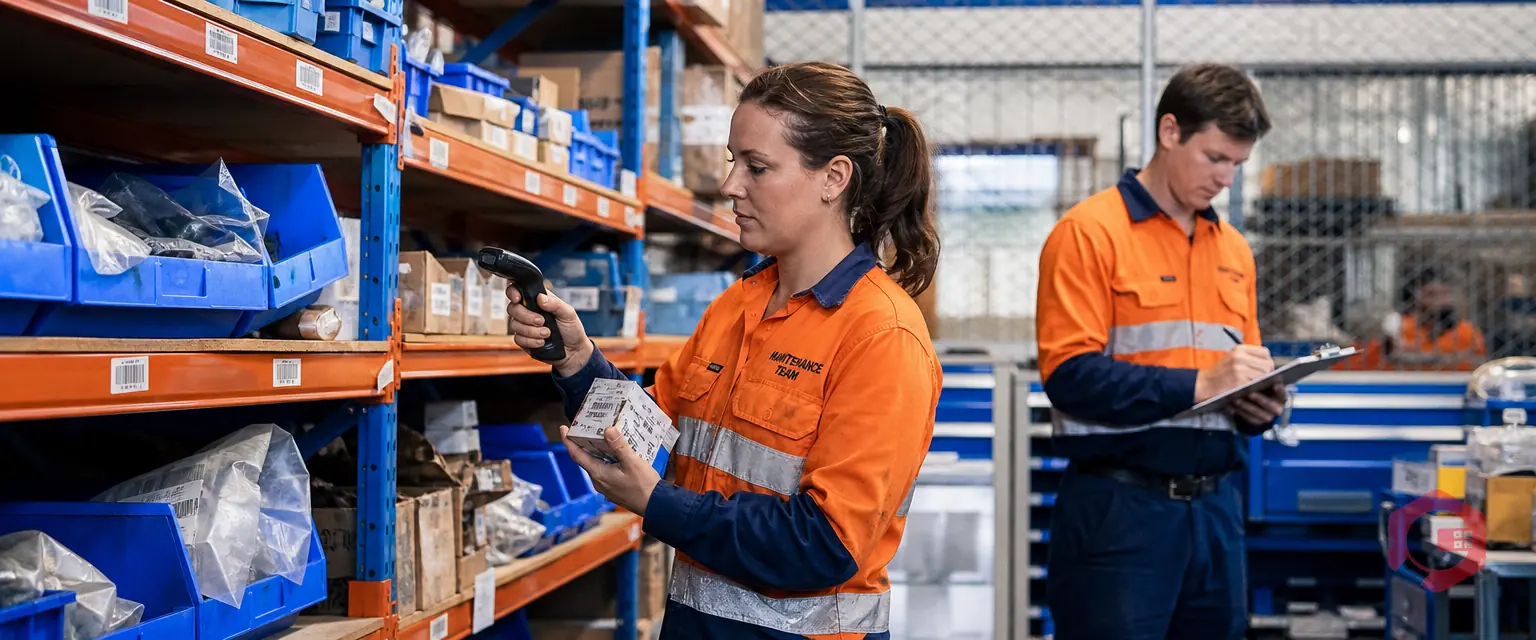
A surprisingly large amount of industrial waste comes from the storeroom. Parts expire, become obsolete, or are over-ordered and eventually scrapped. A robust inventory module helps manage this supply chain efficiently.
- The Green Advantage: Look for features like First-In-First-Out (FIFO) tracking and usage-based forecasting. These ensure that parts are used before they deteriorate and that you only order what is necessary, reducing the environmental impact of manufacturing and shipping spare components.
5. Sustainability-Focused Reporting (Green KPIs)
You cannot improve what you do not measure. A standard dashboard tracks costs; a sustainable dashboard tracks efficiency. The software should allow you to build custom reports that align with ESG goals.
- The Green Advantage: Dashboards should be able to visualize metrics such as asset uptime, energy usage per unit of production, and waste reduction trends. These data points are essential for demonstrating compliance with environmental standards like ISO 14001 and for validating your net-zero strategy to stakeholders.
Benefits of AI-Driven CMMS for Sustainable Operations
Implementing an Asset Management System driven by AI offers a tangible Return on Investment (ROI) that benefits both the bottom line and the environment.
- Drastic Waste Reduction: By optimizing inventory levels through real-time tracking and FIFO (First-In-First-Out) valuation, you prevent parts from expiring or becoming obsolete on the shelf.
- Regulatory Compliance: Environmental audits (like ISO 14001) require strict proof of maintenance. AI-driven systems automate this documentation. With Cryotos, safety certifications and Lockout-Tagout (LOTO) procedures are integrated directly into the workflow, ensuring you are always audit-ready.
- Extended Asset Longevity: Manufacturing a new industrial machine generates a massive carbon footprint. Keeping your existing assets running efficiently for 5 or 10 years longer is one of the most impactful things you can do for the environment.
- Data-Driven Decisions: Moving away from "gut feeling" maintenance to empirical evidence prevents unnecessary repairs and optimizes resource allocation.
How to Adopt AI-Powered CMMS to Support Sustainability Goals
Adopting AI-driven technology is not just a software upgrade; it is a digital transformation of your maintenance culture. Many organizations fail not because the software isn't capable, but because the implementation strategy is flawed.
To successfully leverage a CMMS for sustainability, you need a structured approach that aligns your data, your assets, and your people. Here is a step-by-step guide to making the transition.
1. Start with a Comprehensive Data Audit
AI algorithms are only as intelligent as the data they are fed. If your current records are messy-missing asset models, inconsistent naming conventions, or gaps in maintenance history-the AI cannot accurately predict energy usage or failure patterns.
The Action: Before you migrate, conduct a physical audit of your facility. Tag every asset with a unique identifier (like a QR code). Ensure that critical details (make, model, installation date, energy rating) are standardized. This "clean data" forms the baseline for all future sustainability insights.
2. Launch a Focused Pilot Program
Attempting to roll out AI across an entire factory overnight is a recipe for overwhelm. Instead, "think big, start small."
The Action: Select one specific production line, HVAC system, or critical asset class to start. Implement IoT sensors and predictive workflows on just this section. Measure the results over 90 days. Did energy consumption drop? Did uptime increase? Use these quick wins to prove the ROI to stakeholders and build momentum for a wider rollout.
3. Address the "Human Element" and Culture Change
The biggest barrier to AI adoption is often fear. Technicians may worry that "predictive maintenance" means "replacing people." It is crucial to change this narrative immediately.
The Action: Position the software as a digital assistant, not a replacement. Explain that the AI handles the tedious administrative work-like data entry and scheduling-so technicians can focus on high-value, complex repairs. Show them how mobile apps and voice-commands make their daily lives easier, not harder. When the team sees the tool as an enabler, adoption rates skyrocket.
4. Choose a Partner, Not Just a Vendor
Finally, the software provider you choose matters as much as the code itself. Sustainability is a long-term goal that requires ongoing support.
The Action: Look for a CMMS provider that offers robust onboarding and training. Ensure they have experience with the specific integrations you need (like connecting to your specific ERP or IoT sensors). A good partner will help you configure your dashboards to track the specific green KPIs that matter to your industry, ensuring you are capturing the data needed for environmental compliance.
Future Directions in Sustainable Maintenance Technology
The future of maintenance is intertwined with the Circular Economy. As AI models become more sophisticated, CMMS Software will not just predict failure; it will recommend whether a part should be repaired, refurbished, or recycled based on its material composition and current wear.
We are also moving toward Net-Zero manufacturing where maintenance data feeds directly into corporate sustainability reports. Technologies like Digital Twins will allow us to simulate repairs virtually before touching the physical asset, further reducing the margin for error and waste.
Conclusion
Sustainability is no longer an option for industrial operations; it is a mandate. But you don't need to overhaul your entire factory overnight to make a difference. The secret lies in how you manage what you already have. An AI-powered CMMS acts as the bridge between operational excellence and environmental responsibility. By predicting failures, optimizing energy use, and extending asset life, you are building a future that is resilient, profitable, and green.