

Maintenance leaders have been walking a tightrope between holding onto expensive spare parts and avoiding catastrophic stockouts for several years. The dependence on stiff spreadsheets as well as gut feelings to manage inventory risks with every passing day in today's complex industrial setting. It is not always real and ends with warehouses filled with dead items while critical spares are untraceable when a crucial equipment breakdown occurs.
AI Demand Forecasting just clears away all this guesswork by transforming inventory data into actionable intelligence. While the methods are pretty simple averages, advanced algorithms dig deep into their throats-from historical consumption and asset aging to real-time supply chain trends. This technology detects some fine usage patterns that human planners may overlook and predicts what you need even before a work order is there.
Right away, responsiveness and accuracy are affected. Instead of arbitrary safety margins, stock levels will be aligned to what the actual predictive demand is-such that an organization can greatly reduce carrying costs while increasing service level. Here, the right part is always available at the right time, turning your inventory into a strategic asset that guards uptime from unnecessary expenses.
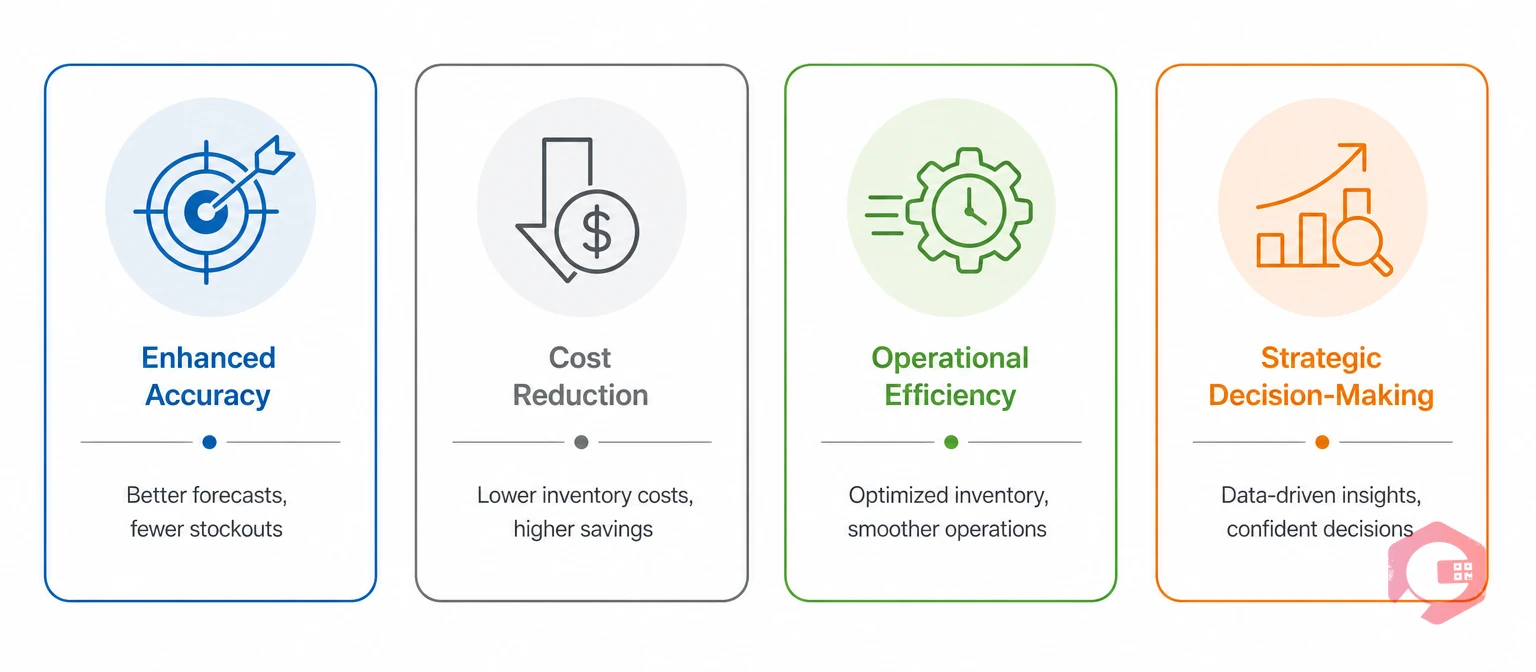
Moving from reactive purchasing to AI-driven forecasting changes the fundamental economics of maintenance management. It shifts the focus from simply filling shelves to optimizing the entire supply chain lifecycle.
Traditional spreadsheets often fail because they rely on static averages. AI thrives on complexity. By utilizing machine learning and neural networks, forecasting models detect subtle patterns in part usage that standard linear formulas miss. The system ingests diverse data-from historical consumption and asset age to external inputs like weather conditions-to generate forecasts that reflect reality, ensuring you are prepared for actual demand rather than just a "best guess."
Inventory carrying costs are the silent killer of maintenance budgets. AI forecasting attacks this financial drain on two fronts. First, it minimizes overstock risks, freeing up capital previously tied to "just in case" safety stock that sits gathering dust. Second, it prevents stockouts, eliminating the exorbitant costs of emergency expedited shipping and the revenue loss associated with prolonged equipment downtime.
While advanced software handles complex calculations of reorder timing and procurement volume, it liberates the team from spending hours counting bins and comparing spreadsheets; these menial tasks are taken over by an automated process. Maintenance planners and procurement teams can therefore dedicate themselves to high-value activities, such as vendor relationship management or reliability strategy development, instead of tedium such as report writing.
Unlike earlier systems of order management for example, instinct based, this technology has taken a significant step toward a more data-driven demand ordering scenario. The questions that now arise are not so much about whether there is enough stock of, say, a particular part but rather - why does this part seem to be used so much? With AI's ability to offer faster and better insights, managers can compare utilization with trends and alterations during the lifecycle before making decisions that would align inventory responsiveness with higher business objectives.
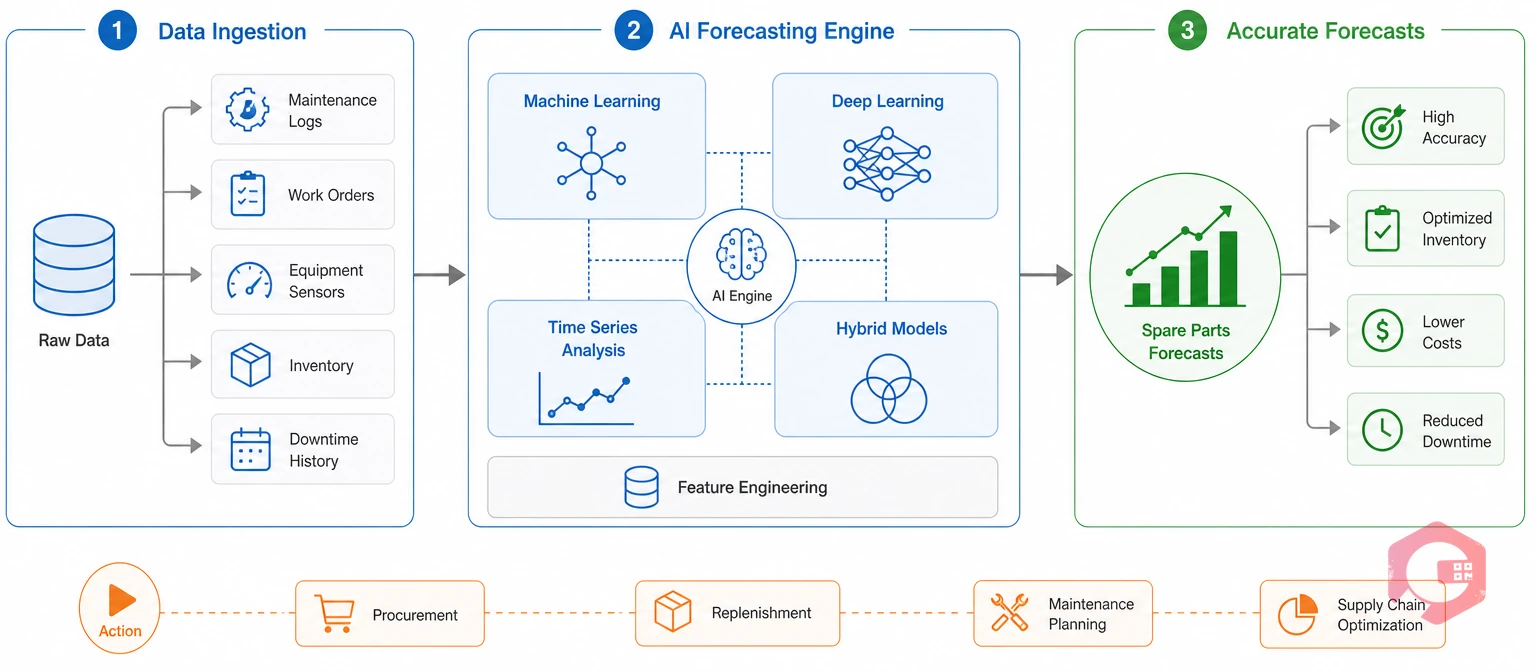
Understanding the engine behind AI forecasting helps in trusting the output. It is not magic; it is advanced computation that turns raw data into actionable inventory strategies.
The foundation of modern forecasting lies in Machine Learning (ML) and Deep Learning (DL).
Beyond raw numbers, Natural Language Processing (NLP) and Generative AI play a crucial role in maintenance. They can scan unstructured data-such as technician voice notes, shift logs, or email communications-to identify potential equipment issues before they result in a part request, effectively predicting demand based on "chatter" rather than just purchase history.
Reliable forecasting rarely relies on a single algorithm. Instead, it uses Hybrid Models that combine traditional statistical techniques with modern AI.
The accuracy of any AI model depends on the quality of its fuel-data.
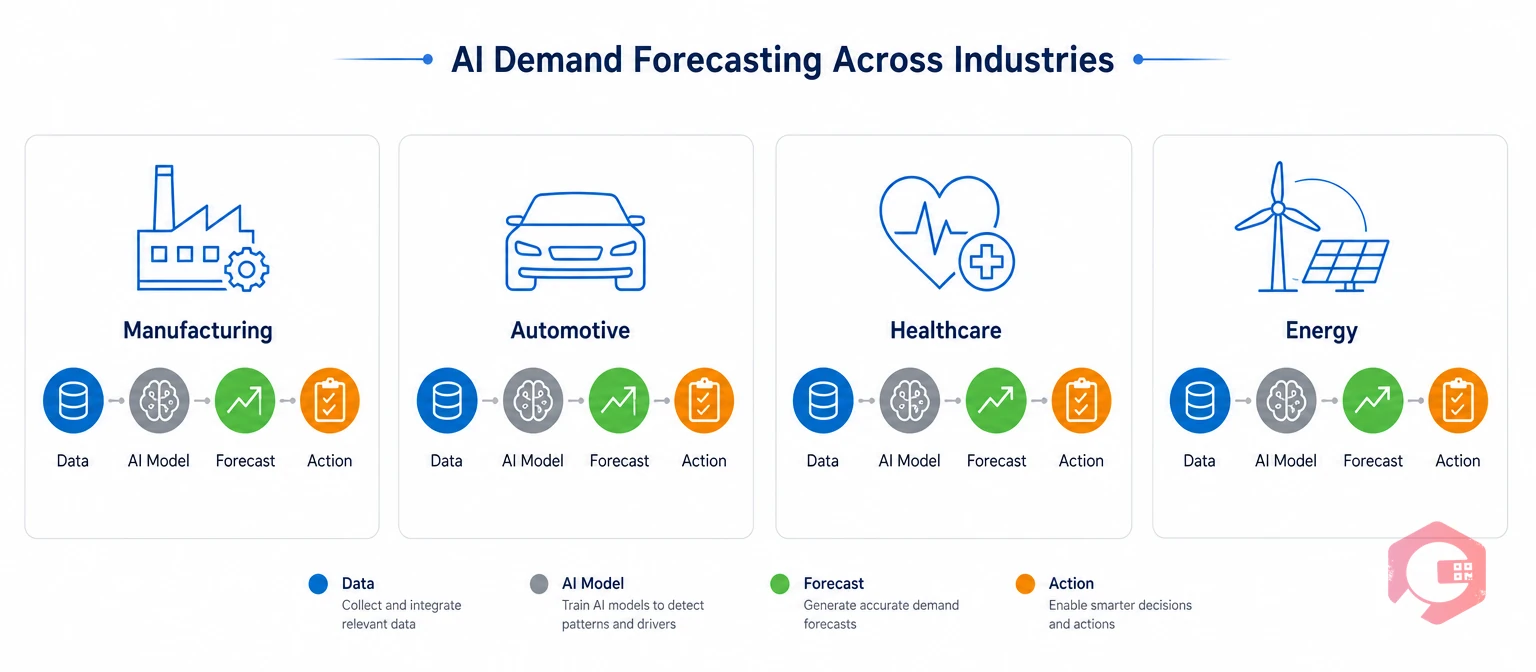
AI forecasting is not a theoretical concept; it is a practical tool that adapts to the specific operational pressures of different sectors.
Down time is the most devastating thing to exist in a high volume atmosphere. AI scatters inventory for an essential spare part in production planning because it directly communicates with production schedules. Suppose there is a 20% upturn in output next month- this point in time would automatically reconfigure safety stocks for the most logged consumables, such as belts and bearings, which are expected to have a match between availability and production goals.
All kinds of automotive plants and after-market services go by say Just-in-Time (JIT). Spare parts inventory is maintained by AI with anticipation of matching demands for repair in service centers as well as assembly line robotics. By using failure rates and driving patterns near-by, there is zero lag between a fault report and part availability, which translates into more satisfied customers and faster service turnaround.
It can easily be said that stock-out in health is fatal. AI forecasting predicts demand for biomedical spare parts and pharmaceutical consumables, analyzing patient admission trends and seasonal factors (for example flu outbreaks), therefore assuring that all critical equipment, from MRI machines to ventilators, has the spare parts necessary to fix it immediately with 100% compliance without risking expired inventory.
Most assets are located in areas of limited accessibility, such as offshore wind farms or far-distant oil rigs, making logistics slower and expensive. Fusing with AI failure rate and consumption predictions, inventories would be pushed close to the top of the point of use just before the failure happens. On another bright side, the EV sector has turned to using AI technology to anticipate demand peak times for users of charging stations, thus keeping maintenance teams well stocked.
Adopting AI is a transformative journey, but it is not without its hurdles. Understanding these obstacles is the first step toward overcoming them.
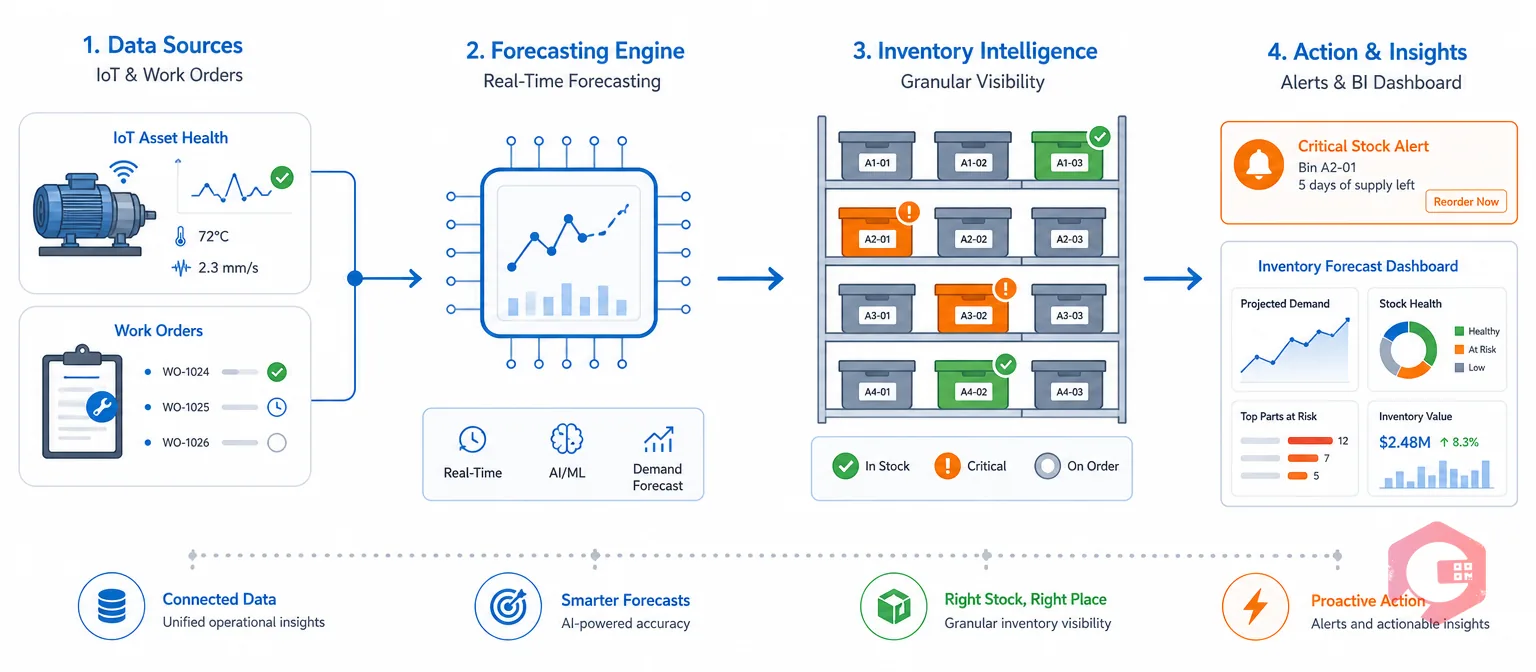
Cryotos CMMS bridges the gap between complex AI technology and practical maintenance operations. We don't just track what you have on the shelf; we help you understand what you will need before the machine even stops.
Cryotos integrates Inventory Management directly with Work Order and IoT modules. Because our system tracks real-time asset health (via IoT sensors) and actual usage (via work orders), our forecasting isn't guessing-it's calculating based on live conditions.
Our clients leverage the Business Intelligence (BI) Dashboard to visualize these forecasts. By correlating downtime data with inventory usage, Cryotos helps users identify which parts are causing extended delays and adjusts stocking strategies accordingly. Whether it's managing end-of-life products or optimizing purchasing via FIFO/LIFO, Cryotos turns inventory data into operational agility.
AI demand forecasting is no longer a futuristic concept; it is a necessary tool for modern inventory optimization. It creates a responsive supply chain that moves at the speed of your operations, reducing waste and ensuring reliability.
For maintenance leaders, the next step is clear: move away from static spreadsheets and adopt a system that learns and evolves with your plant. By integrating AI into your inventory strategy with Cryotos, you aren't just buying parts; you are buying uptime.




Cryotos AI predicts failures, automates work orders, and simplifies maintenance—before problems slow you down.



