

Mobile CMMS in a connected factory gives maintenance teams real-time access to equipment data, work orders, and sensor alerts — directly from the factory floor. A Computerized Maintenance Management System that runs on mobile devices bridges the gap between physical machines and digital operations, so technicians act on accurate data instead of paper logs or radio calls.
Connected factories rely on IIoT sensors, SCADA systems, and edge computing to generate continuous streams of equipment health data. When mobile CMMS plugs into that infrastructure, maintenance stops being reactive and becomes a precision function.
Key Takeaways
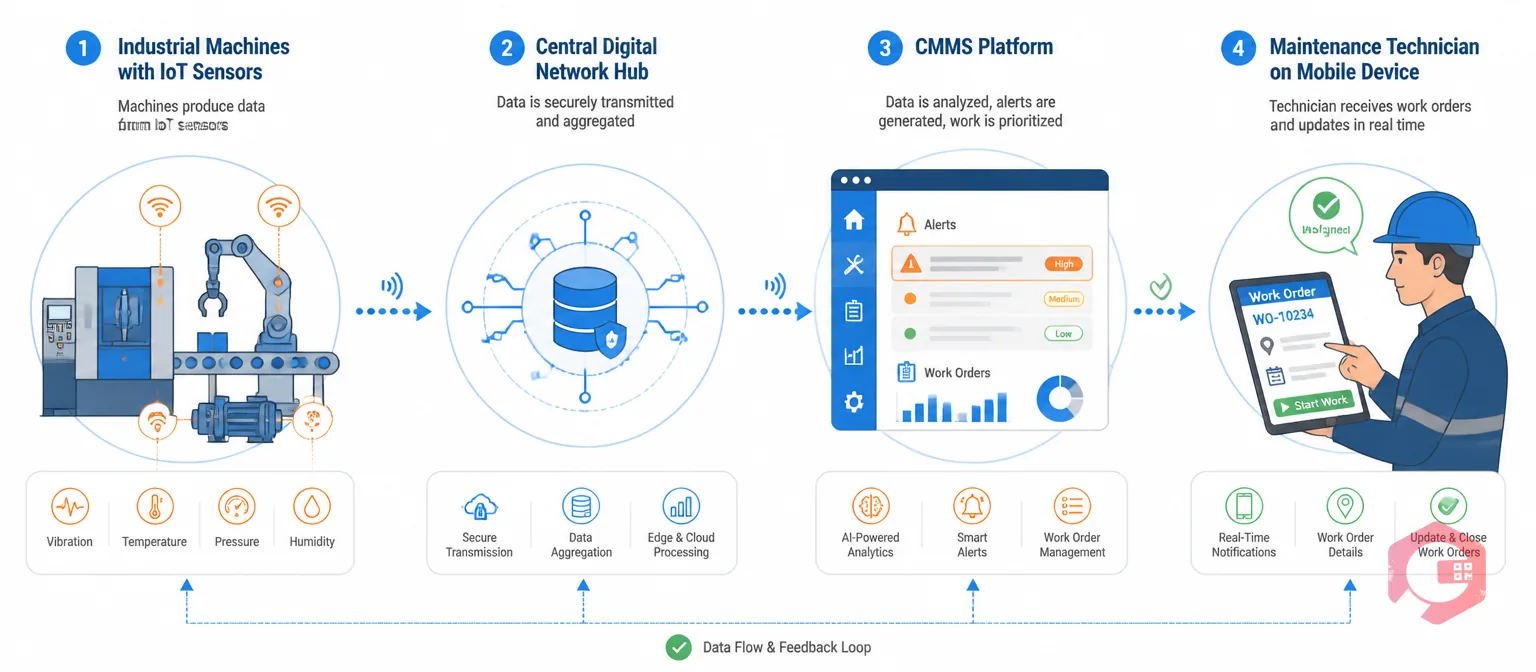
A connected factory is a manufacturing environment where machines, sensors, and systems share data continuously through a common digital network. Every asset — from a conveyor belt to a CNC machine — transmits real-time performance data that operations and maintenance teams can act on immediately.
The connected factory concept sits at the heart of Industry 4.0, the fourth industrial revolution that integrates cyber-physical systems, IoT, and cloud computing into production. According to ISA (International Society of Automation), connected manufacturing environments generate up to 10x more operational data than traditional factories — most of which is maintenance-relevant.
A connected factory generates data constantly, but data alone doesn't prevent breakdowns. Maintenance teams need to receive that data, interpret it, and act on it — often within minutes. Without a system that delivers actionable alerts to the people on the factory floor, all that sensor intelligence sits unused in a dashboard somewhere.
This is exactly where mobile CMMS becomes essential. It is the execution layer that turns machine signals into technician actions.
Mobile CMMS is a maintenance management system accessible from smartphones and tablets, giving technicians full work order, asset, and inventory functionality from anywhere on the plant floor. Unlike desktop-only CMMS platforms, mobile CMMS travels with the technician — whether they're at a remote pump station or in an underground production area with no Wi-Fi.
In a connected factory context, mobile CMMS is the bridge between the machine layer and the people layer. Sensors detect anomalies. IIoT platforms process the data. Mobile CMMS delivers the action — creating a work order, notifying the right technician, and capturing the repair outcome — all in one loop.
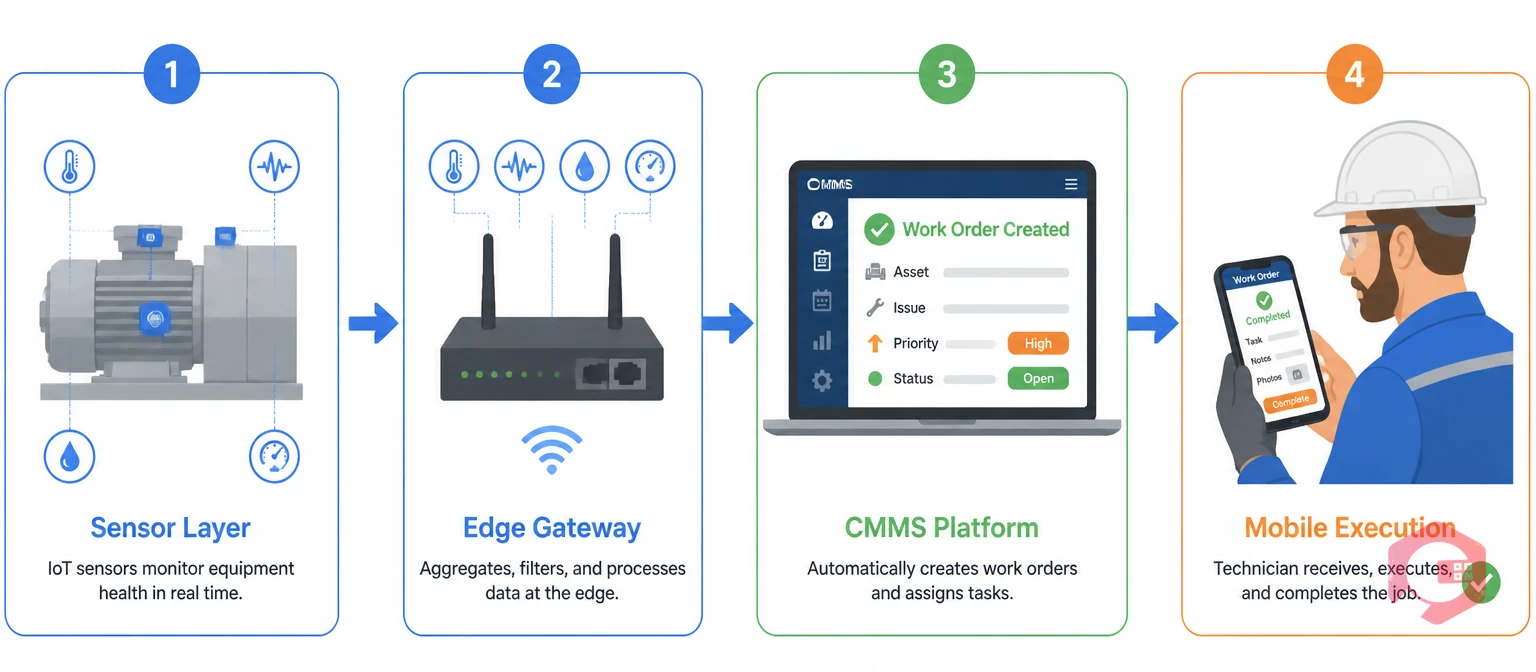
Mobile CMMS connects to a connected factory through a layered integration architecture that moves data from physical sensors all the way to a technician's phone. Understanding how each layer works clarifies why this integration is so powerful — and what breaks down when one layer is missing.
The 4-Layer Mobile CMMS Integration Stack describes the path from machine sensor to technician action:
Cryotos mobile CMMS connects at Layer 3 via SCADA/PLC/edge integrations and pushes all execution to Layer 4 through its native mobile app, including full offline sync so factory floors with patchy Wi-Fi stay fully operational.
See how Cryotos mobile CMMS works in a connected factory — explore the mobile CMMS platform or speak to our team today.
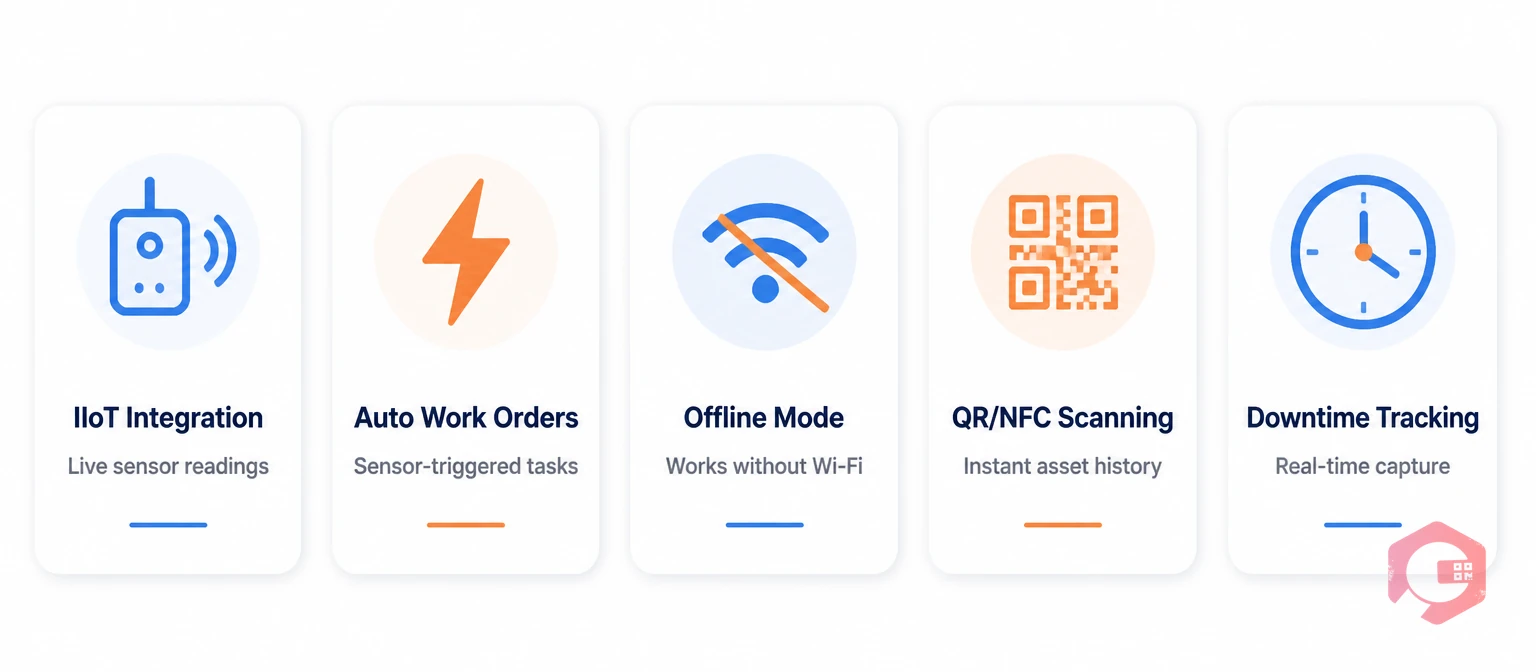
Not every CMMS mobile app delivers full connected factory functionality. The features below separate a genuine connected-factory-ready system from one that simply runs in a browser on a phone.
Mobile CMMS should receive live readings from IIoT sensors and use them to trigger condition-based or meter-based maintenance tasks. Cryotos IoT meter reading connects to SCADA, PLC, and edge gateways to pull runtime hours, temperature exceedances, and pressure readings — then auto-schedules maintenance tasks when thresholds are crossed.
Automated work order creation is the process of generating, assigning, and routing a maintenance task without manual input, triggered by a sensor alert or a scheduled PM trigger. When a motor vibration sensor crosses its alarm threshold at 2 AM, the CMMS creates the work order, assigns it to the on-call technician, and sends a WhatsApp notification — before anyone has looked at a dashboard.
Factory floors — especially in heavy industry, cold storage, and basement plant rooms — often have poor or no connectivity. A mobile CMMS with genuine offline mode lets technicians open work orders, complete checklists, and capture photo evidence without a network connection. All data syncs automatically the moment connectivity returns.
Technicians scan an asset's QR code or NFC tag and immediately see its full history: last PM date, open work orders, spare parts used, and fault patterns. This eliminates the 10-15 minutes per shift typically spent searching for asset records.
Connected factory operations need to know when an asset goes down, how long it stays down, and what the repair cost was. Mobile CMMS captures this at the point of work — not retrospectively in a spreadsheet.
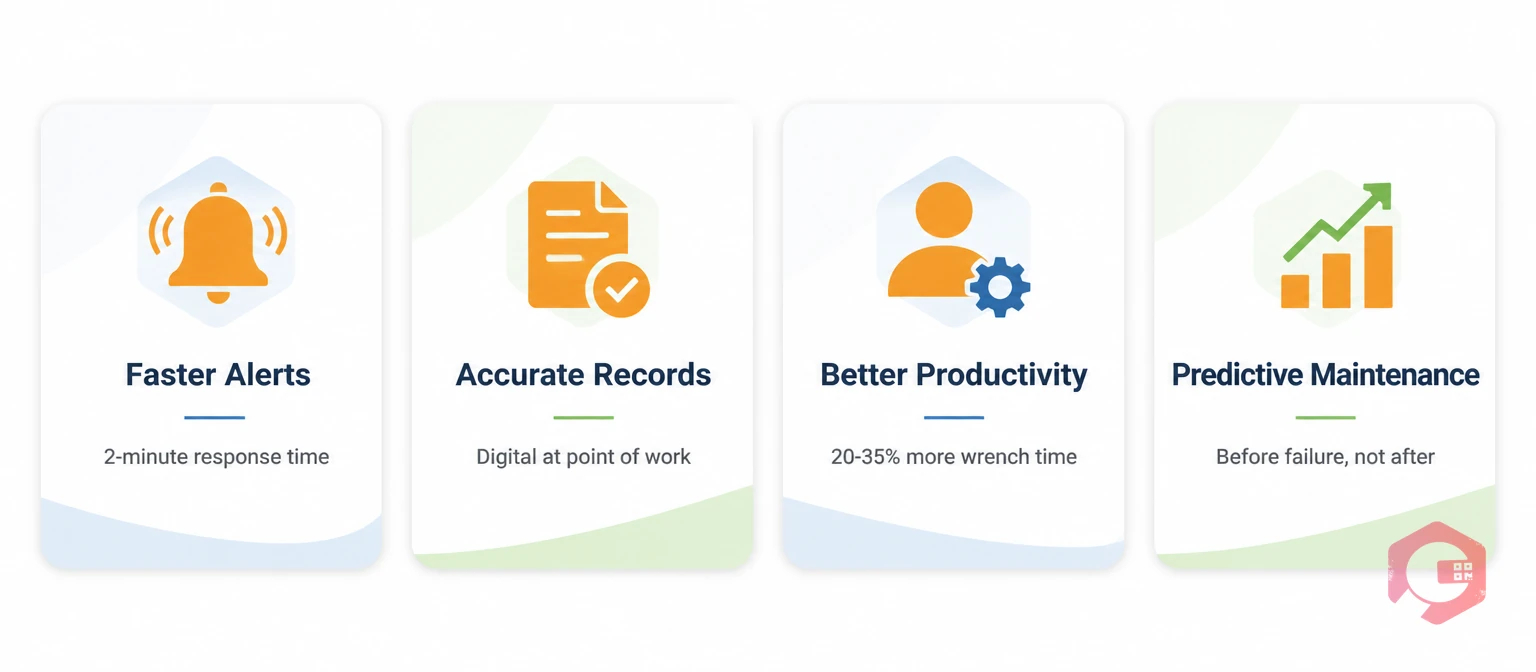
The benefits of mobile CMMS in a connected factory aren't theoretical — they show up in MTTR, OEE, and maintenance cost per asset. SMRP (Society for Maintenance and Reliability Professionals) benchmarks show that connected maintenance programs reduce unplanned downtime by 30-45% compared to reactive-only approaches.
Maintenance teams using Cryotos have reported up to 30% reduction in unplanned downtime and 25% faster repair turnaround — gains that compound across multiple production lines.
When a sensor alert reaches a technician's mobile device in seconds rather than minutes, response time drops dramatically. The difference between a 2-minute response and a 20-minute response is often the difference between a quick adjustment and a full production stop.
Paper-based maintenance logs are routinely incomplete, illegible, or lost. Mobile CMMS captures every job in real time — parts used, time taken, technician notes, and photo evidence — building an asset history that improves future PM planning and supports audit trails.
Technicians spend less time walking to a terminal, hunting for asset records, or waiting for work order approvals. Studies cited by Industry 4.0 researchers suggest connected maintenance programs improve wrench time (actual hands-on repair time) by 20-35% compared to paper-based systems.
Predictive maintenance is a strategy that uses real-time sensor data and historical patterns to schedule maintenance exactly when it is needed — before failure, but not too early. Mobile CMMS makes predictive maintenance actionable by ensuring the right technician gets the right alert at the right time, with full asset context already in hand. Learn more about IIoT-driven maintenance and how it enables this approach.
The gap between traditional and connected factory maintenance is widening. Here's how the two approaches compare across the dimensions that matter most to maintenance managers:
| Dimension | Traditional Maintenance | Connected Factory + Mobile CMMS |
|---|---|---|
| Work Order Creation | Manual — paper form or desktop entry | Automated — triggered by sensor or PM schedule |
| Technician Notification | Radio call or supervisor walk-around | Push notification to mobile device within seconds |
| Asset Data Access | Paper manuals or desktop lookup at a terminal | Instant via QR/NFC scan on mobile |
| Downtime Tracking | Estimated in spreadsheet after the fact | Real-time, captured at point of work |
| Maintenance Strategy | Reactive or calendar-based PM | Condition-based and predictive |
| Audit Trail | Paper records, often incomplete | Full digital record with photos and timestamps |
| Connectivity Required | N/A | No — offline mode with auto-sync |
The shift to connected factory maintenance isn't about replacing technicians — it's about giving them better tools and better information so they can work faster and more accurately.
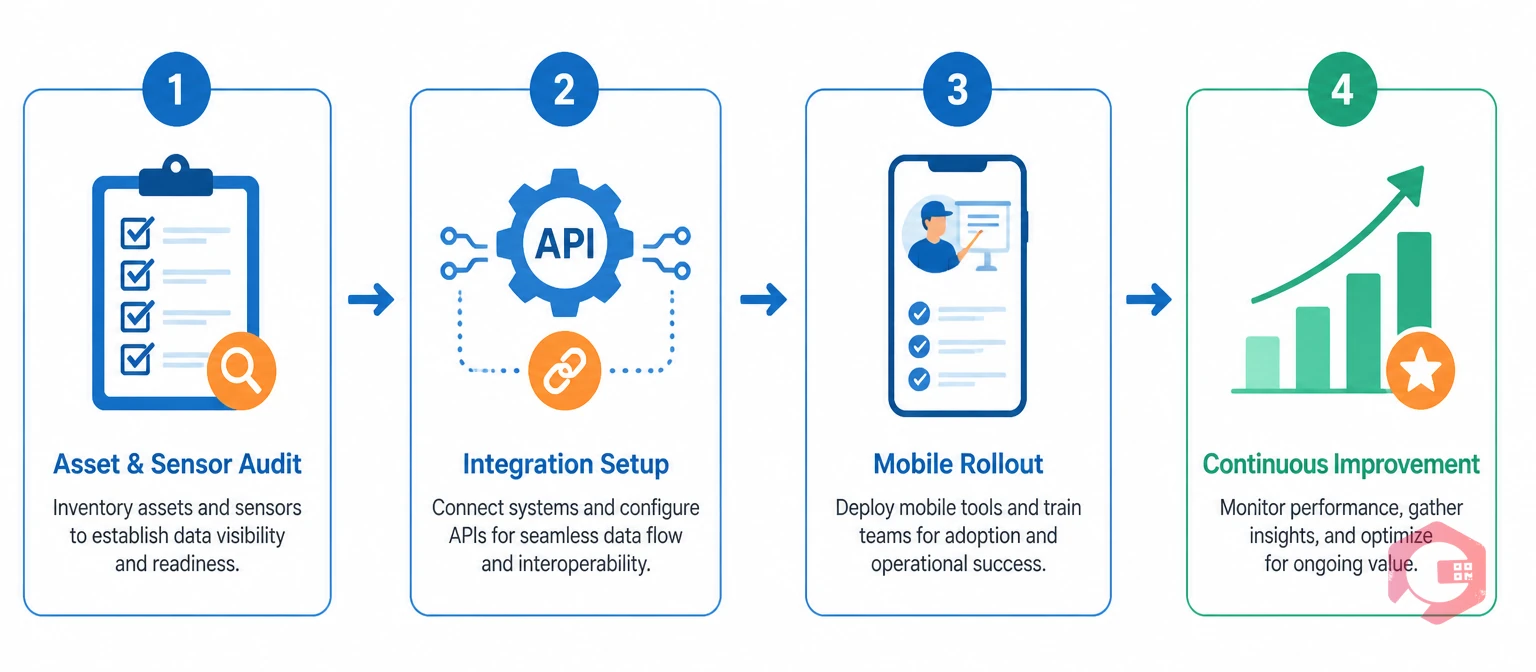
Implementing mobile CMMS in a connected factory is a structured process that typically runs in four phases. Rushing any phase — especially the data mapping stage — leads to incomplete sensor integrations and adoption problems on the floor.
List every asset that will feed data into the CMMS. For each one, document the sensor type, data format (OPC-UA, Modbus, MQTT), and the maintenance-relevant thresholds. This audit becomes the foundation of your integration map.
Connect your SCADA/PLC or edge gateway to the CMMS via API. Cryotos supports direct integrations with SCADA systems and ERP platforms including SAP and MS Dynamics 365. Configure ERP integration at this stage to ensure spare parts availability data flows into work orders automatically.
Deploy the mobile app to technician devices. Configure role-based permissions so each technician sees only the assets and work orders relevant to their area. Run a two-week parallel operation (paper + mobile) to catch any gaps before going fully digital.
Use the CMMS reporting dashboard to track MTTR, MTBF, and wrench time weekly. Review sensor thresholds quarterly to reduce false alarms and ensure the predictive triggers are accurate for your operating conditions.
Mobile CMMS connected factory deployments look different across industries, but the core value — faster response, better data, fewer unplanned stops — is consistent.
An automotive plant running three shifts needs maintenance coverage around the clock. With mobile CMMS connected to vibration sensors on stamping presses, technicians receive alerts on their phones the moment a bearing shows abnormal frequency patterns. The work order is already created, the spare part is already reserved in inventory, and the job gets done during a scheduled break — not during a full production stop.
Refrigeration and conveyor systems in food plants run continuously and are subject to strict hygiene regulations. Mobile CMMS with IIoT integration monitors compressor temperatures and conveyor drive loads in real time, triggering PM tasks before a breakdown that could compromise product safety and regulatory compliance.
Pharmaceutical facilities require validated maintenance records for FDA and GMP audits. Mobile CMMS captures every maintenance action with timestamps, technician signatures, and photo evidence — turning a time-consuming audit preparation process into an automated report pull.
Remote mine sites have limited connectivity. Mobile CMMS with offline mode lets technicians complete work orders in underground operations and sync all data automatically when they return to a connected zone — keeping records complete without requiring constant Wi-Fi.
A connected factory platform manages the data infrastructure — sensors, edge devices, SCADA, and cloud processing. Mobile CMMS is the maintenance execution layer that sits on top: it receives alerts from the connected factory platform and gives technicians the tools to act on them. The two systems work together, with mobile CMMS translating machine signals into technician actions.
Yes — provided the mobile CMMS has a genuine offline mode. Cryotos mobile CMMS stores work orders, asset data, and checklists locally on the device. Technicians can complete full jobs without connectivity, and all data syncs automatically when the device reconnects. This is critical for factories with basement plant rooms, cold storage, or RF-shielded production areas.
Integration works through API connections or middleware that bridges the OT (operational technology) and IT layers. The SCADA or PLC sends real-time equipment data — temperature, pressure, vibration — to the CMMS via an agreed protocol (OPC-UA, MQTT, REST API). The CMMS processes the data, applies threshold rules, and triggers maintenance actions. Cryotos supports these integrations through its IoT meter reading module.
Mobile CMMS can receive any sensor alert that the connected factory platform is configured to send: temperature exceedances, vibration anomalies, pressure deviations, runtime hour thresholds, energy consumption spikes, and fluid level warnings. Each alert type maps to a maintenance task type — inspection, lubrication, part replacement, or full overhaul — based on the threshold rules set up during implementation.
A phased implementation typically takes 6-12 weeks from asset audit to full go-live. The longest phase is usually sensor mapping and integration setup (2-4 weeks), particularly when connecting to legacy SCADA systems. Mobile app rollout and technician training usually runs 1-2 weeks, followed by a parallel-run period before full cutover.
If your factory is ready to move from reactive maintenance to connected, predictive operations, Cryotos is built for exactly this environment. Schedule a free demo to see how Cryotos connects your factory floor to your maintenance team in real time.



Cryotos AI predicts failures, automates work orders, and simplifies maintenance—before problems slow you down.



