

A risk assessment is the process of identifying workplace hazards, judging how likely each one is to cause harm and how severe that harm would be, and then putting controls in place to bring the danger down to an acceptable level. Skip this process and you're not just risking a compliance fine — OSHA recorded 5,283 fatal work injuries in the U.S. in 2023 alone, and unplanned incidents are a leading cause of unplanned downtime.
Risk assessment sounds like a job for a dedicated safety officer, but it's really a logical, repeatable process. Whether you're a Plant Head or a maintenance technician tracking work in a Computerized Maintenance Management System (CMMS), you can run one using a clear 4-step framework.
Key Takeaways
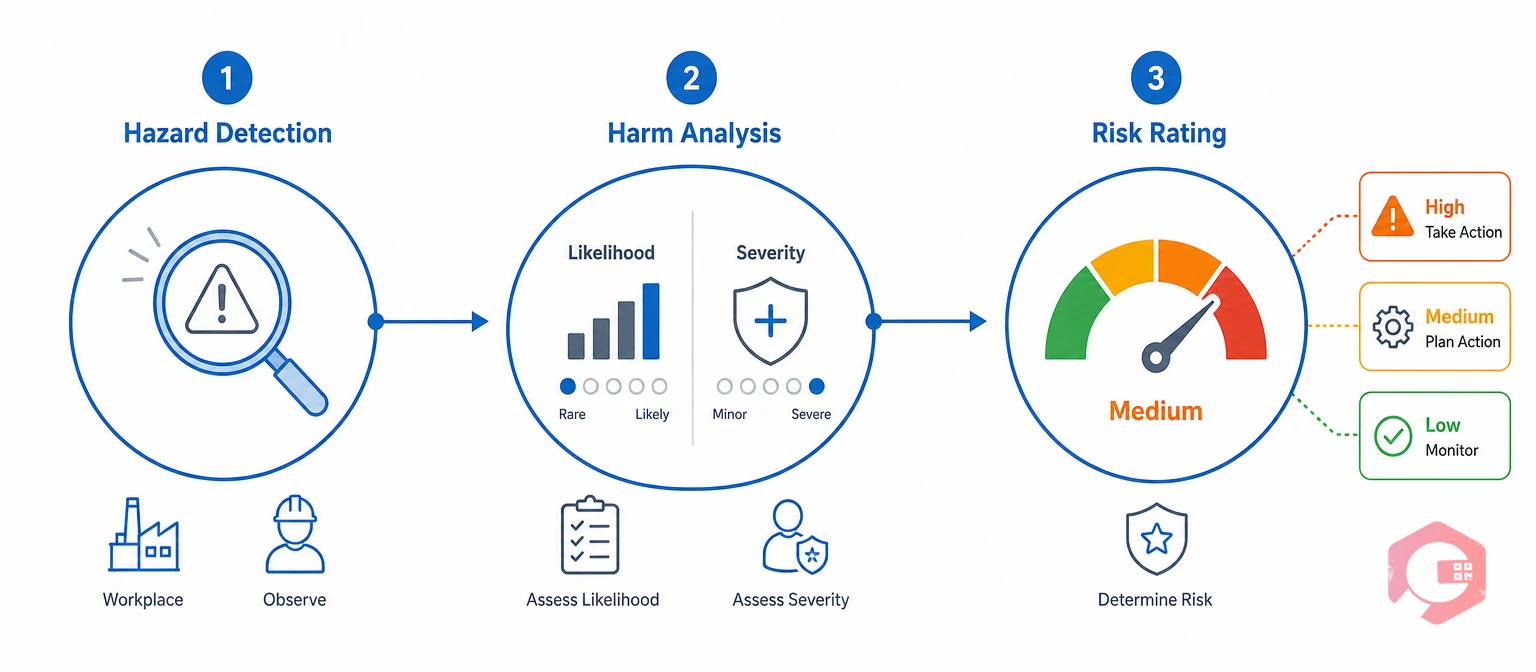
A risk assessment is a structured review that spots workplace hazards, then rates how likely and how severe the resulting harm would be. From there, you decide what controls need to be in place to prevent it.
The process rests on three activities common to formal risk assessment methodologies: detecting hazards, analyzing how they could cause harm, and calculating the resulting risk level. Maintenance teams invest time in this for three reasons:
In maintenance, "hazard" and "risk" get used interchangeably — and that mix-up leads to assessments that miss the point. Get these four terms straight before you start.
| Term | What It Means | Maintenance Example |
|---|---|---|
| Hazard | Anything with the potential to cause harm — the source of danger itself | Exposed wiring, an oil spill, corrosive chemicals, working at height |
| Risk | The likelihood a hazard actually harms someone, combined with how bad that harm would be | Risk = Likelihood × Severity |
| Likelihood | How probable the accident is, rated 1 (extremely unlikely) to 5 (frequent) | A worn guard rail loosening over months of vibration |
| Severity | How bad the outcome would be if it happened, rated 1 (minor) to 5 (catastrophic) | A fall from height vs. a minor bruise |
Think of it this way: a shark in the ocean is a hazard. Swimming next to it is the risk.
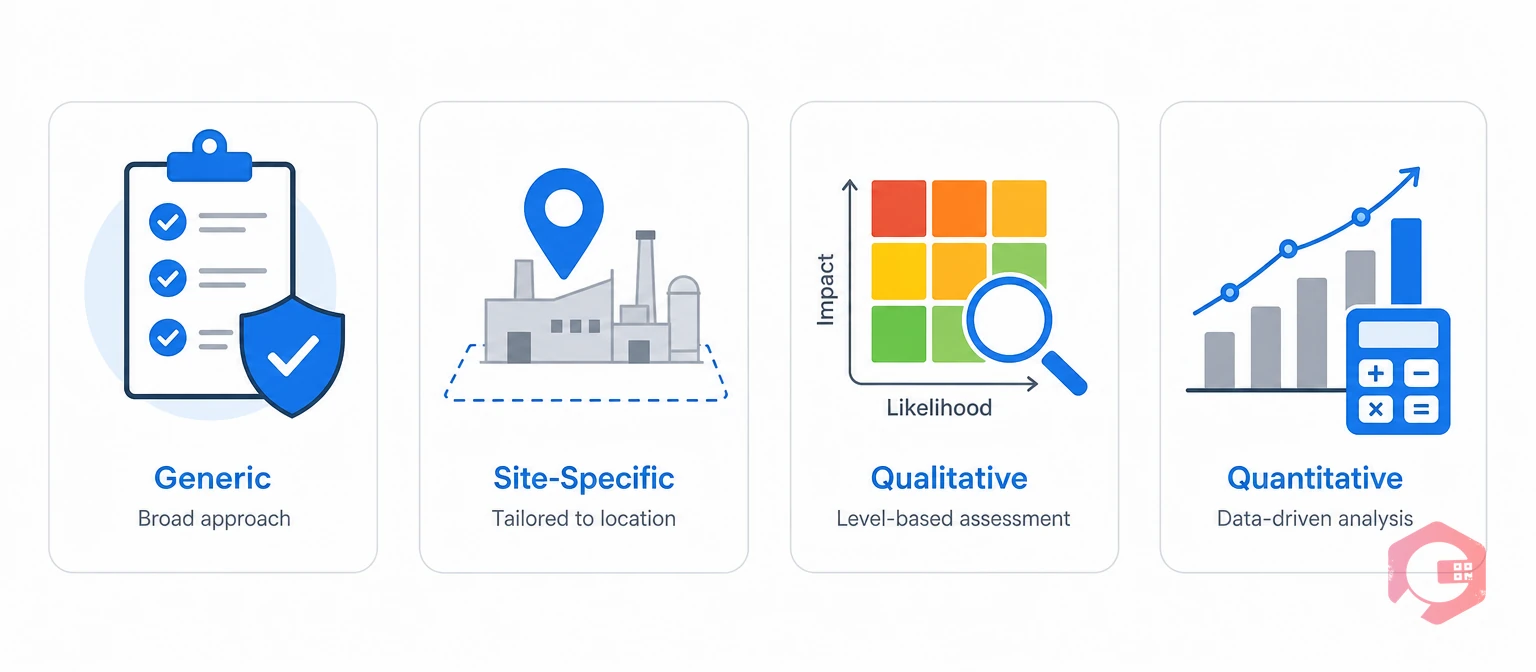
The right lens for judging risk changes with the complexity of the machinery and the environment around it. Four approaches cover most maintenance situations.
This baseline approach uses pre-filled templates for standard activities that carry the same hazards across sites.
This adapts the generic version to the reality of a location, since the environment can be as dangerous as the task itself.
This is the most common method for small-to-medium manufacturing operations, relying on the assessor's judgment rather than complex math.
This data-driven approach removes guesswork by using historical numbers to calculate risk, and it's where your maintenance data becomes valuable.
See how a digital work order system turns a hazard report into a tracked, closed-out corrective action instead of a note that gets forgotten.
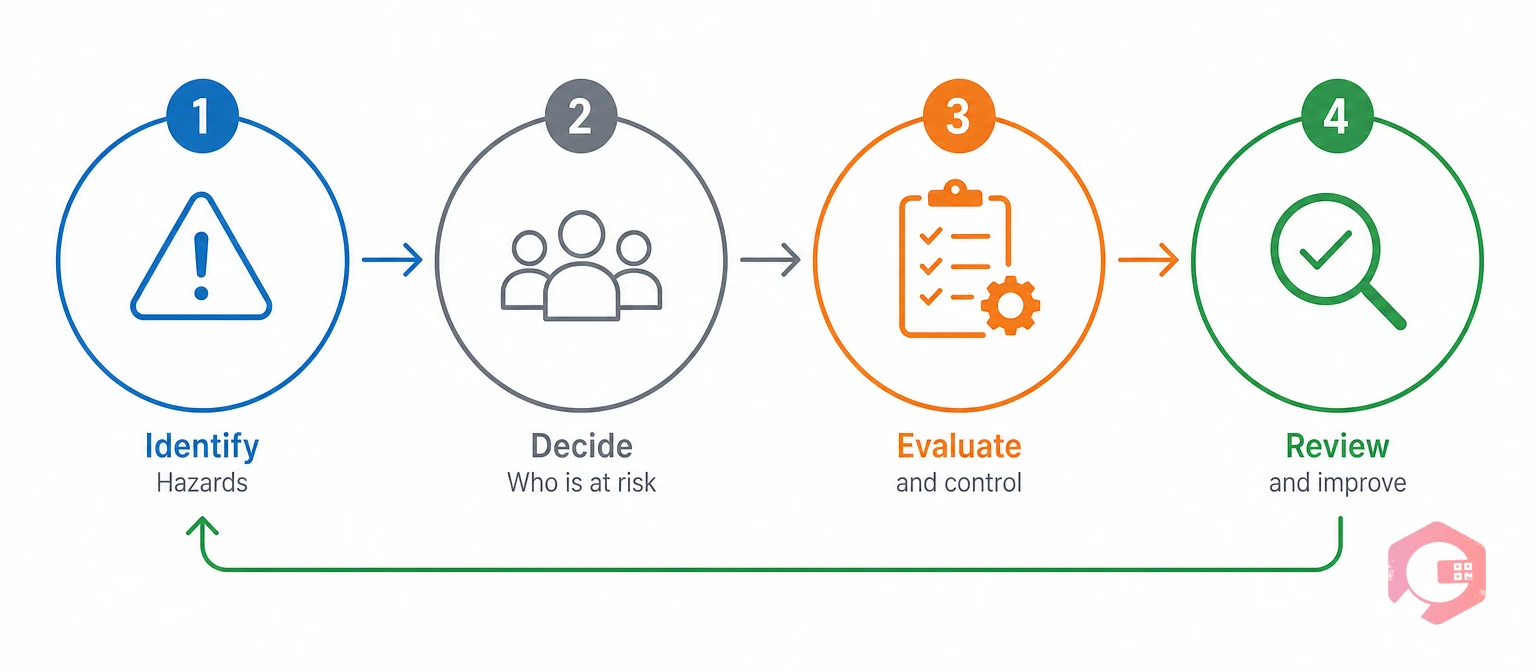
The Four-Step Risk Assessment Framework is a repeatable routine: identify hazards, decide who's at risk, evaluate and control, then review. It turns a vague safety obligation into a schedule you can actually follow. Here's how each step works in practice.
You cannot fix what you don't see. Walk the workplace — physically or virtually — looking for anything that could cause harm.
Don't limit yourself to physical hazards like unguarded machinery or trip risks. Factor in fatigue, stress, and, increasingly, data vulnerabilities from connected equipment. OSHA's hazard identification guidance recommends involving frontline workers directly, since they spot hazards a walkthrough alone can miss.
Modern approach: Instead of a clipboard, technicians can snap a photo of a fault, annotate the hazard on-screen, and log the issue by voice on the spot — capturing the hazard in real time instead of at the end of a shift.
Hazards rarely affect everyone equally, so avoid the trap of writing "everyone" and get specific instead.
Once you know who, work out how. Does the contractor have access to the lockout-tagout (LOTO) procedure? Is a visitor walking near forklift paths?
This is the analysis-and-action phase — you've found the hazard and the people at risk, so now you calculate the danger level and act on it.
A risk assessment isn't a file-and-forget document — it stays a living part of your operation. Trigger a review whenever:
Digital systems can set automated review triggers, letting you schedule a safety-protocol check the same way you schedule preventive maintenance (PM). When asset history shows a piece of equipment has changed, the system can prompt an update to its safety checklist too.
Even with a clear 4-step process, a few things tend to go wrong.
Standards like OSHA and ISO 45001 change over time. Stay current through industry newsletters and seminars, and use a safety compliance checklist your team can update without needing a developer, so everyone works from the latest version.
Bad data leads to bad decisions — if you don't know your breakdown history, you can't judge risk accurately. Clean your data regularly, and lean on BI dashboards that surface trends in breakdown hours (BDH) or MTBF, giving you factual evidence for your risk calculations. Most maintenance teams that adopt this habit catch recurring hazards months earlier than teams relying on memory alone.
Review it whenever new equipment arrives, staff turnover is high, regulations change, or after any accident or near-miss — not on a fixed calendar alone.
A hazard is the source of potential harm, like exposed wiring. Risk is the likelihood that hazard actually harms someone, combined with how severe that harm would be.
Most small-to-medium operations start with a qualitative risk assessment, since it's fast, needs no specialized statistics, and is easy for non-technical staff to apply consistently.
In many regions, employers with five or more staff are legally required to record their findings, including the hazards identified, who's at risk, and the controls put in place.
Yes — a CMMS can log hazards from mobile devices in real time, schedule recurring safety reviews alongside preventive maintenance, and surface the failure data a quantitative risk assessment depends on.
Risk assessment isn't a regulatory hoop to jump through — it's what separates a hazardous floor from a safe, reliable one. The four-step framework above turns that goal into a routine you can actually sustain, review after review. Schedule a free demo to see how Cryotos turns hazard reports and safety schedules into one connected system.




Cryotos AI predicts failures, automates work orders, and simplifies maintenance—before problems slow you down.



