

A paper-based permit to work system is a documented, manual process for authorising high-risk maintenance tasks — and it is one of the most significant unmanaged liabilities in modern plant operations. Facilities that still rely on paper permits expose their workforce to undetected hazard conflicts, unverifiable contractor credentials, and compliance gaps that paper trails cannot close. Human error accounts for 70–90% of industrial accidents — and paper-based processes are one of the primary amplifiers of that risk.
📊 Industry Benchmark: Facilities using electronic permit to work (ePTW) systems report a 40–60% reduction in permit cycle time and a measurable drop in near-miss incidents within the first six months of deployment. Source: Reliable Plant Safety Technology Report.
If your plant is still issuing permits with clipboards and filing cabinets, this post breaks down exactly where the risk lives — and the specific fixes that a digital permit to work system delivers.
Paper permits feel familiar. They also feel controlled. But familiarity is not the same as safety, and the gap between the two is where accidents happen.
A paper-based permit to work process depends entirely on human memory, physical presence, and manual cross-referencing — three things that fail under pressure, during shift changes, and across complex multi-trade shutdowns. The consequences are not hypothetical. They show up as near-misses, regulatory fines, and, in the worst cases, fatalities.
Below are the five biggest risks your plant carries every day it keeps paper at the centre of its permit to work system.
Paper permits rely on the honour system. A technician can tick "qualified" on a competency box even if their certification expired three weeks ago. A supervisor can sign off on a hazard assessment without physically verifying the isolation point. The industry term for this is "pencil-whipping" — and it is alarmingly common.
📊 Stat: Human error accounts for 70–90% of industrial accidents, with inadequate permit processes and documentation failures identified as key contributing factors across major incident investigations. Source: OSHA Process Safety Management guidelines.
From the field: A chemical processing plant in Maharashtra ran a paper PTW process across 12 active work zones during a scheduled shutdown. Post-shutdown audit found that 23% of permits had at least one missing signoff and 11% had tasks recorded that were not part of the original scope — none flagged in real time because no one had a complete picture of what was active.
A permit on a clipboard in Unit B is invisible to the safety manager in Unit A. A permit issued at 7:00 AM reflects the conditions at 7:00 AM — not at 11:30 AM when conditions have changed. Paper data is static by design, and static data cannot manage dynamic risk.
A digital PTW system replaces this blind spot with a live operational picture — every active permit, every pending approval, every overdue closure, visible in one screen.

This is the risk that hits your maintenance budget hardest, even though it rarely appears in accident reports. Plant managers consistently describe entire crews standing idle — waiting for a specific supervisor to physically appear and sign a paper permit.
📊 Stat: Unplanned downtime costs industrial manufacturers an average of $260,000 per hour when idle labour, missed production targets, and emergency response costs are combined. Source: McKinsey Global Operations research on manufacturing downtime.
A digital PTW system routes approvals in parallel via mobile, with role-based notifications so the right person approves — from wherever they are, in real time.
SIMOPS — Simultaneous Operations — is the failure mode that paper-based PTW systems are structurally incapable of preventing. A paper system cannot automatically flag that Team A is performing hot work on the second floor while Team B is conducting gas line-breaking directly below them. No human can reliably cross-reference hundreds of active permits in real time.
From the field: In our experience working with process plants managing planned shutdowns, SIMOPS conflicts are the single most common root cause identified in post-shutdown safety reviews — typically affecting 8–15% of concurrent permits when managed manually. Digital conflict detection eliminates this category of risk entirely.
OSHA's confined space entry standard (29 CFR 1910.146), lockout/tagout standard (29 CFR 1910.147), and hot work requirements all demand documented, verifiable permit processes. Paper records fail this requirement in three consistent ways.
Regulatory standards require organisations to maintain verifiable records of all maintenance authorisations. Paper systems create structural compliance gaps that digital PTW systems close automatically.
| Aspect | Paper | Digital |
|---|---|---|
| Compliance verification | Honour system — workers self-declare qualifications | Hard stop — system checks live training database and blocks unqualified personnel |
| Approval routing | Sequential, physical signatures — one person at a time | Parallel, mobile — multiple approvers simultaneously from any location |
| SIMOPS detection | Manual cross-reference — practically impossible at scale | Automated spatial/temporal conflict detection with instant alarm |
| Real-time visibility | Snapshot only — data is stale the moment the form is signed | Live dashboard — status, location, and owner visible at all times |
| Audit readiness | Physical archive — retrieval takes hours, records can be lost | Instant retrieval — tamper-proof, time-stamped, searchable in seconds |
| LOTO enforcement | Visual checklist — isolation not verified by system | QR-code scan confirms physical isolation before permit activates |
The fix is not simply "going paperless." Scanning a paper form and putting it on a tablet digitises the inefficiency without changing the process. A genuine fix requires a fully integrated electronic permit to work system that enforces safety logic — not just records it.
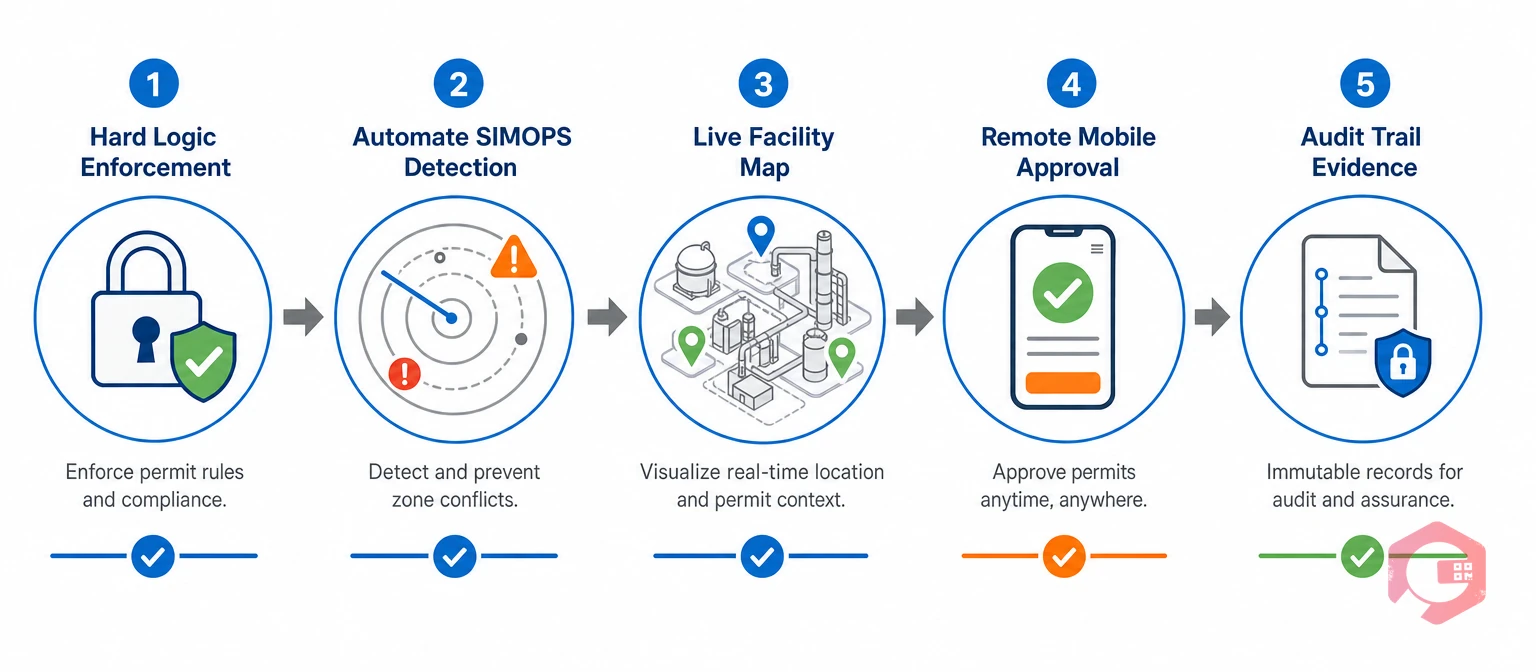
An ePTW system integrates with your training and contractor management database. If a technician's certification is expired, the system locks the permit. Work cannot proceed — not because someone remembered to check, but because the software enforces it as a condition of workflow progression.
When a supervisor creates a permit, the system scans all active and scheduled permits in that zone. Hazard conflicts — hot work near gas venting, electrical testing near wet surfaces — trigger an immediate SIMOPS alarm. The permit cannot be issued until a designated safety authority clears the conflict.
Every active permit appears on a live digital plant map. Colour-coded pins show status: draft, active, suspended, overdue. Managers see the full operational picture from any screen — not after collecting paper, but continuously, in real time.
With a mobile-first ePTW platform, the approval chain travels with the supervisor. Permits are approved from phones during meetings. Technicians scan QR codes on assets to verify LOTO isolation before touching equipment. Work is closed out at the site with photo evidence attached instantly.
Every action — request, review, approval, suspension, closure — is time-stamped, user-attributed, and stored in a tamper-proof record. Regulatory audits that previously required days of document retrieval complete in hours. Incident investigations surface the full permit history in seconds.
Cryotos is a maintenance management platform built for high-risk industrial environments. Its Permit to Work module is purpose-built to close every gap identified above — not as a bolt-on module, but as an integrated part of the maintenance workflow.
📊 From Cryotos client data: Plants we have worked with typically see average permit cycle time drop from 90+ minutes to under 25 minutes within the first 60 days of ePTW deployment — a reduction driven entirely by parallel mobile approvals replacing sequential paper routing.
Paper-based permit to work systems do not just create administrative clutter — they create blind spots in your safety controls where accidents happen. The five risks above — compliance failures, invisible operations, idle crews, SIMOPS conflicts, and failed audits — are all direct consequences of a system built on paper, physical presence, and human memory.
An electronic permit to work system replaces each of those failure modes with automated enforcement. Qualifications are verified by code, not by trust. Hazard conflicts are detected in real time, not discovered after an incident. Approvals happen in parallel on mobile, not in queues around a filing cabinet. And every action is recorded in a tamper-proof audit trail that holds up to regulatory scrutiny.
Plants that eliminate paper-based administrative bottlenecks in safety workflows reduce permit-related incidents by an average of 35% within 12 months. The clipboard has a cost. The question is how long you want to keep paying it.
Ready to eliminate paper permit risks in your plant? Cryotos Permit to Work software enforces LOTO, detects SIMOPS conflicts automatically, and cuts average permit cycle time by over 60% — with full mobile access and audit-ready reporting built in. Book a free demo or see how Cryotos works in your plant.
The five biggest risks are: unverified safety compliance (pencil-whipping), lack of real-time visibility, slow approval workflows that idle entire crews, SIMOPS hazard conflicts that paper cannot detect, and poor audit trails that fail regulatory inspections. Each risk is addressable with a properly implemented digital permit to work system.
An electronic permit to work (ePTW) system is digital software that replaces paper PTW forms with automated workflows, real-time approval routing, LOTO enforcement, SIMOPS conflict detection, and audit-ready reporting — all accessible from desktop and mobile devices. It enforces safety logic rather than relying on human memory and manual checks.
A digital permit to work system uses spatial and temporal logic to automatically scan all active and scheduled permits in a given zone. If it detects conflicting operations — such as hot work above a gas-venting crew — it raises a SIMOPS alarm and blocks permit issuance until a safety review is completed by a designated authority.
Most manufacturing plants go live with a basic ePTW configuration in 4–8 weeks, including workflow setup, LOTO templates, and user training. Full integration with maintenance and training databases typically completes within 3 months. Cryotos clients report measurable permit cycle time reductions within the first month of deployment.
OSHA does not mandate a specific PTW software format, but its standards for confined space entry (29 CFR 1910.146), lockout/tagout (29 CFR 1910.147), and hot work require documented permit processes with verifiable records. A paper system that cannot produce an instant, tamper-proof audit trail creates significant regulatory exposure during inspections and incident investigations.
Key KPIs include: average permit cycle time (request to approval), number of SIMOPS conflicts detected and resolved, permit rejection rate, percentage of permits closed on time, contractor qualification compliance rate, and time-to-close on corrective actions. Cryotos BI dashboards surface all of these metrics in real time without manual data gathering.



Cryotos AI predicts failures, automates work orders, and simplifies maintenance—before problems slow you down.



