

Running a food processing or packaging plant is a demanding undertaking. Production targets must be met alongside strict food safety standards, all while operating complex, fast-moving equipment. In this environment, equipment failure is not merely an inconvenience - it is a direct risk to product safety, regulatory compliance, and the bottom line.
Relying on spreadsheets or paper-based systems for maintenance typically results in reactive chaos. For food processing and packaging plants, a Computerized Maintenance Management System is no longer an optional upgrade - it is a foundational requirement for transitioning to proactive, efficient operations. It helps minimize downtime, improve equipment uptime, and maintain compliance in a highly regulated sector.
At its core, a CMMS is a centralized digital platform for managing all maintenance activities. In a food plant, it serves as the connective tissue between plant managers, quality assurance teams, spare parts inventory, and maintenance of technicians.
Rather than storing preventive maintenance (PM) checklists in a binder on a shelf, a CMMS automates those checklists, schedules them based on time or equipment usage, and requires digital sign-off upon completion. It tracks the complete lifecycle of every asset - from a high-speed filler to a conveyor motor -maintaining a full record of all repairs, inspections, and parts replacements that are always available for audit.
A modern solution such as Cryotos CMMS can transform maintenance from a cost center into a competitive advantage. Here are the top benefits for plant managers and maintenance teams.
Every minute of unplanned downtime in a food processing facility can result in significant production loss and product spoilage. A CMMS transforms the maintenance strategy from reactive - fix it when it breaks - to proactive. By analyzing historical data, teams can identify recurring failure patterns and address them before they cause a major stoppage. Real-time breakdown monitoring enables a rapid response, with facilities reporting reductions in downtime of up to 30 percent.
Audits are high-pressure events, whether they are surprising for FDA inspections or scheduled SQF reviews. In either case, teams must be able to demonstrate the safety and reliability of their equipment at any moment. A CMMS provides detailed, real-time reports covering everything from complex safety procedures to daily maintenance logbooks. With digital signatures, mandatory five-why root cause analyses, and complete audit trails, facilities maintain an airtight record of all maintenance activity - ready for review at any time.
The traditional approach to work order creation is slow and error prone. Modern CMMS platforms address this through generative AI. A technician who identifies a faulty bearing can photograph it with a mobile device, have the AI analyze the fault, and create a work order using a voice command - all within seconds. Public work request submission via QR code scanning allows floor operators to report issues immediately, triggering maintenance alerts without delay.
Food processing equipment requires precise PM schedules to maintain both food safety and operational efficiency. A CMMS provides an intuitive calendar interface that allows easy drag-and-drop rescheduling. Dynamic PM triggers based on actual asset usage - such as the number of hours a mixer has operated -replace fixed time-based schedules that may not reflect real-world conditions. Customizable checklists ensure that no critical safety or sanitation step is overlooked during any maintenance activity.
Capital equipment in a food plant represents a significant financial investment. A CMMS maximizes the return on that investment by tracking asset history, maintenance schedules, and performance metrics through GPS, BEACON, or NFC technology. A clear view of total cost of ownership enables plant heads to make informed decisions on whether to repair, refurbish, or replace aging assets - extending their operational lifespan and deferring unnecessary capital expenditure.
A missing food-grade spare part at the moment of a breakdown is a disruption no plant can afford. A CMMS provides real-time visibility into stock levels within detailed warehouse structures organized by aisle, rack, and bin. When critical stock falls below defined minimum thresholds, the system automatically alerts the procurement team - preventing stockouts without encouraging over-ordering of non-critical items.
Effective operational management requires accurate, current data. The fully customizable Business Intelligence (BI) dashboard in a modern CMMS provides a top-down view of plant-wide asset health. Maintenance managers can drill down into granular metrics including Overall Equipment Effectiveness (OEE), Mean Time to Repair (MTTR), and Mean Time Between Failures (MTBF). This level of visibility enables teams to track cost trends and identify savings opportunities that would otherwise remain hidden in manual records.
Effective maintenance is a team effort. Integrated chat functionality within work orders allows technicians, administrators, and stakeholders to collaborate in real time, sharing media files and documentation as situations develop. Customizable notifications via email and WhatsApp ensure that the entire team receives targeted, timely communication - whether for urgent repairs, scheduled tasks, or critical safety alerts.
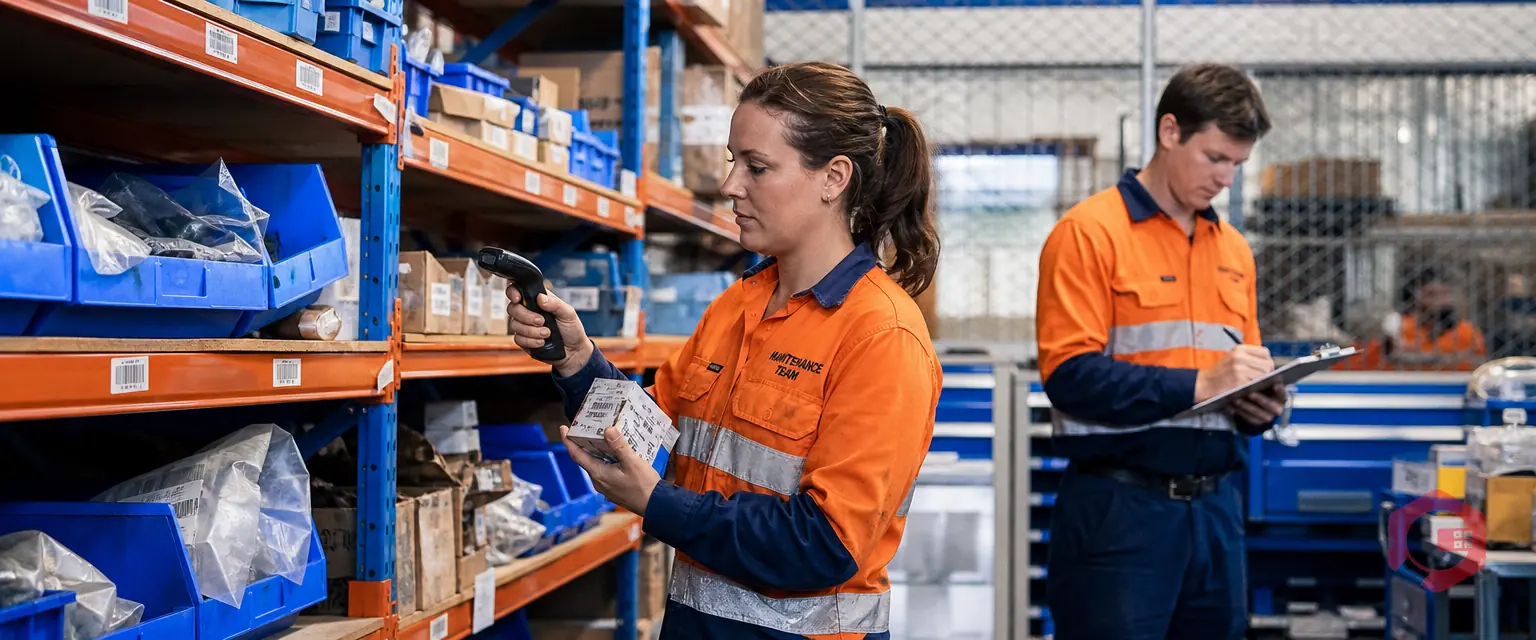
Maintenance technicians are rarely at a desk. A mobile CMMS application allows technicians to manage assets, access equipment manuals, and complete work orders from anywhere on the facility floor by scanning asset QR codes. Critically, the application functions in offline mode in areas with limited connectivity -storing all data locally and synchronizing automatically once a network connection is restored.
Modern food plants operate with IoT sensors, SCADA systems, and PLCs generating continuous streams of equipment data. A CMMS that integrates directly with this infrastructure can trigger automated maintenance responses when a monitored threshold is crossed -for example, when a motor temperature exceeds a safe operating limit. Integration with ERP platforms such as SAP and Microsoft Dynamics 365 enables real-time synchronization of maintenance, financial, and procurement data across the organization.
In food processing, efficiency means producing quality products with minimal waste and maximum output. A CMMS supports this by ensuring that equipment is maintained correctly and operates at optimal performance levels at all times.
Well-maintained equipment produces fewer rejected products, operates more energy efficiently, and experiences fewer unexpected failures. At the same time, a CMMS strengthens compliance by automating documentation, tracking all maintenance activities, and maintaining complete audit trails.
It also supports critical safety processes such as Permit to Work and Lockout/Tagout (LOTO) procedures - ensuring that both regulatory requirements and worker safety standards are consistently met. The result is a production environment that is more controlled, more reliable, and more consistently compliant.
The food processing and packaging sector is becoming increasingly competitive and increasingly regulated. Manual maintenance systems are no longer capable of keeping pace with either demand. A modern CMMS helps food processing and packaging plants automate maintenance workflows, reduce unplanned stoppages, improve equipment availability, and uphold food safety standards through automation and data-driven insights.
For plant managers and maintenance teams committed to building a more efficient, reliable, and compliant operation, adopting a CMMS is not a discretionary upgrade - it is an operational necessity.
Unlock these benefits with Cryotos CMMS for your food processing and packaging operations.



Cryotos AI predicts failures, automates work orders, and simplifies maintenance—before problems slow you down.



