
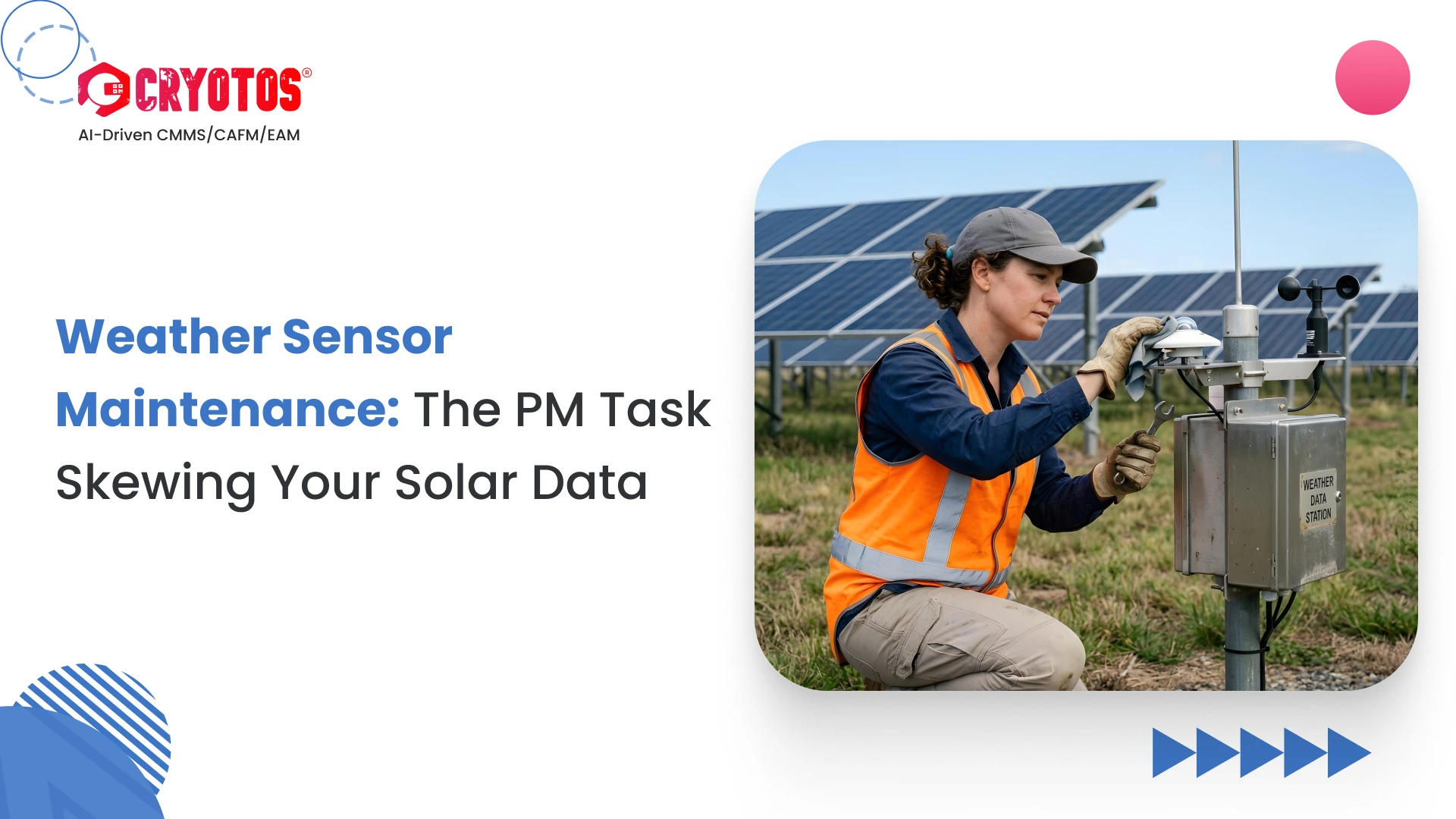
Most solar plant maintenance conversations center on the obvious: clean the panels, check the inverters, inspect the trackers. What rarely makes it into the PM schedule - until something goes wrong - is the network of weather monitoring sensors quietly measuring the sunlight hitting your plant every second of every day.
These sensors are not supplementary instruments. They are the reference baseline against which every kilowatt-hour your plant produces is judged. A soiled or miscalibrated irradiance sensor does not fail visibly. It fails silently - and in doing so, it can make an underperforming plant look healthy, or a healthy plant look like it needs repair.
At the South Jeddah Solar Plant, Cryotos CMMS was used to formalize and track sensor maintenance as a scheduled, accepted, and approved preventive task - not an afterthought. This article explains why that distinction matters enormously.
A professional weather station at a solar plant typically monitors five distinct irradiance and meteorological variables. Each sensor type has a different sensitivity to contamination and a different consequence when it gives bad data.
| Sensor | Full Name | Measures | Why It Matters |
|---|---|---|---|
| GHI | Global Horizontal Irradiance | Total sunlight on flat surface | Primary yield modelling input |
| POA | Plane of Array Irradiance | Sunlight at actual panel angle | Compare received vs. produced |
| DHI | Diffuse Horizontal Irradiance | Scattered sky-dome light | Shade & bifacial analysis |
| DNI | Direct Normal Irradiance | Direct beam radiation (perpendicular) | High-accuracy yield verification |
| Albedo | Reflected Irradiance | Ground-reflected light | Bifacial module performance modelling |
Each of these instruments needs a clean, unobstructed optical surface to give accurate readings. Dust, bird droppings, dew residue, and airborne particulates - all intense problems in desert environments like Jeddah - accumulate on these surfaces continuously. Unlike your PV panels, soiled sensors produce no visible energy loss. They just produce wrong numbers.
The business consequence of sensor drift is not technical - it is financial and contractual. Consider a straightforward scenario:
Your plant's Performance Ratio (PR) target under a power purchase agreement is 78%. Your SCADA system reports a PR of 79.2% - slightly above target, no alarms raised. But your GHI sensor has accumulated enough dust to under-report irradiance by 4%. That means your plant is actually operating at a PR closer to 75% - well below the contractual threshold. The penalty clauses kick in during the next audit, and nobody saw it coming.
The reason weather sensor maintenance gets skipped is not negligence - it is system design. Most generic CMMS platforms treat weather stations as a single asset entry with a single periodic check. There is no differentiation between sensor types, no acceptance criteria specific to optics-based instruments, and no approval chain that distinguishes "checked" from "verified clean and within calibration tolerance."
The result: A technician visits the weather station, looks at it, ticks a box, and moves on. There is no record of which sensor surface was cleaned, what method was used, or whether the reading post-cleaning was compared to a reference.
A PM checklist that says, 'inspect weather station' is not the same as one that says 'clean GHI pyranometer dome with lint-free cloth, verify reading against adjacent reference sensor, and log delta before and after.'
At the South Jeddah Solar Plant, Cryotos CMMS was configured to manage weather station sensor maintenance as a structured preventive task with defined steps, acceptance criteria, and a formal approval workflow before the work order is closed.
In high-dust environments like Jeddah, sensor fouling can occur meaningfully within 7 to 14 days during peak sandstorm season. Cryotos allows the PM frequency to be configured independently for each asset - so sensor cleaning can run on a tighter cycle than transformer inspections without cluttering the general maintenance schedule.
Unlike generic task management tools, Cryotos enforces a formal acceptance and approval step. The work is not considered done until a supervisor reviews the pre/post readings and signs off digitally. This creates an audit trail that is defensible in performance verification audits - critical in plants operating under independent power producer contracts.
Weather sensor maintenance illustrates a principle that applies across solar O&M: the cost of skipping a task is not always proportional to the size of the task. Cleaning a pyranometer dome takes less than five minutes. The cost of three months of skewed performance data - in missed degradation alerts, incorrect PR reporting, and audit exposure - can run into hundreds of thousands of dollars for a utility-scale plant.
A CMMS that treats sensor maintenance as equivalent to replacing a cable tie does not serve solar O&M teams well. The right system creates differentiated PM structures: different frequencies, different acceptance criteria, different approval requirements, and different escalation paths depending on the operational consequence of each task.
That is the operational design philosophy built into how Cryotos was implemented at South Jeddah - and it is the approach that distinguishes solar-aware maintenance management from generic work order software applied to a renewable energy context.
See How Cryotos Structures Solar-Specific PM?
Learn how South Jeddah Solar Plant uses Cryotos CMMS to manage sensor maintenance, safety workflows, and performance reporting - all in one system designed for renewable energy operations.




Cryotos AI predicts failures, automates work orders, and simplifies maintenance—before problems slow you down.



