
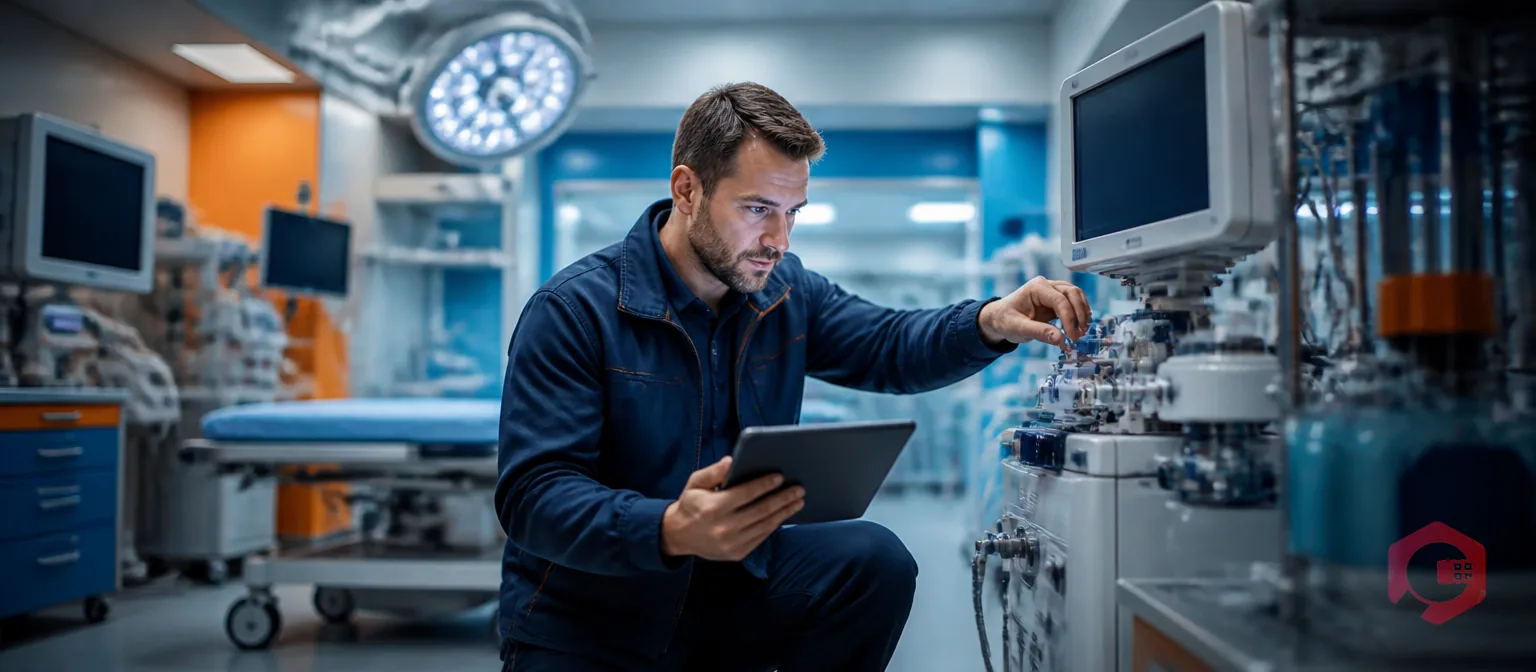
CMMS software for healthcare gives hospitals, clinics, and medical facilities a structured system to manage equipment maintenance, regulatory compliance, and safety inspections — all in one place. A Computerized Maintenance Management System (CMMS) is purpose-built to keep life-critical assets operational, meet Joint Commission and OSHA requirements, and reduce the unplanned downtime that directly affects patient safety.
Healthcare facilities run some of the most complex maintenance environments in any industry. Biomedical equipment, HVAC systems, electrical infrastructure, and plumbing all require meticulous upkeep — not as a best practice, but as a regulatory obligation. When any of these systems fail unexpectedly, the consequences extend beyond operational cost. They affect patient outcomes.
Key Takeaways
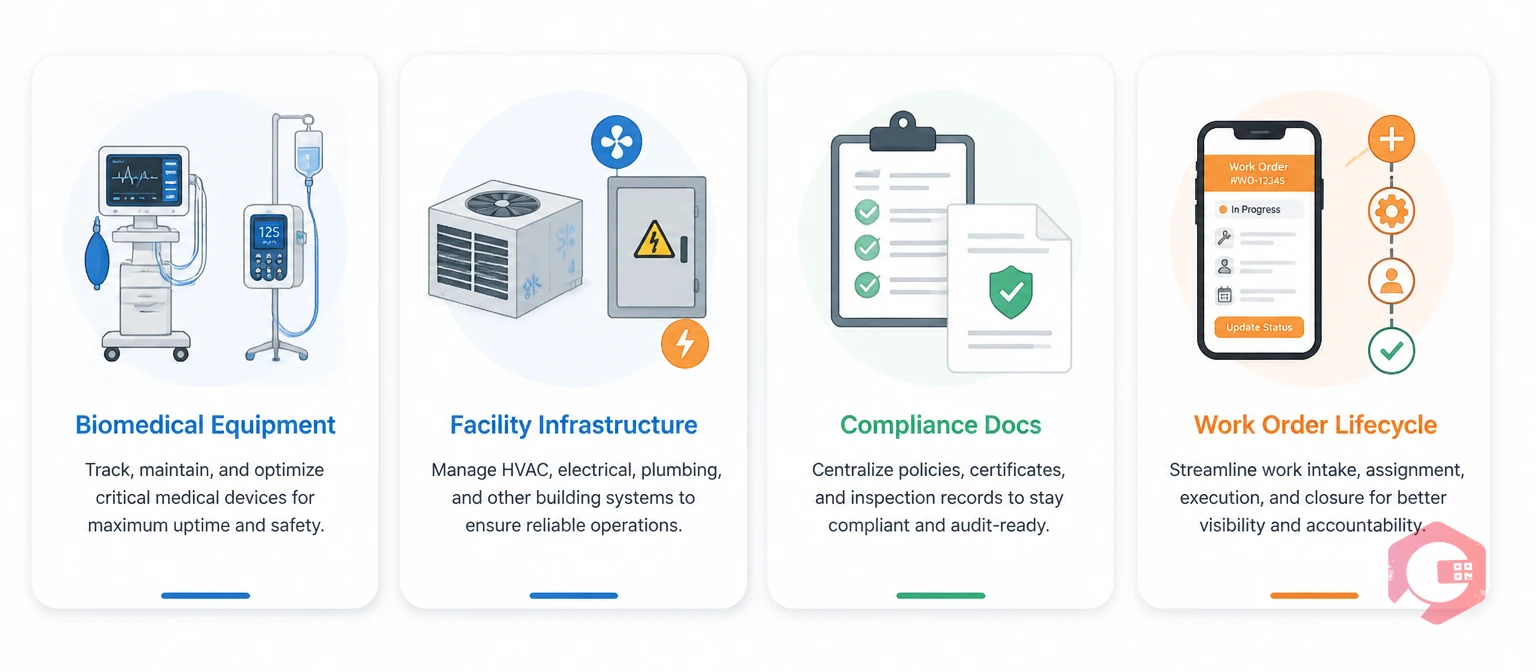
CMMS software for healthcare is a digital maintenance management platform that tracks, schedules, and documents all maintenance activities across a hospital or medical facility — from biomedical equipment and surgical tools to HVAC, plumbing, and electrical systems. Unlike general-purpose maintenance software, healthcare-specific CMMS is built around compliance requirements, biomedical asset management, and the operational realities of a 24/7 patient care environment.
The core difference between a healthcare CMMS and a generic maintenance system is the depth of asset classification and compliance tracking. Healthcare facilities manage thousands of assets simultaneously, each with different inspection schedules, regulatory standards, and criticality levels. A ventilator and a hand-washing station both require maintenance — but on entirely different timelines, with different documentation requirements and very different consequences if they fail.
The Cryotos healthcare CMMS solution covers all these categories with mobile-first access, so biomedical technicians and facilities staff can log work, scan assets, and close work orders from anywhere in the building — including areas with poor connectivity through offline mode and auto-sync.
Healthcare is one of the few industries where maintenance failure is directly linked to patient harm. A failed ventilator, an uncalibrated infusion pump, or a compromised sterile environment does not just create an operational problem — it creates a clinical one. This reality drives every argument for CMMS adoption in healthcare settings.
Beyond patient safety, healthcare facilities operate under some of the strictest regulatory frameworks of any industry. The Joint Commission requires documented preventive maintenance for all patient care equipment, and accreditation surveys include detailed reviews of maintenance records. OSHA standards govern workplace safety equipment, hazardous material handling, and emergency system readiness. The FDA regulates specific categories of medical devices down to the calibration interval and documentation format.
A mid-sized hospital typically manages between 7,000 and 15,000 assets, each with its own maintenance schedule, compliance requirements, and service history. Managing that inventory on spreadsheets or paper-based systems is not just inefficient — it is statistically guaranteed to produce gaps. Those gaps, when found during a Joint Commission survey, become findings. When they produce an equipment failure, they become incidents.
A CMMS eliminates the scale problem by centralizing all asset data, automating PM schedule generation, and creating an unbroken audit trail for every maintenance action taken. Maintenance teams using Cryotos have reported up to 30% reduction in unplanned downtime and 25% faster repair turnaround — gains that translate directly to care continuity in a hospital environment.

Healthcare maintenance teams face a specific set of operational challenges that generic maintenance software does not fully address. Understanding these challenges clarifies why CMMS adoption in healthcare is accelerating — and what facilities risk by delaying it.
Explore how the Cryotos safety compliance checklist gives healthcare teams a structured starting point for identifying gaps in their current maintenance and inspection processes.
Healthcare equipment does not follow business hours. Ventilators run through the night. Imaging machines see patients at 2 AM. Infusion pumps work continuously across every shift. Any of these assets going offline unexpectedly creates an immediate clinical risk — not just a maintenance backlog item. CMMS prevents this by scheduling preventive maintenance during planned downtime windows, tracking equipment condition in real time, and alerting technicians before a problem becomes a failure.
The Occupational Safety and Health Administration (OSHA) and the Joint Commission both require healthcare facilities to maintain detailed, retrievable records of all maintenance activities. Paper-based systems make this retrieval slow, unreliable, and dependent on individual filing discipline. A CMMS captures every work order, inspection result, and corrective action automatically — generating audit-ready reports in minutes rather than the hours it takes to pull paper files.
Most healthcare maintenance departments are understaffed relative to their asset load. Biomedical technicians carry responsibility for hundreds or thousands of devices, each requiring different inspection intervals and service procedures. Without a CMMS to prioritize, schedule, and route work, technicians spend significant time deciding what to do next rather than doing it. CMMS eliminates that friction with automated work order generation and mobile task delivery.
Running out of a spare part for a ventilator or an infusion pump does not just delay a repair — it keeps the device out of service until the part arrives. Healthcare CMMS manages spare parts inventory with minimum stock alerts, usage tracking, and reorder triggers, ensuring that critical replacement parts are in stock before they are needed rather than scrambled for during an emergency repair.

The best way to understand what CMMS software for healthcare delivers is through four interconnected value areas. The C.A.R.E. Framework maps the four pillars of healthcare CMMS performance:
Healthcare facilities that apply all four pillars consistently move from a reactive maintenance posture — fixing things after they break — to a proactive one, where failure is anticipated, prevented, and documented before it affects patient care.
The operational benefits of healthcare CMMS are measurable, compounding, and directly linked to both clinical outcomes and financial performance. These are not abstract improvements — they show up in equipment uptime percentages, audit pass rates, and maintenance cost per asset.
Preventive maintenance scheduling in a CMMS eliminates the reactive cycle where equipment fails, gets repaired, and fails again — replacing it with planned maintenance windows that keep clinical assets consistently operational. For equipment like ventilators, patient monitors, and infusion pumps, a single unplanned failure during active patient use is a clinical emergency. A PM schedule that runs automatically, generates work orders in advance, and confirms completion with technician sign-off breaks that cycle entirely.
Cryotos preventive maintenance software supports both calendar-based and usage-based PM schedules for medical equipment — ensuring ventilators are serviced by hours of use, not just by calendar date, which is how most biomedical standards recommend interval-setting.
Joint Commission surveyors do not accept good intentions — they require documented evidence. CMMS creates that evidence automatically. Every work order, every completed inspection, every calibration record is time-stamped, technician-attributed, and stored in a searchable database. When a surveyor asks for the last six PM records on every patient-lift device in the building, the CMMS produces that report in seconds rather than requiring staff to pull physical files across multiple filing cabinets.
The FDA's requirements for medical device maintenance documentation under 21 CFR Part 820 follow the same principle: documented processes, documented outcomes, documented corrective actions. A CMMS builds this documentation as a byproduct of normal maintenance operations — not as a separate administrative task.
Work order management in a healthcare setting is not just an efficiency issue — it is a patient care issue. When an IV pump fails in an ICU bay, the clock starts immediately. Every minute the biomedical tech spends trying to find the work order, confirm the device's location, or check its service history is a minute a patient waits for functioning equipment. CMMS compresses that entire sequence — from reported failure to technician dispatch — into minutes rather than the hours that paper-based systems produce.
Cryotos work order management software delivers real-time mobile notifications to technicians, includes complete asset history in every work order, and enables photo capture and digital sign-off at the point of work — so the repair record is complete before the technician leaves the room.
Inventory gaps are one of the most controllable contributors to equipment downtime in healthcare. When a critical spare part is not in stock, repair time extends from hours to days while the part is sourced. Healthcare CMMS manages parts inventory with usage tracking, minimum stock alerts, and automated reorder triggers. The result: critical replacement parts are always available before they are needed, not scrambled for during a clinical emergency.
Every work order completed in a CMMS adds to a growing cost history for each asset. Over 12 to 24 months, this history reveals which pieces of equipment cost more to maintain than to replace, which assets are approaching the end of their reliable service life, and where maintenance spend is concentrated. Healthcare administrators use this data to build defensible capital equipment budgets — replacing the guesswork of annual budget cycles with evidence from actual maintenance performance. A solid facility management software platform connects this asset cost data to broader facility planning decisions.
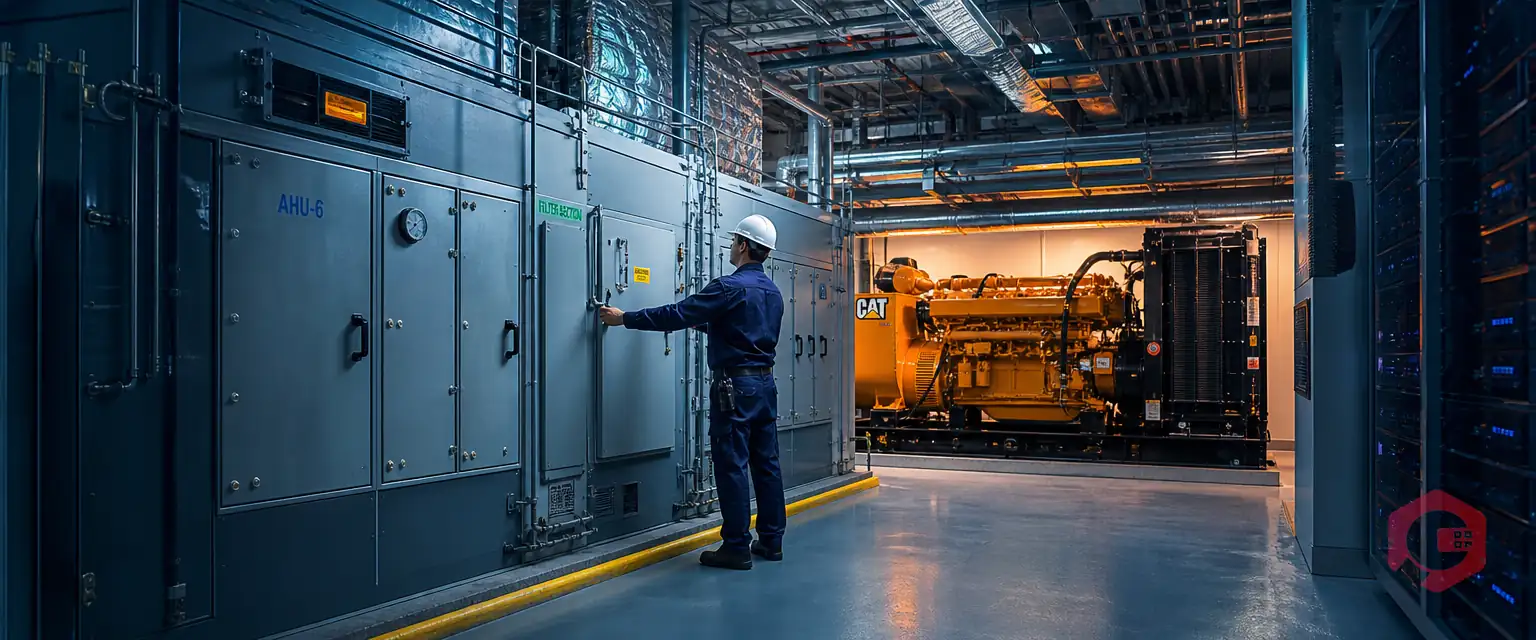
Healthcare facilities manage hazardous materials, radiation sources, medical gas systems, and a range of other environmental health risks that require documented inspection and maintenance. CMMS tracks all of these alongside clinical equipment — scheduling fire suppression tests, HVAC filter changes, medical gas manifold inspections, and sharps disposal audits with the same rigor applied to biomedical equipment.
Not every CMMS is suited for the regulatory complexity and asset density of a healthcare environment. These are the features that separate a genuine healthcare CMMS from a general-purpose maintenance tool.
| Feature | Why It Matters in Healthcare | Without It |
|---|---|---|
| Biomedical Asset Registry | Tracks every device by serial number, model, and service history | Assets fall off inspection schedules; compliance gaps accumulate |
| Preventive Maintenance Scheduling | Calendar and usage-based PM for every asset class | Reactive maintenance dominates; equipment fails without warning |
| Mobile Work Orders (with Offline Mode) | Technicians work throughout the facility, including areas with poor connectivity | Paper-based work orders; incomplete or delayed records |
| Compliance Report Generation | Instant audit-ready reports for Joint Commission, OSHA, and FDA surveys | Manual record retrieval takes hours; surveyors find gaps |
| Spare Parts Inventory Management | Ensures critical parts are in stock before they are needed | Emergency procurement; extended equipment downtime |
| QR/Barcode Asset Scanning | Technicians scan a device to pull its full history and open a work order | Manual asset lookup; errors in device identification during repairs |
| Role-Based Access Controls | Different access levels for biomedical techs, facilities staff, and administrators | Unauthorized changes to maintenance records; compliance risk |
| EHR/ERP Integration | Connects maintenance data to clinical and financial systems | Siloed data; manual reconciliation between systems |
Facilities evaluating CMMS platforms for healthcare use should prioritize mobile capability and compliance reporting above all other features — these two capabilities deliver the most immediate impact in a clinical environment.

CMMS implementation in a healthcare setting requires more careful planning than in manufacturing or facilities management, because the assets being managed are clinical — and any disruption to maintenance workflows during implementation carries patient safety implications. A phased approach works best.
Before any software is configured, every maintainable asset in the facility needs to be identified, catalogued, and classified. This means walking every department, recording every device by make, model, and serial number, and assigning each one to a maintenance category — biomedical, facilities, life safety, or general. This inventory becomes the foundation of the CMMS asset registry and directly determines the quality of PM schedules generated from day one.
For each asset class, PM schedules should be built from manufacturer recommendations, Joint Commission Equipment Management standards, and any facility-specific requirements from previous surveys. This is the most technically intensive phase of implementation — getting PM intervals right prevents both under-maintenance (compliance risk) and over-maintenance (unnecessary cost). The FDA's guidance on medical device maintenance provides baseline reference points for clinical equipment intervals.
Running the CMMS in parallel with existing systems for two to four weeks — before fully cutting over — lets staff build confidence with the new platform while maintaining continuity of documentation. Biomedical technicians, facilities staff, and compliance coordinators all need different training tracks, since their workflows within the CMMS look different. Training on mobile work order completion is the highest-priority skill to establish early.
After full cutover, use the CMMS reporting dashboards to track PM completion rates, work order response times, and equipment downtime weekly. The first three months of live data typically reveal PM schedule gaps (some assets missed their first cycle) and inventory shortfalls (parts consumed faster than anticipated). Quarterly reviews of CMMS reports — compared against Joint Commission standards — keep the program improving rather than drifting back toward reactive maintenance habits.
Paper-based maintenance management in healthcare is a documentation approach where work orders, PM records, and inspection logs are created, filed, and retrieved manually — a method that consistently produces incomplete records, delayed responses, and preventable compliance gaps. Most healthcare facilities that have operated on paper systems for years understand the symptoms: technicians spending time hunting for asset records, surveyors requesting documentation that requires hours to compile, and recurring findings around PM overdue rates for assets whose schedules no one tracked systematically.
The contrast between paper-based and CMMS-driven healthcare maintenance shows up most clearly during three moments: a Joint Commission survey, an equipment failure during patient care, and an annual budget cycle.
The clinical and financial case for CMMS over paper is not marginal — it is structural. Paper systems create compliance risk as a feature of their design, not as an occasional failure. CMMS eliminates that risk by making documentation automatic.

Infection control is one of the most direct connections between maintenance performance and patient safety in a healthcare setting. Poorly maintained HVAC systems, failed sterilization equipment, or compromised negative-pressure rooms create conditions where healthcare-associated infections (HAIs) can spread — with direct consequences for patient outcomes and regulatory standing.
A CMMS supports infection control programs by scheduling and documenting maintenance for the specific systems that infection control depends on:
Connecting maintenance operations to infection control objectives is one of the less-discussed but most clinically significant ways CMMS adds value in a healthcare setting. The documentation trail it creates is also directly relevant to HAI reporting requirements and Joint Commission Environment of Care standards.
No regulation mandates a specific software system, but the Joint Commission's Environment of Care standards require documented, evidence-based equipment maintenance programs. OSHA 29 CFR 1910 requires documented safety inspections. FDA 21 CFR Part 820 governs maintenance documentation for medical devices used in care delivery. A CMMS is the most reliable way to meet all three simultaneously, because it creates the documentation as a byproduct of normal maintenance operations rather than requiring separate administrative effort.
Joint Commission surveyors request PM records, corrective action documentation, and inspection logs during accreditation reviews. A CMMS makes all of this retrievable in minutes — by asset, by date range, by technician, or by equipment category. Facilities with CMMS-generated records typically spend significantly less time preparing for surveys than those relying on paper systems, and encounter fewer documentation gaps that become findings.
Yes. Modern CMMS platforms can integrate with EHR and ERP systems through API connections, allowing equipment status, maintenance histories, and asset locations to flow between clinical and facilities systems. This integration is particularly valuable for biomedical equipment that is tracked in both clinical and maintenance systems — reducing the manual reconciliation burden that creates errors when systems are managed separately.
A phased implementation in a mid-sized hospital typically takes 8 to 16 weeks from asset inventory through full go-live. The longest phase is usually the asset cataloguing and PM schedule design (4 to 6 weeks), because getting device records complete and intervals correct requires input from biomedical engineering, facilities management, and compliance teams. The software configuration and staff training phases typically run 2 to 4 weeks each.
Yes, because the compliance obligations that drive CMMS value in hospitals apply equally to clinics, outpatient surgical centers, and specialty practices. Any facility that manages patient care equipment under Joint Commission, OSHA, or FDA oversight benefits from systematic maintenance documentation. For smaller facilities, cloud-based CMMS platforms offer lower implementation complexity and subscription-based pricing that scales with the number of assets managed — making the cost-benefit case straightforward even for facilities with relatively small equipment inventories.
CMMS focuses on equipment maintenance — tracking assets, scheduling PMs, managing work orders, and documenting compliance. CAFM (Computer-Aided Facility Management) focuses on space management, occupancy planning, and facility resource allocation. Healthcare facilities often benefit from both, but CMMS is the higher-priority system for any facility with regulated clinical equipment, because it directly supports accreditation and patient safety requirements. Some platforms, including Cryotos, combine core CMMS capabilities with facility management features in a single system.
CMMS reduces HAI risk by ensuring that the facility systems linked to infection control — HVAC, sterilization equipment, water systems, and negative-pressure rooms — are maintained on documented schedules rather than reactively. When a filter change or autoclave validation is overdue, a CMMS flags it automatically and generates a work order before the gap becomes a clinical risk. This proactive approach to maintaining infection-sensitive systems is one of the clearest examples of how maintenance quality directly affects patient safety, and why accreditation programs like the Joint Commission place such emphasis on documented maintenance records for environmental systems.
Healthcare facilities that move from reactive maintenance to a CMMS-driven program protect patient safety, reduce regulatory risk, and build a defensible evidence base for every accreditation survey they face. Schedule a free demo to see how Cryotos healthcare CMMS keeps your clinical equipment compliant, your biomedical team efficient, and your facility audit-ready every day of the year.


Cryotos AI predicts failures, automates work orders, and simplifies maintenance—before problems slow you down.



