The money of success in contemporary manufacturing is reliability. In a situation where production goals are fewer and the margins are thinner; an unpredicted failure of equipment is not just a stunt; it is a profit murderer quieting down.
The word efficiency has come to be discussed with regards to speed, but the real definition of efficiency is stability. The fact is that due to unplanned downtime, industrial manufacturers spend up to 50 billion dollars a year. That is an alarming number, but still, a significant number of operations use reactive approaches, waiting until something breaks down to result in some action.
There is a better way to go. Predictive Maintenance (PdM) is a change of paradigm. With it, you switch your mode of operation that is putting out fire with a fire extinguisher to putting out fire before it lights.
What is Predictive Maintenance
The Core Concept
Predictive Maintenance changes the traditional calendar-based maintenance procedure into the condition-based process executed by real-time data. Rather than trying to service a machine because it is a Tuesday, you service the machine because the machine has actually spoken to you and requested assistance.
How It Works
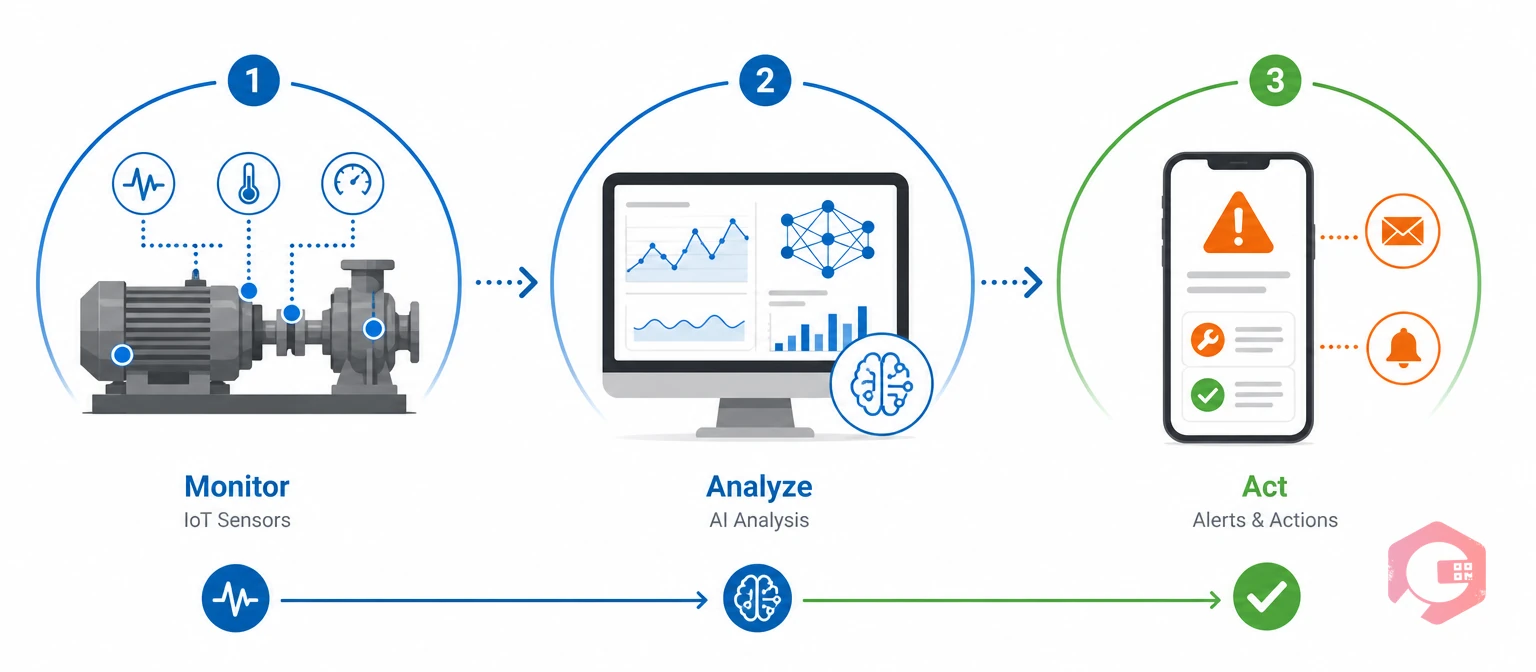
It is a data-driven, complex process:
Data Collection: IoT sensors will act as the eyes and ears of your machine. They constantly control such critical variables as vibration, temperature, acoustic features, and pressure.
Analysis and Detection: This stream of data is analyzed using highly developed AI and Machine Learning models. They search by signs of anomaly- e.g. a conveyor motor operating 5degC above its usual temperature- that betokens initial wear.
Actionable Alerts: In case a particular threshold is breached, the system would issue real time alerts. This will enable your maintenance team to take action in time before a disastrous breakdown takes place.
Key Technologies Behind PdM
IoT Sensors: Equipment that measures the physical condition of equipment.
AI & Machine Learning: Algorithms that improve accuracy with time, which are being taught by past information to minimize false alarms.
CMMS: The central nervous system (like Cryotos) that automates the creation of work orders based on sensor data.
Digital Twins: Simulated representations of assets in order to model performance and anticipate failure, never having to actually run the physical machine.
The True Cost of Equipment Downtime
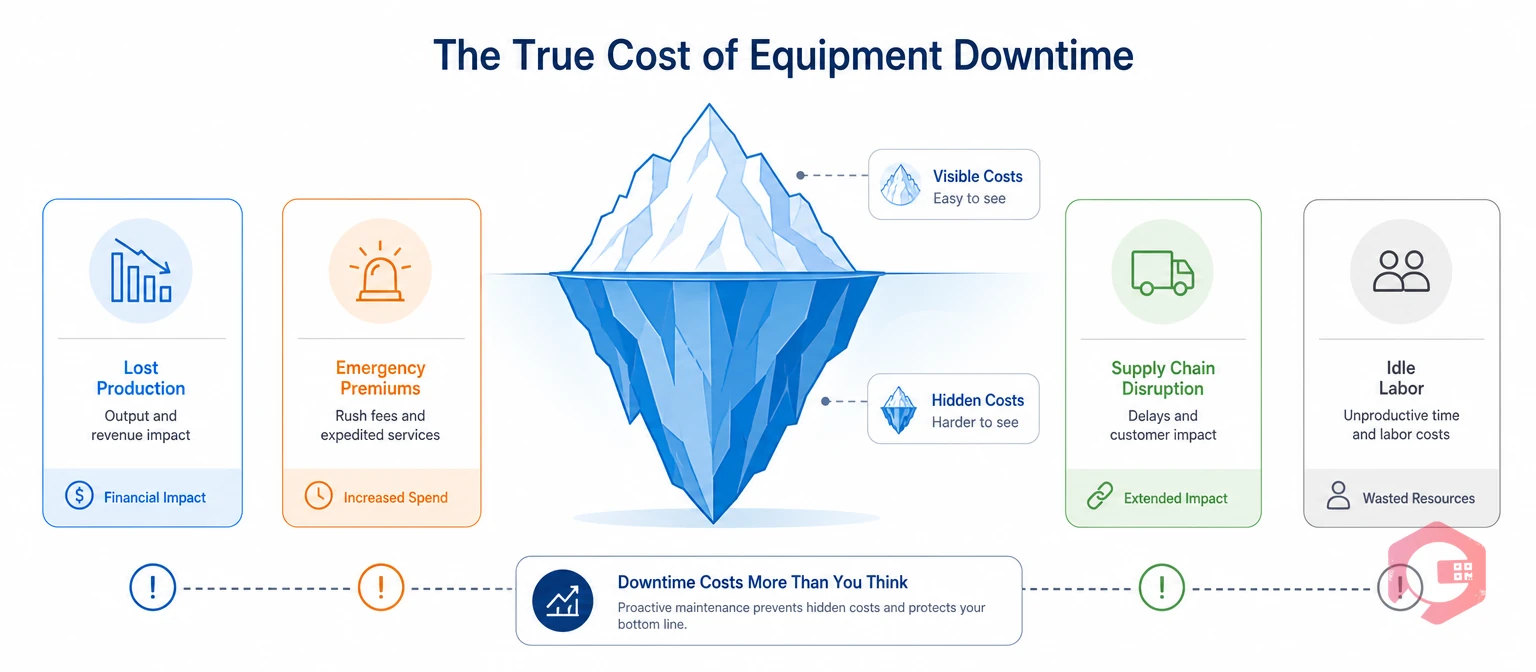
Downtime is often viewed only through the lens of repair bills. If a part costs $500 to replace, that is seen as the loss. But the actual cost is an iceberg; the visible repair cost is just the tip.
Direct Financial Losses
Production Volume: Every minute a line is offline is revenue that can never be recovered.
Emergency Premiums: Reactive repairs are expensive. You pay overtime labor rates and expedited shipping fees for spare parts to get back online fast.
Budget Impact: Unplanned downtime inflates overall maintenance budgets. Shifting to a predictive model can lower these costs by 12-18%.
Operational Ripple Effects
Supply Chain Disruption: A stalled supply chain will have a domino effect. You fail to meet shipping deadlines, have to take penalties on a contract, and it can destroy a relationship with an old client.
Inventory Issues: Reactive models make companies accumulate costly spares parts, in case. This occupies capital that can be utilized in other fields.
Employee Morale: There is nothing more likely to burn up a maintenance team than incessant firefighting. The breakdowns occur regularly, contributing to the idleness of the operators, aggravated technicians, and interrupted workflow.
Why Predictive Maintenance Is Key to Reducing Downtime
To understand why Predictive Maintenance (PdM) is the superior strategy for downtime reduction, we must first look at the "Anatomy of a Breakdown." Machinery is not likely to malfunction immediately; it wears out.
PdM does not only minimize downtime by avoiding failures, but it transforms the date of your reaction to it and redefines the timeline of failure management on an entirely new level. Here is the sequential mechanism of how this strategy unlocks uptime.
The Early Warning System (The "P-F Interval")
In a traditional reactive model, you don't know if there is a problem until the machine stops. By then, it was too late.
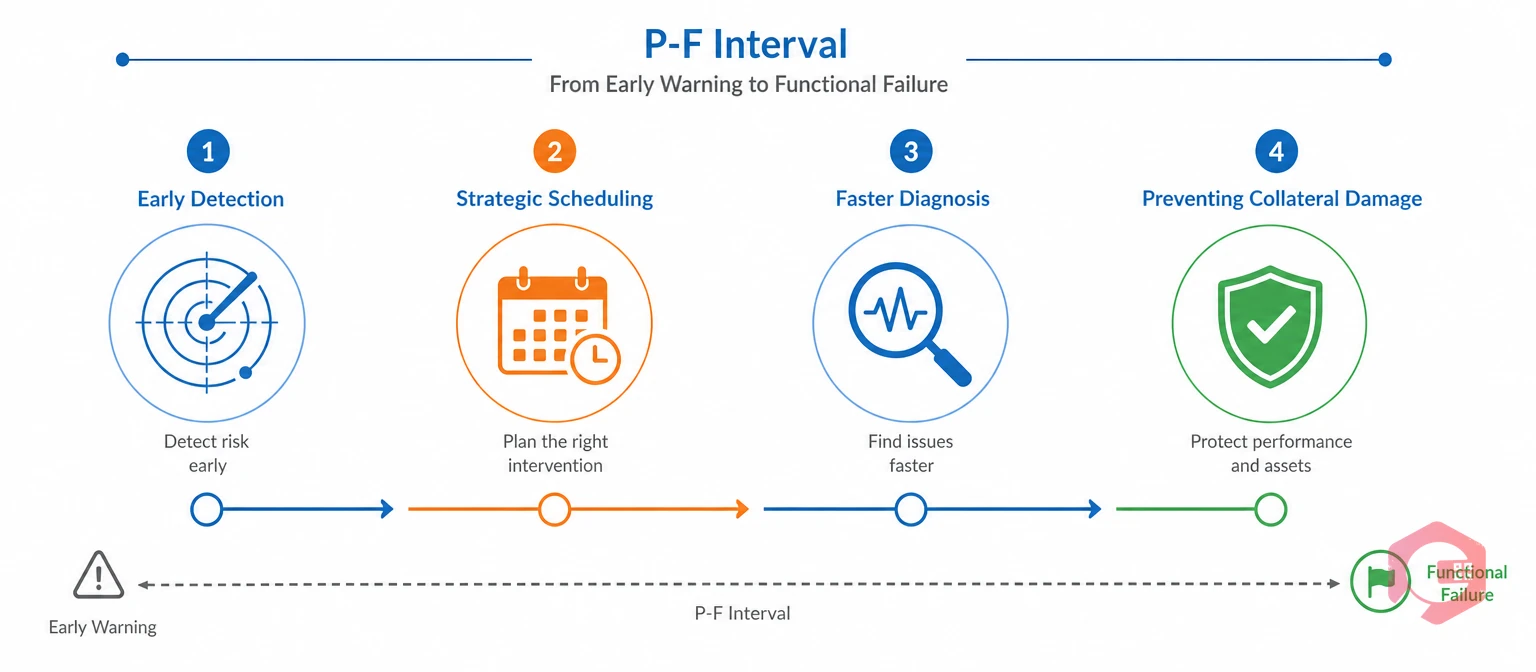
Predictive maintenance is within the P-F Interval-the period between the potential failure (P) that can be detected and the real functional failure (F).
The Sequence: Sensors pick up minute variations, micro-vibrations in a bearing or friction in a gearbox which are audible or visible to a human operator week or even months later.
The Impact: This warning saves you the best in maintenance, Time. You are notified when the machine is still operating at full capacity instead of rushing to try to solve the issue that has already brought the production to a halt.
Strategic vs. Forced Scheduling
As soon as one realizes that there is a possible failure, it turns into an option and not a casualty of the situation.
The Reactive Scenario: A motor burns out at 10:00 AM on Tuesday. Production stops immediately. The team forces a shutdown during peak hours to swap the motor.
The Predictive Scenario: Your CMMS (like Cryotos) flags that motor temperature is trending up. You review the production schedule and see a planned changeover on Friday afternoon. You schedule the motor swap for that window.
The Result: The repair happens, but zero production time is lost. The "downtime" is moved from high-cost production hours to low-cost non-productive hours.
Surgical Precision in Diagnosis (Reducing MTTR)
A significant portion of downtime is spent just trying to figure out what is wrong. This is the "Mean Time To Diagnose" (MTTD).
The Sequence: With reactive maintenance, a technician comes to a stopped machine and begins troubleshooting at that point. Is it the electrical supply? Is it the shaft? Is it a jam? This research consumes time.
The Predictive Advantage: PdM tells you exactly what the issue is before the technician even picks up a wrench. The data doesn't just say "Error"; it says, "High Vibration, Frequency 2x, Drive End."
The Impact: Technician walks to the asset with the exact part and the exact tool needed. This "surgical" approach drastically cuts Mean Time To Repair (MTTR).
Preventing "Collateral Damage"
The downtime is usually very long as a single failure will be triggered, leading to a chain reaction which will cause major components to be destroyed.
The Sequence: A $50 seal fails. If unnoticed (Reactive), it leads to a leak, which causes a bearing to seize, which then snaps the main drive shaft. What would have been a 30-minute process of changing the seal takes a 3-day shaft manufacturing and replacement order.
The Predictive Intervention: The system identifies the first anomaly (the falling pressure or vibration of the malfunctioning seal) as soon as it occurs.
The Result: You change the $50 component before it kills the $5,000 one. You do not have a big rebuild with its disastrous downtime.
Business Outcomes with Predictive Maintenance
Implementing a predictive maintenance (PdM) strategy is not just a technical upgrade-it is a business transformation. When you switch from reacting to forecasting, the positive ripple effects are felt across every department, from the shop floor to the CFO's office.
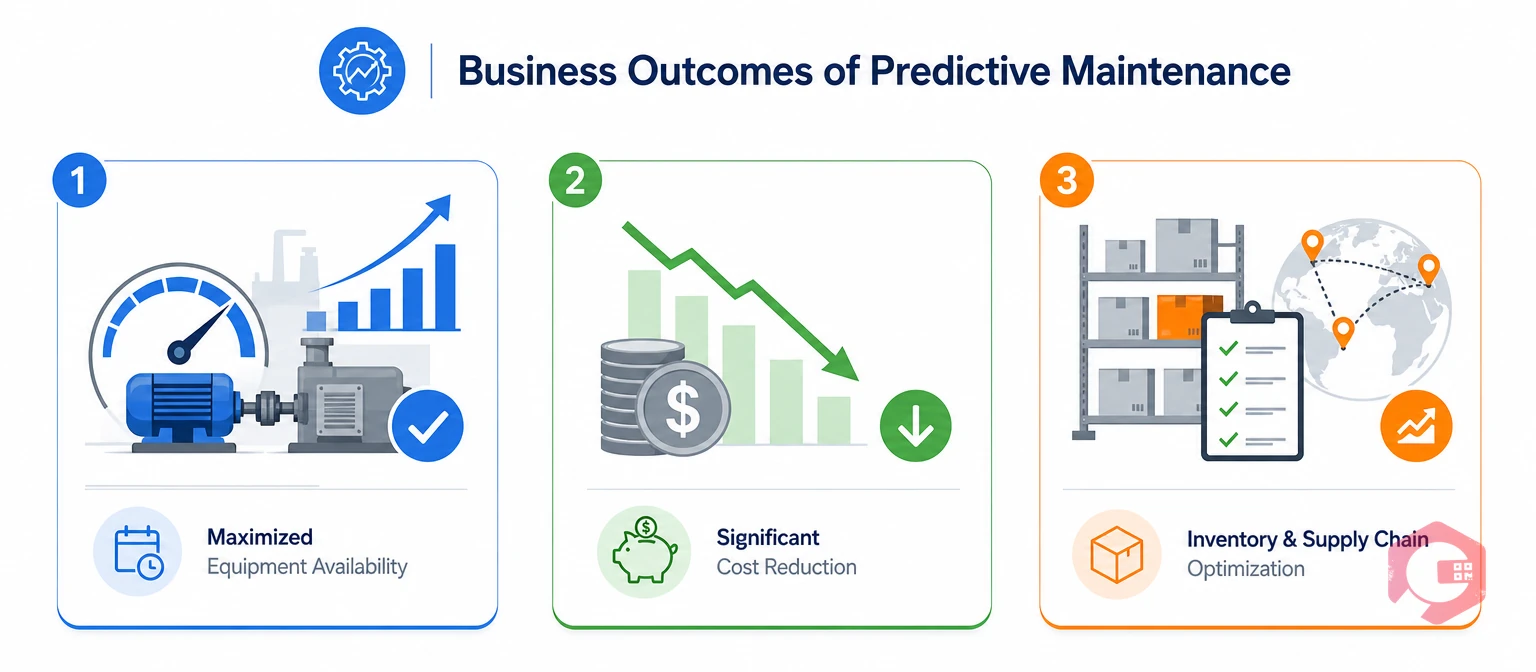
Maximized Equipment Availability (The Production Win)
The shortest-term consequence of PdM is an extreme increase in OEE (Overall Equipment Effectiveness).
Eliminate "Surprise" Stoppages: You transform unexpected downtime into scheduled maintenance with early defect detection.
Faster Repairs: Technicians come with a diagnosis in hand and the amount of time taken to visit is considerably less than the wrench time.
The Metric: According to industry data and Cryotos user benchmarks, the developed predictive strategy that is executed properly can help to save up to 30 percent of downtime and reduce the time spent repairing the systems by 25 percent.
Significant Cost Reduction (The Financial Win)
Downtime is expensive, but so is inefficient maintenance. PdM attacks costs from two angles: Operational Expenditure (OpEx) and Capital Expenditure (CapEx).
Reduced Maintenance Budget: You stop paying premium prices for emergency overnight shipping of parts and emergency overtime labor. Studies show PdM can slash overall maintenance costs by 25-30%.
Extended Asset Lifespan (CapEx Savings): When something very slightly vibrates or does not fit it does not last long. These small nitpicky problems will be corrected right away, which means that the asset will operate within its expected lifecycle (or even beyond), postponing the necessity of costly capital replacements.
Inventory & Supply Chain Optimization (The Logistical Win)
One of the hidden costs of reactive maintenance is the "Just-in-Case" inventory. Warehouses are often stuffed with expensive spare parts "just in case" something breaks.
Shift to "Just-in-Time": With predictive insights, you know exactly when a part will fail. This enables you to only order parts on demand, and the large working capital is now available to work.
Smarter Procurement: Get this one integrated with your CMMS (such as Cryotos) and purchase orders will be automatically generated, depending on the asset of health trends, so that you will never have to deal with a stockout during an urgent repair.
How Cryotos Streamlines Predictive Maintenance
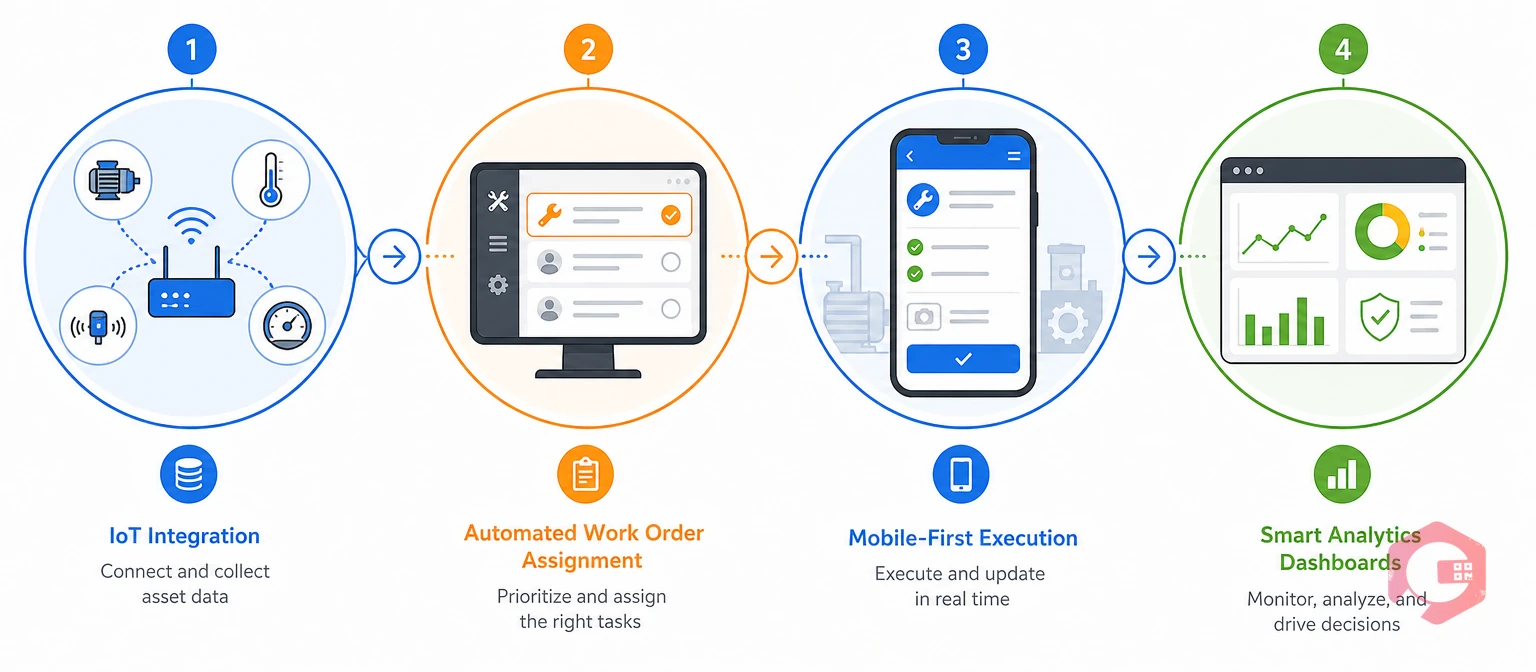
To effectively implement predictive maintenance, you need a robust Computerized Maintenance Management System (CMMS) to act as the "nervous system" of your operations. This is where Cryotos excel.
Seamless IoT Integration
Cryotos bridges the gap between hardware and action. Through its IoT Meter Reading module, it integrates directly with IoT sensors, SCADA systems, and PLCs. It automatically converts data anomalies into actionable insights, ensuring no alert goes unnoticed.
Automated Workflow Management
Data is useless if it doesn't trigger action. Cryotos automates the flow from Detection ? Alert ? Work Order Assignment. Instead of manual data entry, the system detects a threshold breach and immediately assigns a work order to the nearest available technician. This reduces reaction time and ensures the right person is dispatched with the right information.
Mobile-First Execution
Technicians are rarely at their desks. With the Cryotos mobile app, they can access real-time sensor data, asset history logs, and repair checklists right on the machine. This improves efficiency and boosts "first-time fix" rates.
Smart Analytics & Reporting
Cryotos provides customizable Business Intelligence (BI) dashboards that visualize downtime trends. You can track KPIs like Breakdown Hours (BDH), Mean Time To Repair (MTTR), and Mean Time Between Failures (MTBF). This empowers leadership to make data-backed decisions on whether to repair an asset or replace it entirely.
Conclusion
Predictive Maintenance is no longer a vision of the future enjoyed by tech giants- it is a competitive requirement for any industrial operation. With the shift of the reactive crisis management towards proactive, data-driven planning, businesses are bound to unlock greater productivity, safer workplaces, and much healthier profit margins.
In a fast-paced world, the machine that never sleeps is the one that wins. Predictive maintenance is such that the race is never forgone to a failure.