

CAFM vs CMMS comes down to what you manage: CAFM software plans and tracks space, occupancy, and building services. A CMMS runs the maintenance program for production and operational equipment. Both raise work orders. Both schedule preventive tasks. That overlap is why the two categories get confused so often. The right answer depends on whether your backlog is driven by machines or by square footage.
Key Takeaways
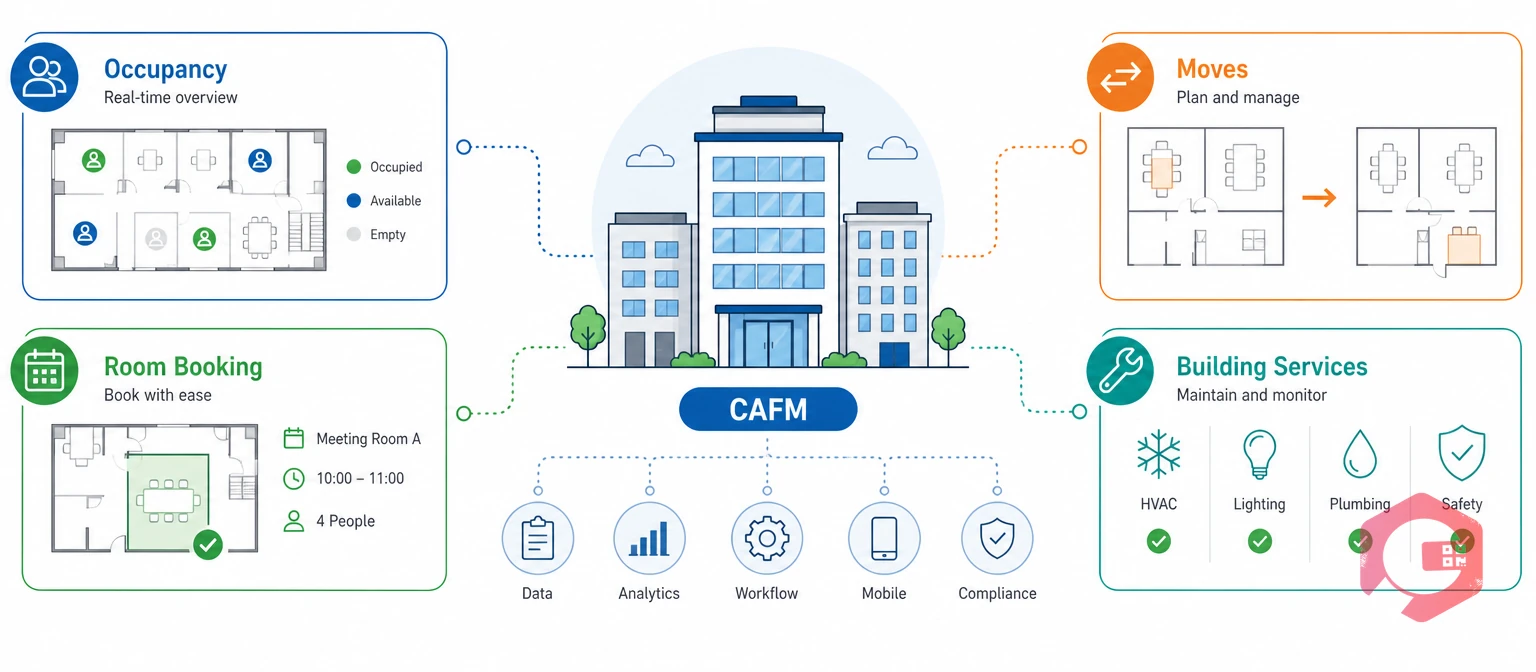
CAFM software plans, tracks, and reports on how a building's space and services get used. It grew out of computer-aided design (CAD) in the 1980s. Facility teams started linking floor plans to live occupancy and asset data instead of paper drawings.
ISO 41011 defines facility management as the function that integrates people, place, and process. CAFM is the software built for the "place" half of that job.
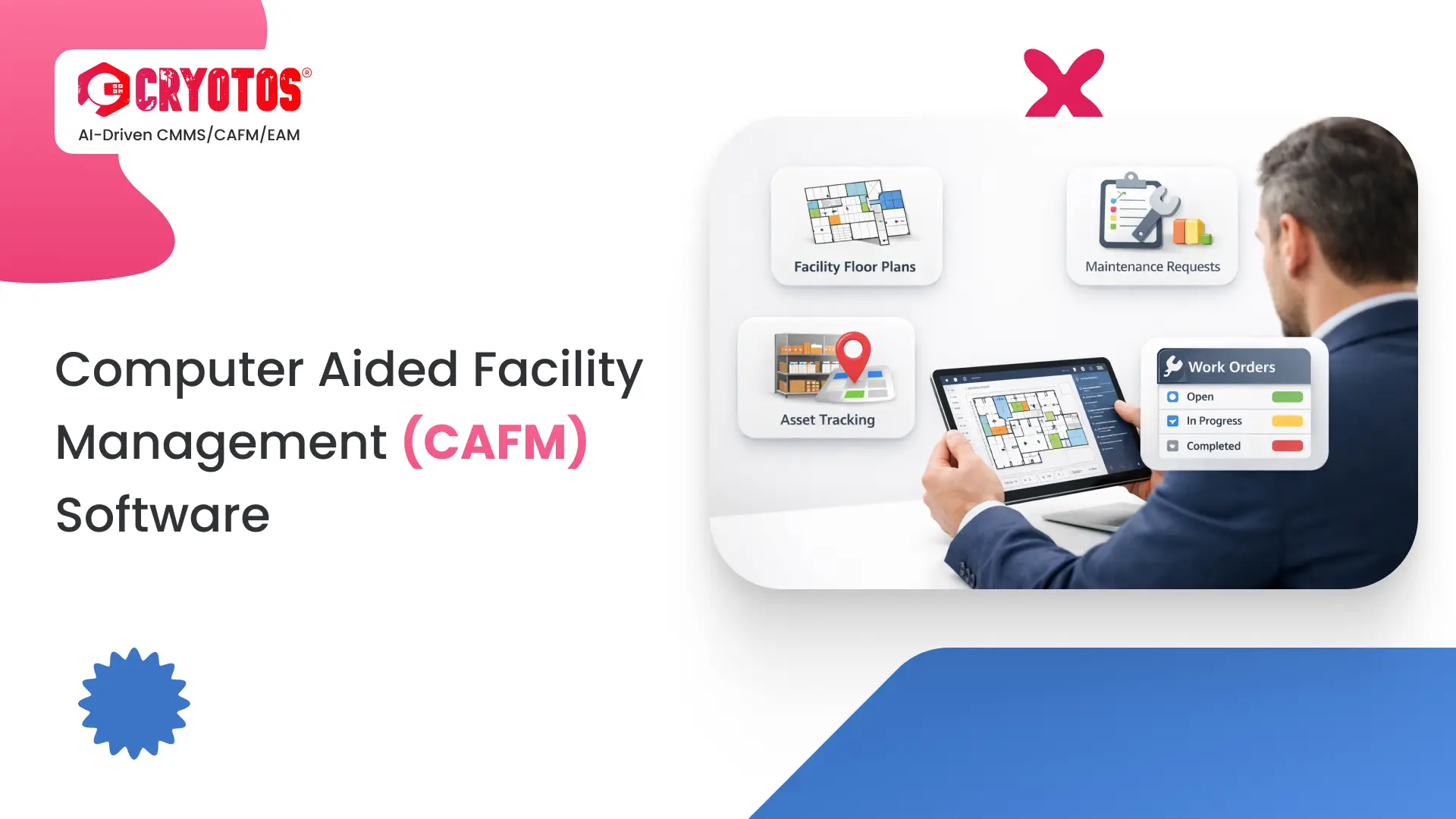
A facilities manager using CAFM software asks it three things: how much of this floor is occupied, where is this equipment on the plan, and who booked this room? Core CAFM functions include space planning, move management, room and desk booking, and building-services tracking.
A CMMS (Computerized Maintenance Management System) schedules, assigns, and tracks the work that keeps equipment running. CAFM starts from the floor plan. A Computerized Maintenance Management System starts from the asset register instead.
Maintenance teams use a CMMS to answer a different question: is this asset working, and when does it need attention next? Core CMMS functions include work order management, preventive maintenance (PM) scheduling, asset history, and spare parts inventory. Most maintenance teams judge the software by one thing: how fast it gets a technician from alert to repair.
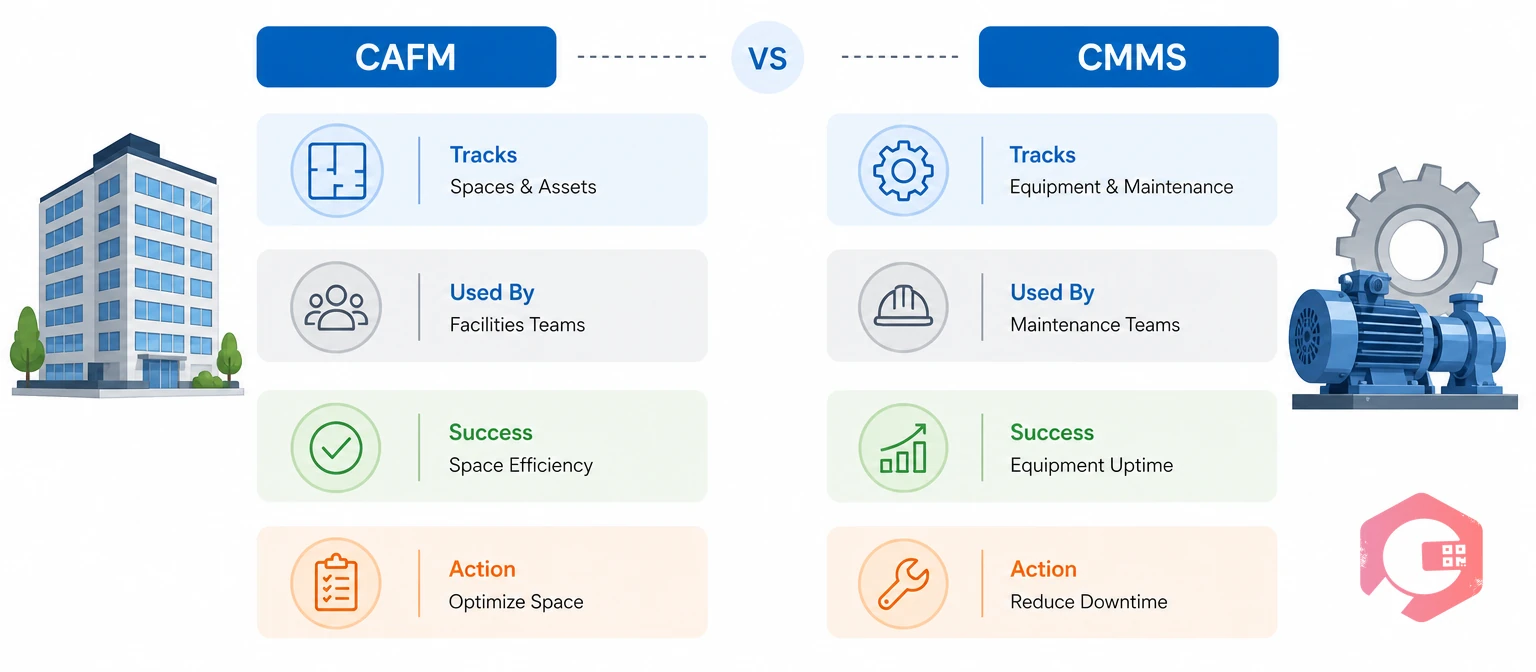
The clearest way to see CAFM vs CMMS side by side is a simple table. It shows what each system tracks and who relies on it every day.
| Dimension | CAFM | CMMS |
|---|---|---|
| Primary unit tracked | Space — floors, rooms, desks | Assets — machines, vehicles, tools |
| Typical buyer | Facilities or workplace manager | Maintenance or reliability manager |
| Core modules | Space planning, moves, room booking | Work orders, PM scheduling, parts inventory |
| Maintenance depth | Building services — HVAC, cleaning, security | Deep — RCA, MTTR/MTBF, condition-based PM |
| Reporting emphasis | Utilization rate, cost per square foot | Uptime, downtime, cost per asset |
Neither system beats the other on raw features. They answer different questions, and mixing them up is the most common mistake in the CAFM vs CMMS decision. A facilities manager who buys a full CAFM suite expecting deep reliability tools will find that side thin. A plant manager who buys a CMMS expecting lease and space-planning modules will find those missing too.
See how facility maintenance software fits your industry before you pick either category.
Most of the CAFM vs CMMS confusion comes from real overlap, not marketing.
This overlap is why most organizations end up wanting one system, not two that duplicate the same work-order engine.
The CAFM vs CMMS question usually resolves once you know what drives your backlog: equipment, or space and occupancy.
The Three-Question Fit Test:
| If you are... | You mainly need |
|---|---|
| A manufacturer, plant, or fleet operator | CMMS |
| A corporate real estate team managing leased sites | CAFM |
| A hospital, university, hotel, or retail chain | Both, ideally converged |
| A mid-size facilities team with light space-planning needs | CMMS with CAFM-adjacent features |
Teams that run this test tend to land on CMMS first. They decide later if they still need dedicated space-planning tools on top. Most facilities that check occupancy less than once a quarter never needed a full CAFM suite — a CMMS with building-systems coverage was enough all along.
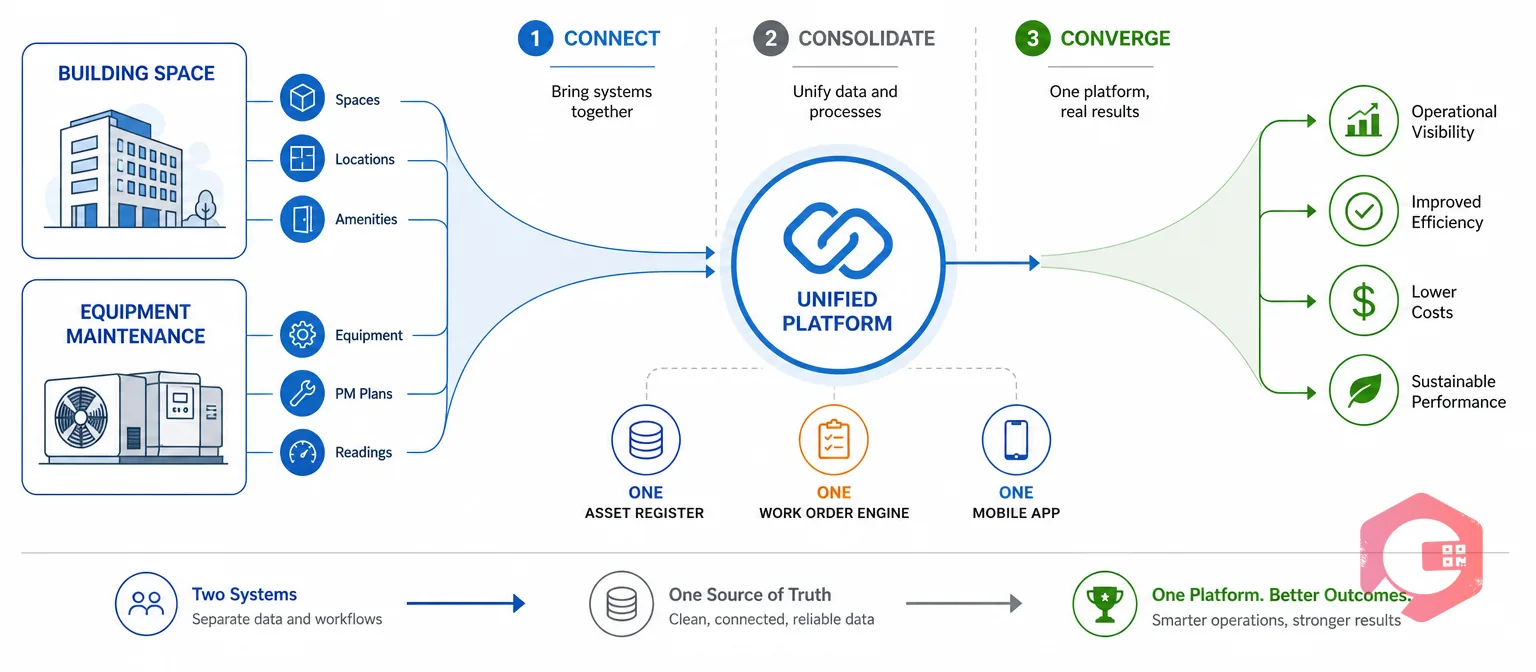
Running separate CAFM and CMMS systems creates friction fast.
A converged platform is one system that runs the CMMS work-order engine and covers CAFM-style building services too. One asset register, one work order engine, one mobile app. That model removes friction for most organizations whose CAFM needs stop short of full lease administration and space planning.
Cryotos is a CMMS with enough building-systems depth to cover the CAFM needs most facilities teams actually have. You don't pay for a separate space-planning suite you'll rarely open.
Maintenance teams using Cryotos have reported up to 30% reduction in unplanned downtime and 25% faster repair turnaround. Those gains reach building-services assets too, since both run through the same PM engine. Most facilities teams that consolidate this way see fewer duplicate tickets within the first month, simply because there's only one place to log a request.
Cryotos doesn't compete on dedicated space planning, floor-stacking, or lease administration. If your main need is managing a large leased real estate portfolio, a full CAFM or IWMS suite still wins there. For most mid-market facilities and maintenance teams, though, the CAFM vs CMMS decision settles in favor of one platform that already does both jobs.
CAFM software is the platform built for space; a CMMS is the platform built for equipment. They share work orders and PM scheduling, but the asset each one is built around is different.
For most mid-market facilities teams, yes. A CMMS with building-systems maintenance coverage handles the CAFM tasks that matter most. Teams that need dedicated space planning or lease administration for a large real estate portfolio still benefit from a full CAFM or IWMS suite.
An IWMS (Integrated Workplace Management System) sits above CAFM. It adds real estate portfolio and lease financial management. CAFM focuses on space and building operations; IWMS adds the capital and lease strategy layer on top.
Most organizations need both jobs done, but not always both separate systems. A converged platform that handles equipment maintenance and building-services work orders removes the duplicate data entry that comes from running CAFM and CMMS side by side.
Corporate real estate teams, universities, and large office portfolios lean CAFM when space utilization is their main daily concern. Manufacturers, plants, and fleet operators lean CMMS instead.
If your maintenance backlog is driven by equipment rather than space, the CAFM vs CMMS decision usually favors a single platform. Schedule a free demo to see how Cryotos covers building-services maintenance and production equipment on one system.

Cryotos AI predicts failures, automates work orders, and simplifies maintenance—before problems slow you down.



