Seal water management extends mechanical seal and pump life by keeping the seal faces cool, clean and lubricated with the right flow of clean water at the right pressure. When seal water slips, seals run hot or pick up solids, and the pump stops for repair. A simple routine with an owner, instruments and clear start-up rules prevents many of these failures.
This guide explains what seal water does and how its failure wears out seals. It gives a routine matrix, start-up rules and a four-part framework, and shows what a maintenance system can and cannot do.
Key Takeaways

A mechanical seal keeps the pumped liquid inside the pump where the shaft passes through the casing.
Seal water is clean water supplied to the seal area to cool, lubricate, flush and protect the seal. Many slurry pumps in mining, minerals, power, steel and cement rely on it.
Seal water management is the routine of controlling the quality, flow, pressure and supply of that water. You may also hear the words flush, quench, barrier fluid or gland water. They are related ideas.
Standards such as API 682 and ISO 21049 describe planned seal support systems for pumps. The pump and seal manufacturers' instructions always govern. See also these overviews of a mechanical seal and a centrifugal pump.
This guide gives no flow, pressure or interval values. Those come from your seal and pump manufacturers. Seal installation is a separate topic.
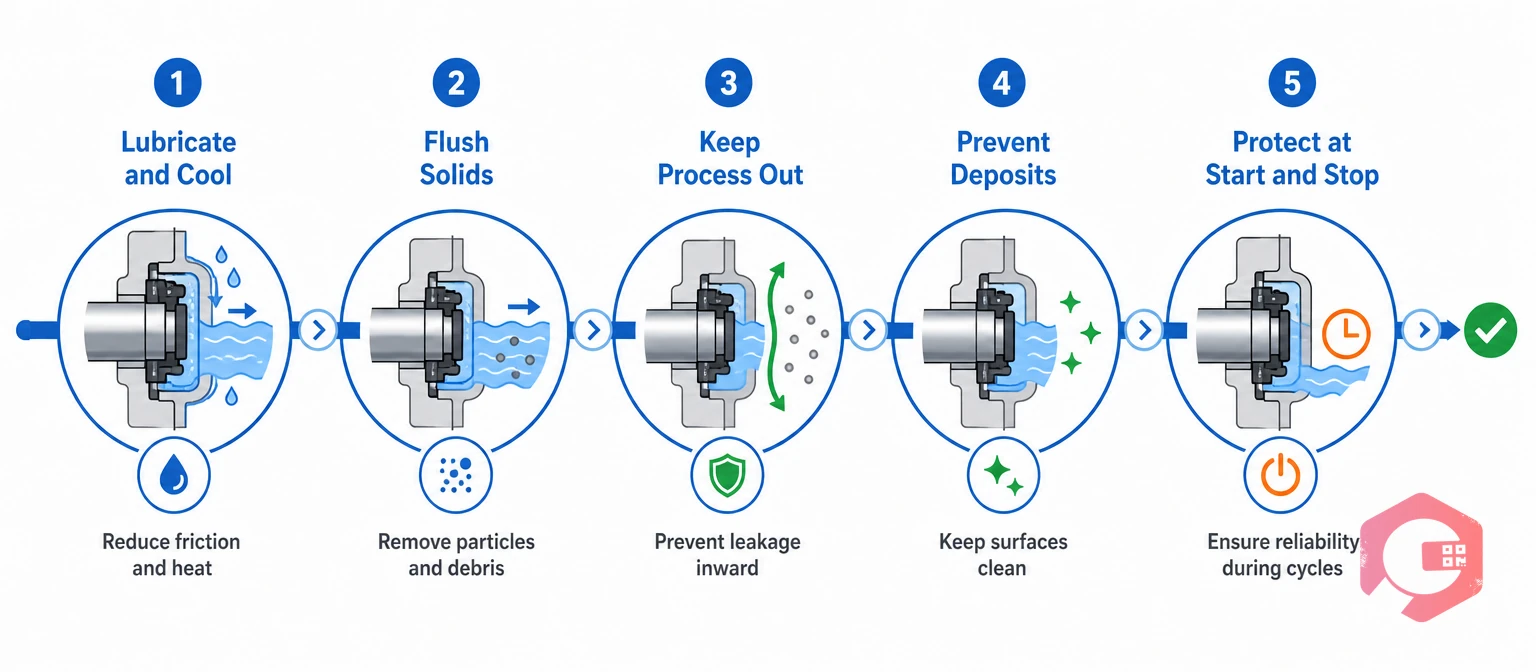
Seal water does five jobs. When one fails, the seal pays for it.
Seals also fail from other causes, such as misalignment and cavitation. Read the failed seal before you blame the water.
Use the matrix on each round. The rhythms are examples only. Your seal and pump manufacturers and plant procedures set the real ones.
| Area | What to Check | Sign of Trouble | Suggested Rhythm |
|---|---|---|---|
| Supply and header | Supply pressure; header leaks; seal water pump and tank condition. | Low or unstable pressure; leaks. | Each round. |
| Strainers and filters | Pressure drop; cleanliness; no bypass. | Rising pressure drop; solids downstream. | Each round; clean on condition. |
| Flow meters | Flow at each pump against the set value; meters readable. | Low or high flow; fouled meter. | Daily. |
| Flow switches and interlocks | Alarm and trip function; no bypass left in place. | Failed test; bypass found. | Tested per plan. |
| Regulators and gauges | Set pressure; gauge condition; valve positions. | Drift; wrong settings. | Weekly. |
| Gland and seal area | Leakage; slurry ingress; housing temperature; noise. | Slurry at the gland; heat; dripping. | Each round. |
| Piping, hoses and valves | Blocked or kinked lines; leaks; correct valves open. | Low flow at one pump only. | Weekly. |
| Start-up and shutdown | Water on before start and until the pump stops. | Pump started with no water. | Every start and stop. |
| Seal life records | Seal change date, hours run and failure cause. | No record; repeat failures. | Every seal change. |
Seal life is the running time between seal changes on a pump. Recording it for each pump shows which pumps are bad actors. Add your own pumps and set values to each row, because a generic list misses what is specific to your plant.
Build your round sheets from the mobile maintenance checklist.
Start-up and shutdown are moments when seals are easily damaged. These principles are general, so follow your manufacturers' instructions.

The CLEAN-FLOW-PRESSURE-PROTECT framework turns the routine into four checks. Use them on every pump.
The CLEAN-FLOW-PRESSURE-PROTECT Framework:
Here is an illustrative example. A slurry pump seal keeps failing early. Round readings show low seal water flow at that pump only. A kinked hose is found and replaced, the cause is recorded, and the next seal lasts longer.
Many failures here are quiet. Seal water is just water, so nobody owns it. Many maintenance teams recognize at least two of these.
A Computerized Maintenance Management System supports seal water management by scheduling rounds, capturing readings and recording seal life and failure causes. It does not select seals or control pumps. Cryotos is a maintenance platform for mining operations and other industries, not a seal engineering tool.
Maintenance teams using Cryotos have reported up to 30% reduction in unplanned downtime and 25% faster repair turnaround. For pumps, spotting low seal water flow early can also avoid a seal failure.
Seal selection, failure analysis, water balance studies and pump interlocks stay with seal engineers and your control system. Ask any software vendor how its records connect to them.
It is the routine of controlling the quality, flow, pressure and supply of the water that protects a seal. That water cools and lubricates the seal faces, flushes away solids and helps keep process liquid out. Without it, faces can overheat or wear quickly.
The seal faces can overheat and be damaged quickly, because they lose their cooling and lubricating film. Never start a pump with no seal water, and follow your manufacturer's instructions for start-up and shutdown.
It depends on the pump, the seal and the duty, so use the manufacturer's value. Too little flow starves the seal, and too much wastes water and can thin the slurry. Check flow on every round.
Solids in the water can wear the seal faces and block small passages. Hard water can leave deposits. Keep strainers working, and check the water supply when seal life drops.
All three groups touch it, so name one owner. Operations starts and stops pumps, maintenance inspects and repairs, and reliability reviews seal life and causes.
Yes, for the maintenance side: rounds, readings, alerts, work orders and seal life records. It does not select seals or interlock pumps.
Seal water management only works when the rounds happen and the findings get fixed. Schedule a free demo to see how Cryotos schedules seal water rounds, captures readings and tracks seal life in one place.



Cryotos AI predicts failures, automates work orders, and simplifies maintenance—before problems slow you down.