An asset investment plan (AIP) is a multi-year plan that decides which assets to maintain, renew or replace, when to act and how much to spend. It ranks every funding request by risk, cost and business value, so limited capital goes where it protects the most output and safety.
Without a plan, spending follows whatever broke last. With one, teams see capital needs years ahead and defend them with data. This guide explains what an AIP contains, how it helps your organization and how to build one in six steps. It also shows how maintenance records keep the plan accurate.
Key Takeaways

An asset investment plan is a multi-year plan that ranks asset spending by risk, cost and business value. It covers renewal, replacement, upgrade and new-asset projects, and it shows when each one needs funding.
Some organizations call it asset investment planning, a capital investment plan or a renewal plan. The name changes, but the job stays the same: match limited money to the assets that matter most.
The ISO 55000 family of asset management standards expects spending decisions to link back to organizational goals and risk. The Institute of Asset Management offers practical guidance on that link between strategy and investment. A well-built AIP is how most organizations show that link in practice.
Most maintenance teams already hold the raw data behind these decisions. The plan pulls it into one ranked list that finance and operations can both read.
An asset investment plan helps an organization by putting capital where it cuts the most risk, downtime and lifecycle cost. It replaces request-by-request funding with a ranked, multi-year view. The benefits show up in operations, finance and safety.
Say a plant has five aging assets and budget for two. Without a plan, the team funds the two that failed most recently. With a plan, the team scores all five on risk and cost, and the main switchboard that could stop the whole site ranks first, even though it has never failed.
Accurate asset records are the base of every plan, and asset QR code scanning keeps them current from the shop floor.
An asset investment plan usually contains seven parts. The exact headings vary, but strong plans cover each one.
An asset register is the master list of every asset with its key details and history. A plan built on weak register data produces weak rankings. A Computerized Maintenance Management System (CMMS) keeps that register and its history current as work gets done.
An investment register turns the plan into a ranked list. The table below shows five example assets with illustrative figures.
| Asset | Condition | Risk Score | Preferred Action | Estimated Cost | Planned Year |
|---|---|---|---|---|---|
| Main switchboard | Fair, near end of service life | High | Replace | $240,000 | Year 1 |
| Chiller 2 | Poor, rising repair costs | High | Replace | $180,000 | Year 1 |
| Line 3 conveyor drive | Fair, frequent stops | High | Replace drive unit | $65,000 | Year 2 |
| Boiler feed pump | Fair, aging seals | Medium | Refurbish | $22,000 | Year 2 |
| Rooftop air handler | Good, minor wear | Low | Keep and monitor | $8,000 | Year 4 |
The cheapest line is not always the lowest priority. Risk and timing drive the order, not price alone.
The main difference is the question each plan answers: an asset investment plan decides where capital goes and when, while an asset management plan sets how each asset group is operated and maintained. The table shows seven differences side by side.
| Area | Asset Investment Plan | Asset Management Plan |
|---|---|---|
| Main question | Which assets get capital, and when? | How do we operate and maintain each asset group? |
| Focus | Renewal, replacement, upgrade and new-asset spending | Tasks, inspections, service levels and routine costs |
| Time horizon | Usually 3 to 10 years, reviewed each budget cycle | Medium to long term, with detailed near-term actions |
| Main inputs | Condition, risk, criticality, lifecycle cost and funding limits | Asset register, failure history, maintenance strategy and standards |
| Typical output | Ranked project list with a funding profile by year | Maintenance plans, schedules and service targets |
| Main audience | Finance, executives and asset owners | Planners, engineers and maintenance managers |
| Review trigger | Budget cycle, major failure, new regulation or strategy change | Condition changes, failures and changes in service levels |
The two documents work as a pair. The management plan shows what an asset group needs, and the investment plan decides which of those needs get funded first.
A common mistake is to treat the maintenance budget as the investment plan. Routine repairs belong in the operating budget, while renewal and replacement projects belong in the AIP.
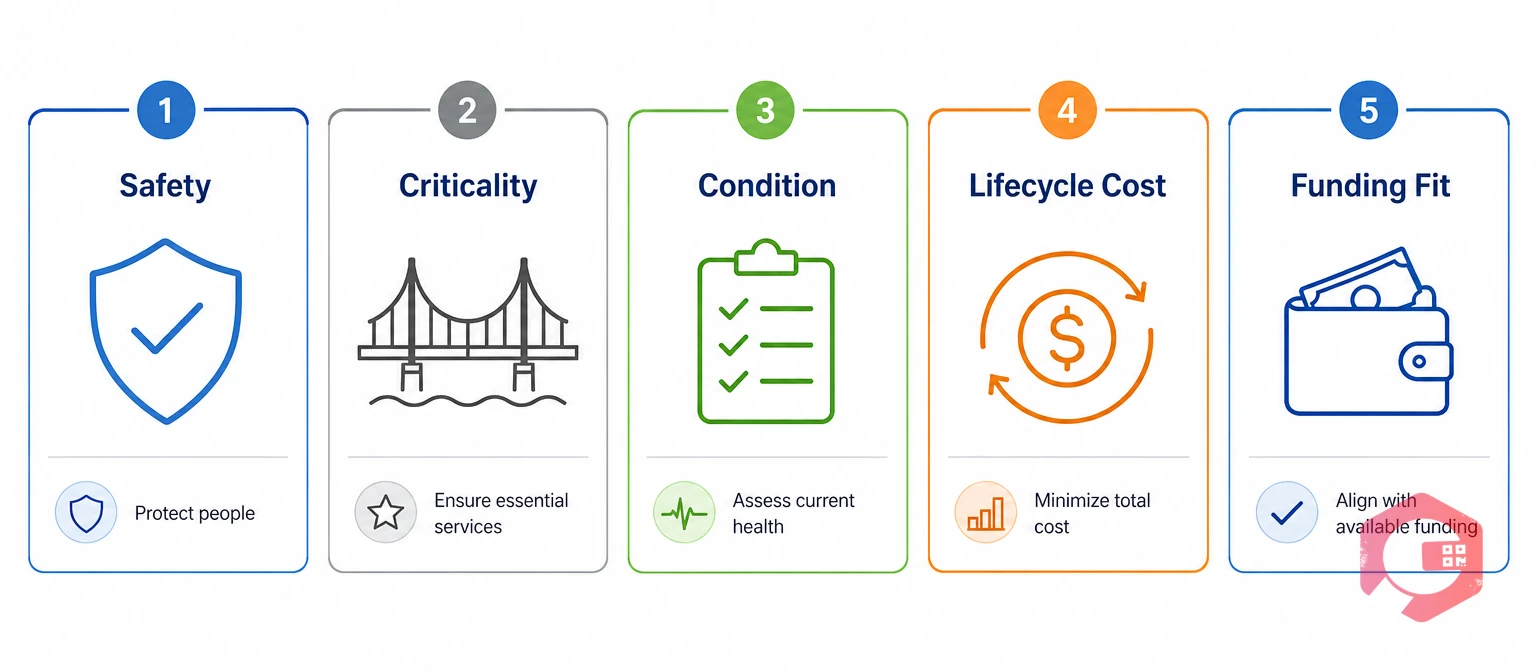
You prioritize investments by scoring every candidate project against the same criteria, then funding in rank order until the budget runs out. Consistent scoring is what makes the ranking easy to defend.
The Five-Gate AIP Framework:
A simple risk matrix is enough to start. Score likelihood and consequence on a 1 to 5 scale, then multiply the two.
The repair-or-replace choice is where many plans are won or lost. Compare the cost of keeping an asset running with the cost of replacing it, using real repair history.
Say a pump costs $9,000 a year to repair and $28,000 to replace. After about three years, repairs cost as much as a new pump, and the risk of failure keeps rising.
Where an asset is critical but not yet failing, condition-based maintenance can show whether it has life left before you commit capital.

You build an asset investment plan by moving from goals to data, then to risk, options, ranking and funding. Bring operations, maintenance and finance into the room from the start, because each group sees different risks.
Test large projects with standard capital budgeting methods, such as net present value. Keep the plan short enough that executives will read it, and move asset-level detail into supporting files.
Most asset investment plan failures come from poor data and weak follow-through, not from the math. These six mistakes are common and fixable.
Most operations that struggle with capital planning have a plan on paper but no live data feeding it. Fixing that feedback loop usually matters more than polishing the document.
A CMMS supports an asset investment plan by supplying the asset, cost and failure data that every ranking depends on. It also records what happens after the money is spent.
Maintenance teams using Cryotos have reported up to 30% reduction in unplanned downtime and 25% faster repair turnaround. Fewer unplanned failures also means fewer emergency purchases, which is the outcome an AIP is designed to deliver.
A CMMS does not write the plan for you. It supplies the evidence, so each review starts from facts instead of memory.
AIP stands for asset investment plan, also called asset investment planning. It is the multi-year plan that decides which assets to repair, renew or replace, and when. Some organizations call it a capital investment plan.
The purpose is to match limited capital to the assets that matter most. It ranks projects on risk, cost and value, so decisions are consistent and easy to defend to finance and leadership.
An asset investment plan decides where capital goes and when. An asset management plan sets how each asset group is operated and maintained. The management plan shows the needs, and the investment plan decides which needs are funded first.
Most organizations plan three to ten years ahead. Long-life assets such as switchgear, boilers and building systems need the longer view, while the first one or two years carry the most detail and the firmest budgets.
Maintenance, operations, finance and safety should all take part. Maintenance supplies condition and failure data, operations explains the impact of downtime, and finance sets the budget limits. An executive sponsor approves the final ranking.
Review the plan at least once a year, aligned with the budget cycle. Also review it after a major failure, a regulation change or a shift in business strategy, because any of these can change which projects rank highest.
You need a complete asset register, condition or inspection results, failure and repair history, criticality scores and replacement cost estimates. Gaps in this data are the most common reason plans stall, so fix them before scoring begins.
Yes. A CMMS holds the asset register, work history, repair cost and failure data that the plan depends on. It does not write the plan for you, but it supplies the evidence for every ranking and every review.
A clear plan gives every asset decision a purpose, and live maintenance data keeps it honest. Schedule a free demo to see how Cryotos connects asset records, planned maintenance and cost reporting to your asset investment plan.


Cryotos AI predicts failures, automates work orders, and simplifies maintenance—before problems slow you down.