Asset criticality analysis is a compliance requirement under ISO 55001 and a foundational input to API 580 risk-based inspection programs. Both standards expect organizations to rank assets by the consequence and likelihood of failure, document the scoring method, and use the result to guide maintenance, inspection, and capital decisions. Maintenance teams that treat asset criticality as an internal exercise often discover during an audit that their rankings lack the structure, evidence trail, and update discipline these standards demand.
This guide maps the key ISO 55001 clauses and the API 580 risk framework to the asset criticality steps your team needs to follow. It shows the differences between the two standards. It explains how to build an assessment that passes an audit.
Key Takeaways

Asset criticality in a compliance context is a documented, repeatable ranking of equipment by the business, safety, and regulatory consequences of its failure, maintained as auditable evidence that risk-based decisions are being made. Operational criticality answers which assets matter most to production. Compliance criticality adds three requirements: a defined scoring method, written records of each score, and a review cycle that keeps rankings current.
A Computerized Maintenance Management System (CMMS) stores these records against each asset, so the scoring rationale, the date of the last review, and the resulting maintenance strategy are available on demand during an audit.
A compliance-ready asset criticality register is a scored, documented, and regularly reviewed ranking of equipment that an auditor can verify independently. It goes beyond a list of important machines. It includes the method, the evidence, and the review history that prove the ranking is active and current.
Operational asset criticality often lives in a supervisor's head or an aging spreadsheet. Compliance-level asset criticality must live in a controlled document or system record. Three differences matter:
Without these three elements, a criticality ranking may be operationally useful but will not satisfy an ISO 55001 certification auditor or an API 580 inspection program reviewer.
ISO 55001 is the international standard for asset management systems, and it requires organizations to identify risks and opportunities associated with their assets and to make decisions that reflect those risks. The standard does not prescribe a specific criticality scoring method, but its clauses create obligations that a structured criticality assessment is the most practical way to meet.
The ISO 55001 standard sits within the broader ISO 55000 family, which defines asset management terminology, requirements, and guidance. Enterprise asset management software supports the system-level integration these standards expect.
Clause 6.1 requires the organization to determine the risks and opportunities that need to be addressed and to plan actions to manage them. For maintenance teams, this means identifying which assets carry the highest consequence of failure and documenting how the organization responds differently to high-consequence versus low-consequence equipment.
The clause does not require perfection. It requires a method that the team follows, records, and improves over time. An asset criticality assessment that covers these points gives auditors what they need at the 6.1 level.
Most facilities already score assets in their heads. The gap is paperwork, not knowledge. Write the method down. Apply it to every asset. Keep the records. That step alone closes the most common 6.1 finding.
Auditors also check whether the asset criticality ranking covers safety-critical equipment. An asset with a high safety consequence that sits in a low tier raises a red flag. Make sure your scoring gives safety enough weight to push those assets to the top, even when their production impact is low.
Clause 8.2 requires the organization to manage changes that could affect asset management objectives, including changes to asset condition, operating context, or organizational priorities. A criticality ranking that never changes after the initial study fails this clause.
Management of change is where many asset criticality programs fail an audit. The initial study scores well, but the lack of a review cycle means the register drifts out of step with the real plant.
A simple fix is to add asset criticality review triggers to your existing change management procedure. When a work order closes with a major finding, flag it. When a new asset is installed, score it before it enters service. When a backup unit is removed, raise the tier of the remaining unit. These triggers keep the register alive without a full annual re-study each time.
API 580 is the American Petroleum Institute standard for risk-based inspection (RBI), and it uses consequence-of-failure scoring as a direct input to inspection planning. Where ISO 55001 requires risk-based thinking across all asset management decisions, API 580 focuses specifically on how criticality and likelihood drive the type, scope, and frequency of equipment inspections.
The standard applies primarily to pressure equipment in refining, petrochemical, and power generation, but its risk framework is widely adopted in other industries as a model for structured criticality assessment. Reliability-centered maintenance programs often borrow the same consequence-and-likelihood logic.
API 580 splits the risk equation into two halves, each scored independently:
The product of CoF and LoF places each asset in a risk-based inspection matrix. High-risk assets get shorter inspection intervals and deeper techniques. Low-risk assets get longer intervals, which frees resources for the equipment that needs them most.
An asset criticality score under API 580 is the consequence-of-failure rating that sets how much inspection attention each piece of equipment gets. A high CoF score means more frequent, more detailed inspections — even if the asset has never failed. A low CoF score lets the team extend intervals and focus elsewhere.
Most teams start by listing every asset in scope and scoring CoF first. Then they add LoF based on inspection history and corrosion data. The asset criticality ranking from the CoF step usually stays stable for years. The LoF score changes after each inspection, which is why API 580 calls for re-assessment on a set cycle.
Establish baseline failure rates for each asset before scoring likelihood. The free failure rate calculator turns your work order history into the probability input API 580 expects.
Both standards expect a structured criticality assessment, but they differ in scope, output, and industry focus. The table below maps the key differences that affect how maintenance teams build their assessment.
| Dimension | ISO 55001 | API 580 |
|---|---|---|
| Scope | All asset types across any industry | Pressure equipment in oil, gas, petrochemical, and power |
| What it requires | Risk-based decision-making across the asset management system | Risk-based inspection planning with documented CoF and LoF scores |
| Criticality output | Tiers or scores that drive maintenance strategy, spares, and capital planning | A risk matrix position that sets inspection type, scope, and interval |
| Scoring method | Not prescribed — organization defines its own criteria and weightings | Structured CoF and LoF methodology with semi-quantitative or quantitative options |
| Review requirement | Management of change (Clause 8.2) — re-score on triggers and at intervals | Re-assess after each inspection, process change, or at the RBI plan interval |
| Audit evidence | Documented method, scored assets, evidence that scores drive decisions | RBI plan with CoF and LoF matrices, inspection records, and degradation data |
| Certification | Third-party certifiable management system | Recommended practice — no certification, but often required by insurers and regulators |
Organizations in oil and gas, petrochemical, and power often need to satisfy both standards at once. ISO 55001 covers the overall asset management system, and API 580 covers pressure equipment inspection. A single asset criticality assessment can serve both when it includes all the consequence and likelihood categories each standard expects.
The practical takeaway is scope. ISO 55001 needs asset criticality rankings across every asset type in the facility. API 580 needs deeper, more technical scores on pressure equipment specifically. Teams that build one master asset criticality register with enough detail for API 580 and enough breadth for ISO 55001 avoid doing the work twice.
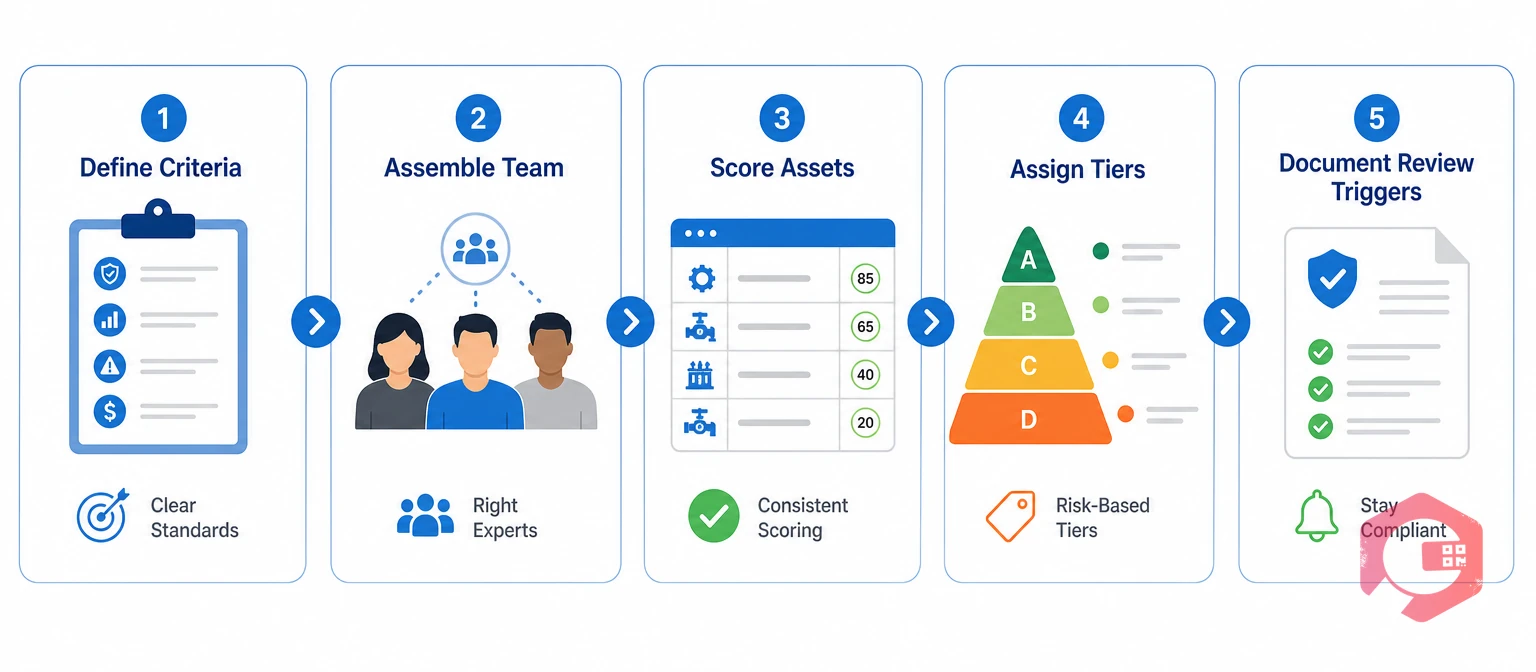
A compliance-ready criticality assessment meets three tests at once: it ranks assets by real consequence, it follows a documented and repeatable method, and it produces records an auditor can verify. Most assessments that fail an audit pass the first test but miss the second or third.
The Compliance Criticality Triad:
Each element of the triad maps to a common audit question. "How did you decide this asset is Tier 2?" tests Consequence Mapping. "What data supports this likelihood score?" tests Likelihood Evidence. "When was this last reviewed, and why?" tests Audit Trail.
Follow these steps to produce a criticality register that satisfies ISO 55001, API 580, or both:
Use asset maintenance management software to store the tier against each asset record, so every work order, PM schedule, and inspection task inherits the correct priority automatically. When an asset is re-scored, the system updates all downstream tasks without manual rework.
For failure mode detail on top-tier assets, run a simplified FMEA to identify which components drive the asset criticality score and which failure modes the maintenance strategy must address.
A compliance-ready asset criticality assessment is one that an independent auditor can verify without asking the team to explain it. The method, the scores, the data behind them, and the resulting actions should all be readable from the records alone.
If the person who ran the original study leaves, the register should still make sense to the next reviewer. Write scoring definitions in plain language. Attach data sources to each score. Record every review date and trigger.
Most facilities that follow the five steps above finish their first full asset criticality register in two to four cross-functional workshop sessions. The effort pays back right away in audit readiness. It keeps paying back through better-targeted maintenance and inspection programs that direct resources where the risk is highest.
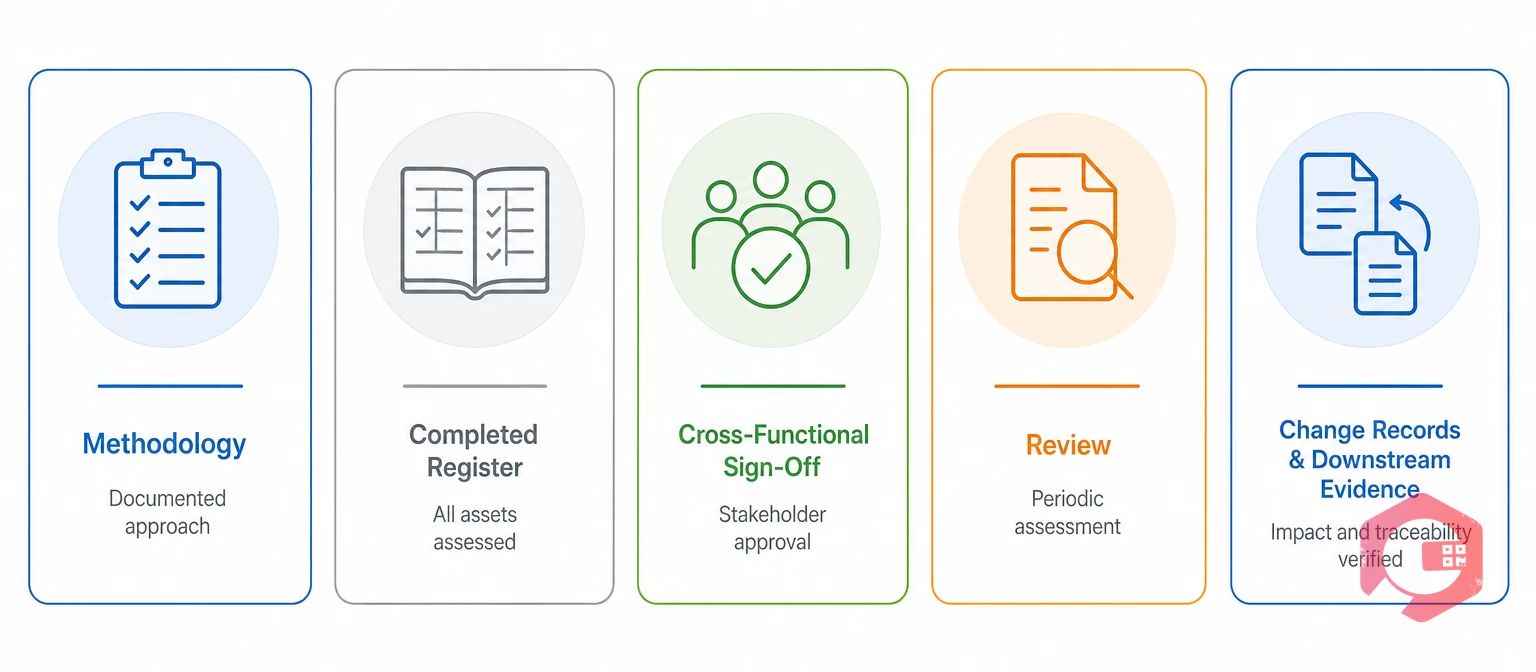
Audit evidence for criticality analysis is the documented proof that your organization identified asset risks, scored them using a defined method, and used the scores to make maintenance and inspection decisions. Assessors do not expect perfection. They expect a system that works, is followed, and improves over time.
Most maintenance teams can answer "which assets are critical?" in conversation. The audit question is whether that answer exists in a record that someone else can verify. Assessors typically look for five things:
Calculate failure intervals with the MTBF calculator and attach the output to each asset's likelihood score. This gives assessors the data link they look for between failure history and the probability rating.
The most common audit finding is not a wrong score. It is a missing link between the score and the action. A Tier 1 asset with the same PM interval as a Tier 3 asset raises a nonconformity, because the asset criticality ranking is not changing the maintenance strategy it is supposed to change.
A second common gap is the review record. Auditors expect to see a dated log showing when each asset's score was last checked and what triggered the check. Even if no score changed, the record of the review matters. Teams that build the review step into their annual planning cycle close this gap without extra effort.
A CMMS turns a static criticality register into a living compliance system by storing the tier on every asset record, linking it to failure history, PM schedules, and inspection plans, and logging every change with a timestamp. Spreadsheet-based registers satisfy the first audit cycle but fail the second, because updates are inconsistent, version control is manual, and downstream evidence is stored elsewhere.
Maintenance teams using Cryotos have reported up to 30% reduction in unplanned downtime and 25% faster repair turnaround. Much of that improvement comes from embedding criticality into the daily workflow rather than treating it as a separate compliance exercise.
When asset criticality lives inside the maintenance system, the audit trail is a by-product of daily work. Teams do not need a separate documentation project before an audit. The records are already there because the system creates them during normal operations.
For teams going after ISO 55001 certification, a CMMS also helps with the continual improvement clause (Clause 10.2). It shows how asset criticality scores and their linked strategies change over time. Auditors can see the shift from reactive to risk-based work in the data. That trend gives them confidence the management system is getting better.
On the API 580 side, a CMMS links each asset's inspection history to its consequence and likelihood scores. When an inspector closes a report, the system can update the LoF rating. That keeps the risk matrix current without a manual re-scoring exercise. Inspection planners see the latest risk position every time they set the next interval.
ISO 55001 does not use the exact phrase "criticality analysis" in its clauses. It requires the organization to identify risks tied to its assets (Clause 6.1) and to manage changes that affect asset management goals (Clause 8.2). A structured asset criticality assessment is the most practical way to meet both requirements. Certification auditors routinely look for one, and its absence is a common major nonconformity.
ISO 55001 covers the entire asset management system across any industry and requires risk-based decision-making without prescribing a specific method. API 580 is an American Petroleum Institute recommended practice focused on pressure equipment inspection, and it prescribes a consequence-and-likelihood framework for setting inspection intervals. Organizations in oil, gas, and power often need both: ISO 55001 for the management system and API 580 for the inspection program.
Review the full register at least once a year. Re-score individual assets after any major failure, process change, new equipment installation, or decommissioning. ISO 55001 Clause 8.2 expects documented evidence that reviews happen on defined triggers, not just at a fixed calendar interval.
Yes, a spreadsheet can produce a valid criticality register for the first assessment. The challenge is sustaining it. Without a system that links the tier to PM schedules, work order priority, and failure history, the register goes stale and the downstream evidence auditors expect — different maintenance strategies for different tiers — is hard to demonstrate.
Under ISO 55001, the absence of a risk-based asset ranking is a major nonconformity against Clause 6.1. The organization must show corrective action before the next surveillance audit. Under API 580, a missing or undocumented RBI plan means inspection intervals cannot be justified as risk-based. That gap may trigger regulatory action or insurer review.
Oil and gas, power generation, petrochemical, pharmaceutical, and food manufacturing benefit most because they face both asset management audits (ISO 55001) and industry-specific inspection requirements (API 580, FDA, OSHA). However, any facility pursuing ISO 55001 certification needs a documented asset criticality ranking regardless of industry. The standard applies to all asset types.
Asset criticality analysis is the bridge between knowing which equipment matters and proving it to an auditor. When the ranking is documented, scored with evidence, and built into your maintenance system, every PM task, inspection plan, and spare part decision becomes compliance evidence by default. The work you already do each day creates the records both standards expect. Schedule a free demo to see how Cryotos stores asset criticality tiers on every asset record and turns daily maintenance work into the audit trail ISO 55001 and API 580 require.


Cryotos AI predicts failures, automates work orders, and simplifies maintenance—before problems slow you down.