
Deferred maintenance happens when maintenance tasks are postponed past their scheduled date, allowing equipment, facilities, and assets to deteriorate beyond their optimal condition. According to the Facility Guidelines Institute, deferred maintenance backlogs in U.S. facilities exceed $1 trillion — and most of that burden started with a single skipped inspection or delayed repair. If you are managing assets without a clear system to stay on top of upkeep, deferred maintenance is not a matter of if — it is a matter of when. A modern CMMS gives maintenance teams the structure to prevent backlogs before they spiral out of control.
Key Takeaways
Deferred maintenance is any maintenance work that has been identified, scheduled, and then postponed — usually because of budget constraints, staffing gaps, or competing priorities. It is not the same as reactive maintenance triggered by an unexpected failure. Deferred maintenance is a known obligation that gets pushed to a later date and, if left unaddressed, grows into a costly backlog.
The term is common in facility management, manufacturing, healthcare, and public infrastructure. A leaking HVAC seal, a fraying conveyor belt, or a worn floor coating that was noted six months ago but never fixed — these are textbook examples. Each deferred task adds risk: equipment that runs past its service window fails sooner, and unplanned downtime costs far more than the original repair would have.
| Attribute | Deferred Maintenance | Neglect |
|---|---|---|
| Definition | Planned work postponed past its scheduled date | No plan or intent to perform maintenance |
| Awareness | Issue is known and logged | Issue is ignored or untracked |
| Cause | Budget gaps, staffing, competing priorities | Poor culture, no system, or deliberate avoidance |
| Outcome | Growing backlog with known risk | Sudden failure with unknown risk exposure |
| Recoverability | Can be prioritized and scheduled | Often requires emergency repair or replacement |
Deferred maintenance is manageable when teams have a system. Neglect is the absence of a system entirely.

Understanding the root causes of deferred maintenance helps you fix the system, not just the symptoms. Most backlogs trace back to one or more of these five drivers:
Deferred maintenance is not free — it is a debt that accrues interest in the form of accelerated asset degradation, higher repair costs, and increased safety risk. Research from the American Society of Civil Engineers estimates that every $1 in deferred building maintenance creates $4 in future repair costs.
Beyond the financial impact, deferred maintenance drives up unplanned downtime. Equipment that misses its service window fails at the worst possible moment — during peak production, an audit, or a safety inspection. Teams using downtime tracking consistently find that a large share of their unplanned outages traces back to deferred PMs, not random failures.
Liability is another dimension. In healthcare and food and beverage environments, regulators expect documented proof that maintenance schedules were followed. A deferred maintenance backlog without a remediation plan is a compliance liability that can result in fines, shutdowns, or both.
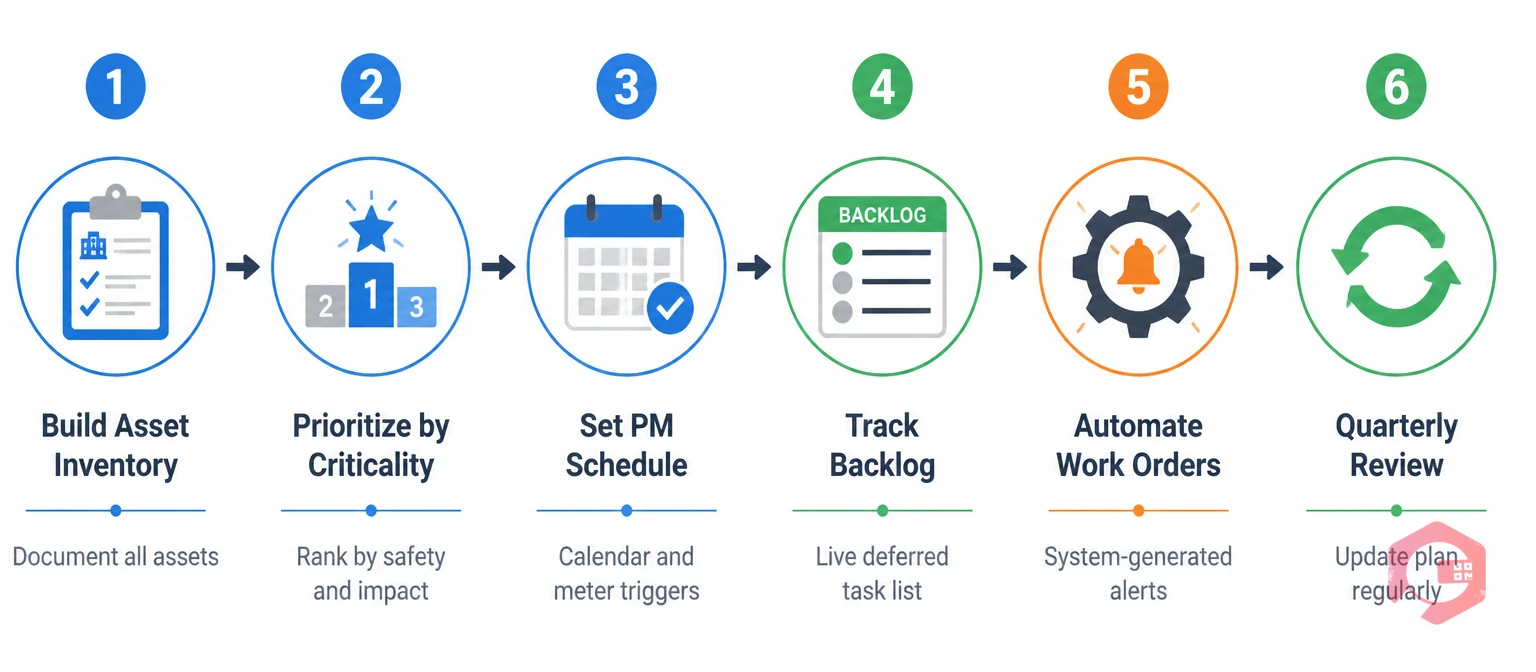
Avoiding deferred maintenance is not about having unlimited budget — it is about building a system that makes deliberate trade-offs and keeps the backlog from growing silently. Here is a practical six-step framework that maintenance teams can implement regardless of facility size.
You cannot maintain what you cannot see. Start by documenting every asset in your facility: equipment type, location, manufacturer, model, serial number, install date, and expected service life. Include utility systems, HVAC, electrical panels, and structural components — not just production machinery.
A complete asset register is the foundation for everything else. Without it, gaps in your maintenance schedule are invisible until something fails.
Once you have your asset list, rank every item by criticality. A criticality score typically weighs three factors:
High-criticality assets should never enter the deferred queue. Medium and low-criticality assets can be prioritized within budget cycles — but they still need scheduled dates, not open-ended deferrals.
For every asset on your register, define a PM schedule based on manufacturer recommendations, industry standards, and actual operating conditions. Use calendar-based triggers for time-sensitive maintenance (monthly, quarterly, annually) and meter-based triggers for usage-sensitive equipment (hours run, cycles, mileage).
A well-configured preventive maintenance software automates these triggers so tasks are generated on time without manual follow-up. Equally important, planned downtime built into your schedule is always cheaper than the unplanned variety.
Create a live backlog list of every task that has been postponed, including the original due date, the reason for deferral, and the estimated cost. Review this list weekly. If a task has been deferred more than twice, escalate it — it is now a risk item, not a planning item.
Backlog visibility prevents silent drift. When maintenance managers can see the full deferred queue in one place, they can make informed trade-offs instead of hoping nothing fails first.
Manual work order tracking on spreadsheets is the single biggest contributor to deferred maintenance in mid-size operations. Tasks fall through the cracks, escalations get missed, and there is no audit trail when something goes wrong.
A maintenance management software automatically generates work orders from your PM schedule, assigns them to technicians, and sends reminders when due dates approach. If a task is not completed on time, the system flags it — so managers act on it instead of discovering it after a failure.
Asset conditions change, operating schedules shift, and new equipment gets added. A maintenance plan that is static becomes outdated within months. Schedule a quarterly review to update PM frequencies, retire assets that have been replaced, and add new equipment to the register. Use maintenance reports and KPI dashboards to identify which asset categories have the highest backlog — and adjust budget and staffing accordingly.
Use Cryotos maintenance checklists to standardize your quarterly review process and ensure nothing gets missed when updating your PM schedule.
If you already have a backlog, the goal is to triage it systematically rather than trying to fix everything at once. A structured approach keeps the backlog from growing while you work through existing items.
Deferred maintenance looks different depending on your sector. Here are common examples across industries and why they matter:

Cryotos is built to prevent the conditions that create deferred maintenance in the first place. The platform gives your team a single system to manage asset registers, automate PM schedules, generate and track work orders, and monitor your backlog in real time — all from mobile or desktop, even offline.
With Cryotos, maintenance managers get BI dashboards that show deferred vs. completed work by asset, department, or location. Teams using Cryotos have reported 30% reductions in downtime and 25% faster repair cycles — outcomes that directly shrink the conditions where deferred maintenance takes root.
Preventive maintenance is scheduled upkeep performed before failure occurs. Deferred maintenance is preventive (or corrective) work that was scheduled but postponed past its due date. One is proactive by design; the other is a reactive gap in an otherwise proactive system.
Multiply the estimated repair cost of each deferred task by a deterioration factor — typically 1.5x to 4x for tasks deferred by one to three years, depending on asset type and operating environment. Add these figures across your full backlog to get a total deferred maintenance liability. CMMS platforms can calculate this automatically from work order cost data.
Common examples include: skipped HVAC filter replacements, delayed roof leak repairs, overdue conveyor belt inspections, postponed fire suppression system tests, and deferred electrical panel upgrades. Any task that was identified, put on a schedule, and then pushed past its due date qualifies as deferred maintenance.
In practice, some level of deferral is unavoidable — emergencies happen, budgets get cut, and priorities shift. The goal is not zero deferred maintenance but a small, visible, actively managed backlog. Organizations with strong PM programs and CMMS support consistently keep their deferred maintenance ratio below 10% of total work orders.
Ready to eliminate your deferred maintenance backlog for good? Schedule a free demo to see how Cryotos automates your PM schedules, tracks your backlog in real time, and gives your team the visibility to stay proactive.


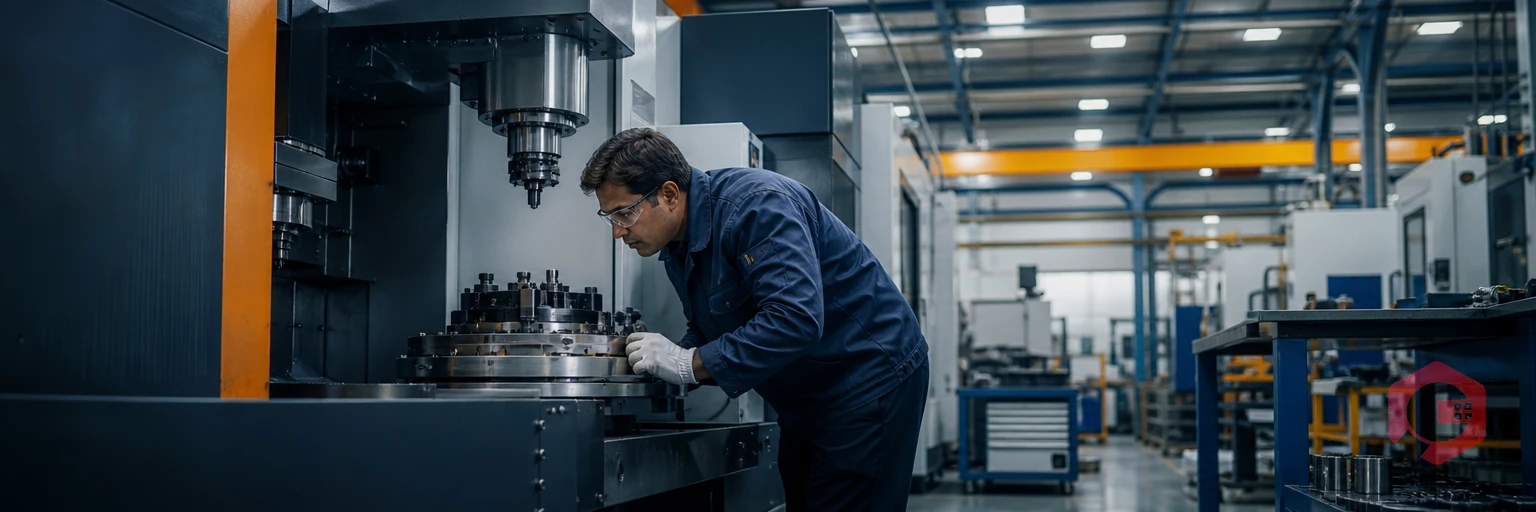

Cryotos AI predicts failures, automates work orders, and simplifies maintenance—before problems slow you down.