

Reducing maintenance costs isn't about cutting corners — it's about eliminating the hidden waste that bleeds your budget every single day. Whether it's a bearing failure that could have been prevented with a ₹200 part, a technician waiting 45 minutes to find a work order, or a compliance fine triggered by a missed inspection, maintenance inefficiency compounds silently until it becomes a financial crisis.
According to a McKinsey report on industrial operations, unplanned equipment downtime costs manufacturers an average of $260,000 per hour. Yet across most facilities, 30–40% of total maintenance spending goes toward reactive repairs that a structured preventive program would have avoided entirely. A Computerized Maintenance Management System (CMMS) is the operational foundation that makes cost savings systematic — not accidental.
This guide breaks down the most impactful maintenance cost savings strategies, how to measure them, and how Cryotos CMMS powers each one.

Before you can reduce costs, you need to know where they're leaking. Most maintenance budgets are eaten by four silent killers:
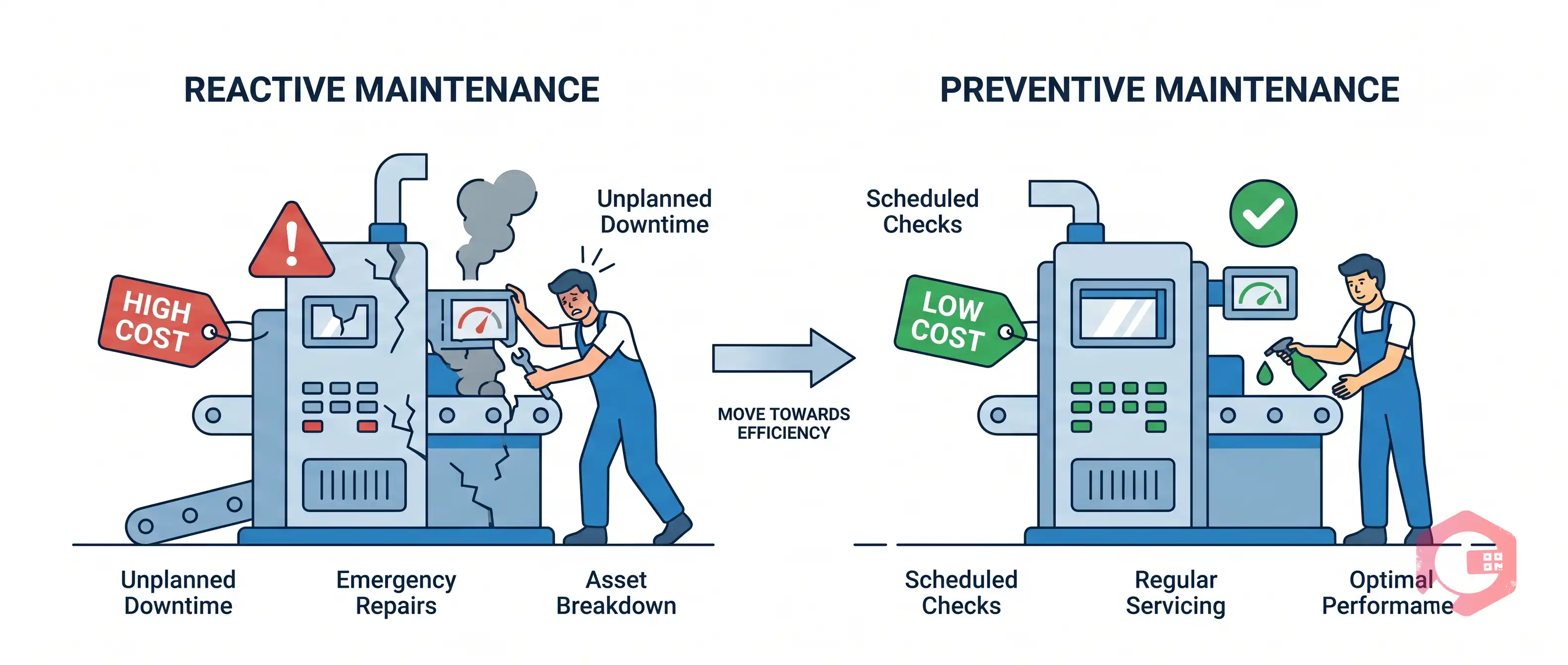
The single highest-ROI move any maintenance team can make is reducing the ratio of reactive to planned work. The target for a world-class operation is 80% planned work and 20% reactive. Most facilities struggling with costs sit at the reverse.
The financial case is direct. Planned maintenance costs a fraction of reactive maintenance per task — because you're buying the right part in advance at standard price, scheduling labor during normal hours, and completing the work before secondary damage occurs. A bearing replaced during a scheduled monthly inspection costs ₹500 in parts and one hour of labor. That same bearing, if it fails catastrophically and takes out the shaft and gearbox with it, can cost ₹50,000 or more — plus production loss.
Cryotos CMMS supports both static PM scheduling (fixed calendar intervals — daily, weekly, monthly) and dynamic PM scheduling (usage-based triggers — hours run, cycles completed, kilometres travelled). When a PM work order generates in Cryotos, it arrives on the technician's mobile device with the full checklist, required parts pre-linked from inventory, asset history, and OEM documentation — so the job happens efficiently and completely, the first time.
Spare parts inventory is one of the most significant and most overlooked cost drivers in maintenance management. The typical facility without structured inventory management carries two distinct problems simultaneously: expensive parts it never uses, and critical consumables that run out at the worst possible moment.
Cryotos inventory management software tracks every spare part in real time using QR code and barcode scanning, sets minimum stock thresholds with automatic reorder alerts, and links parts consumption directly to work orders so inventory updates automatically.

Labor is typically the largest single line item in a maintenance budget. If your technicians are spending 30% of their shift on administrative tasks — logging work orders, tracking down information, waiting for approvals — you're effectively paying a third of your labor bill for zero maintenance output.
Cryotos eliminates this friction with AI-powered work order creation. Technicians can log a breakdown by scanning a QR code on the asset and describing the fault by voice command or photo. Cryotos customers report an average 25% reduction in Mean Time to Repair (MTTR) after implementation.
Energy is often the largest single operating cost for manufacturing facilities. HVAC systems with dirty filters consume 10–15% more energy than clean ones. Compressors with worn seals run longer to maintain the same pressure output. A CMMS directly attacks energy waste by ensuring energy-consuming equipment is serviced on schedule. Some Cryotos deployments also integrate with IoT sensors that monitor power consumption in real time.
A single OSHA willful violation carries a penalty of up to $156,259 per violation in the United States. Cryotos solves this with automated compliance tracking — safety inspections and regulatory deadlines generate work orders automatically, and every completed inspection is stored as a timestamped digital record with technician sign-off and photo documentation.
Cryotos maintains a complete digital profile for every asset — every work order, inspection, part replacement, and failure event with full cost tracking. Organizations that track asset history through a CMMS consistently report extending average asset lifespans by 15–25% compared to reactive-maintenance-only operations.

CMMS Annual ROI = (Reduced Repair Costs + Labor Savings + Inventory Savings + Avoided Penalties) − CMMS Annual Cost
Here's a worked example for a mid-size manufacturing facility spending ₹50 lakhs annually on maintenance: A 15% reduction in reactive maintenance costs saves ₹7.5 lakhs. A 20% improvement in technician productive time saves ₹6 lakhs. A 10% reduction in inventory carrying costs saves ₹2 lakhs. Avoiding one compliance penalty event saves ₹3–5 lakhs. Total annual saving: ₹18.5–20.5 lakhs, against a CMMS subscription of ₹3–5 lakhs per year. Most Cryotos implementations pay for themselves within 6–12 months.
Teams using Cryotos have reported up to a 30% reduction in maintenance costs within the first year of implementation. Book your Cryotos demo today →
The fastest single lever is reducing reactive maintenance. Shifting even 20% of reactive work to planned preventive maintenance typically delivers a 15–25% cost reduction in the first year.
A CMMS reduces maintenance costs through five mechanisms: automating preventive maintenance; optimizing spare parts inventory; improving labor productivity; tracking compliance to avoid penalties; and building asset history data for repair-versus-replace decisions.
Industry benchmarks suggest facilities moving from reactive to preventive maintenance with CMMS support can reduce total maintenance costs by 10–30% in the first year. Cryotos customers report an average 30% reduction in downtime.
Yes — the U.S. Department of Energy estimates that preventive maintenance costs 3–9 times less per task than reactive maintenance when you account for emergency labor rates, expedited parts, secondary damage, and lost production.


Cryotos AI predicts failures, automates work orders, and simplifies maintenance—before problems slow you down.



