

Lockout tagout (LOTO) is one of the most critical safety procedures in industrial maintenance. Every year, approximately 120,000 workers are injured by unexpected equipment startup or energy release during maintenance and servicing. LOTO prevents these incidents by isolating energy sources and preventing reactivation until work is complete. This guide walks you through every step of conducting a proper LOTO procedure, from pre-planning through final verification, ensuring your team follows OSHA standards and industry best practices.

Lockout tagout is a safety procedure that disables machinery by physically isolating it from energy sources. When maintenance work begins, technicians lock out power switches and attach warning tags to prevent anyone from accidentally restarting the equipment. LOTO covers electrical, hydraulic, pneumatic, mechanical, chemical, thermal, and other energy forms.
OSHA requires LOTO under 29 CFR 1910.147 for any servicing or maintenance where unexpected equipment movement or startup could cause injury. This applies to most industrial plants, manufacturing facilities, food processing operations, utilities, and facilities with complex machinery. The procedure is mandatory before any work that involves removing guards, working in hazardous zones, or servicing machinery with moving parts.
The core principle is simple: never allow energy to flow to equipment while people are working on it. Yet the execution requires discipline, training, coordination, and proper documentation to work reliably.
Many workplace injuries stem from inadequate or skipped LOTO procedures. Common failures include:
OSHA citations for LOTO violations carry penalties averaging $10,000–$15,000 per violation. More importantly, injuries are preventable: proper LOTO has virtually eliminated accidental startup injuries in facilities that enforce it rigorously.
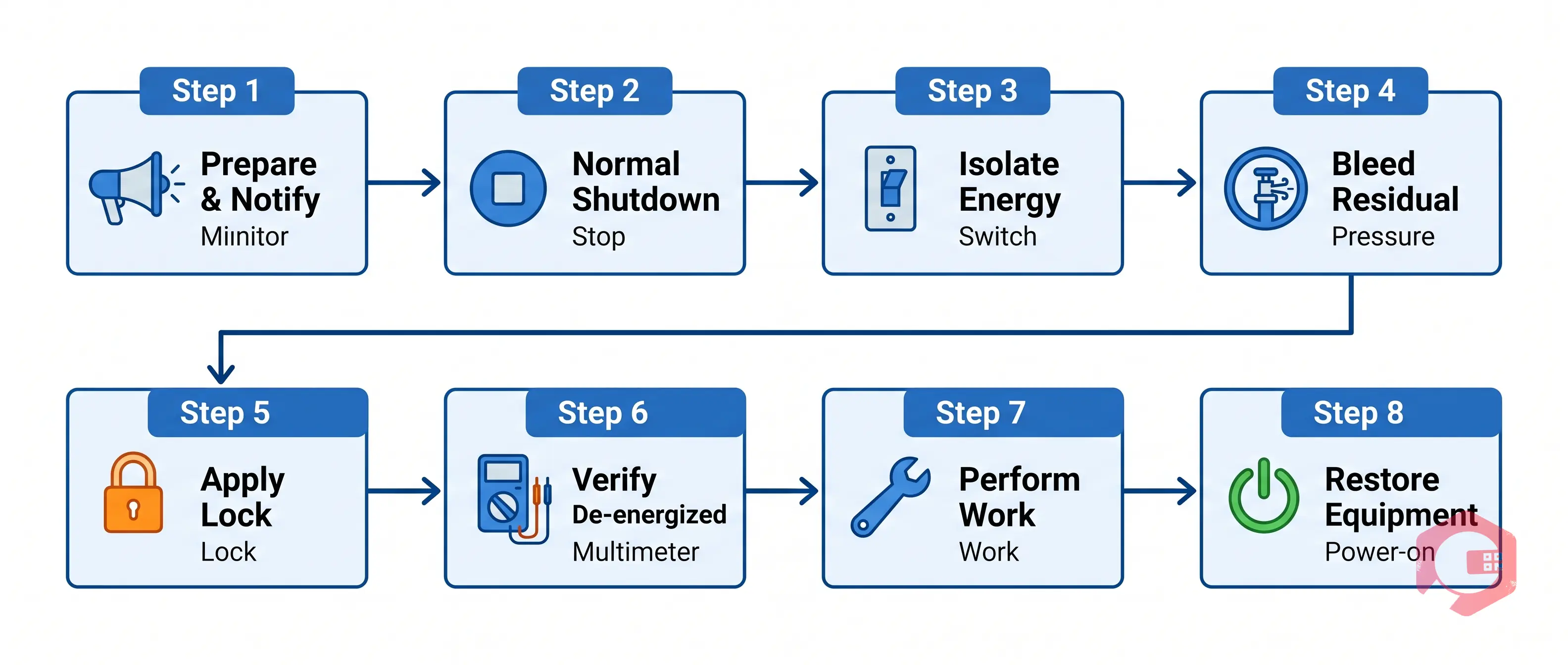
A proper LOTO follows this sequence:
Before touching any equipment, notify all affected personnel that LOTO will begin. This includes machine operators, other maintenance staff, supervisors, and anyone in the area. Identify the equipment by name and asset tag. Clarify who will perform LOTO (authorized employees only), who will perform the work, and who will supervise. If multiple people are working on the same machine, each must apply their own lock to the lockout device—no shared locks.
Turn off the machine using normal operating procedures: press the stop button, shut down the process control system, or perform a controlled shutdown. This is not the final shutdown—it's a transition step. Let the equipment come to a complete halt and allow pressure or temperature to normalize if applicable.
Locate all energy sources feeding the equipment. Create a comprehensive list for your facility's equipment—electrical panels, compressed air supplies, hydraulic lines, steam lines, chemical feeds, and backup power. For each source, place a lockout device (a padlock on an energy isolation switch, circuit breaker, valve, or plug). If the equipment has multiple independent power sources, all must be isolated. Document which lockout devices were applied and by whom.
After isolation, residual energy—stored pressure, spring tension, or electrical charge—can still cause movement. Manually operate the equipment controls (press the start button, open a relief valve) to verify nothing happens and to bleed residual energy. For hydraulic systems, open bleed valves. For electrical systems with large capacitors, ensure discharge. For mechanical systems with springs, use blocking devices or manual release mechanisms. Do not rely on gravity alone to lower heavy components—use chains or blocks.
Each person working on the equipment must apply their own lock to the lockout hasp or energy isolation point. Never share a lock or use a lock applied by someone else. Your lock stays in place until you remove it—this ensures no one can unknowingly re-energize the equipment while you're working. If a multi-lock hasp is used (allowing several locks on one point), everyone's lock must be present before work begins and removed only when that individual's work is complete.
Test that the equipment is truly de-energized using appropriate test equipment: multimeter for electrical circuits, pressure gauges for pneumatic/hydraulic lines, thermometers for thermal systems. Do not assume—verify. Press the start button (nothing should happen). Try to manually rotate shafts (they should not move). Test all control mechanisms. Document the verification in writing or electronically. This step catches oversights in step 3.
Now that energy is isolated and verified, perform maintenance, repairs, cleaning, adjustments, or inspections. Maintain awareness of your lockout devices and surroundings. If you leave the job temporarily, keep your lock in place. If someone else will continue the work, coordinate: the incoming technician applies their lock before your lock is removed. Never remove another person's lock.
Before restoring power, verify that all maintenance work is complete, tools are removed, guards are reinstalled, and all personnel have cleared the area. Each person removes only their own lock. Once all locks are removed, re-energize the equipment using normal startup procedures. Notify all personnel that equipment is being returned to service. Test the equipment briefly to confirm normal operation before resuming production.

Beyond the core procedure, best practices prevent errors:
LOTO requires careful documentation. Maintain records of:
This documentation protects your facility in audits and investigations. It also enables continuous improvement: reviewing logs reveals patterns (e.g., LOTO taking too long on one machine, repeated issues with specific equipment).
When multiple technicians work on the same equipment, use a multi-lock hasp: a single attachment point that accepts multiple locks. Each person applies their own lock. Work cannot begin until all locks are present. No one can remove their lock until their work is done. The final person to remove their lock restores power.
For complex systems (e.g., production lines with interconnected machines), coordinate lockout across multiple stations:
LOTO procedures break down when:
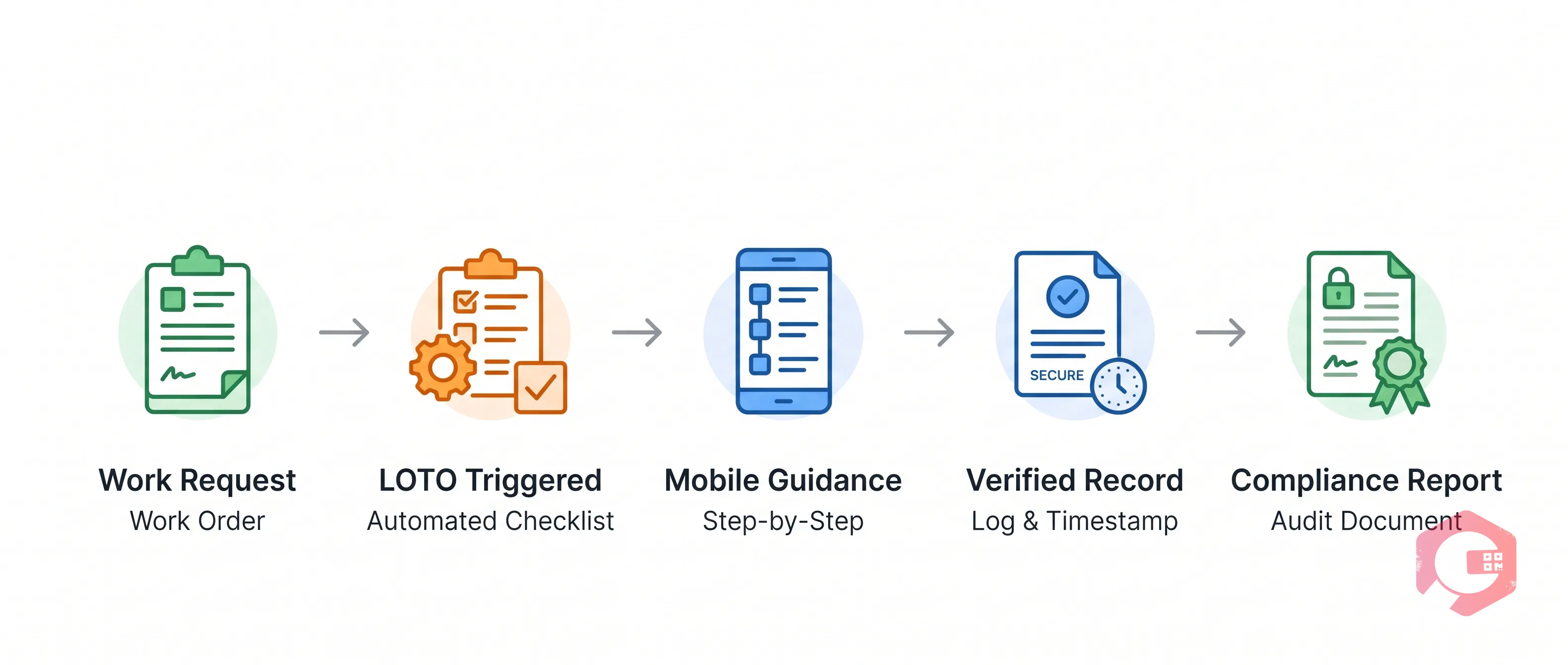
A CMMS with workflow automation ensures consistent LOTO compliance. Modern systems can:
When LOTO is embedded into your maintenance workflow, skipping steps becomes visibly difficult—the system won't mark work complete until all checklist items are verified.
Lockout tagout is not bureaucracy—it's a proven, life-saving procedure. Every step (preparation, shutdown, isolation, energy bleed, personal lock, verification, work, and restoration) addresses a specific failure mode. Skipping steps reintroduces those risks.
The best LOTO culture combines clear procedures, accessible documentation, rigorous training, and systems that make compliance automatic. Whether you manage a single machine or a facility full of interconnected equipment, implementing LOTO properly protects your workforce and keeps your operations safe and compliant.
Ready to strengthen your LOTO compliance? Cryotos CMMS includes built-in permit-to-work and LOTO workflow management designed to keep your team safe and audits on track. Learn how Cryotos helps facilities enforce safety procedures at scale.




Cryotos AI predicts failures, automates work orders, and simplifies maintenance—before problems slow you down.



