

A motor repair specification is a written work scope that tells a repair shop what to repair, which tests to pass and which records to return. When you send a motor out for repair, specify six things: identity, duty and failure history, repair scope, standards and tests, parts and materials, and delivery records.
Without one, the shop quotes from a nameplate photo and a phone call, then repairs the motor its own way. This guide covers each item and includes a worksheet. A realistic scenario shows how a Computerized Maintenance Management System (CMMS) keeps the specification and repair history in one place.
Key Takeaways

A motor repair specification is a written work scope that defines the motor, the repair and the tests it must pass. It turns a request such as “fix this motor” into a job a shop can quote, perform and be checked against.
Shops commonly work to ANSI/EASA AR100, a recommended practice for repairing motors and other rotating machines. It comes from the Electrical Apparatus Service Association (EASA). A 2003 study by EASA and the UK’s Association of Electrical and Mechanical Trades (AEMT) found that good repair practice can preserve the efficiency of an electric motor. Poor practice, such as overheating the core while removing old windings, can reduce it.
Most maintenance teams learn what a shop did only when the motor comes back. A vague request leaves three things open:
A specification takes minutes to write and defines what a good repair looks like before work starts.

A complete motor repair specification covers six parts, from identifying the motor to the paperwork that comes back with it. Each part answers a question the shop would otherwise answer for you.
The Six-Part Motor Repair Specification Framework:
Put all six on one page and attach it to the repair order, so the shop quotes from the same document you will inspect against.
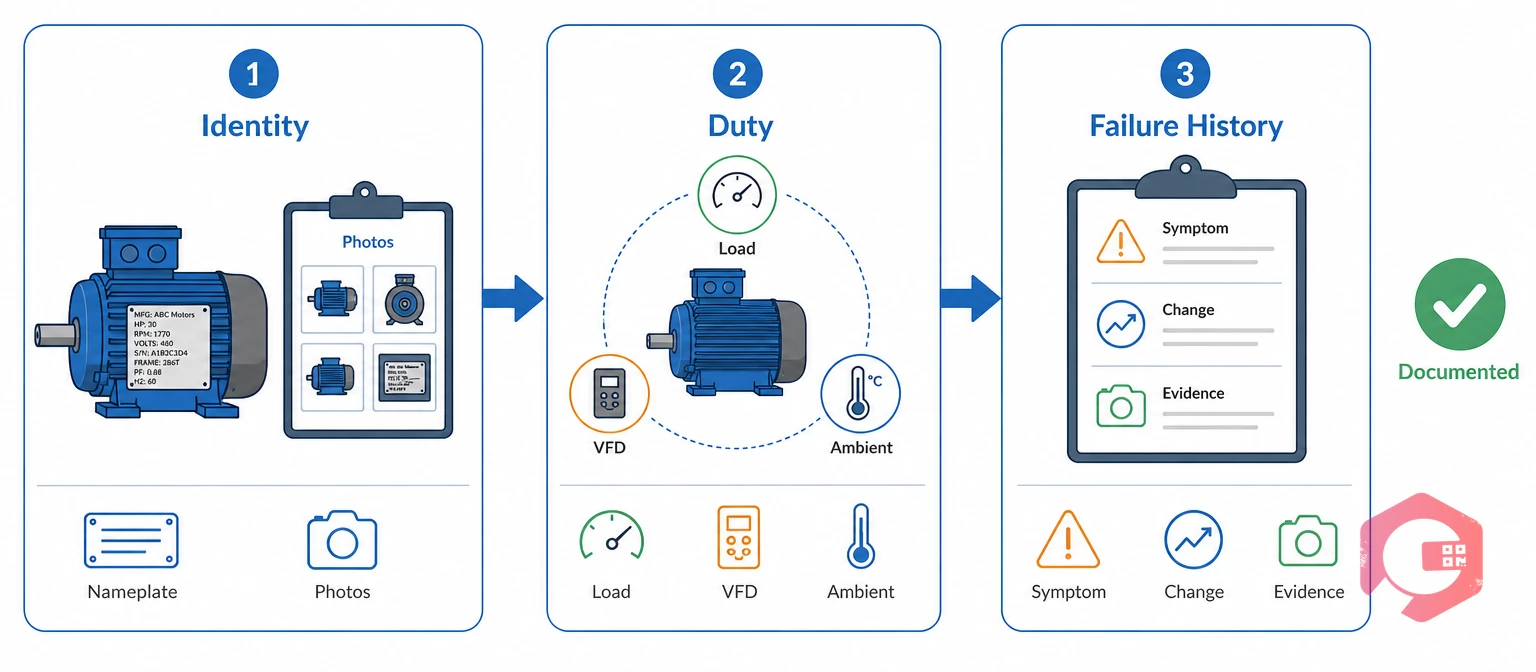
Document identity with the full nameplate and photographs, then describe the duty and the failure in plain terms. The shop cannot match a rating it cannot read, and a photo of a damaged nameplate beats a guess.
Add the duty: the driven load, ambient temperature, starts per hour and whether a variable frequency drive (VFD) powers the motor. Flag any hazardous-area rating, because the repair must keep the certification valid. IEC 60079-19 covers repair of equipment for explosive atmospheres.
For the failure history, give the shop three things:
Follow your lockout/tagout procedure before disconnecting. OSHA’s lockout/tagout standard sets the minimum rules for controlling hazardous energy. Photograph the coupling position and any shims before removal. A motor that arrives with identity, duty and history attached gets a faster, more accurate quote.
If the same motor keeps coming back, check its failure pattern with the MTBF calculator before you pay for another repair.
A motor repair specification worksheet turns the six parts into lines the shop can quote. You can then check each line on return. Use the table as a template, then adjust the limits to your motor and site standards.
| Spec item | What to state | Example requirement | Check on return |
|---|---|---|---|
| Identity | Full nameplate data | Nameplate photo attached to the order | Serial number and ratings match |
| Failure report | Cause of failure, in writing | Photos of windings and bearings | Report arrives with the quote |
| Hold point | Stop after inspection | No repair without written approval | Quote matches the work done |
| Winding | Repair or rewind, insulation class | Same class or better, controlled burnout | Winding data and test results |
| Bearings | Type, clearance, VFD protection | New bearings, insulated if VFD-fed | Part numbers on the report |
| Balance and vibration | Balance grade and limit | Rotor balanced to a stated grade | Vibration readings recorded |
| Final tests | Pass limit for each test | Insulation resistance, no-load current, run test | Signed test report |
| Delivery and warranty | Date, packing, warranty | Terms confirmed in writing | Matches the purchase order |
Attach the completed worksheet to the purchase order and ask the shop to confirm every line in writing. A shop that confirms the worksheet has read the scope.
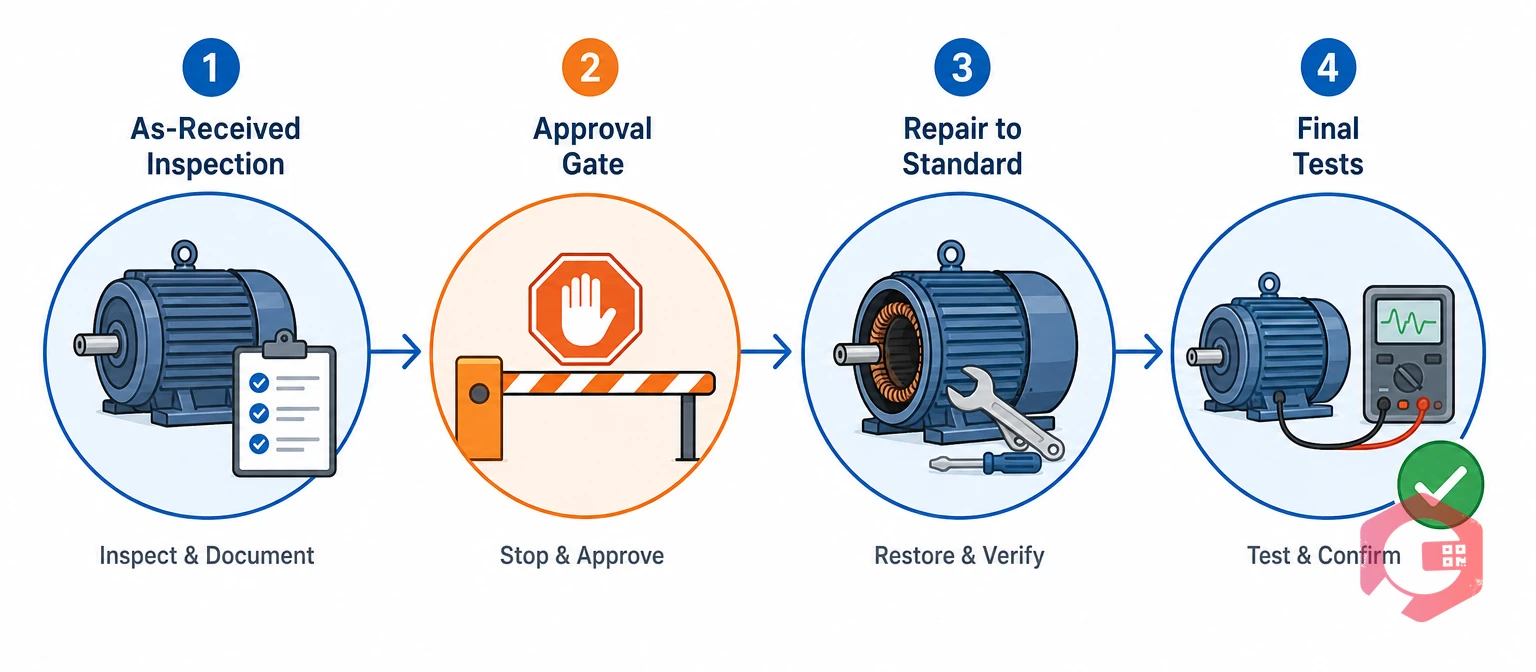
Require an as-received inspection, a written quote, repair to a named standard such as ANSI/EASA AR100 and a documented final test. A hold point is a stage where the shop must stop and wait for your written approval. Build one into your motor repair specification, after inspection and before any repair.
Bearing fluting is a pattern of fine grooves in a bearing race caused by current passing through the bearing. It is a known problem on VFD-fed motors, which is why the VFD line matters.
State acceptance limits in numbers wherever you can. “Runs smoothly” is an opinion, while a vibration reading is a record.
Repair a motor when the repair costs well below a new one and the motor is still the right size and efficiency. Replace it when repair costs approach the price of a new motor, or when the same motor keeps failing. Many plants set a limit of roughly 50% to 60% of the new-motor price, but your own policy and lead times should decide.
Write the repair limit into the motor repair specification. The shop then quotes a replacement option whenever a repair passes it.
The major challenge: the plant sent motors out on a tag and a phone call, with no motor repair specification. It could not tell whether a repair was done correctly. This scenario is a composite of patterns maintenance teams commonly report, not a named customer.
How Cryotos solved it: the plant moved each motor’s record, specification and repair into Cryotos.
A motor repair specification only works if the shop confirms it and someone checks the return paperwork against it. What changed is that the plant could prove what it asked for and what came back. Maintenance teams using Cryotos have reported up to 30% reduction in unplanned downtime and 25% faster repair turnaround, though results vary by site.
Yes. Ask for an as-received inspection and failure report first, then a written quote you approve before any repair begins. That hold point stops a shop from rewinding a motor that should be replaced.
Send the full nameplate data, photos, the duty, the failure symptoms and your written motor repair specification. The duty covers load, VFD use, ambient temperature and any hazardous area. Include the coupling, key and any accessories that travel with the motor.
Not when the shop follows good practice. The EASA and AEMT study found efficiency was preserved with good practice, while overheating the core can reduce it. Specify controlled burnout and ask for core-loss records.
Terms vary by shop and by repair type, so there is no single standard length. Get the term, what it covers and any exclusions in writing before you approve the quote.
Yes. A CMMS holds the nameplate data, attaches the specification to a repair work order, tracks status and stores test reports on the asset record.
A repair is only as good as the instructions that travel with the motor. Schedule a free demo to see how Cryotos keeps every motor repair specification, repair and test report on one record.



Cryotos AI predicts failures, automates work orders, and simplifies maintenance—before problems slow you down.



