

Motor startup after a plant shutdown is safe when plant maintenance teams work through five steps in order: confirm safe re-energization, test the insulation, check the mechanical side, start motors in a planned sequence, and watch the first run. Skip a step and the restart often ends at a tripped breaker, a damaged winding or a seized bearing.
This guide covers each step, the readings that matter and a simple record to keep. It also shows how a Computerized Maintenance Management System (CMMS) keeps the checks out of notebooks and group chats.
Key Takeaways

A motor restart sequence is the ordered set of checks and starts that returns idle motors to service safely. It needs a plan because a shutdown changes motors even when nobody touches them.
Shutdown work adds risk. Motors get rewound, realigned, disconnected and reconnected. OSHA's lockout/tagout standard (29 CFR 1910.147) requires you to inspect the work area, confirm everyone is clear and notify affected employees before locks come off.
A written restart plan turns these hazards into checks that teams can sign off.
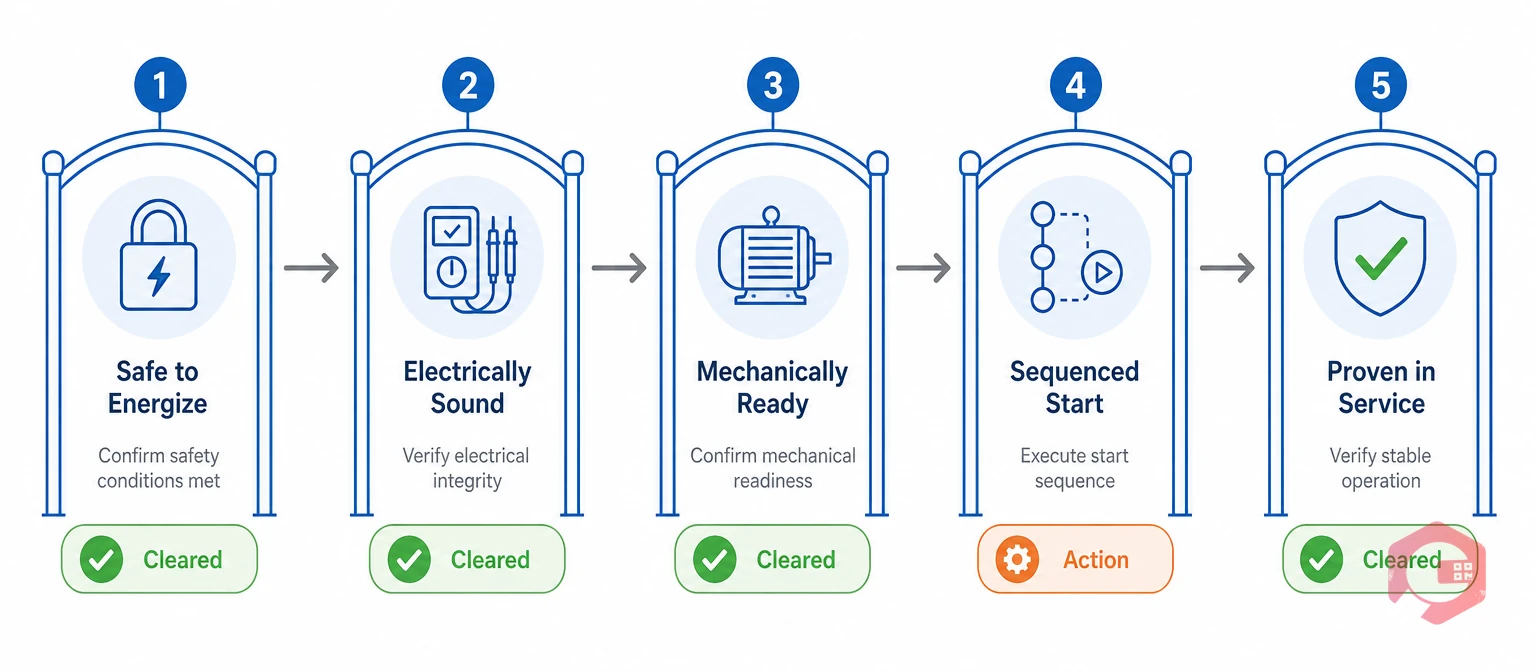
The most reliable motor startup practice is a gated sequence, where each gate must pass before the next one opens. Most facilities that restart cleanly use some version of this structure, even if they name it differently.
The Five-Gate Motor Restart Framework:
Give each gate one named owner and require a sign-off before the next gate opens. A gate with no owner is the one that gets skipped when production presses.
Want the gates as ready-made forms? See how Cryotos maintenance checklists turn each gate into a mobile sign-off.

Before you restart a motor, test the winding insulation first, then confirm bearings, alignment and rotation. Start with the electrical test, because moisture in the windings is a common hidden problem after a long idle period.
Insulation resistance is the opposition of winding insulation to leakage current, measured in megohms. Lock out the motor, disconnect it from the drive or starter and test with a megohmmeter. IEEE 43 advises 500 V DC for motors rated below 1,000 V.
A low reading is a stop sign. Dry the winding, find the cause and retest before any start attempt.
These checks take minutes per motor. A failed bearing or winding takes days of plant maintenance work to repair.
A motor restart readiness matrix lists every check with its pass guide, owner and the record it creates. Use the table below as a starting template for your own plant maintenance restart plan.
| Gate | Check | Pass Guide | Owner | Record |
|---|---|---|---|---|
| 1. Safe to energize | Locks, tags and permits cleared | Area clear, guards fitted | Operations lead | Permit closed |
| 2. Electrically sound | Insulation resistance and PI | Meets IEEE 43 and maker limits | Electrician | Readings on work order |
| 2. Electrically sound | Overloads, breaker, phase rotation | Matches nameplate and drawings | Electrician | Checklist sign-off |
| 3. Mechanically ready | Rotation, lubrication, alignment | Spins freely, correct lubricant | Mechanical technician | Checklist and photos |
| 4. Sequenced start | Utilities up, one large motor at a time | Current settles before next start | Control room operator | Start log |
| 5. Proven in service | Current, vibration, bearing temperature | Stable and near baseline | Reliability technician | Baseline entry |
The pass guides are general. Your motor nameplate, maker manual and site standards always take priority.
Sequence motor starts by bringing up utilities first, then starting the largest loads one at a time with a pause between each. This limits voltage dip and gives operators time to confirm each motor has settled.
Agree the order on paper before the shutdown ends. Operations and plant maintenance should sign it together, with the control room holding the master list.
Monitor current on each phase, vibration, bearing temperature and noise during the first hour. Compare each reading with the nameplate and the last known baseline, and stop the motor if anything trends the wrong way.
Log every reading with a time stamp. These first-hour numbers become the baseline for trending and for the next shutdown.
The biggest plant maintenance challenge after a shutdown is scattered information, not a lack of skill. The scenario below is a composite of what maintenance teams in process and manufacturing plants commonly report. It is not a named customer.
A mid-size plant finished a planned shutdown with dozens of motors reworked. Some were rewound, some realigned and some reconnected after cable work. Restart checks lived on paper tags, personal spreadsheets and chat messages.
Cryotos manufacturing maintenance software ties each motor asset record to its checklists, permits, readings and history. That moves the restart into one managed job.
That gives the team a restart it can audit line by line. Maintenance teams using Cryotos have reported up to 30% reduction in unplanned downtime and 25% faster repair turnaround. Results vary by site, and the gains come from disciplined follow-through, not software alone.
No single limit applies, because moisture, temperature and storage conditions vary by site. Test any motor after a shutdown of more than a few days, after damp or washdown exposure and before the first start following any repair. Set the trigger in your plant maintenance plan.
NEMA MG 1 sets a baseline of two starts in a row from ambient temperature, coasting to rest between them, or one start from rated operating temperature. After that, let the motor cool. Large or high-inertia motors often have tighter limits in the maker data.
IEEE 43 recommends at least 5 MΩ for random-wound stators and for form-wound coils rated below 1 kV. It recommends 100 MΩ for most form-wound stators built after about 1970. Correct readings to 40 °C, and watch the trend, because a falling reading matters even when it still passes.
Yes. An uncoupled run confirms rotation direction, no-load current, vibration and bearing behavior without risking the driven machine. It is cheap insurance for any rewound, replaced or rewired motor.
Yes. A CMMS can hold each motor repair history, send restart checklists to technicians, store readings and sign-offs, and keep a start log. That gives plant maintenance teams one record instead of several.
A clean restart is planned, tested and recorded. Schedule a free demo to see how Cryotos turns your restart gates into work orders, checklists and sign-offs.



Cryotos AI predicts failures, automates work orders, and simplifies maintenance—before problems slow you down.



