

An RFQ in maintenance is a formal request sent to vendors asking them to submit competitive quotes for a specific repair, service, or spare part your team needs. Instead of calling one contractor you've always used, an RFQ forces multiple vendors to compete on price, turnaround time, and quality - giving you the data to pick the best option every time.
Most maintenance teams still handle quotations through scattered emails, phone calls, and spreadsheets. The result? Missed quotes, approval bottlenecks, and repairs that start days later than they should. According to Deloitte, unplanned downtime costs industrial manufacturers an estimated $50 billion annually - and slow procurement is one of the biggest hidden contributors.
In this guide, you'll learn a 7-step structured quotation process that takes you from RFQ creation all the way through to an approved work order - with no manual handoffs, no lost emails, and full audit trails.

A Request for Quotation (RFQ) in maintenance is a system-driven document that defines exactly what work needs to be done, which asset needs attention, what the technical specs are, and when the job must be completed. Unlike a casual "can you send me a price?" email, a maintenance RFQ standardizes the information every vendor receives - so you can compare apples to apples.
In a well-structured maintenance operation, RFQs aren't created from scratch. They're generated directly from service reports or open work orders, which means every quotation request is tied to an actual operational need. This eliminates guesswork and ensures vendors quote against real requirements - not vague descriptions.
Here's what separates a maintenance RFQ from a general procurement RFQ:
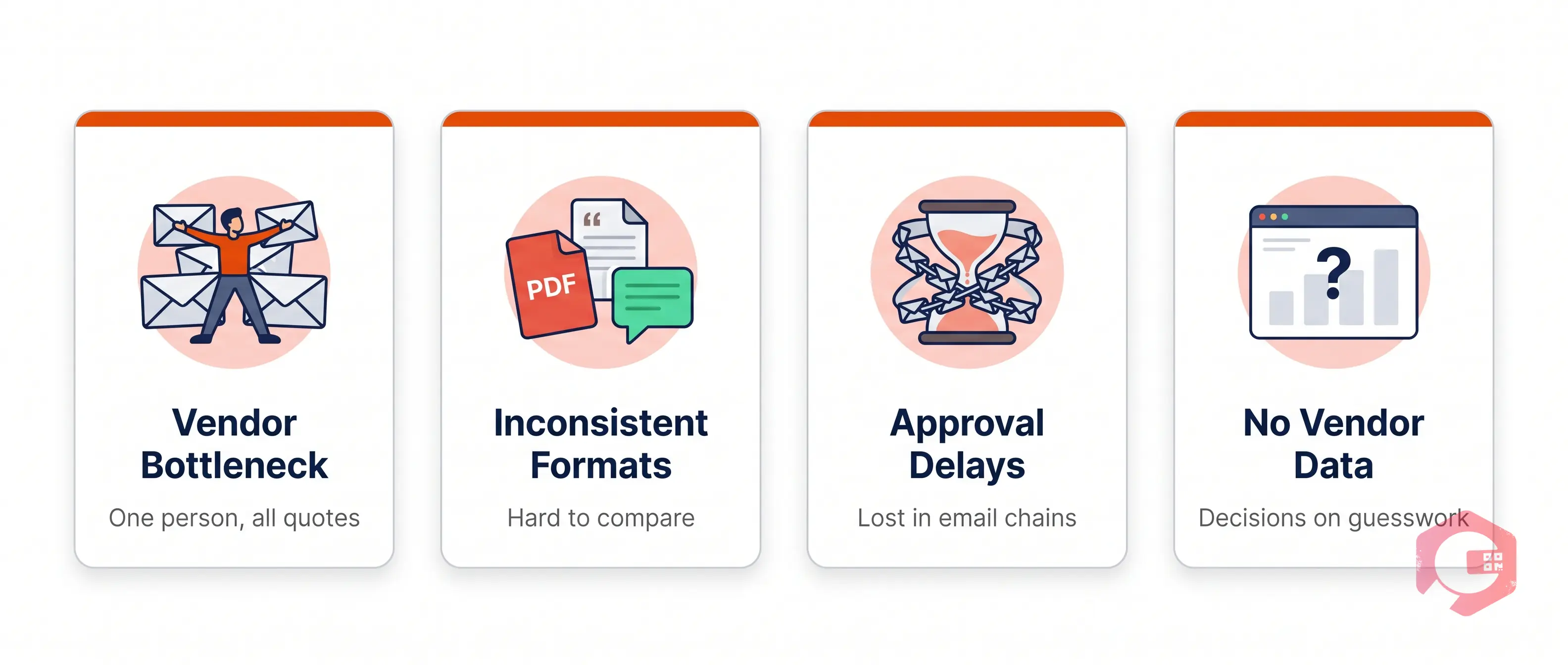
Most maintenance managers obsess over work order completion rates and preventive maintenance schedules - and they should. But the quotation process sits upstream of all of that. If it takes you three days to get vendor quotes compared and approved, your MTTR (Mean Time to Repair) suffers no matter how fast your technicians work.
Here's what goes wrong when quotations are handled manually:
A structured quotation process fixes all of this - not by adding more steps, but by connecting the steps you already have into one trackable workflow.
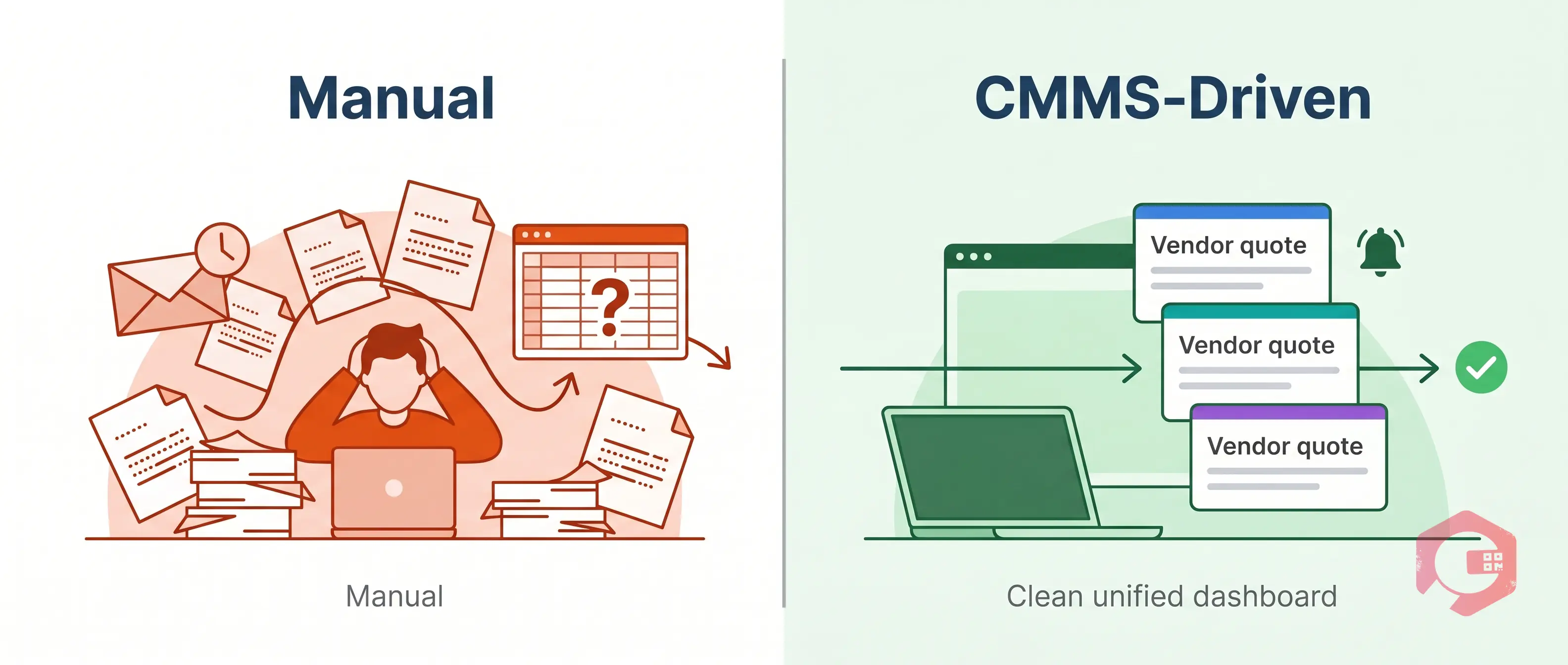
The easiest way to see the impact of a structured RFQ process is to compare what most teams do today with what's possible when you run quotations through a CMMS platform.
| Stage | Manual Process | CMMS-Driven Process |
|---|---|---|
| RFQ Creation | Written from memory or a blank email | Auto-generated from service reports with asset data pre-filled |
| Vendor Outreach | Call or email 1-2 known vendors | RFQ sent to multiple qualified vendors in parallel |
| Quote Collection | Quotes arrive in different formats across channels | All quotes submitted into one platform in a standard format |
| Comparison | Manual side-by-side in spreadsheet | Automatic comparison across cost, timeline, and vendor rating |
| Approval | Forwarded via email chain; days of waiting | Routed to the right approver automatically with real-time status |
| Work Order Creation | Re-entered manually after approval | Approved quote converts to work order instantly |
| Audit Trail | Scattered or non-existent | Every action logged — who, what, when |

Here's how to build a quotation process that actually speeds up your maintenance execution instead of slowing it down.
Don't start from a blank page. A strong RFQ begins with the service report, inspection finding, or breakdown ticket that triggered the need. Pull in the asset ID, location, failure description, photos, and any relevant maintenance history. When vendors see this level of detail, they quote more accurately - and you spend less time going back and forth on clarifications.
In organizations managing maintenance across multiple sites (like facility management companies or manufacturing groups), this step alone eliminates hours of manual data gathering per RFQ.
Competition drives better pricing and accountability. Instead of calling your go-to contractor, send the RFQ to 3-5 qualified vendors simultaneously. This isn't about creating extra work - a CMMS can distribute RFQs to your pre-approved vendor list with one click.
Multi-vendor engagement is especially critical for high-value repairs and recurring service contracts. Even a 10% cost improvement per quote adds up to significant annual savings across hundreds of maintenance activities.
This is where most manual processes fall apart. When quotes come in via email, WhatsApp, and phone calls, someone has to manually consolidate everything into a spreadsheet - and things get missed.
A centralized system ensures every vendor submits their quote in the same format, linked to the same RFQ. No misplaced PDFs. No "I sent it last Tuesday" debates. Every response is timestamped, stored, and ready for comparison.
With all quotes in a standard format, comparison becomes straightforward. Look at more than just cost - evaluate turnaround time, warranty terms, vendor track record, and scope completeness. A good CMMS presents this in a comparison view so decision-makers can see the trade-offs at a glance.
This data-driven approach replaces the "gut feeling" decisions that quietly inflate maintenance budgets over time. When you can show exactly why you chose Vendor A over Vendor B, you build trust with finance and operations leadership.
Approval delays are the silent killer of maintenance efficiency. In manual workflows, getting a quote signed off might involve printing it, walking it to a manager's office, or forwarding an email and hoping for a reply.
With automated workflows, the selected quote routes to the right approver based on predefined rules - by cost threshold, department, asset type, or location. Approvers get real-time notifications and can approve directly from their phone. Everyone can see where the approval stands at any moment.
Once approved, the quote should become a work order without anyone re-entering a single field. The vendor, scope, cost, and timeline carry forward automatically. This eliminates transcription errors and means maintenance work can start the same day the quote is approved - not three days later after someone copies the details into a separate system.
This seamless handoff between procurement and execution is what separates reactive maintenance teams from proactive ones.
Every step in the process - who created the RFQ, which vendors were invited, what they quoted, who approved it, and what work order was generated - should be logged automatically. This isn't just about compliance (though it helps with ISO audits and internal reviews). It's about building an intelligence layer.
Over time, this audit data shows you which vendors deliver on time, which consistently overquote, and where your procurement process has bottlenecks. That insight is worth more than any single quote comparison.
Whether you're building RFQs manually or generating them through a CMMS, make sure every one includes these elements:
Cryotos CMMS was built to connect every stage of the maintenance quotation process - from the moment a need is identified to the moment a technician starts work.
Here's what that looks like in practice:
The result? Faster approvals, better cost control, and a clear record of every maintenance procurement decision your team makes.
An RFQ (Request for Quotation) in maintenance is a formal document sent to vendors requesting competitive price quotes for a specific maintenance service, repair, or spare part. It standardizes what vendors receive so you can compare responses fairly and make data-driven vendor selection decisions.
Best practice is to collect quotes from at least 3 vendors for any maintenance job above your minimum threshold. For high-value repairs or annual service contracts, 4-5 quotes give you stronger negotiation leverage and a clearer picture of market pricing.
An RFQ asks vendors for a price on a clearly defined scope of work - you know exactly what you need. An RFP (Request for Proposal) is used when the scope is less defined and you want vendors to propose their own approach. For most routine and corrective maintenance tasks, an RFQ is the right tool.
A CMMS automates RFQ generation from service reports, distributes requests to multiple vendors simultaneously, collects quotes in a standardized format, enables side-by-side comparison, routes approvals automatically, and converts approved quotes directly into work orders - all while maintaining a full audit trail.
Yes. Modern CMMS platforms like Cryotos let you automate the entire quotation workflow - from RFQ creation to vendor distribution, comparison, approval routing, and work order conversion. This reduces procurement time from days to hours.
An audit trail documents every decision in the quotation process - which vendors were contacted, what they quoted, who approved it, and why. This supports ISO compliance, internal audits, vendor performance reviews, and helps identify cost-saving opportunities over time.




Cryotos AI predicts failures, automates work orders, and simplifies maintenance—before problems slow you down.



