
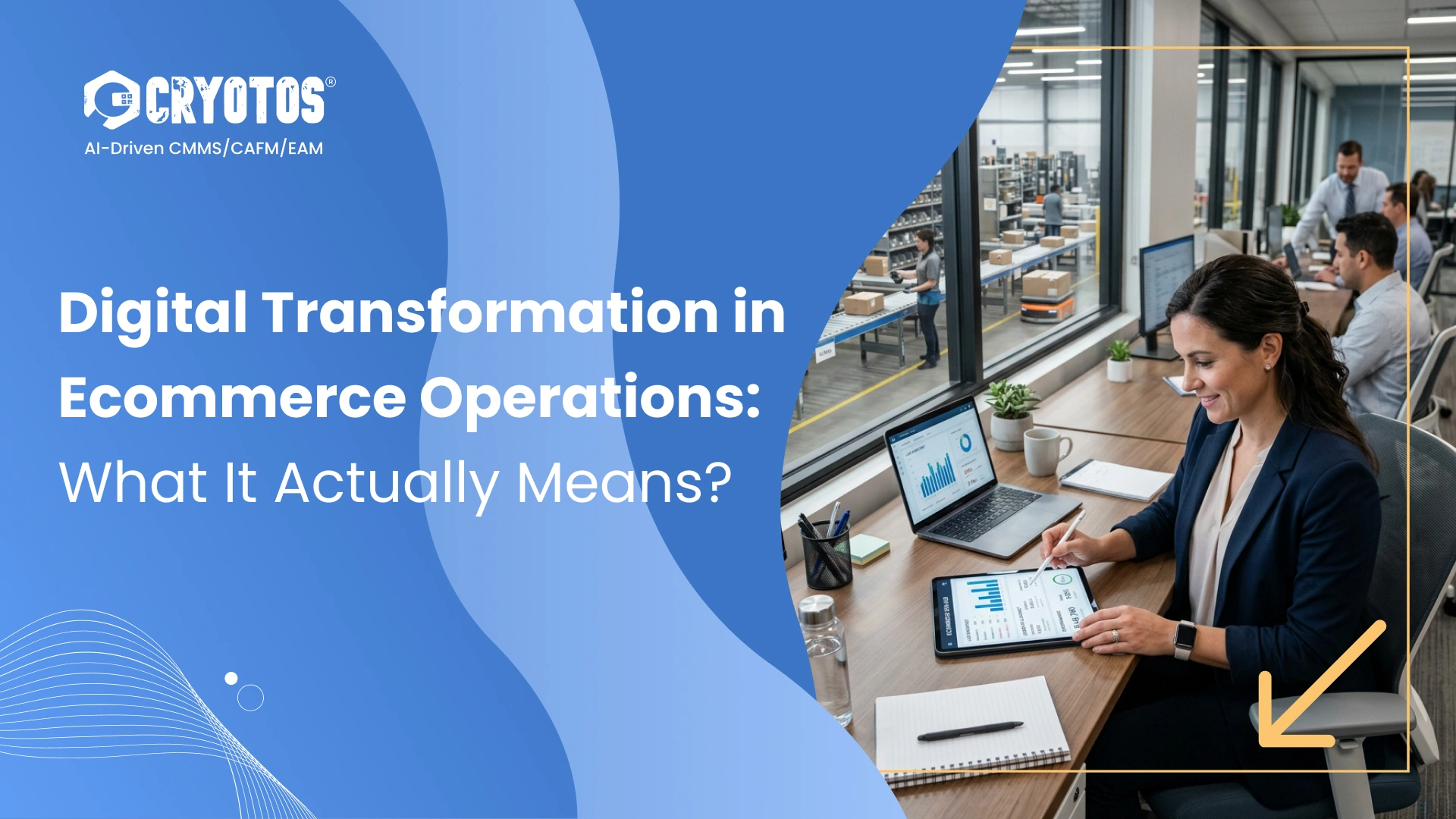
Most ecommerce businesses started their digital transformation at the front end—a clean website, a checkout flow that doesn’t make people rage-quit, and mobile app customers enjoy using. And that part worked. Orders came in. Revenue grew. Everyone was happy.
Then the operation behind it started to crack.
Stock levels didn’t match what the website was showing. Warehouses are still running on spreadsheets nobody really trusted. Purchase orders raised manually, based on someone’s best guess. Items leaving the facility with no record of where they went. Five different systems that refused to talk to each other—and one poor person whose entire job was reconciling them every morning before coffee.
This is the digital transformation gap most ecommerce businesses are living with right now. The front end went digital years ago. The operational backbone—inventory, warehouse management, procurement, asset management—is still running the same manual processes it always did.
And that gap gets expensive fast. Inventory distortion alone costs ecommerce businesses around $818 billion a year. Not because of bad products or weak marketing, but because operational systems can’t keep up with the speed at which modern ecommerce moves.
Whenever people talk about digital transformation in ecommerce, the conversation almost always drifts toward customer experience—personalization, AI recommendations, frictionless checkouts, same-day delivery.
Those things matter. But they’re really just the visible surface of the operation.
Digital transformation in ecommerce operations means something more fundamental. It’s about replacing every manual, disconnected, paper-based process in your supply chain and warehouse with a connected, real-time, data-driven system—so that every decision made in the operation is based on what’s actually happening, not on what someone thinks might be happening based on yesterday’s report.
Think of it this way. An ecommerce brand that has poured money into its digital customer experience but still manages inventory on spreadsheets is basically a restaurant with a stunning dining room and a kitchen running on handwritten sticky notes. Customers see the beautiful front. They don’t see the chaos in the back—until an order shows wrong or doesn’t show up at all.
Digital transformation in operations is about making the kitchen as sophisticated as the dining room.
In most ecommerce businesses, the inventory number shown on the website isn’t the number sitting in the warehouse. It’s the number that was in the warehouse when someone last updated the spreadsheet—which might have been this morning or might have been two days ago.
Between those updates, orders get fulfilled, stock is received, items are damaged, returns come back, and transfers happen between locations. None of that updates the spreadsheet in real time. By the time somebody notices a discrepancy, customers have already been promised products that don’t exist—or reorders have been placed for stock that’s already sitting in a different location.
Real-time, system-driven inventory tracking is the foundation of operational digital transformation. Every movement—inbound, outbound, transfer, adjustment—updates the inventory record the moment it happens. No lag. No manual reconciliation. Just one number that everyone trusts, because it reflects what’s physically in the warehouse right now.
Ask a warehouse manager where a specific SKU is located, and you’ll usually get one of two answers. Either they tell you right away because they personally know the warehouse inside out, or they walk over to the location to check.
Both of those answers point to a problem. The first means the warehouse depends on institutional knowledge that walks out the door the day that manager leaves. The second means the system doesn’t really know where anything is—only people do.
A digitally transformed warehouse maps every aisle, rack, shelf, and bin into the system. Every SKU has a defined home. When a picker receives a work order, they’re directed to the exact bin location on their mobile device. When stock is received, the put-away process scans items into their designated spot and updates the system instantly. When anything moves, the system knows.
This isn’t just operational convenience. It’s the foundation of accurate inventory records, fast pick times, and fulfillment promises you can keep.
The traditional ecommerce replenishment process tends to look like this. A warehouse manager notices stock is running low on a product—either because they happen to check, or because someone raises the alarm about a stockout. They send a message or email to the procurement team. A purchase order is eventually raised. By the time the goods actually show up, the stockout has already cost real sales.
This reactive cycle isn’t a problem for people. It’s a systems problem. When inventory levels aren’t tracked in real time, replenishment can’t happen proactively. And when stock request approvals are stuck in email chains, the lead time before a PO is raised stretches way beyond what it needs to be.
Digitally transformed procurement connects inventory levels directly to replenishment triggers. The moment a SKU crosses its minimum threshold, an alert fires automatically. A stock request is raised in the system, routed through a defined approval workflow, and converted into a purchase order—without anyone having to notice and react manually. The process becomes event-driven, not memory-driven.
Every ecommerce operation has outbound movements that aren’t customer orders—returns to vendors, stock transfers between warehouses, items sent out for repair, samples dispatched for review. In most operations, these movements happen with wildly different levels of documentation. Some get a paper gate pass. Some get an email. Some get nothing at all.
Every undocumented outbound movement is an inventory discrepancy waiting to happen. When stock levels don’t match physical reality, the investigation almost always ends up in the same place—movement that happened but was never recorded.
A digital gate pass system captures every outbound movement, regardless of type. It requires authorization before anything leaves, verifies quantities at the point of dispatch, and updates inventory records automatically the moment the movement is confirmed. Returns expected back—items sent for repair, for instance—create open tracking records that alert the team when they’re overdue.
The result is a complete chain of custody for every unit in the operation. Not just the units that go to customers.
Most ecommerce businesses do a physical inventory count once or twice a year. The process usually involves shutting down operations for a couple of days, counting everything, reconciling with the system, and adjusting for discrepancies. Then operations start again with a number that’s accurate—for exactly one day, after which it begins drifting all over again.
Annual counts are expensive, disruptive, and go stale almost immediately. They’re a legacy practice from a time when inventory systems couldn’t track movements in real time, so the only way to know what you had was to physically count everything.
Continuous cycle counting replaces that with an ongoing process. Small sections of the warehouse are counted regularly, on a rotating schedule, without disrupting day-to-day operations. High-velocity SKUs are counted more often. Discrepancies get caught and investigated quickly, while the evidence is still fresh. Inventory accuracy stays high all year round, rather than peaking once and slowly deteriorating.
For ecommerce operations where fulfillment accuracy is effectively a customer experience metric, this matters directly. An inventory accuracy rate of 99% means 1% of orders could be promised incorrectly—and at scale, that’s thousands of orders a month.
The equipment that keeps an ecommerce warehouse running—forklifts, conveyors, scanners, packing stations, storage systems—is often managed with the same informal approach that used to govern inventory a decade ago. Service histories live in paper files or in someone’s head. Maintenance happens reactively when something breaks. Assets get moved between locations without anyone updating a system record.
This becomes especially painful for ecommerce businesses that have expanded to multiple warehouses. An asset transferred from one location to another carries its service history, warranty status, and maintenance requirements with it—but only if the system knows where it is and what’s been done to it.
Digital asset management tracks every piece of equipment across every location. Service schedules live in the system and get triggered by usage—hours of operation, cycles run—rather than calendar dates that may or may not reflect actual wear and tear. When an asset is transferred, its history travels with it. When equipment reaches end of life, the disposal process is documented, and the asset is formally removed from records.
For ecommerce warehouses where equipment uptime directly affects fulfillment throughput, maintaining the physical operation is just as critical as managing the inventory inside it.
In many ecommerce operations, the people making decisions and the data that should inform those decisions live in completely separate places. A warehouse manager making a layout change doesn’t have easy access to pick frequency data by SKU. A procurement manager placing a reorder doesn’t have a reliable view of current stock across all locations. A finance director reviewing margins doesn’t see inventory carrying costs broken down by warehouse.
Each of these people has access to some data. But it’s scattered across different systems, exported at different times, and formatted differently by different teams. Assembling a complete operational picture becomes a manual task in itself—collecting, reconciling, and interpreting data that should already be connected.
A BI dashboard that pulls live from all operational systems—inventory, warehouse, procurement, assets—gives every stakeholder the same real-time picture of the operation. The warehouse manager sees pick performance by location. The procurement team sees replenishment triggers the moment they fire. Leadership sees inventory turnover, carrying costs, and fulfillment accuracy without waiting for a monthly report to be pieced together.
When decision-making is data-driven and real-time, the operation gets faster and smarter without getting bigger.
Picture an ecommerce warehouse on Tuesday morning. An overnight batch of 400 orders has already been processed. The picking team is moving through the warehouse guided by mobile work orders that direct them to exact bin locations. As items are picked and packed, inventory levels update automatically.
During the shift, a barcode scan on incoming goods triggers a putaway workflow. The receiving team is directed to specific bin locations based on the warehouse storage logic—fast-moving SKUs near the dispatch area, slower movers tucked into deeper storage.
A SKU that’s been running low finally hits its threshold. A stock request fires off to the procurement team. The request is approved in the system within minutes and automatically converted into a purchase order.
A van pulls up to collect items being returned to a supplier. The warehouse team opens a digital gate pass for the return, scans the items against the authorization, confirms the quantities match, and closes the gate pass. Inventory updates immediately.
By midday, the warehouse manager opens a BI dashboard and sees pick accuracy, inventory levels across all locations, open stock requests, pending purchase orders, and any assets with maintenance due—all in one view, without making a single phone call.
This isn’t a vision of future technology. It’s the operational reality a connected, digitally transformed ecommerce operation can run today.
Cryotos was built as an integrated operational platform—not a pile of tools bolted together, but a connected system where inventory, warehouse, procurement, assets, and operations all share the same data in real time.
For ecommerce businesses specifically, Cryotos addresses the operational gaps that manual systems tend to leave wide open:
Digital transformation in ecommerce operations is sometimes talked about as if it’s primarily a technology decision. Which platform to buy. Which systems to integrate. Which processes to automate.
But the technology itself isn’t what’s transforming. The transformation is what happens to an operation once it finally has complete visibility into everything going on—not yesterday’s data, not one department’s narrow view, not a manual reconciliation someone cobbles together every Monday morning.
When every movement is tracked, every decision is informed. When every system is connected, there are no blind spots. When every process is structured, there’s no ambiguity about who did what, when, or why.
Ecommerce businesses that have digitally transformed their operations aren’t just more efficient. They’re more resilient—because when something goes wrong, they can spot it immediately, trace it precisely, and fix it before it compounds.
And in an industry where global ecommerce revenue is climbing toward $4.96 trillion and customer tolerance for fulfillment failure is measured in minutes rather than days, that resilience isn’t optional.
Your storefront went digital a long time ago. Your customers see a fast, polished, seamless experience whenever they shop with you. What they don’t see—and what increasingly decides whether you can keep delivering that experience as you grow—is whether your operations are as digital as your front end. The spreadsheet that tracks inventory. The email chain that approves a stock request. The paper register at the warehouse gate. The annual count that takes the operation offline for two days. The equipment service history that lives in a dusty binder in the manager’s office. These aren’t small inefficiencies. They’re structural limits on how fast, how accurately, and how profitably your ecommerce operation can scale.
Digital transformation in operations is really the work of closing the gap between what your website promises and what your warehouse can reliably deliver. Cryotos exists to help ecommerce operations make that shift—one connected, visible, data-driven process at a time.
If you’d like to see what a digitally transformed ecommerce operation looks like inside Cryotos, book a free product tour.



Cryotos AI predicts failures, automates work orders, and simplifies maintenance—before problems slow you down.



