Maintenance management challenges are the hidden costs that drain industrial operations - unplanned downtime, missed PM schedules, paper-based work orders, and zero visibility into asset health collectively cost manufacturers an estimated $50 billion annually in lost productivity. If your team is still chasing technicians with clipboards or hunting for spare parts during breakdowns, you already know the pain firsthand.
This post breaks down the eight most common challenges maintenance teams face today - and shows exactly how Cryotos CMMS eliminates each one with purpose-built features. Whether you manage a manufacturing plant, a food facility, or a multi-site operation, you’ll find actionable insight and a clear path forward here.

Reactive maintenance - fixing equipment only after it breaks - is the default mode for teams without a proper system. The result? Scrambling technicians, delayed production, unhappy clients, and repair bills that are three to four times higher than planned maintenance costs, according to Reliable Plant.
The real danger isn’t the single breakdown - it’s the compounding effect. Every unplanned stop disrupts the schedule that follows it, and the root cause often goes unfixed because there’s no time to investigate when the next alarm is already ringing.
Cryotos gives your team a dedicated downtime tracking module that logs every equipment failure by department, plant, and asset - no work order required. You can track key KPIs like MTTR (Mean Time to Repair) and MTBF (Mean Time Between Failures) in real time, so patterns become visible before they become emergencies.
The platform’s built-in “5 Whys” root cause analysis is attached directly to work orders, so technicians document the real cause - not just the symptom. Teams using Cryotos downtime tracking report a 30% reduction in downtime within the first six months. That’s not a workaround - that’s a structural fix.
Spreadsheets, sticky notes, and WhatsApp messages are not a work order system. Yet a surprising number of maintenance teams still operate this way - and pay for it with missed tasks, duplicate work, lost history, and no accountability when things go wrong.
When work requests arrive through multiple informal channels, priorities get confused. High-urgency repairs sit unassigned while routine jobs get done first - simply because nobody had a clear view of the queue.
Cryotos centralizes every work request and work order in one place. Technicians and requesters can log jobs via QR code scanning, voice commands, or photo uploads - the system even uses generative AI to auto-populate work order details from a photo of a broken part. Priority levels (urgent, high, medium, low) are set at creation, and the work order flows automatically to the right technician based on skill and location.
Real-time status updates push via mobile, email, or WhatsApp - so supervisors always know where every job stands without picking up the phone. With Cryotos work order management, every job has a clear owner, a deadline, and a documented history.
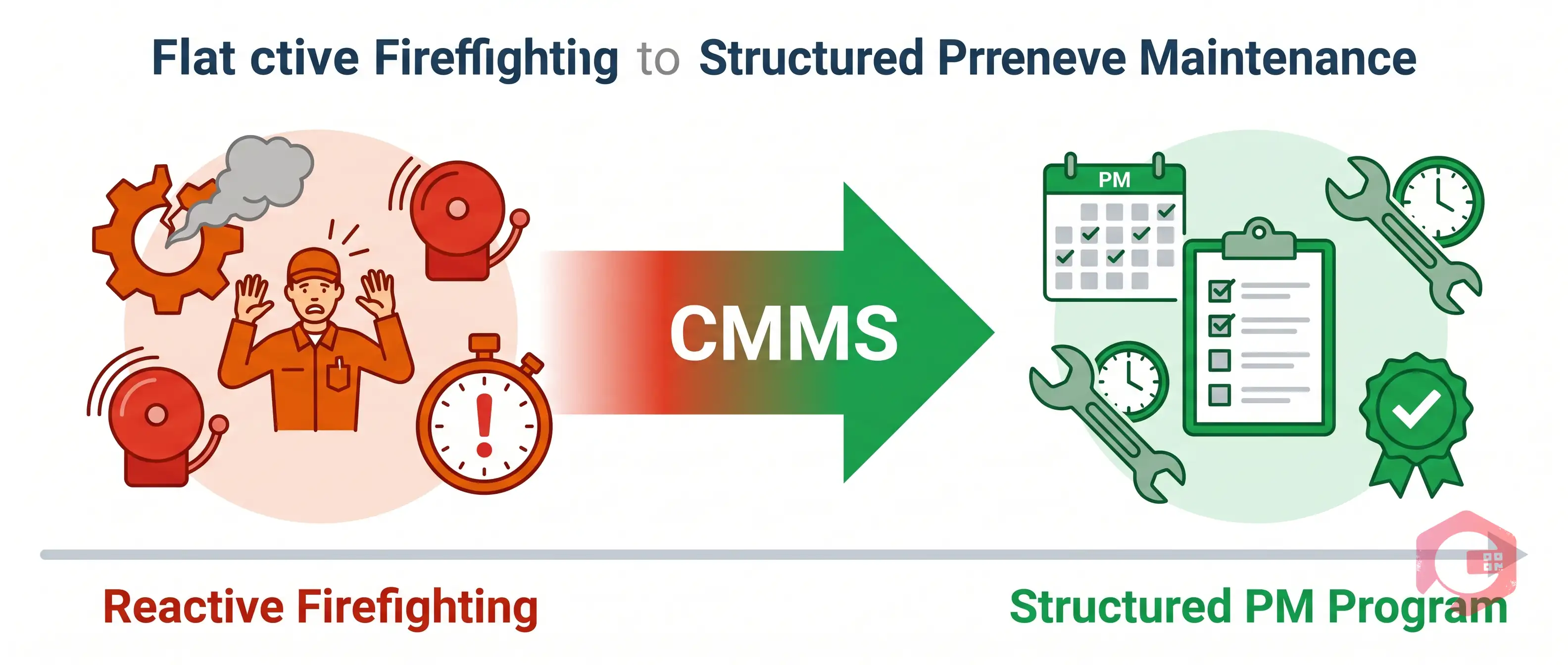
Most maintenance teams know they should be doing preventive maintenance. The problem is executing it consistently. PM schedules slip when the calendar is already full of reactive work. Checklists go uncompleted. Equipment gets serviced based on gut feel rather than actual usage data.
According to a McKinsey study on manufacturing operations, organizations with mature preventive maintenance programs achieve OEE improvements of 10-25% compared to reactive-only approaches. The gap between knowing and doing is where most operations lose money.
Cryotos includes a full preventive maintenance module with a calendar interface, drag-and-drop rescheduling, and pre-built templates for common asset types. You can set both static PMs (fixed time intervals - daily, weekly, monthly) and dynamic PMs (usage-based - by hours, mileage, or cycles) depending on the asset.
Checklists are fully customizable and can be imported from Excel or scanned from paper using OCR. Automated alerts fire before each PM is due - so nothing falls through the cracks even when the team is busy with reactive work. Complex scheduling conditions like “Either/Or” and “And” logic ensure your most critical assets always get serviced on time.
A technician arrives to fix a pump - and the critical seal isn’t in stock. The repair sits idle for two days while a rush order is processed. This scenario plays out daily in facilities without proper inventory management, and the cost goes far beyond the part itself: it’s the labor hours, the extended downtime, and the expediting fees that add up fast.
On the flip side, teams that over-order to “be safe” tie up capital in slow-moving or expired parts, cluttering the warehouse and distorting financial reporting.
The Cryotos inventory module gives your team real-time stock visibility down to the bin level - aisle, rack, shelf, and bin are all mapped in the system. Every part is tagged with a QR code or barcode, so stock counts take minutes, not hours.
Critical stock thresholds trigger automatic reorder alerts when quantities fall below your set minimum. The system supports FIFO, LIFO, and Average Cost valuation methods for accurate financial tracking, and end-of-life product notifications ensure you’re not stocking parts for decommissioned assets. The result: the right part is always available when the technician needs it - no stockouts, no excess.
Do you know where your forklifts are right now? Which assets are overdue for inspection? Which ones have open work orders sitting against them? For most teams without a CMMS, these questions require manual digging - and by the time you have the answer, the situation has already changed.
Lack of asset visibility leads to duplicate maintenance, missed inspections, warranty lapses, and decisions based on incomplete information. ISO 55000 - the international standard for asset management - specifically calls out the need for systematic, data-driven asset lifecycle visibility as a core requirement for operational excellence.
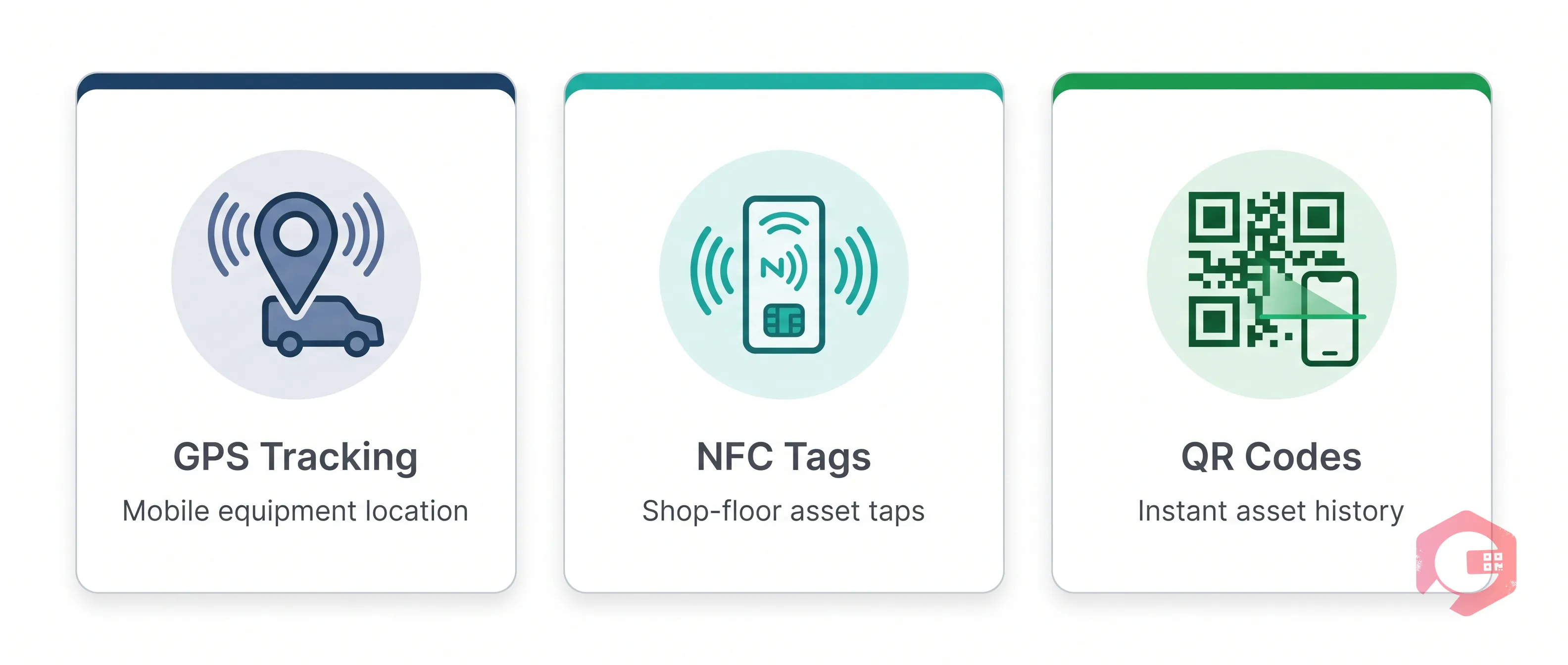
Cryotos tracks every asset in real time using GPS, BEACON, and NFC technology. Each asset has a unique QR code that technicians can scan with a mobile device to instantly access its full history - maintenance records, warranty status, specifications, open work orders, and parts history - all in one screen.
The Cryotos asset management module also includes a tool management component for tracking portable equipment: which technician has it, what condition it’s in, and when it was last serviced. No more lost tools, no more guessing.
Regulatory compliance in maintenance isn’t optional - it’s mandatory. OSHA requirements, ISO standards, industry-specific safety certifications, and Permit to Work (PTW) and Lockout/Tagout (LOTO) procedures all require documented proof that the right steps were taken. Manual records - whether paper-based or scattered across spreadsheets - create serious audit risk and leave you exposed when an inspector asks for evidence.
OSHA’s control of hazardous energy standard (29 CFR 1910.147) mandates documented LOTO procedures for every authorized energy source. A single gap in your records can result in citations, fines, and operational shutdowns.
Cryotos automates compliance documentation through its workflow automation engine. Permit to Work and LOTO procedures are built into work order workflows - technicians complete each step digitally, with digital signatures auto-populated from the web portal. Every action is timestamped and stored as an immutable audit record.
Safety certifications, photo evidence, PDFs, and video attachments can be linked directly to work orders. The Report Builder generates 50+ predefined compliance and maintenance reports on demand - or schedules them to reach your inbox daily or weekly. Audits that used to take days of manual data gathering now take minutes.
Maintenance technicians often lose hours every day to non-productive activities: hunting for work orders, waiting for approvals, calling supervisors for clarification, or traveling to the storeroom to find parts that turn out to be out of stock. A Plant Engineering survey found that technicians in facilities without a CMMS spend only 25-35% of their shift on actual hands-on repair work - what’s called “wrench time.”
The rest is administrative overhead that a good system should eliminate.
Cryotos puts everything a technician needs on their phone. The mobile app (iOS and Android) supports offline mode with automatic sync, so technicians can access work orders, checklists, and asset history even in areas without signal. QR code scanning from the phone gives instant access to asset specs and maintenance history without any manual lookup.
Built-in integrated chat within work orders eliminates back-and-forth calls. Technicians can ask questions, share photos, and escalate issues directly within the work order thread - keeping every conversation contextual and permanently recorded. Customizable WhatsApp and email notification templates ensure the right person gets the right alert at the right time, without unnecessary noise.
If your maintenance strategy is built on experience and intuition rather than data, you’re leaving serious money on the table. Which assets are eating the most repair budget? Which failure modes repeat most often? Where is downtime concentrated across your facilities? Without structured data, these questions go unanswered - and budget decisions get made on guesswork.
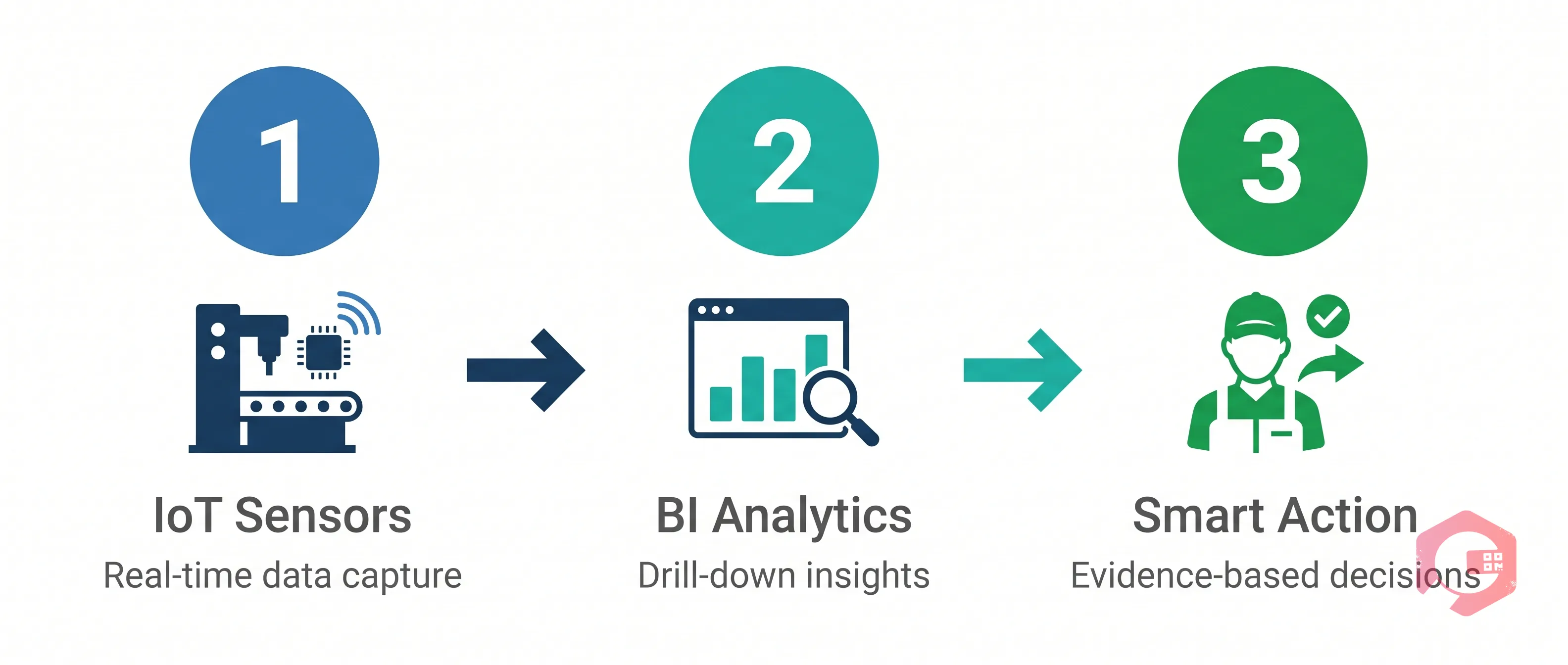
The shift from reactive to predictive maintenance - identified by Deloitte as a key Industry 4.0 capability - requires real-time sensor data and analytics that most teams don’t have access to because their systems can’t connect to IoT devices or generate meaningful reports.
Cryotos includes a BI Dashboard with drill-down capability - from organization level all the way down to individual asset performance. OEE, availability percentage, quality, and performance metrics are displayed in real time, with the ability to break down data by department, plant, or unit.
For IoT-enabled facilities, Cryotos integrates with SCADA, PLC, and edge devices - pulling real-time sensor data and triggering alerts when readings cross defined thresholds. ERP integration with SAP and Microsoft Dynamics 365 ensures your maintenance data feeds directly into your broader financial and operational systems. The result is a maintenance operation that measures what matters and acts on evidence, not instinct.
Unplanned downtime is widely cited as the most costly challenge, because it disrupts production schedules, inflates repair costs, and creates cascading delays throughout operations. Addressing it requires a shift from reactive to preventive maintenance - supported by a CMMS that tracks asset health, schedules PMs automatically, and captures failure data for root cause analysis.
A CMMS reduces costs by preventing expensive breakdowns through scheduled preventive maintenance, eliminating spare parts waste through real-time inventory visibility, improving technician productivity by removing administrative overhead, and providing data that helps managers eliminate repeat failures. Cryotos customers report up to 30% reduction in downtime and 25% faster repair times after implementation.
Yes. Cryotos is built to scale - from small single-site operations to large multi-facility enterprises. The no-code workflow builder means small teams can set up the system without IT support, and the mobile app gives technicians full functionality in the field without needing to be at a desktop.
Cryotos supports direct integration with SAP and Microsoft Dynamics 365, and connects to IoT infrastructure through SCADA, PLC, and edge device integrations. This means your maintenance data flows into your broader business systems without manual data entry or duplicate records.
Implementation timelines vary based on facility complexity and data migration needs, but most Cryotos customers are running live operations within a few weeks. The platform’s no-code configuration, pre-built templates, and Excel import tools for asset data and checklists significantly reduce setup time compared to traditional enterprise software deployments.
Every challenge listed in this post has one thing in common: it’s solvable. The teams that still struggle with reactive fire-fighting, inventory chaos, and compliance headaches aren’t short on talent - they’re short on the right tools. Cryotos CMMS was built specifically for maintenance teams who are ready to move from firefighting to proactive control. If you’re ready to see what that looks like for your facility, start a free trial or request a demo today and let your data do the talking.




Cryotos AI predicts failures, automates work orders, and simplifies maintenance—before problems slow you down.