

A Standard Operating Procedure (SOP) and a Work Instruction are both documentation tools — but they operate at different levels of detail and serve different purposes. An SOP describes what needs to happen and why. A Work Instruction describes exactly how to do a specific task, step by step. Confusing the two leads to documentation that is either too vague to follow or too granular to govern a process.
In maintenance-intensive industries, this distinction matters enormously. According to a Lean Institute study on process documentation, organizations with clearly defined work instructions experience 30–40% fewer procedural errors than those relying on informal knowledge transfer. This guide breaks down both document types, explains when to use each, and shows how a CMMS keeps them linked to the work being done on the floor.
A Standard Operating Procedure is a documented set of instructions that describes how a process should be carried out consistently to meet a defined outcome. SOPs operate at the process level — they outline who is responsible, what the steps are in broad terms, what standards apply, and what to do when things go wrong. They are commonly required by ISO 9001 quality management systems, OSHA regulations, and GMP compliance frameworks.
Think of an SOP as the management layer of a procedure. It answers the question: "What does this process look like, who owns it, and what must be achieved?" It doesn't get into the minute-by-minute mechanics of how each step is physically executed — that's the job of the Work Instruction that sits beneath it.
A well-structured SOP typically contains the following elements:
A Work Instruction is a task-level document that provides step-by-step directions for completing a single, specific activity. Where an SOP describes the process, a Work Instruction describes the exact movements, settings, tools, safety checks, and tolerances required to perform one task within that process correctly and safely.
Work Instructions are the documents a technician reads before picking up a wrench. They leave nothing to interpretation. According to the ISO 9001:2015 standard, documented Work Instructions are required wherever their absence could adversely affect quality, safety, or regulatory compliance. In maintenance, that threshold is crossed constantly — from lockout/tagout procedures to calibration tasks to equipment changeovers.
A complete Work Instruction should include:
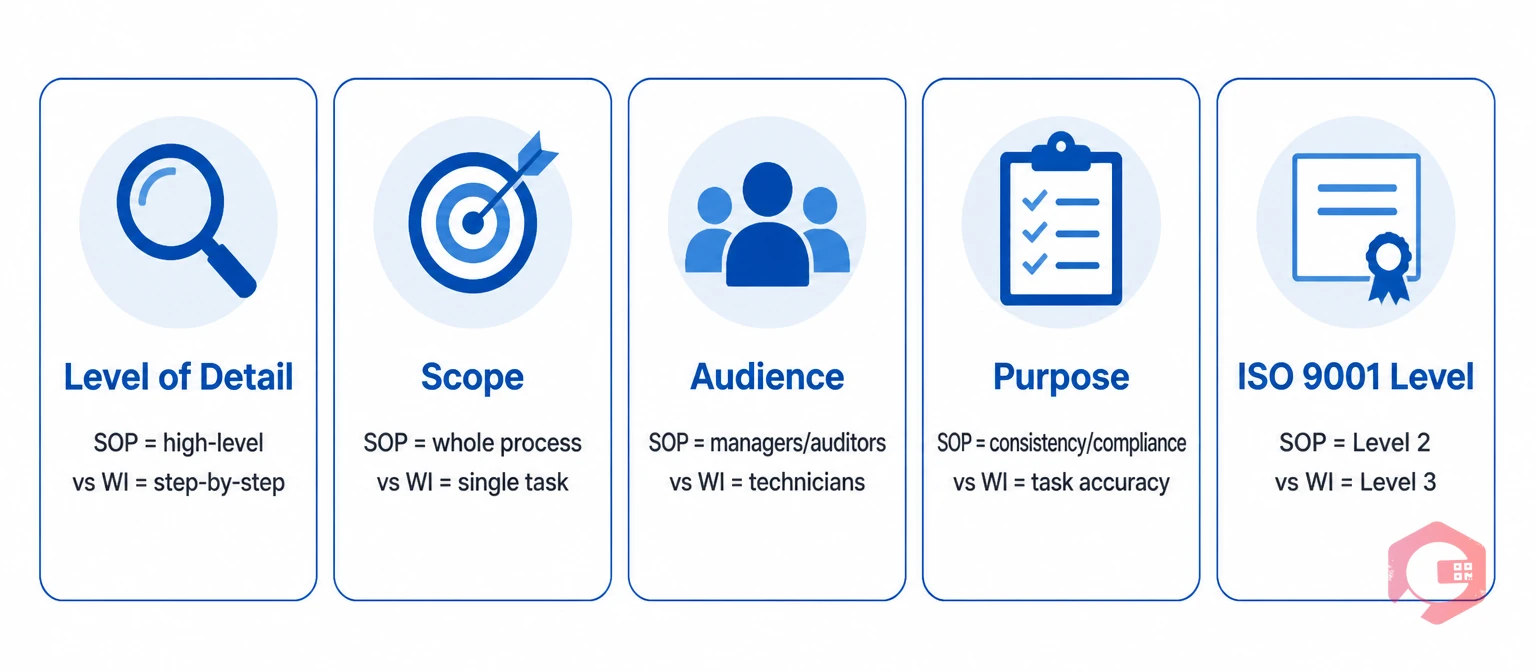
The clearest way to understand the two documents is to compare them directly across the dimensions that matter most in practice:
| Comparison Point | Standard Operating Procedure (SOP) | Work Instruction |
|---|---|---|
| Level of detail | high-level process overview | granular, step-by-step task directions |
| Scope | covers an entire process (e.g., "Preventive Maintenance Process") | covers one specific task within that process (e.g., "How to replace a bearing on Pump P-104") |
| Audience | process owners, managers, auditors, and quality teams | the technician performing the task |
| Purpose | ensures process consistency, assigns accountability, meets regulatory requirements | ensures task accuracy, prevents errors, transfers knowledge |
| Length | typically 2–10 pages | typically 1–3 pages per task |
| Change frequency | reviewed periodically (annually or on process change) | updated when equipment, tools, or methods change |
| ISO 9001 relationship | typically a Level 2 document (procedure level) | Level 3 document (task level) |
Use an SOP when you need to govern a repeatable process that spans multiple people, roles, or departments. If you are defining who owns a process, what sequence of activities constitutes it, and what standards it must meet — that is an SOP. Create a Work Instruction when a single task within that process requires precise execution where variation could cause injury, equipment damage, quality failure, or compliance violation.
A practical rule: if your instructions answer "what should happen and who is responsible," you're writing an SOP. If your instructions answer "exactly how do I do this right now, at this machine, with this tool," you're writing a Work Instruction. Both documents can exist for the same topic — the SOP governs the process, and the Work Instruction enables the technician to execute one step of it correctly.
For preventive maintenance programs, for example, the SOP defines the PM process — scheduling, sign-off, escalation paths. The Work Instruction for a specific PM task tells the technician which fastener torque settings to use and in which sequence to check them.
Understanding where SOPs and Work Instructions sit in the broader documentation hierarchy helps you design a system that is neither too thin nor too bureaucratic. Most quality management frameworks use a four-level pyramid:
| Documentation Level | Definition & Purpose | Characteristics & Examples |
|---|---|---|
| Level 1 — Policy | The organization's high-level commitment — "we will maintain all critical assets to defined safety and performance standards." | One or two pages, rarely changes. |
| Level 2 — Process/SOP | How the organization fulfills that commitment — "here is how the preventive maintenance process works, who owns each step, and what standards apply." | Standard Operating Procedure. |
| Level 3 — Work Instruction | How a specific task within the process is performed — "here is exactly how a technician changes the oil on Compressor C-07." | Task-level detail, tied to specific equipment or activities. |
| Level 4 — Records/Forms | Evidence that the process and tasks were completed as documented. | Completed checklists, sign-off sheets, work order logs. |
Most maintenance teams that struggle with documentation are either missing Level 3 entirely (they have SOPs but no Work Instructions for critical tasks) or they have written Work Instructions for everything but never connected them to a governing SOP. Both situations create audit findings and operational gaps.
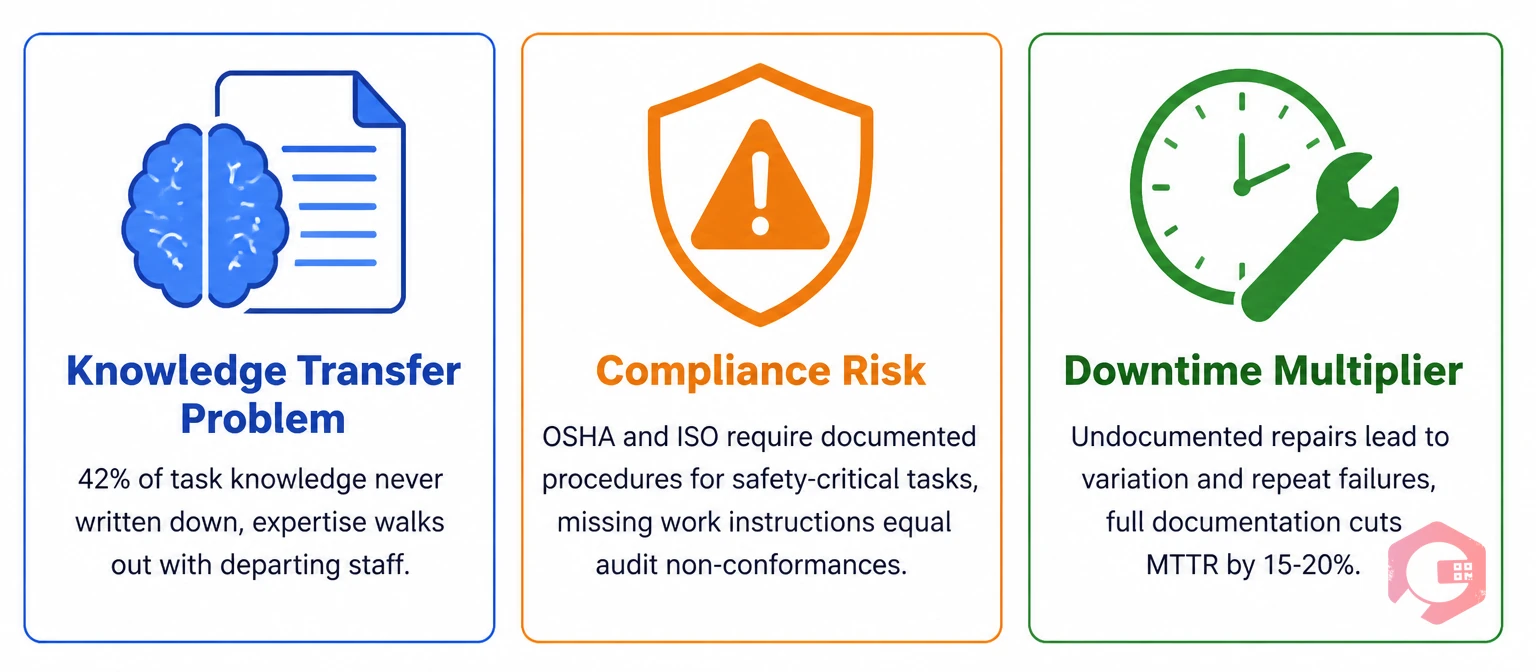
The cost of missing or inadequate SOPs and Work Instructions is not theoretical. In maintenance operations, undocumented procedures create three measurable categories of loss.
First, there is the knowledge transfer problem. When a senior technician leaves, the procedures stored in their memory leave with them. A 2022 McKinsey operations report estimated that 42% of task-specific knowledge in industrial operations is not written down anywhere. Every time that knowledge is re-learned from scratch, it costs time and introduces variation.
Second, there is the compliance risk. Regulatory bodies — from OSHA to ISO auditors — require documented procedures for safety-critical tasks. In industries like food processing, pharmaceuticals, and oil and gas, missing Work Instructions directly translate into audit non-conformances and, in some cases, legal liability.
Third, there is the downtime multiplier. When technicians perform the same repair differently each time because there is no Work Instruction, first-time fix rates fall and repeat failures increase. According to Reliable Plant, facilities with complete task-level documentation achieve 15–20% lower mean time to repair (MTTR) compared to those relying on verbal instructions.
You can calculate your own MTTR baseline using the MTTR Calculator from Cryotos — and track improvements as you roll out better documentation.
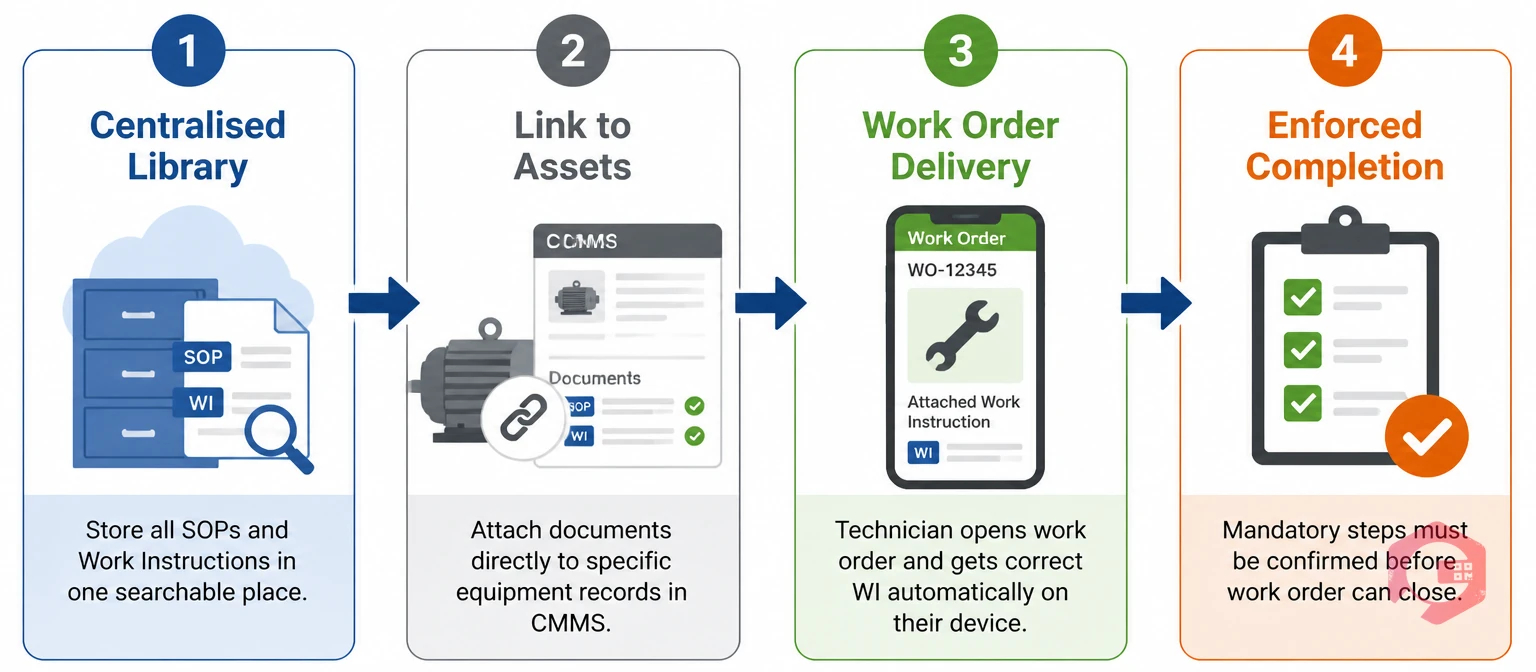
Documenting SOPs and Work Instructions is only half the challenge. The other half is making sure the right document reaches the right technician at the right moment. A CMMS bridges that gap by embedding documentation directly into the maintenance workflow.
Cryotos CMMS connects maintenance checklists and attached documents — including Work Instructions and SOPs — directly to work orders and assets. When a technician opens a work order on their mobile app, the relevant Work Instruction is already there, attached to the specific asset. No searching for a binder, no calling back to the office, no variation between shifts.
The document management feature in Cryotos allows maintenance managers to store the full version-controlled library of SOPs and Work Instructions centrally — searchable, always current, and accessible from the field via QR code scan. When a Work Instruction is updated, it is instantly reflected on every work order that references it. This eliminates the classic problem of technicians using outdated print-outs of procedures that were revised months ago.
For safety-critical tasks, the Permit to Work module in Cryotos enforces the completion of specific checklist steps — including LOTO isolation confirmation — before a work order can be progressed. This means your Work Instructions are not just advisory documents; they become mandatory gates in the work order lifecycle.
To make the distinction concrete, here are real examples of how the two document types work together in a typical industrial maintenance context.
The SOP governs the overall PM process — it defines the PM schedule (quarterly), the approval workflow (technician performs, supervisor signs off), the compliance standard (OSHA 1910.119 PSM requirements), and the escalation path if an anomaly is found. It does not specify which descaling chemical to use or at what concentration.
The Work Instruction for that same task specifies exactly that: the approved descaling agent, dilution ratio, application method, safety PPE required, rinse procedure, water chemistry test targets, and sign-off criteria. A new technician with no prior experience on that cooling tower can perform the task correctly the first time.
The SOP defines the electrical inspection process — annual schedule, qualified personnel requirements, insurance compliance rules, and reporting obligations. The Work Instruction for a panel inspection lists every circuit breaker, the measured values to record, the acceptable tolerance range for each reading, the infrared thermography procedure, and the exact language to use when tagging an anomaly.
The terms are often used interchangeably, but a distinction exists in quality management frameworks. A "procedure" typically refers to any documented sequence of steps. An SOP specifically implies that the document is the standard, approved way the organization requires that process to be performed — it carries governance authority, has a defined owner, and is part of a documented quality or safety management system.
Yes. Work Instructions should go through the same approval and version control process as SOPs, particularly for safety-critical tasks. In ISO 9001-certified organizations, any controlled document — including Work Instructions — must be reviewed, approved, and version-controlled. The rigor may be lighter for low-risk tasks, but approvals matter for any task that could cause injury or quality failure if done incorrectly.
SOPs should be reviewed whenever the process they govern changes — new equipment, regulatory updates, or organizational changes — and at a minimum annually. Work Instructions should be reviewed whenever the specific task method, tools, or equipment changes. In practice, link Work Instruction reviews to planned maintenance milestones or asset modification records in your CMMS to ensure nothing is missed.
This is a common audit finding. The SOP always takes precedence, as it represents the approved process design. If a Work Instruction has evolved through practical use to differ from the SOP, the SOP must be updated to reflect the actual process — or the Work Instruction must be brought into alignment. Running two conflicting documents creates compliance exposure and technician confusion. A version-controlled document management system inside your CMMS prevents this drift.
Yes. Modern CMMS platforms like Cryotos attach Work Instructions directly to asset records and work order types. When a work order is created for a specific asset and task type, the relevant Work Instruction appears automatically. Mandatory checklist steps can be configured so the work order cannot be closed until the technician confirms each step is complete — turning a passive document into an active quality control gate.
SOPs and Work Instructions are not competing documents — they work at different levels of the same quality and safety management system. SOPs define the process; Work Instructions enable the task. Both are necessary, and both need to reach the right person at the right moment to have any practical impact.
In modern maintenance operations, that moment is when a technician opens a work order on their mobile device. If your SOPs and Work Instructions are in a filing cabinet or a shared drive no one checks before starting a job, they are not doing the work they were written to do. Cryotos CMMS brings both document types into the active maintenance workflow — attached to assets, embedded in work orders, and enforced through configurable checklists. Book a free demo to see how Cryotos connects your documentation to the work being done on the floor.



Cryotos AI predicts failures, automates work orders, and simplifies maintenance—before problems slow you down.



