Stale data, unused KPIs and skipped reviews silently undermine a strategic asset management program, because each one looks like progress while value leaks out. Reports still run. PM tasks still generate. Meetings still happen. Yet decisions stop changing, and most teams sense something is off without being able to name it.
This guide names eight silent threats and gives a quick test for each. It also shows a four-part audit you can run in 30 days, and where software helps and where only leaders can fix the problem.
Key Takeaways
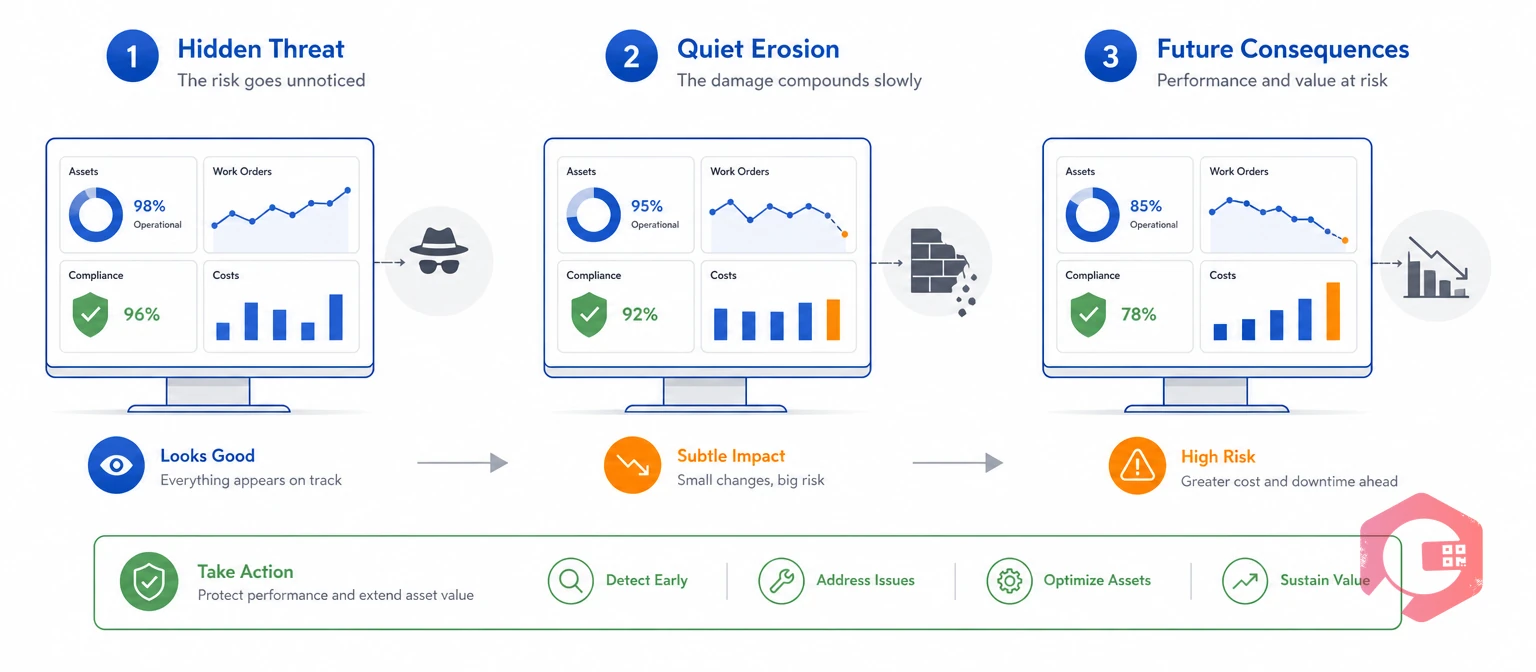
A silent threat is a weakness that erodes results without raising an alert. The program still looks active, so nobody asks whether it still works.
A strategic asset management program is the set of plans, people and routines that turn asset goals into daily work. The ISO 55000 family covers this work, and ISO 55001 includes performance evaluation (Clause 9) and improvement (Clause 10). Those two clauses are where silent failures hide, because reviews get skipped and lessons never return to the plan.

These eight threats share one trait: the dashboards still look fine. Each item gives a warning sign you can check this week.
A planned-work share is the percentage of maintenance hours spent on scheduled jobs. Track it by asset class, not only plant-wide, so one weak area cannot hide inside a good average.
Most maintenance teams find that several of these threats overlap. Wondering what firefighting costs you? Try the unplanned downtime calculator.
A scorecard turns the eight threats into quick checks. Score each row green, amber or red in one meeting, then fix the reds first.
| Threat | What You See | Quick Test | First Fix |
|---|---|---|---|
| Stale data | Rankings that miss reality | Do 10 assets on site match the register? | Name record owners |
| Strategy gap | PM tasks nobody can justify | Can you name the goal behind 5 PM tasks? | Tag tasks to criticality |
| Firefighting | Repeat breakdowns | What share of hours was planned? | Protect planning time |
| Cost silos | Replacement on price alone | Does the last capital request cite repair history? | Share cost history |
| Activity KPIs | Green dashboards, flat results | Which KPI moved a goal this year? | Pair each KPI with an outcome |
| No learning loop | Generic failure codes | How many failures have a specific cause? | Code causes at close-out |
| Fading governance | Skipped reviews | When did leaders last review goals? | Fix a review calendar |
| Knowledge loss | Tasks only one person can do | Which tasks stop if one person leaves? | Capture steps in checklists |
Here is an illustrative example. A plant reports 95% PM compliance, yet availability on its bottleneck lines has not moved in a year. A trace test shows every asset gets the same PM interval, whatever its criticality. The activity was real, but it was not aimed at the goal.
Run the quick tests in one 60-minute meeting. The goal is evidence, not blame.

The Four-Leak Audit groups the eight threats into four places where value escapes. Spend one week on each leak, then write a one-page action list.
The Four-Leak Audit Framework:
For a wider maturity check, see guidance from the Institute of Asset Management. Fix the biggest leak first, because small finished fixes build trust.
Silent threats thrive where nobody owns the result. Give each leak one named owner and one review date.
Titles differ between sites. What matters is that each owner can name their leak and the next review date.
A Computerized Maintenance Management System supports a strategic asset management program by holding the daily evidence behind each leak. It does not set strategy and cannot replace sponsorship. Cryotos is a maintenance platform, not a strategic planning tool.
Maintenance teams using Cryotos have reported up to 30% reduction in unplanned downtime and 25% faster repair turnaround. Fewer emergency repairs leave more time for planned work, which is where the delivery leak closes.
Steps such as criticality scoring and multi-year capital plans may need a separate planning tool. A CMMS then supplies the asset and cost history those plans depend on. Teams running several sites can also look at enterprise asset management software.
A good place to start is stale asset data, because every ranking, schedule and budget depends on it. It stays hidden because reports still run. Check it first with a site walk-down.
A plan and software do not guarantee use. Goals may not reach the task list, KPIs may track effort, and reviews may slip. The program then looks active while results stay flat.
Walk the site and pick ten assets. Check each one against the register for location, status and criticality. Any gap shows that updates are not happening at the point of work.
Set a fixed calendar, and review at least once a year and after any strategy or major risk change. Many organizations add shorter quarterly checks on KPIs. Confirm what your standard or regulator expects.
Some fixes start in weeks, such as naming record owners and setting a review calendar. Data cleanup and better failure coding take longer. Plan in quarters, and judge progress by results, not activity.
No. Many organizations run a program without certification. The ISO standards are a useful reference, but silent threats apply either way.
No. A CMMS supplies records, schedules, costs and reports. Leadership, ownership and culture still decide whether the program changes decisions.
A strategic asset management program stays healthy when you check results and not just activity. Schedule a free demo to see how Cryotos keeps asset records, planned work and downtime reports in one place.


Cryotos AI predicts failures, automates work orders, and simplifies maintenance—before problems slow you down.