

Data centers are no longer just server rooms — they are the backbone of the global economy. Every bank transaction, cloud application, AI inference, and video stream runs through a data center facility somewhere. And as the AI infrastructure boom drives unprecedented capital investment in 2026, the complexity of maintaining these facilities has crossed a threshold that spreadsheets and manual work orders simply cannot handle.
A single hour of unplanned downtime in a data center costs an average of $540,000, according to the Uptime Institute's Global Data Center Survey. The facilities and maintenance teams responsible for keeping these environments running need a purpose-built CMMS — not as an optional upgrade, but as operational infrastructure.
A data center CMMS is a software platform designed to plan, schedule, track, and document all maintenance activities across a data center facility. It manages the full lifecycle of critical physical infrastructure — from UPS systems and cooling towers to generators, fire suppression systems, and electrical distribution units.

DCIM tools focus on real-time capacity planning, power usage effectiveness, and IT infrastructure visibility. A CMMS focuses on the maintenance workflows that keep physical assets healthy over time. Best practice in 2026: integrate both. DCIM sensors feed condition data into the CMMS, triggering work orders before a failure occurs.
The Ponemon Institute puts the average cost of an unplanned data center outage at $9,000 per minute. The root cause in the majority of outages is not hardware failure — it is missed preventive maintenance. A study by the Uptime Institute found that over 70% of data center outages were preventable with proper maintenance processes.


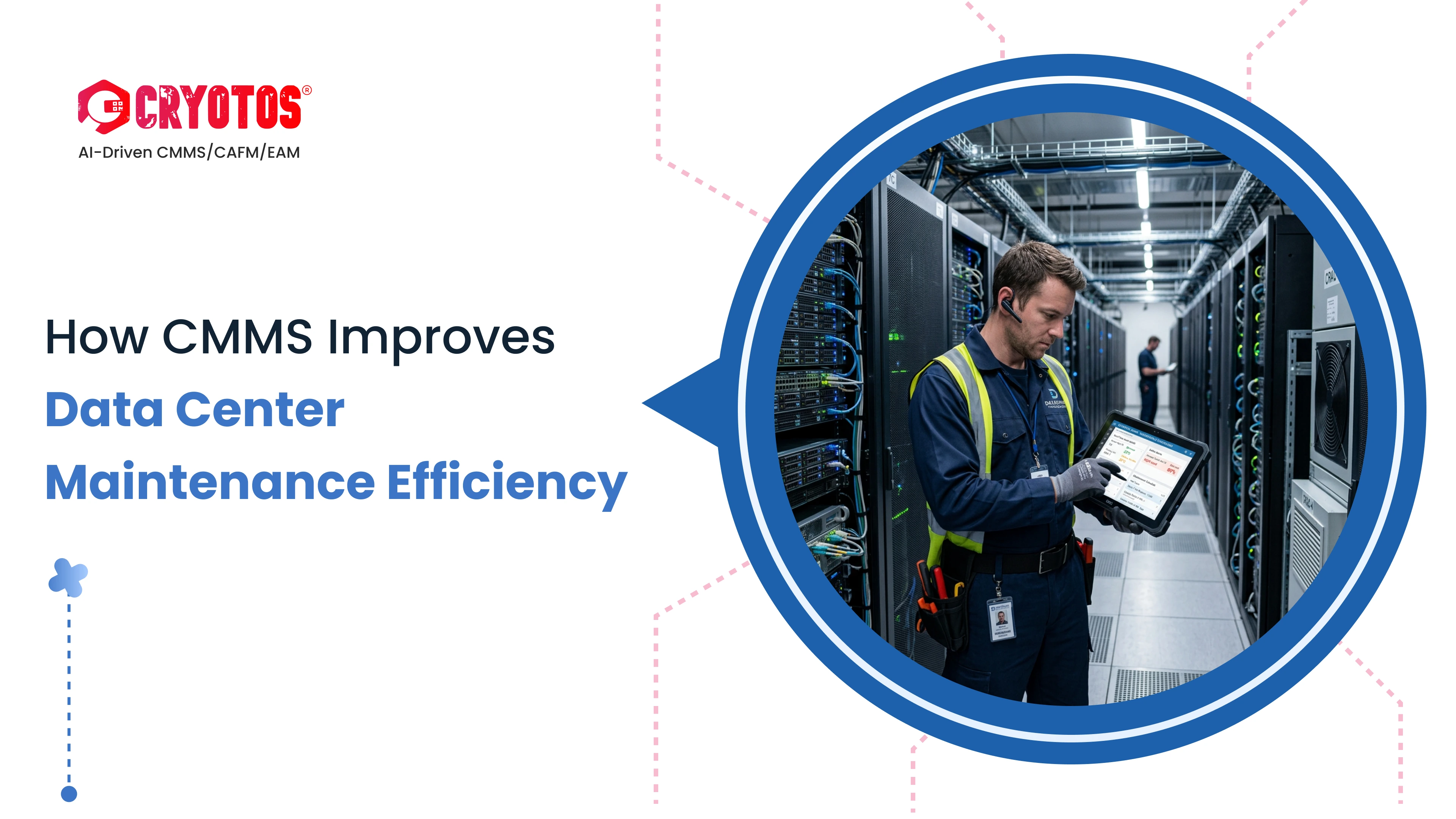
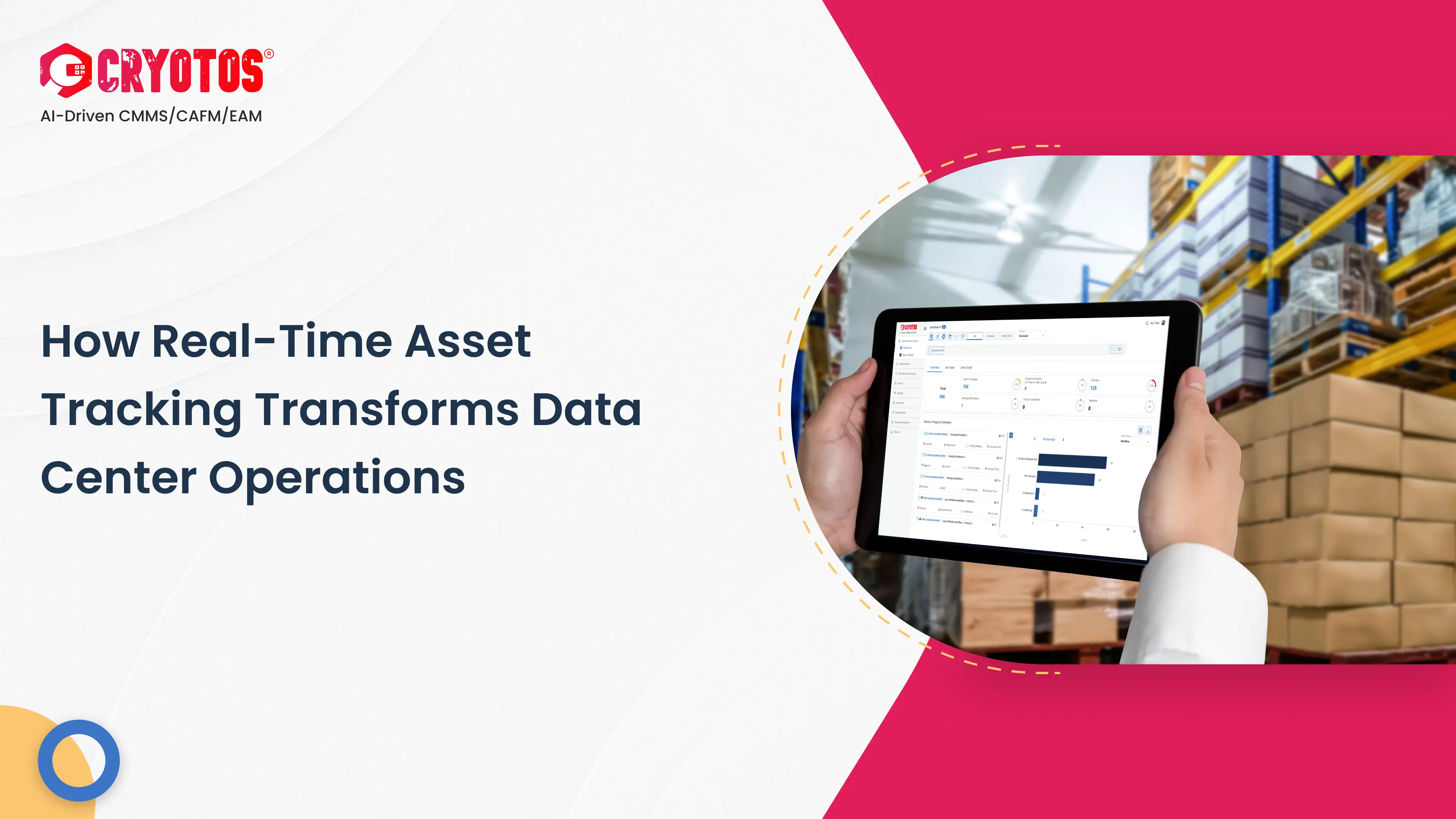
Three capabilities define how a CMMS keeps data centers online: automated preventive maintenance scheduling across hundreds of assets simultaneously, IoT sensor integration enabling condition-based maintenance triggers, and work order management providing a single source of truth across shifts. Cryotos CMMS supports multi-frequency nested PM schedules and connects IoT sensor data to automated work order creation. See how Cryotos IoT integration and work order management apply here.
Uptime Institute Tier III and IV auditors expect documented PM schedules with completion records, generator test logs, UPS maintenance records, and change management documentation. Every work order completed in a CMMS generates an immutable record — the audit trail that Tier III and IV auditors need. Facilities running a CMMS can generate a complete maintenance history report in minutes rather than weeks.
A well-maintained cooling system consumes significantly less energy than a system with clogged filters or failing compressors. Proactive cooling maintenance has been shown to improve PUE by 0.05–0.15 points. The global average PUE in 2024 was approximately 1.58 according to the Uptime Institute's Annual Survey.
Cryotos CMMS is purpose-configured for high-availability facility environments with multi-site asset management, nested preventive maintenance, mobile work orders, IoT and sensor integration, compliance-ready audit trails, and spare parts inventory management. Cryotos gives data center facility teams the tools they need to prevent downtime, maintain Tier certification, and demonstrate sustainability progress. Schedule a demo to see how Cryotos can be deployed across your data center operations in under 30 days.
DCIM monitors real-time IT capacity, power consumption, and cooling headroom. A CMMS manages the maintenance lifecycle of physical assets — scheduling PM tasks, issuing work orders, and documenting repairs. In 2026, leading data centers integrate both.
A CMMS reduces downtime by enforcing preventive maintenance schedules across all critical assets and enabling condition-based maintenance by integrating with IoT sensors. The Uptime Institute reports that over 70% of data center outages are preventable with proper maintenance processes.
Yes. A CMMS generates a complete, time-stamped audit trail of every maintenance activity. This documentation is required for Uptime Institute Tier III and Tier IV certification audits, SOC 2 Type II reviews, ISO 27001 compliance, and NFPA 75 fire suppression inspections.


Cryotos AI predicts failures, automates work orders, and simplifies maintenance—before problems slow you down.



