
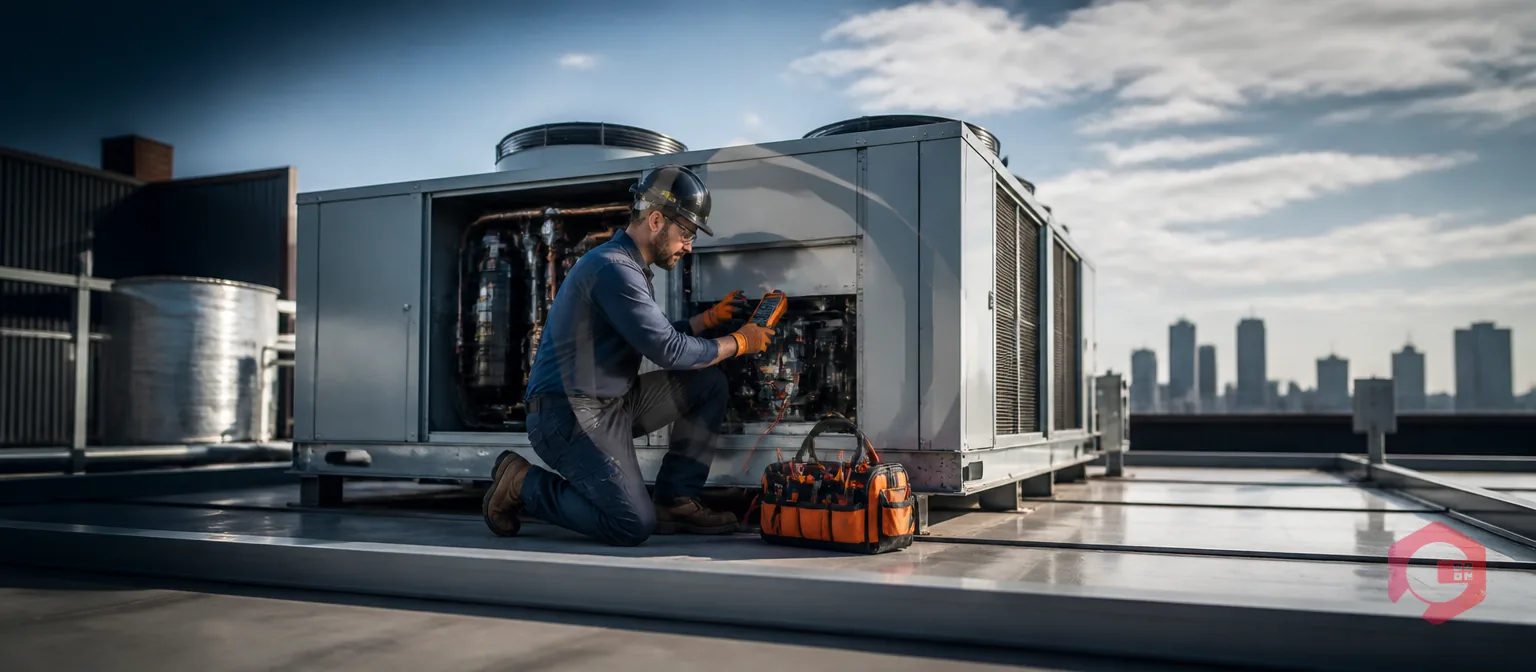
Preventive maintenance for heating and cooling equipment is the practice of scheduling regular inspections, cleaning, and component servicing before failures occur — keeping HVAC systems running efficiently and safely throughout the year. According to the U.S. Department of Energy, HVAC systems account for nearly 50% of total building energy use, making their upkeep one of the highest-impact maintenance decisions any facility manager can make.
When HVAC equipment is left without a structured maintenance plan, the consequences show up fast: higher utility bills, shorter equipment life, unexpected breakdowns, and — in commercial or healthcare settings — compliance risks. A proactive approach changes that equation entirely.
Key Takeaways
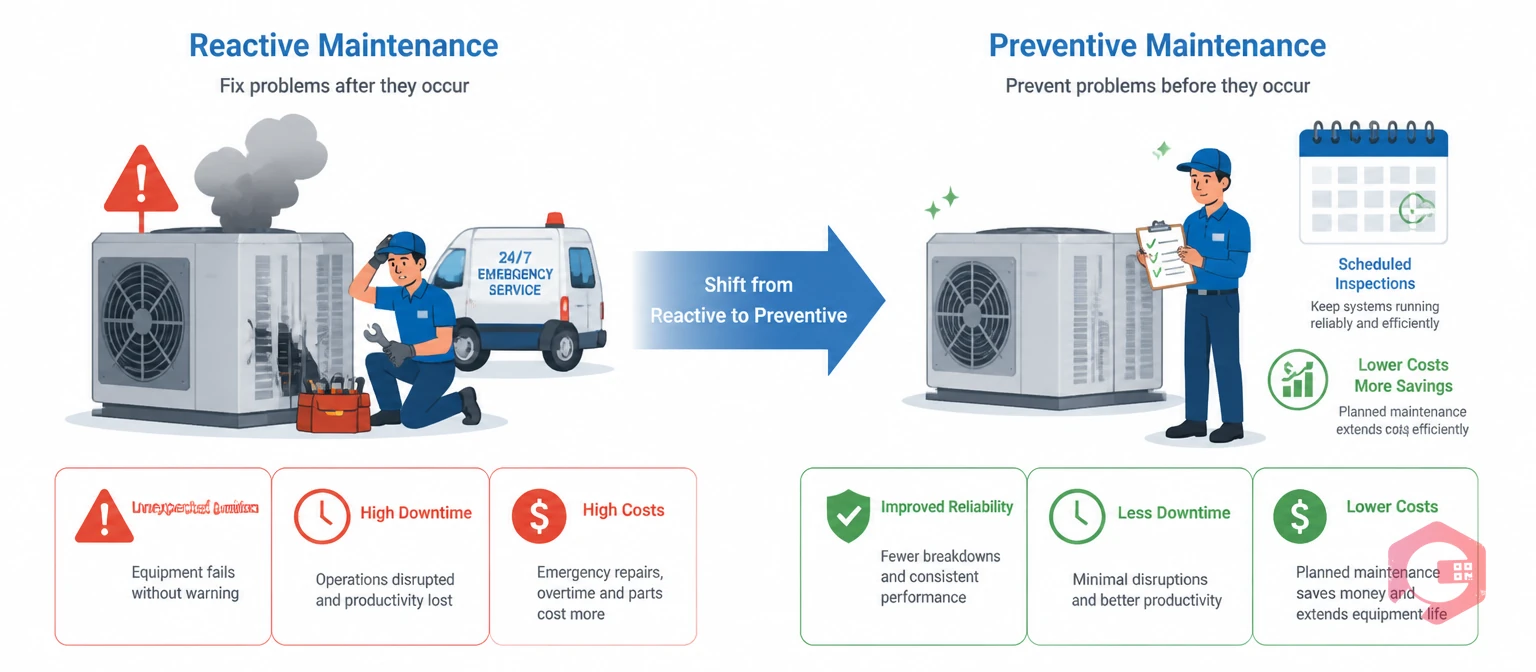
Preventive maintenance for HVAC equipment is a planned, recurring maintenance strategy that services heating and cooling systems on a fixed schedule — before problems develop. Unlike reactive maintenance, which responds to failures after they happen, preventive maintenance interrupts the failure cycle at the source.
The core distinction matters for budgeting and reliability planning. Reactive repairs cost two to four times more than scheduled maintenance, largely because emergency labor rates are higher and unplanned downtime affects operations. Facilities that run structured HVAC PM programs consistently report lower annual maintenance spend and fewer emergency callouts.
Preventive maintenance applies to every category of heating and cooling equipment, though the specific tasks and intervals vary by system type:
For facilities managing multiple HVAC assets across all these categories, tracking tasks manually quickly becomes impractical. This is where a preventive maintenance software platform becomes central to execution — automating scheduling, tracking completion, and storing every service record against the correct asset.
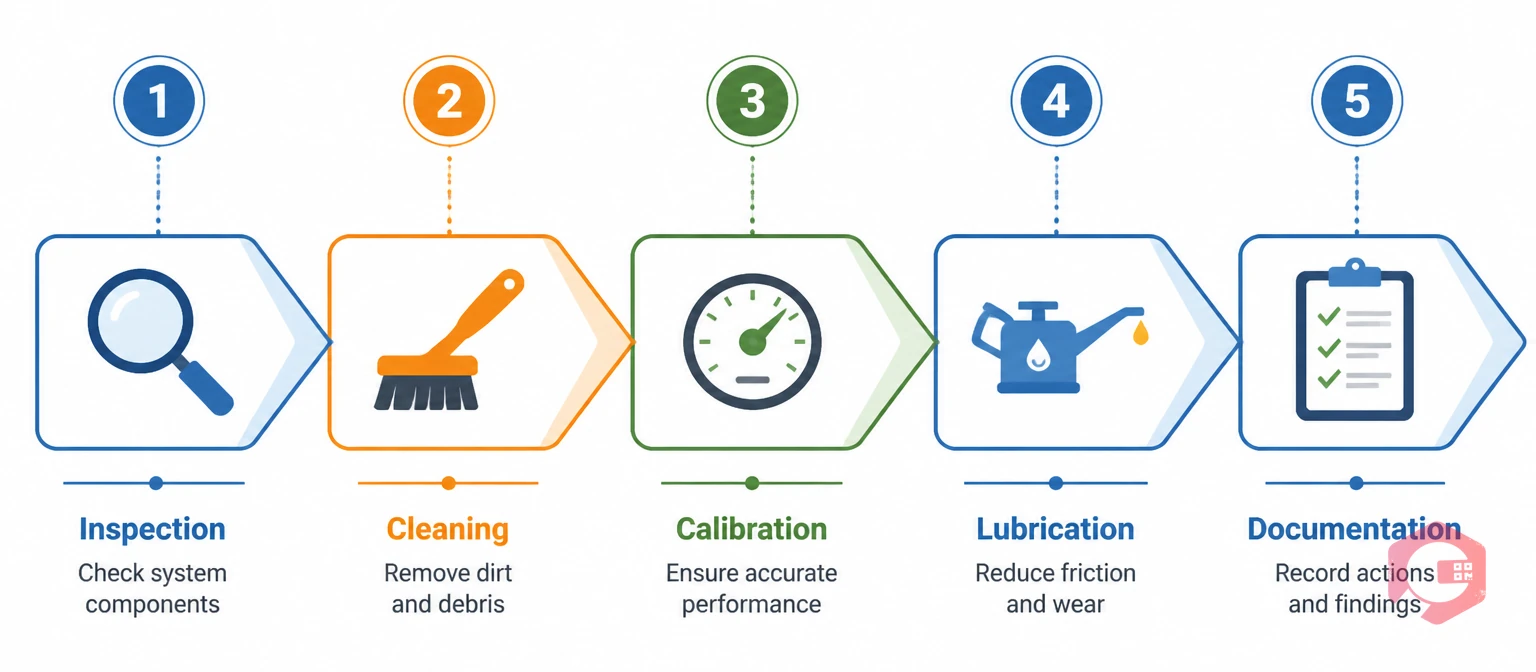
The 5-Pillar HVAC PM Framework is a structured model for building a complete, repeatable preventive maintenance program for heating and cooling equipment. Each pillar addresses a distinct maintenance function that the others cannot substitute for:
These five pillars work together — and reinforce each other. Skipping any one creates gaps the others cannot fill. A facility that cleans coils but skips calibration still ends up with energy waste and comfort complaints. A team that inspects thoroughly but fails to document creates institutional knowledge that disappears when a technician leaves.

The benefits of preventive maintenance for heating and cooling equipment extend well beyond avoiding breakdowns. Here is what maintenance teams and facility managers consistently report when they move from reactive to preventive approaches:
HVAC systems that receive regular preventive maintenance typically last 15–20 years, compared to 10–12 years for neglected units. The compressor is the most expensive HVAC component — and the most failure-prone when maintenance is deferred. Proper refrigerant management, coil cleanliness, and filter maintenance protect the compressor directly, reducing the risk of premature burnout.
Most HVAC manufacturers specify minimum maintenance requirements as a condition of warranty coverage. Documented PM records serve as proof of compliance when a warranty claim arises. Without them, warranty claims are routinely denied — even for equipment failures that were clearly a manufacturing defect.
A dirty condenser coil forces the compressor to work significantly harder to reject heat. Research from the U.S. Department of Energy shows that HVAC systems lose 5–40% efficiency depending on the severity of neglect. For commercial facilities with high cooling loads, that efficiency loss translates directly to thousands of dollars in preventable utility costs each year.
Regular filter changes alone can reduce HVAC energy consumption by 5–15%, making filter maintenance one of the highest-ROI tasks available to facility teams. It costs a few dollars per filter and returns that investment many times over in reduced compressor runtime.
Maintenance teams using Cryotos have reported up to 30% reduction in unplanned downtime and 25% faster repair turnaround when HVAC assets are managed under a structured PM schedule. The reason is straightforward: most HVAC failures — compressor burnout, refrigerant leaks, motor seizure — are preceded by detectable warning signs. A thorough PM inspection catches these signals. A reactive approach does not.
Neglected HVAC systems actively degrade indoor air quality by circulating dust, mold spores, and other contaminants through ductwork and air handlers. In healthcare, food processing, and educational facilities, this is a regulatory compliance issue, not merely a comfort concern. Regular coil cleaning, drain pan maintenance, and filter replacement directly reduce airborne contaminant loads and keep indoor environments within acceptable health and safety standards.
Heating equipment carries safety risks that preventive maintenance directly addresses. Gas furnaces require annual heat exchanger inspections — a cracked heat exchanger can allow carbon monoxide to enter the building air supply, a hazard with severe health consequences. Electrical connections in HVAC equipment must be checked for corrosion and tightness to prevent arc faults and fires.
These checks are not optional in any compliant maintenance program. They are the reason most jurisdictions require licensed technicians to perform annual HVAC service — and why documentation of that service matters.
Ready to move beyond reactive HVAC repairs? Cryotos preventive maintenance software helps teams schedule, track, and document every HVAC service task from one platform — across any number of assets and locations.
Effective HVAC preventive maintenance covers a defined set of tasks, each tied to specific components and service intervals. The table below maps the most critical tasks to their recommended frequency, the system they protect, and their priority level:
| Maintenance Task | Recommended Frequency | System Protected | Priority |
|---|---|---|---|
| Air filter inspection and replacement | Monthly to quarterly | Air handler, ductwork, compressor | Critical |
| Condenser and evaporator coil cleaning | Annually (pre-season) | Cooling system | Critical |
| Refrigerant level check | Annually | Compressor, cooling system | High |
| Drain pan and condensate line clearing | Quarterly | Air handler, ductwork | High |
| Belt inspection and tensioning | Bi-annually | Fans, air handlers | High |
| Motor lubrication | Annually | Fans, compressors, blowers | Medium |
| Electrical connection tightening | Annually | Controls, motors, compressors | Critical |
| Thermostat and controls calibration | Annually | Control system | Medium |
| Heat exchanger inspection (gas furnaces) | Annually | Heating system | Critical (safety) |
| Ductwork inspection for leaks | Every 2–3 years | Distribution system | Medium |
Maintenance teams using digital maintenance checklists complete these tasks faster and with fewer omissions than paper-based processes, because each checklist step is prompted sequentially on a mobile device and completion is captured automatically.

HVAC systems operate under different loads and conditions across seasons. A seasonal PM schedule ensures each system is prepared for its peak demand period, reducing the risk of failure when the equipment is needed most. Most HVAC failures in commercial buildings occur within the first two weeks of a season change — precisely when the system is asked to perform after months of reduced operation.
| Season | Key PM Tasks | Primary System | Goal |
|---|---|---|---|
| Spring (Pre-Cooling) | Coil cleaning, refrigerant check, filter replacement, condenser fan inspection | Cooling | Ready for peak cooling demand |
| Summer (Peak Cooling) | Monthly filter checks, drain pan inspection, thermostat calibration verification | Cooling | Sustain efficiency under heavy load |
| Fall (Pre-Heating) | Heat exchanger inspection, burner cleaning, belt check, gas pressure test | Heating | Safety check before first heating cycle |
| Winter (Peak Heating) | Monthly filter checks, flue inspection, emergency heating system test | Heating | Prevent heat loss and safety hazards |
The seasonal schedule directly targets this vulnerability by ensuring systems are inspected and serviced before peak loads begin. ASHRAE Standard 180, the standard practice for inspection and maintenance of commercial building HVAC systems, provides detailed guidance for building operations teams developing seasonal PM schedules.
A Computerized Maintenance Management System transforms HVAC preventive maintenance from a manual, calendar-based process into a managed workflow where every task is scheduled, assigned, tracked, and documented automatically. Most facilities managing more than 10 HVAC assets find that manual scheduling creates gaps — seasonal tasks get delayed, technicians are unsure what was last serviced, and warranty records become incomplete. A CMMS solves all three problems simultaneously.
CMMS platforms allow maintenance teams to build HVAC PM schedules based on calendar intervals, runtime hours, or condition thresholds. When a service window arrives, the system automatically generates a work order, assigns it to the appropriate technician, and sends notifications via mobile, email, or WhatsApp. No task falls through the gap because of a missed calendar entry or a technician on leave.
Every HVAC unit in a CMMS has its own asset record — installation date, model, serial number, warranty expiry, and a full log of every service performed. This history is essential for warranty claims, audit trails, and making informed replacement-versus-repair decisions. It also enables condition-based maintenance planning, where past failure patterns inform future service intervals rather than relying on generic manufacturer defaults.
When an HVAC inspection uncovers a defect — a failing belt, low refrigerant, a tripped safety switch — a work order management system generates a corrective work order on the spot. The technician documents the finding, the work order captures parts used and labor time, and the maintenance manager has full visibility without chasing updates by phone or email. Every corrective action is linked back to the original PM that found it, creating a complete audit trail.
Facilities in regulated industries — healthcare, food processing, pharmaceuticals — must demonstrate that HVAC systems meet specific maintenance standards. A CMMS generates compliance-ready reports on demand: what was inspected, when, by whom, and what was found. This documentation supports regulatory audits and internal QA reviews without manual data assembly.
HVAC PM documentation is not merely an operational benefit — it is a compliance requirement under frameworks like ASHRAE 180, Joint Commission standards for healthcare facilities, and EPA Section 608 for refrigerant management. Without documented evidence that scheduled maintenance occurred, facilities face both regulatory exposure and voided equipment warranties.

Even maintenance teams with structured programs make avoidable mistakes that reduce the effectiveness of their HVAC PM efforts. Understanding these patterns helps operations leaders close the gaps before they become failures.
The most common HVAC maintenance failure is skipping the spring and fall pre-season inspections. Teams deprioritize them during quieter operational periods — then the system fails during the first heat wave or cold snap. Pre-season checks should be locked into the annual maintenance calendar as non-negotiable, high-priority events with no flexibility on timing.
Changing filters on a fixed monthly schedule works in theory but misses the real-world variation in dust loads, occupancy, and air quality. High-traffic facilities may need bi-weekly filter changes during peak seasons. Low-occupancy buildings may be fine with quarterly changes. A smart PM program checks filter condition on a fixed schedule and replaces based on actual pressure drop or visual inspection — not just the calendar date. This approach reduces unnecessary filter spend in low-load periods while preventing efficiency loss during peak operation.
Maintenance without documentation is maintenance without memory. When an HVAC unit fails and there is no service history, the repair team has no baseline to work from. Recurring issues go undetected because no one can see the pattern across multiple service visits. Every inspection finding — even a "no defects found" result — should be recorded in the asset's maintenance log with date, technician, and condition observations.
A rooftop unit serving a server room runs at near-100% capacity year-round and needs more frequent PM than one serving a seldom-used meeting room. Asset criticality — based on the cost of failure, the load the asset carries, and the consequence of downtime — should determine PM frequency. A criticality-based approach to planned downtime scheduling ensures high-risk assets get proportionally more attention without inflating costs on lower-priority units.
Low refrigerant is often attributed to normal consumption, when in fact it signals a leak. The EPA Section 608 regulations require that refrigerant leaks above defined thresholds be repaired promptly and that refrigerant levels be documented. Deferring this check exposes the facility to both equipment damage and regulatory penalties — especially now that many older refrigerants are being phased out under federal regulations.
Most commercial HVAC systems require at minimum a bi-annual PM service — once in spring before the cooling season and once in fall before the heating season. High-use systems, such as those serving data centers, hospitals, or manufacturing facilities with continuous operation, typically require quarterly or monthly inspections for high-wear components like filters and belts. The right interval depends on equipment type, usage intensity, and the criticality of the space it serves.
Preventive maintenance is schedule-based: you service the equipment at fixed intervals regardless of its current condition. Predictive maintenance is condition-based: sensors monitor real-time data — vibration, temperature, refrigerant pressure — and trigger maintenance only when parameters deviate from normal. Preventive maintenance is the foundation; predictive maintenance is an enhancement that reduces unnecessary service visits for equipment performing well. Most facilities start with a solid preventive program before adding predictive capabilities.
Yes — the energy savings from regular HVAC maintenance are well-documented. A dirty evaporator coil can increase compressor energy consumption by 20–30%. Clogged filters reduce airflow and force the system to run longer to reach set-point temperatures. Proper refrigerant charge, clean coils, and calibrated controls together can reduce HVAC energy consumption by 15–25% compared to a neglected system of the same age and type. For large commercial facilities, this represents meaningful cost savings each year.
A complete HVAC PM checklist covers: filter inspection and replacement, coil cleaning (evaporator and condenser), refrigerant level check, drain pan and condensate line clearing, belt tension and condition check, motor lubrication, electrical connection tightening, thermostat and controls calibration, safety switch testing, and — for gas-fired equipment — heat exchanger and burner inspection. The checklist should be tailored to the specific equipment type and record the condition found, action taken, and technician sign-off for each item.
A CMMS automates the scheduling, assignment, and documentation of HVAC PM tasks. It generates work orders automatically when a service interval arrives, assigns them to qualified technicians, tracks completion status, and stores the full service history against each asset record. This eliminates the manual tracking burden, ensures no scheduled maintenance is missed, and provides the documentation needed for warranty compliance, regulatory audits, and informed repair-versus-replace decisions.
A structured HVAC preventive maintenance program reduces operating costs, extends equipment life, and keeps facilities comfortable and compliant throughout the year. If your team is still managing HVAC service schedules manually — or relying on reactive repairs — there is a direct path to better outcomes. Schedule a free demo to see how Cryotos automates HVAC preventive maintenance scheduling, work order management, and compliance documentation for facilities of every size.



Cryotos AI predicts failures, automates work orders, and simplifies maintenance—before problems slow you down.



