

Key Takeaways
The 5-Why method is a root cause analysis technique where you ask "Why?" five times in sequence to trace an equipment failure back to its true underlying cause — not just the symptom visible on the surface. Developed by Sakichi Toyoda and embedded into the Toyota Production System, it remains one of the most effective tools in any maintenance team's toolkit. According to research published by Plant Engineering, over 60% of repeat equipment failures trace back to root causes that were never properly identified — teams fixed the symptom and moved on, leaving the underlying problem intact.
This guide covers how the 5-Why method works, how to apply it correctly on the shop floor, a complete worked example, common mistakes that produce wrong answers, and how a CMMS turns individual RCA sessions into a living knowledge base that prevents repeat failures across your entire fleet.
The 5-Why method is a structured questioning process used in root cause analysis to find the source of a problem by repeatedly asking "Why?" at each level of the answer chain. You start with the observable failure — the symptom that triggered a work order — and keep drilling down until you reach the actual root cause: a controllable decision, missing process, or system gap that, if fixed, would permanently eliminate the failure.
The core principle is that most equipment failures are not caused by a single trigger. They are the end result of a cause chain — a sequence of connected decisions, missing checks, and degrading conditions. The 5-Why method forces your team to follow that chain to its source instead of stopping at the first plausible answer.
The number five is a guideline, not a law. Simple failures may yield a root cause in three whys. Complex failures may need seven. What matters is reaching a cause that is actionable — something your team can actually fix, schedule, or build into a process — rather than stopping at an answer that is beyond your control or too vague to act on.
When a machine breaks down, the pressure to restore production is immediate. The default response is to identify the failed component, replace or repair it, and close the work order. This gets the line running — but it does nothing to prevent the same failure from coming back.
Surface fixes address the symptom. Root cause analysis addresses the system. Research by the Society for Maintenance and Reliability Professionals (SMRP) shows that plants practising structured RCA consistently achieve lower reactive maintenance ratios and higher asset availability than those relying on experience-based diagnosis alone. That improvement does not come from fixing failures faster — it comes from eliminating the conditions that allow them to occur in the first place.
The cost difference compounds quickly. A single repeat failure carries the same reactive maintenance cost as the first occurrence: emergency labour, parts expediting, and production downtime. If that failure repeats four times a year across multiple assets, the financial impact far exceeds the time it would have taken to run a proper 5-Why investigation after the first incident.
The other cost is organisational. Every repeat failure erodes confidence in the maintenance team and pressures managers to reduce asset reliability targets. Building a culture where 5-Why analysis is the standard response to significant failures changes that pattern — and the data from each analysis feeds directly into better preventive maintenance schedules.
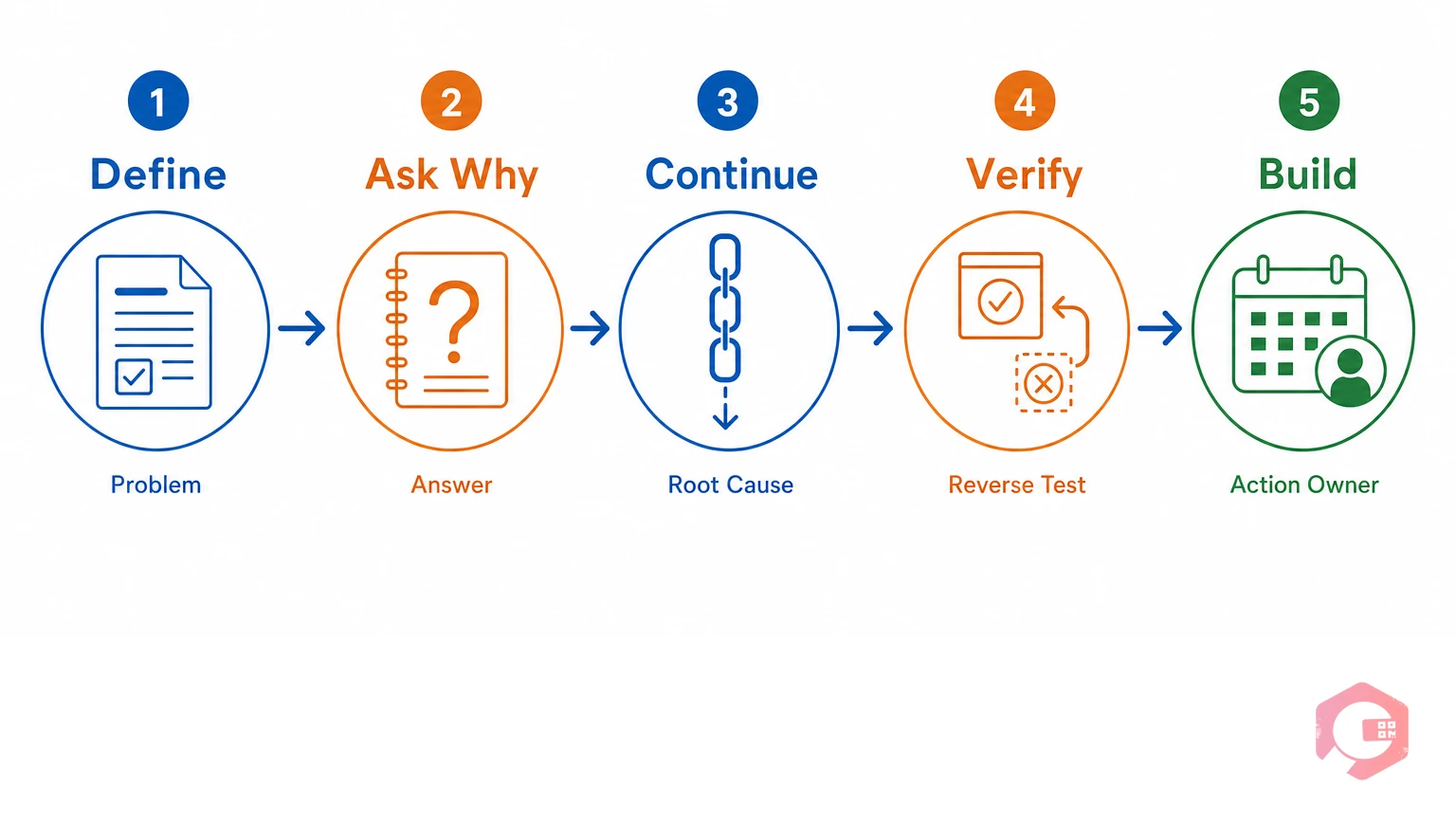
Applying the 5-Why method correctly requires discipline at each step. Here is the complete process your team should follow for every significant equipment failure.
Step 1 — Write a precise problem statement. Vague problem statements produce vague answers. Before asking a single "Why?", capture: what failed, when it failed, where it failed, and the measurable impact. "The machine stopped" is not a problem statement. "The main assembly conveyor stopped at 09:14 on Thursday, halting production for 47 minutes and scrapping 12 units" is. Precision at this step shapes every subsequent answer.
Step 2 — Ask the first "Why?" and record a factual answer. The answer to each "Why?" must be a fact that can be confirmed — not a theory, an assumption, or a blame statement. If you cannot verify the answer, gather more data before proceeding. Guessing your way through a 5-Why chain produces a wrong root cause and a corrective action that fixes the wrong thing.
Step 3 — Continue asking "Why?" until you reach the root cause. The signal that you have reached the root cause is a controllable system gap — a missing PM task, a procedure that doesn't exist, a training gap, a design decision that was never reviewed, or a threshold that was never set. If the next "Why?" leads to "because physics" or "because the equipment is old", back up one step and look for the controllable gap at that level.
Step 4 — Verify the chain by reading it in reverse. Read your cause chain from root to symptom using "therefore": "The PM checklist had no brush inspection item, therefore the brushes wore past their effective height, therefore belt friction increased, therefore the motor ran above rated load, therefore it overheated, therefore thermal protection triggered and the conveyor stopped." If the chain reads logically in both directions, your root cause is valid.
Step 5 — Build a corrective action plan and log it. A root cause without corrective action is just paperwork. Every 5-Why session should produce: a specific corrective action, an owner, a target completion date, and an expected outcome. Log all of this in your maintenance management software against the originating work order so the RCA is searchable and auditable.
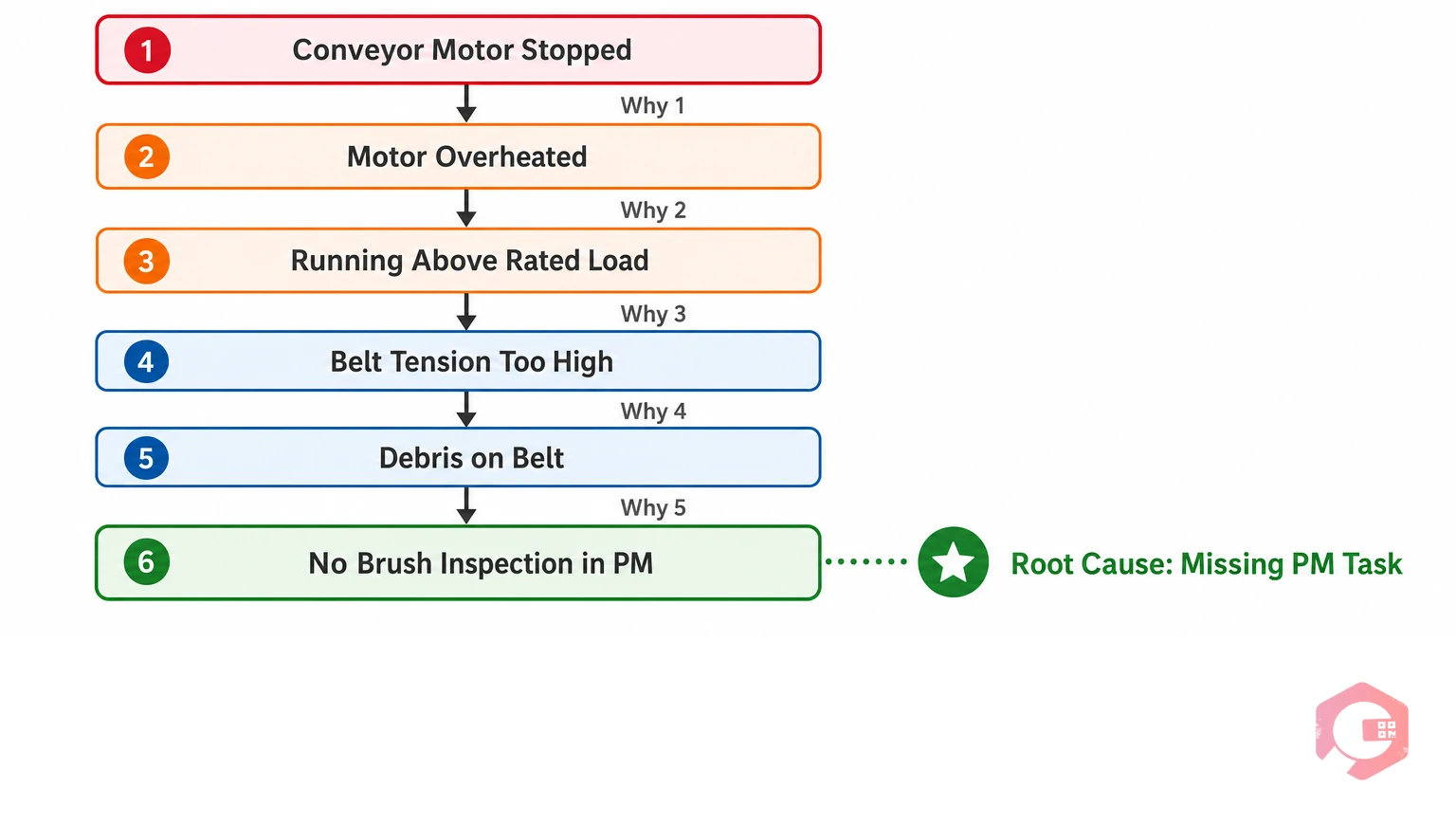
Here is a complete 5-Why investigation for a real-world equipment failure that shows how each step connects to the next.
Problem Statement: The main assembly conveyor stopped at 09:14 on Thursday, halting production for 47 minutes and scrapping 12 units due to incomplete assemblies at the time of stoppage.
Why #1: The drive motor overheated and triggered its thermal protection cutout.
Why #2: The motor was running above its rated load for an extended period.
Why #3: Belt tension had increased significantly beyond the designed operating range.
Why #4: The conveyor belt had accumulated debris buildup that substantially increased friction against the drive system.
Why #5: The belt cleaning brushes had worn below their effective operating height and there was no inspection interval set for brush condition in the preventive maintenance schedule.
Root Cause: No PM task existed for inspecting or replacing conveyor belt cleaning brushes. The brushes were installed when the line was commissioned but were never added to the recurring maintenance schedule.
Corrective Actions:
Note that the third corrective action addresses a systemic gap — the process by which new equipment enters the maintenance programme. That is the difference between 5-Why analysis and reactive repair: one prevents future failures across your entire fleet; the other prevents only this specific failure on this specific asset.
The 5-Why method is simple to describe and surprisingly easy to do poorly. These are the most common errors that cause teams to arrive at the wrong root cause and implement corrective actions that don't stick.
Accepting the first plausible answer. "The bearing failed" is a symptom, not a root cause. Teams under production pressure often stop here because it sounds specific and justifies a repair. Push past the failed component to the conditions that caused it to fail prematurely.
Blaming the operator. "Operator error" is almost never a root cause — it is a symptom of a missing procedure, inadequate training, a confusing interface, or a system that allows errors to propagate. If your chain lands on operator error, ask why the error was possible and why there was no system to catch it.
Using assumptions instead of facts. Each "Why?" answer must be verifiable. If your team cannot confirm the answer with physical evidence, maintenance records, or measurement data, mark it as an assumption and gather the evidence before proceeding. An unverified assumption at step two sends the entire chain in the wrong direction.
Running 5-Why from memory without data. Effective root cause analysis requires downtime tracking records, work order history, inspection reports, and sensor data. If your maintenance team cannot quickly access this data at the point of investigation, the quality of the analysis suffers significantly.
Skipping reverse-chain verification. Many teams finish the forward chain and immediately write corrective actions without checking whether the chain reads logically in reverse. Verification catches logical gaps and confirms that the identified root cause actually explains the observable symptom.
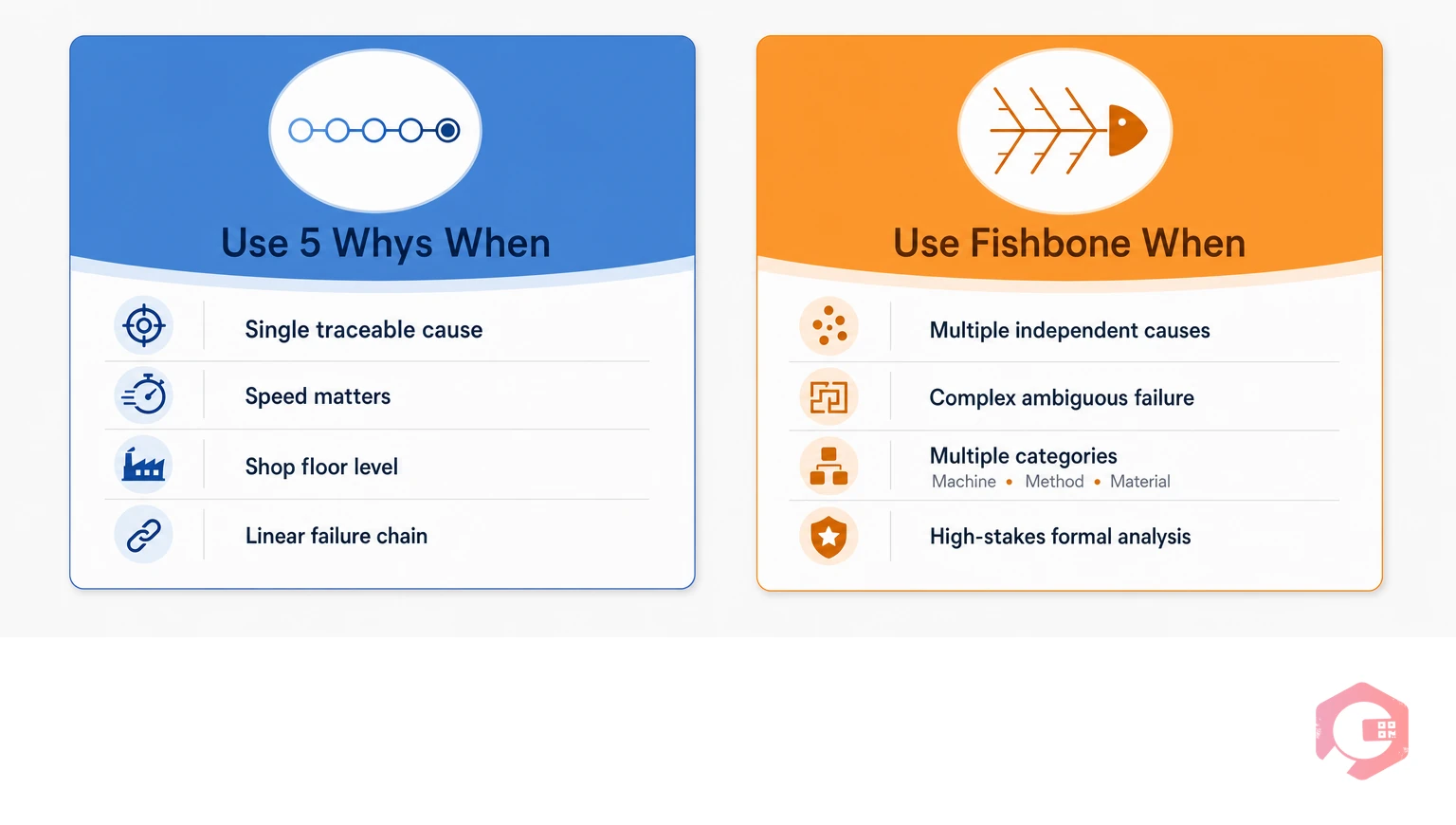
Both tools exist to find root causes, but they work differently and suit different failure types. Choosing the wrong tool wastes time and produces incomplete analysis.
Use the 5-Why method when: the failure is relatively contained and well-defined, the cause chain is likely to be linear, you need a result quickly, and the team has direct knowledge of the failure. The 5-Why method is fast, requires no special templates, and can be completed at the machine by the technicians who responded to the breakdown.
Use a Fishbone (Ishikawa) Diagram when: the failure could have multiple independent contributing causes, you need to systematically explore categories — Machine, Method, Material, Man, Environment, Measurement — and you have time to assemble a cross-functional team. Fishbone analysis suits complex failures where the cause chain is not linear and where different functional groups need to contribute.
Use both together when: the failure is severe enough to justify a full investigation. Use Fishbone to identify all possible cause categories and then 5-Why to drill down into each branch. According to the American Society for Quality (ASQ), the 5-Why method is most effective when the problem is well-defined and the team has firsthand knowledge of the failure event.
For most shop-floor equipment failures, start with 5-Why. Reserve Fishbone for major reliability events, safety incidents, or failures that have already repeated despite prior corrective actions.
A 5-Why investigation captured only as a handwritten note or standalone spreadsheet delivers a fraction of its potential value. When 5-Why findings are recorded directly in your work order management system, every analysis becomes part of a searchable knowledge base that benefits your entire maintenance operation.
When a technician closes a corrective work order in Cryotos CMMS, the 5-Why RCA tool is accessible directly from the work order interface. The technician records the problem statement, each Why-and-Answer pair, the identified root cause, and the corrective actions — all linked to the specific asset, location, and failure mode. That data is then available to:
This compounds over time. A team that logs 50 structured RCA investigations in a year builds an asset-specific failure knowledge base that significantly reduces diagnostic time on future failures, because the cause chain has already been documented and validated. You can standardise the investigation process across your team by using the root cause analysis investigation checklist to ensure every investigation covers the same steps at consistent depth.
Cryotos also aligns with reliability-centred maintenance principles — meaning the RCA data captured in each work order feeds directly into asset reliability profiles, helping your team identify which failure modes warrant more proactive PM investment versus continued reactive response.
The "5" in 5-Why is a guideline, not a fixed rule. For simple failures, you may reach the root cause in three whys. For complex failures, you may need seven. Stop when the next "Why?" leads outside your control, requires unverifiable assumptions, or when the answer is a fundamental system or process gap that a corrective action can directly address. The goal is a controllable root cause, not reaching the number five.
Yes — and this is where teams run into trouble with 5-Why. If a failure has multiple independent contributing causes, a single 5-Why chain will only surface one of them. When your investigation suggests more than one cause branch, either run a separate 5-Why for each branch or switch to a Fishbone diagram that allows you to explore multiple cause categories simultaneously. Fixing only one root cause when two exist will reduce failure frequency but will not eliminate it.
The 5-Why method works poorly for complex failures with multiple simultaneous causes — different investigators asking the same questions often arrive at different root causes depending on their experience and assumptions. It also depends heavily on the knowledge of the people conducting the analysis. For high-stakes failures, always validate findings with measurement data and maintenance records before committing to corrective action.
Failure Mode and Effects Analysis (FMEA) is a proactive tool for identifying potential failure modes before they occur. 5-Why is a reactive tool for investigating failures after they occur. The two are complementary: 5-Why findings should feed back into the FMEA for the affected asset, updating the failure mode library with real-world cause chains that improve the accuracy of future risk assessments and PM task selections.
No — 5-Why analysis is most valuable for failures significant enough to warrant the time investment: unexpected downtime events, safety-related failures, repeat failures on the same asset, and any failure that triggered a quality or production impact. A good rule of thumb is to run 5-Why on any failure that cost more than a defined threshold in downtime or repair cost, or any failure that has occurred more than once in the past 90 days.
Ready to build structured root cause analysis into every work order in your maintenance operation? Schedule a free demo of Cryotos CMMS — the 5-Why RCA tool is built directly into the work order workflow, so your team can run investigations at the machine without switching systems.



Cryotos AI predicts failures, automates work orders, and simplifies maintenance—before problems slow you down.



