

Medical equipment service businesses manage some of the most demanding operational environments in any service industry. Your technicians are skilled. Your intentions are good. But if your operations still run on phone calls, spreadsheets, and individual technicians carrying critical knowledge in their heads — you are quietly losing client trust, revenue, and renewal contracts every single day. This post names the six operational killers that consistently drain life sciences and medical equipment service companies, and shows exactly how purpose-built CMMS software stops each one.
Key Takeaways
Life sciences service companies — those servicing PCR systems, microscopes, analytical instruments, biomedical devices, and diagnostic equipment — operate in one of the strictest compliance environments in any service sector. Clients in clinical labs, pharmaceutical manufacturing, food science, and veterinary research need instruments running within defined parameters at all times. According to the WHO's guidelines on medical equipment management, a structured maintenance programme is foundational to ensuring clinical and research equipment performs reliably and safely — yet the majority of equipment service organisations in this space still manage operations manually.
The consequence is an organisation that is always reacting, never leading. Clients notice the difference between a service partner who calls with a proactive heads-up before a calibration window closes and one who calls to apologise for a failure they should have seen coming. That difference determines renewal rates, referrals, and ultimately the ceiling on your growth.
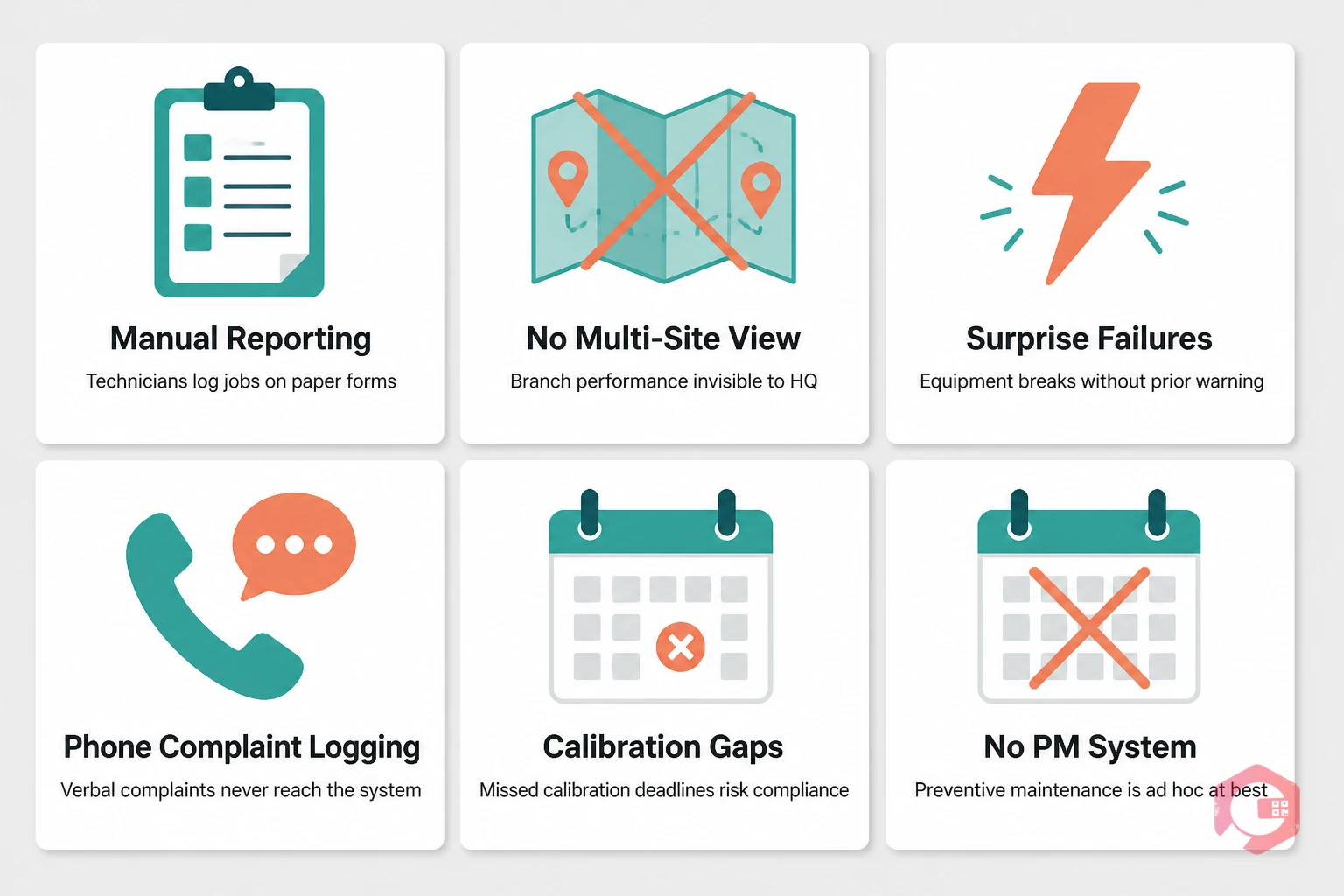
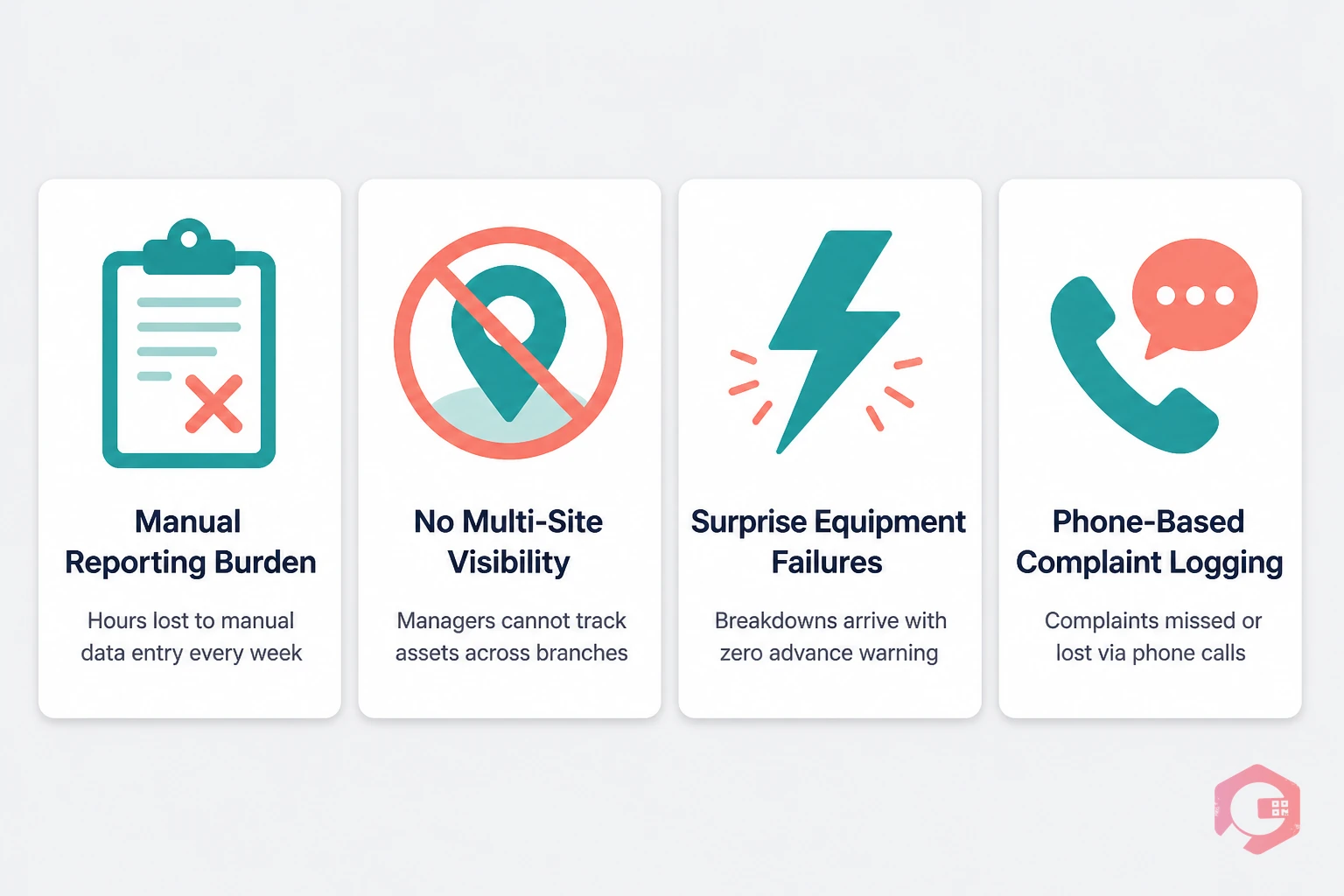
Every client expects a tailored service report — a structured record of what was done, when, and what the equipment's status is. Without the right software, engineers build these manually: pulling data from scattered notes, emails, and spreadsheets, one report at a time. Hours meant for service delivery disappear into paperwork. Reports are inconsistent across engineers. And clients who receive a polished summary from one technician and a patchy email from another draw conclusions about your organisation's quality and consistency.
The fix is automated reporting pulled directly from the work order system — structured, client-specific, and generated without any manual compilation. Engineers close the job; the report builds itself.
Most clients in this sector operate across more than one facility — a central lab, satellite testing locations, a manufacturing site. Without centralised asset management, service histories live in individual technicians' notes, local spreadsheets, or nowhere at all. When a client asks what was serviced at a specific facility three months ago, your team is digging through emails to find out. That hesitation costs credibility fast in a regulated environment where clients expect you to know their equipment as well as they do.
Purpose-built asset tracking software puts every asset across every client site in a single platform — with full service history, calibration records, and upcoming maintenance windows visible in real time, regardless of how many locations your clients operate from.
Reactive maintenance is not just inefficient in medical equipment service — it is reputationally damaging. When an analytical instrument fails without warning, the client experiences unplanned downtime, delayed research, or disrupted diagnostic workflows. Your team is managing a crisis rather than preventing one. The client remembers that their trusted service partner let a failure happen when it could have been caught two weeks earlier.
IoT-integrated condition monitoring changes this dynamic entirely. When instrument parameters drift outside defined thresholds, an automatic alert reaches the service team before the client even notices a problem. This is the shift from reactive to predictive that separates the highest-retention service companies in the sector from those constantly fighting fires.
Clients should not have to call your office to report a problem with their equipment. Every hold time, missed call, or verbal handoff that loses a detail chips away at the service relationship. Worse, because complaints logged by phone are rarely captured systematically, your management team cannot identify recurring problems, track resolution times, or demonstrate responsiveness with data. You appear slower and less organised than you actually are — and in life sciences, perception is reality when contract renewal time arrives.
QR-code-based complaint logging lets a lab technician scan the asset and log the issue in under 60 seconds, directly from the lab bench. The complaint is instantly time-stamped, categorised, and routed to the right engineer — no hold times, no missed calls, no lost detail. The work order management system then tracks the resolution from open to close, giving your team — and your client — full visibility over every issue.
This is the highest-risk gap for any organisation offering life sciences equipment maintenance. The instruments across your client portfolio carry different calibration intervals — monthly for some, quarterly for others, annually for more. Tracking this manually in a spreadsheet is a structural liability. ISO 13485, the international quality standard for medical device management, requires documented evidence that calibration and maintenance schedules are systematically controlled — a requirement that a shared spreadsheet cannot reliably meet.
Something has likely already slipped on your watch. The only question is whether a client or an auditor finds out first. The expiration reminder module in Cryotos tracks every calibration deadline, sends automated alerts before each window closes, and generates audit-ready compliance documentation on demand — not assembled in a panic the night before an inspection.
Different instruments require maintenance at different frequencies: a PCR system has different PM requirements from a water distiller, and both differ from a diagnostic analyser. Without automated PM scheduling, engineers miss planned visits, arrive unprepared for what a specific instrument requires, or schedule conflicting jobs on the same day. Clients notice that their equipment does not receive consistent, structured care. Preventable breakdowns happen. And the data trail that would demonstrate your service quality to clients — and to their quality managers — does not exist.
According to the NIST calibration and traceability guidelines, documented maintenance records are a prerequisite for any organisation claiming traceable calibration status. Without systematic PM scheduling, those records are patchy at best.
Explore how Cryotos CMMS for healthcare addresses all six of these gaps in a single platform built for regulated service environments.
| Operational Killer | What It Costs You | Cryotos Fix |
|---|---|---|
| Manual reporting | Engineer hours lost; inconsistent client documentation | Automated client-specific reports generated from live work order data |
| No multi-site visibility | Can't answer client questions without digging through emails | All assets across all client sites in one real-time platform |
| Surprise equipment failures | Unplanned client downtime; reactive crisis management | IoT condition monitoring triggers alerts before failures occur |
| Phone-based complaint logging | Missed calls; lost complaint detail; slow resolution times | QR code logging from lab bench in under 60 seconds; full resolution tracking |
| Calibration tracking by spreadsheet | Compliance breach risk; audit exposure; contract loss | Automated scheduling, deadline alerts, and audit-ready documentation |
| No PM system | Missed visits; inconsistent care; client credibility erosion | Interval-based PM scheduling per instrument; automated reminders and completion tracking |
The organisations that close these six gaps consistently outperform those that don't on every client retention metric that matters.
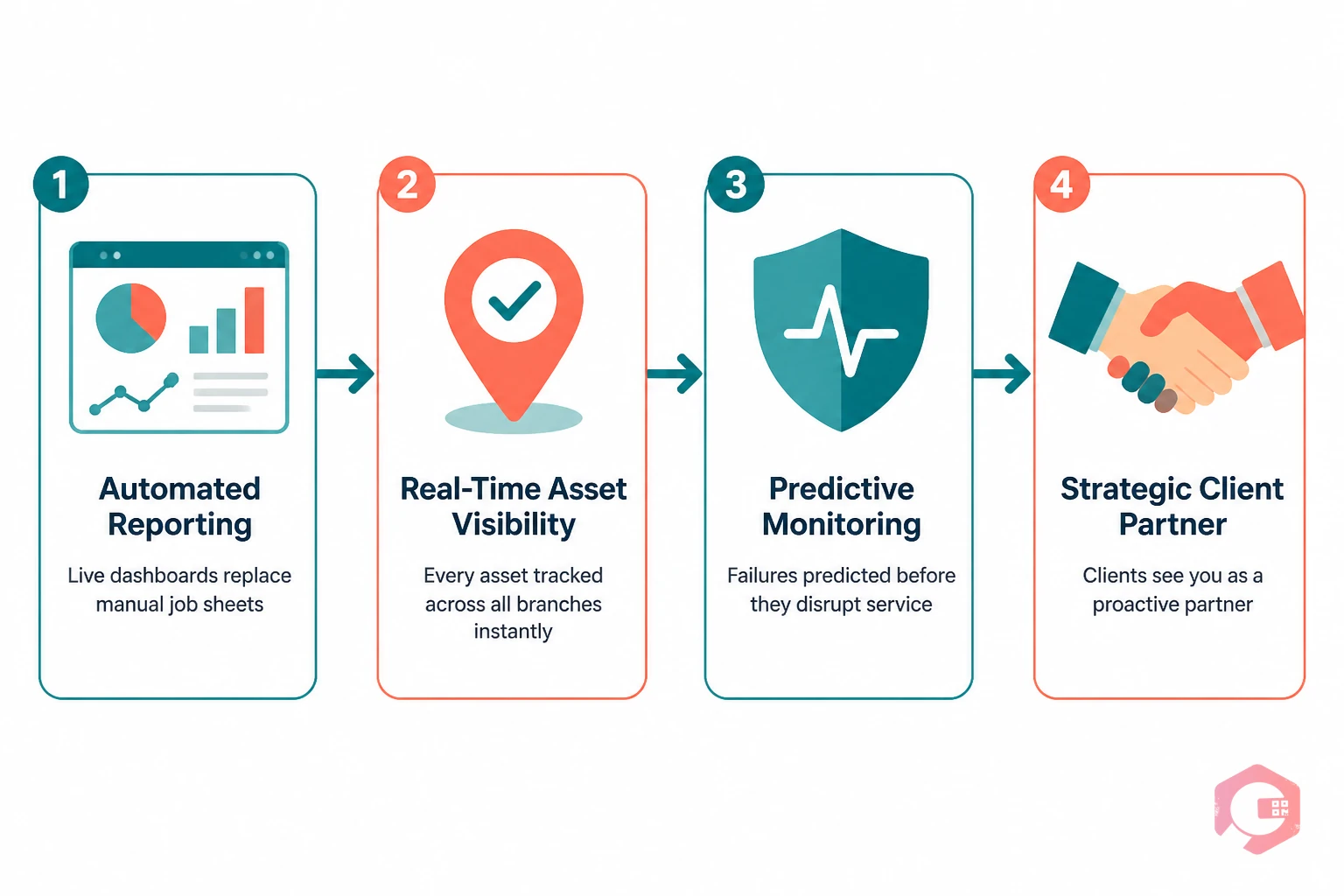
Cryotos is a purpose-built CMMS designed for organisations managing complex, multi-site asset portfolios in regulated service environments. Here is what changes when the six gaps above are closed.
Engineers spend more time on actual service work. When reports generate automatically from closed work orders, and when every calibration reminder arrives before the window — not after — the administrative load that was quietly consuming your most skilled people simply disappears. The preventive maintenance scheduling module handles every instrument's specific interval without manual input. The BI dashboard gives service managers real-time visibility across all clients, all sites, and all upcoming work in one view.
Client relationships shift from transactional to strategic. When clients can scan a QR code to log a complaint and receive an update the same day, when they receive structured calibration documentation without having to request it, and when they see that your team caught a drifting instrument before it affected their workflow — your position changes from vendor to essential service partner. That shift is what drives contract renewals, scope expansions, and referrals.
The data trail becomes a competitive asset. Every PM completion, every calibration event, every complaint resolved and timestamped — the maintenance checklists module captures it all in a documented, auditable record. When a client's quality manager requests service history for an upcoming inspection, you provide a comprehensive, structured report in minutes rather than assembling evidence from scattered sources under pressure.
Cryotos is a strong fit if you recognise yourself in any of the following:
A CMMS (Computerised Maintenance Management System) for medical equipment service is a platform that manages work orders, preventive maintenance schedules, calibration tracking, complaint logging, and compliance documentation for organisations that service clinical, laboratory, and biomedical equipment across multiple client sites. Unlike generic CMMS platforms, those built for regulated service environments include features like audit-ready calibration records, QR-code-based complaint logging, and client-specific reporting.
Calibration tracking software automates the scheduling of upcoming calibration events, sends advance alerts before each deadline, and stores completed calibration records against the specific asset. This means no deadline is missed due to a manual oversight, and compliance documentation is available immediately on demand — rather than being assembled retrospectively when an audit is announced. For organisations operating under ISO 13485 or similar quality management frameworks, this systematic documentation is a core requirement.
Yes. Cryotos stores every asset, at every client site, in a single platform with full service history, calibration status, and upcoming maintenance windows visible in real time. Service managers can filter by client, by site, by asset type, or by upcoming task — giving the multi-site visibility that phone and spreadsheet-based systems cannot deliver.
Each asset registered in Cryotos carries a unique QR code — typically a label attached to the physical instrument. When a client's staff member identifies a problem, they scan the QR code with their phone, fill in a short form describing the issue, and submit it. The complaint is instantly time-stamped, categorised, and assigned to the appropriate service engineer via the work order management system. No phone calls, no hold times, no detail lost in verbal handoffs.
Reactive maintenance means waiting for a device to fail before intervening — repairing it after the breakdown. Preventive maintenance means scheduling inspections and servicing tasks at defined intervals to catch developing problems before they cause failure. For medical equipment, the difference is significant: reactive maintenance leads to unplanned client downtime, compliance risk if a calibrated instrument fails outside its service window, and costs that are typically three times higher per event than equivalent planned maintenance.
Six operational killers are draining medical equipment service businesses right now — and most of them are invisible until a client renewal conversation goes the wrong way. Schedule a free demo to see how Cryotos closes every one of these gaps for your operation — from calibration tracking and PM scheduling to QR complaint logging and automated client reporting.


Cryotos AI predicts failures, automates work orders, and simplifies maintenance—before problems slow you down.



