

Approval workflows in maintenance are structured, multi-step sign-off processes that require designated personnel to review, authorize, and confirm each stage of a maintenance task — from initial request to final completion. According to a Reliable Plant industry study, facilities that implement structured maintenance approval workflows reduce maintenance-related incidents by up to 40% and cut unauthorized work orders by more than half.
A maintenance approval workflow is a defined sequence of authorization steps that a work request must pass through before, during, and after execution. Each step assigns accountability to a specific role — a maintenance planner, safety officer, department manager, or supervisor — who reviews the task against their area of responsibility and either approves it to move forward or flags it for revision.
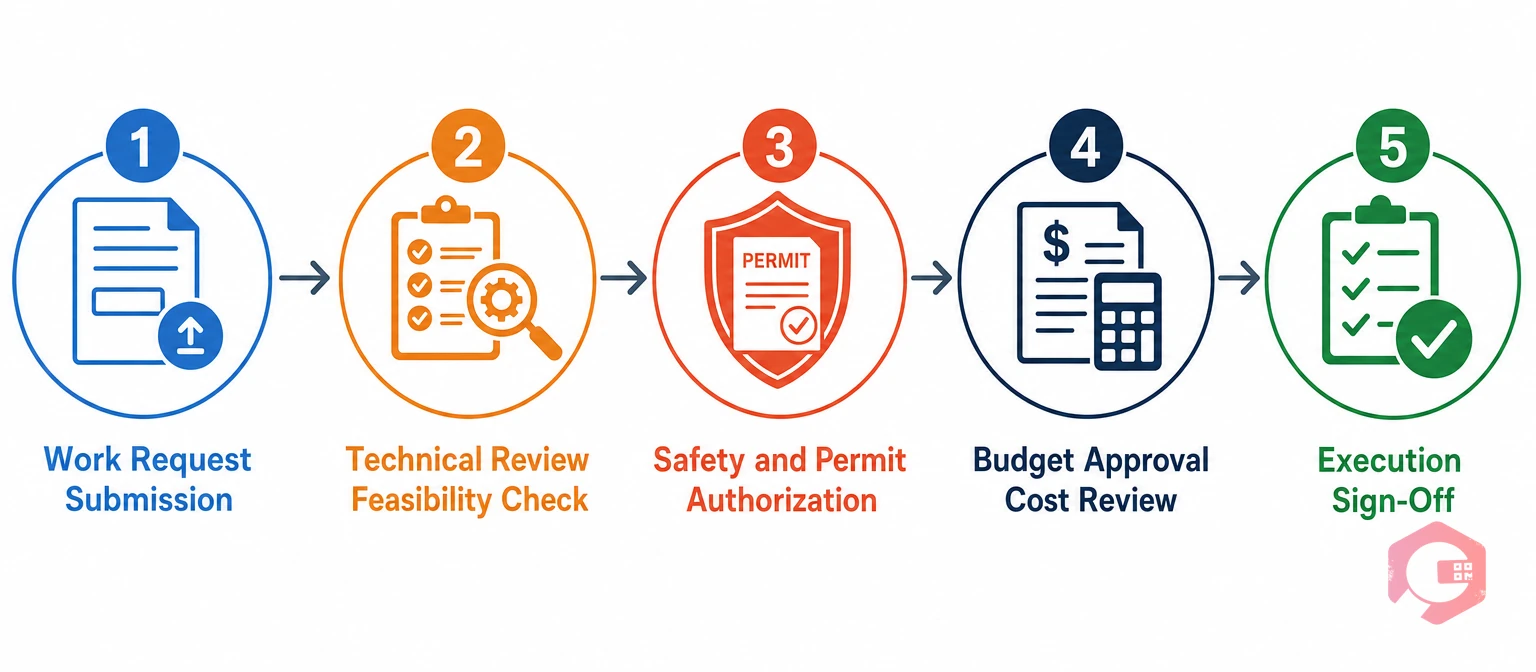
Multi-step approvals require sequential sign-off from multiple roles. A corrective maintenance job on a high-voltage panel might require technical review from the maintenance planner, safety authorization from the HSE officer, budget clearance from the plant manager, and final execution sign-off by the lead technician. Each step creates a verifiable record of who reviewed what and when. OSHA’s Control of Hazardous Energy standard (1910.147) specifically mandates documented authorization before any maintenance on energy-containing equipment.
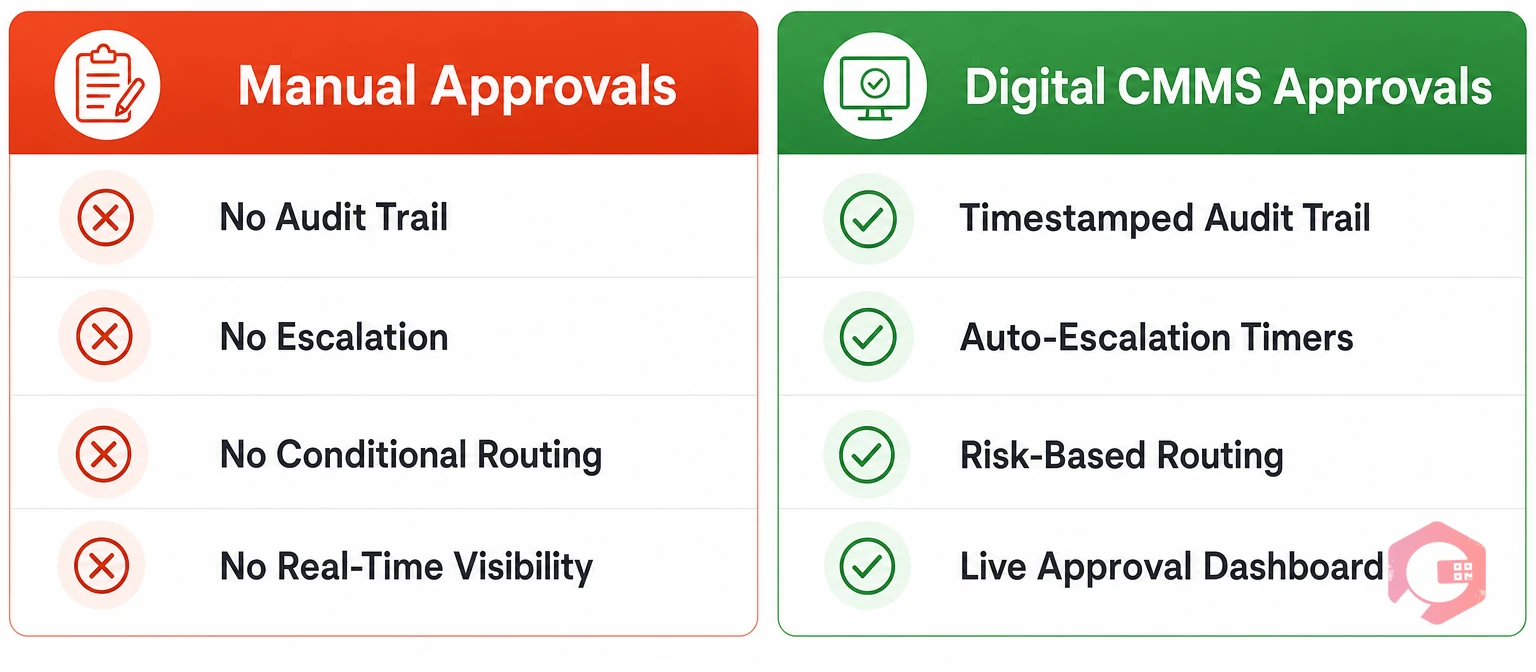
Manual approval workflows — paper sign-off sheets, email chains, WhatsApp confirmations — have four fundamental failure modes that digital workflows eliminate: no audit trail (verbal approvals leave no evidence), no escalation (paper forms don’t escalate themselves), no conditional routing (same path for every request regardless of risk), and no real-time visibility (no way to see which approvals are stalled). Digital workflows timestamp every action, auto-escalate on timers, route by risk tier, and show live approval queues on a dashboard.
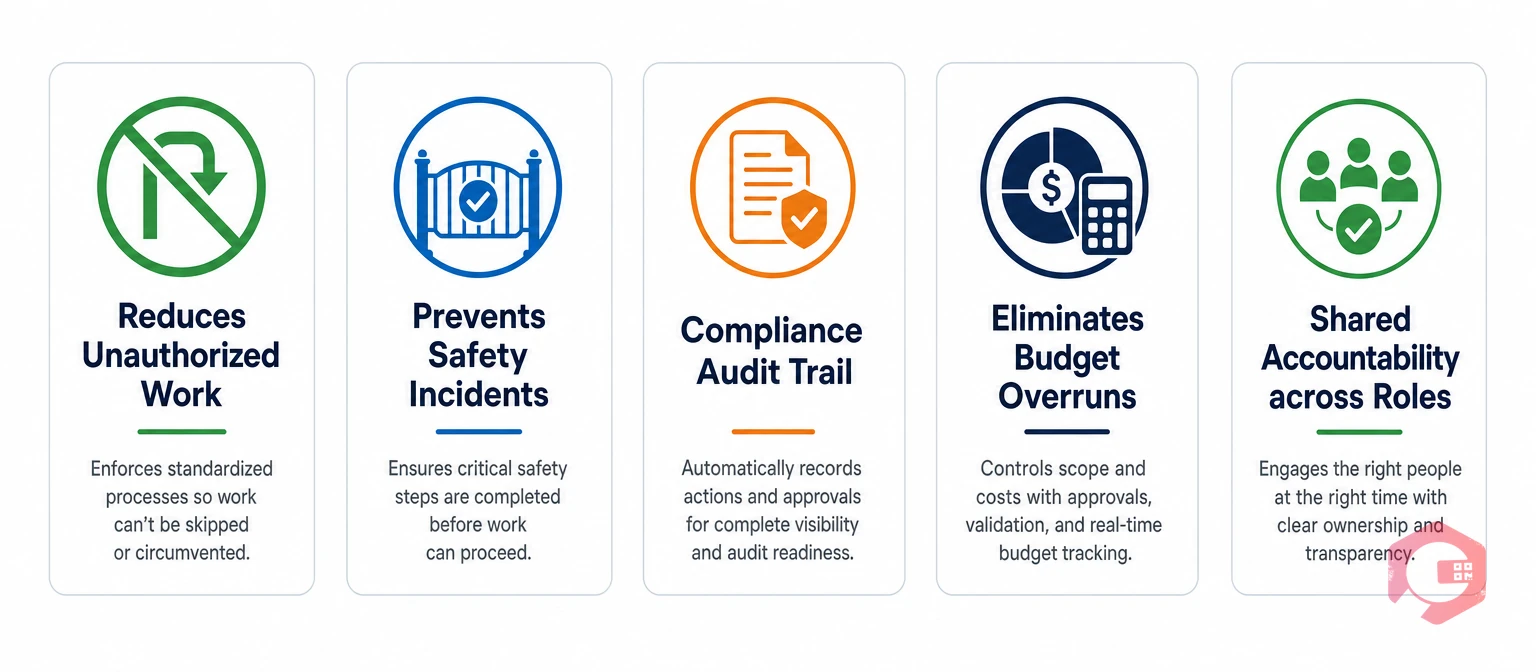
Cryotos’s no-code workflow builder lets maintenance managers configure approval chains for each work order type without writing a single line of code. You define which roles are required at each stage, set threshold conditions that trigger different approval paths, and assign escalation rules for non-responses. The system enforces these rules automatically — a technician cannot accept a work order that has not cleared all preceding approval stages.
Approvers do not need to be at a desktop. Cryotos sends approval requests via mobile push notification, email, or WhatsApp. They can review the full work order context and approve or reject with a single tap. Every approval action is logged with a timestamp and the approver’s identity, creating an immutable audit trail for ISO 55001, ISO 45001, and OSHA 1910.147 compliance.
For maintenance teams still relying on verbal approvals and paper sign-offs, the switch to structured digital workflows is one of the fastest ways to improve both accountability and safety outcomes simultaneously. See how Cryotos can bring structure and traceability to your maintenance approval process at cryotos.com.
A maintenance approval workflow is a structured, multi-step authorization process that a work request must pass through before, during, and after execution. Each step requires a specific role to review the work and digitally confirm authorization, creating a complete auditable record of who approved what and when.
It depends on the risk level. Low-risk routine tasks need one or two approval steps. Medium-risk corrective work requires three to four stages. High-risk tasks involving hazardous energy, confined spaces, or significant cost typically need five stages. A well-configured CMMS applies the appropriate approval depth based on the work order’s risk classification automatically.
Yes. A CMMS like Cryotos automates the entire approval chain — routing requests to the correct approvers, sending notifications via mobile, email, or WhatsApp, escalating automatically when approvals are not acted on within defined time windows, and logging every action with a timestamp for compliance reporting.




Cryotos AI predicts failures, automates work orders, and simplifies maintenance—before problems slow you down.



