
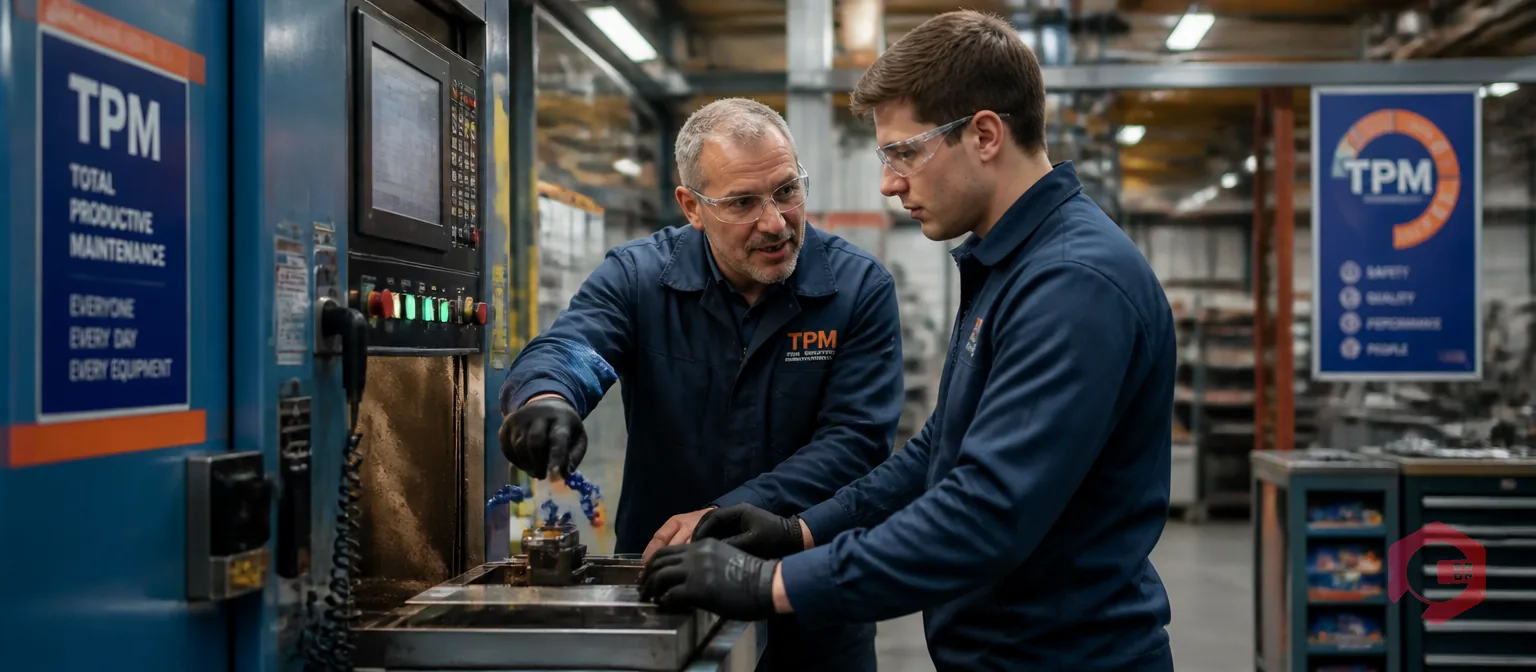
Training for autonomous maintenance teams is the structured program that teaches equipment operators how to detect abnormalities, perform basic servicing, and take daily ownership of machine health — without relying on the maintenance department for every minor task. According to a Plant Engineering survey, facilities with mature autonomous maintenance programs achieve up to 40% fewer unplanned breakdowns and 25% higher Overall Equipment Effectiveness (OEE) than those without. The difference between an AM program that transforms a facility and one that quietly fades after launch is almost always training quality.
Autonomous maintenance (AM) is the first and most foundational pillar of Total Productive Maintenance (TPM). It shifts basic machine care — cleaning, lubrication, inspection, tightening — from specialist maintenance technicians to the operators who work with the equipment every day. But operators don't arrive on the shop floor knowing how to read a lubrication label, identify a bearing that's running hot, or fill in a one-point lesson. They need a training program that builds both the knowledge and the habit.
This guide covers exactly what that training looks like: the skills required, the curriculum tied to each of the 7 AM steps, who delivers it, how long it takes, and how to measure whether it's working.

Autonomous maintenance is a systematic process in which production operators are trained to clean, inspect, lubricate, and make minor adjustments to their equipment — tasks traditionally reserved for specialist maintenance technicians. It is the first pillar of Total Productive Maintenance (TPM), the production philosophy originally developed in Japan in the 1970s and now used by manufacturers worldwide from automotive to food processing to pharmaceuticals.
The core premise of AM is straightforward: the person who runs a machine every day is in the best position to notice when something isn't right. A slight change in sound, a vibration that wasn't there last week, a fitting that's started to weep — operators who know their equipment notice these things. Operators who have never been shown what to look for do not. Training is what creates the difference.
TPM has eight pillars: autonomous maintenance, planned maintenance, quality maintenance, focused improvement (Kaizen), early equipment management, training and education, safety and health, and office TPM. Autonomous maintenance underpins almost all of them. Without operators taking ownership of basic machine care, the planned maintenance schedule becomes reactive, quality defects linked to equipment condition go undetected, and Kaizen activities lack the shop-floor data to be meaningful.
AM is structured as a seven-step progression, each step building on the last. A team that skips steps or rushes through the training phase typically ends up with a program that looks good on paper but produces no measurable change in OEE, downtime, or maintenance costs.
The most common reason AM programs underdeliver is inadequate frontline training. Operators are handed a checklist, told to "own their machine," and left without the foundational knowledge to know what they're looking at. A maintenance technician who has spent years learning to read vibration signatures and diagnose hydraulic leaks cannot transfer that knowledge to an operator with a 30-minute briefing. It takes a deliberate, phased training curriculum tied to each step of the AM journey.
A Lean Enterprise Institute analysis of TPM implementations found that the top predictor of long-term AM success was training investment in the first six months. Plants that invested at least two hours of structured training per operator per AM step saw sustained OEE improvements averaging 12–18%. Those that treated training as a briefing rather than a curriculum saw gains erode within 12 months.

Each of the seven AM steps requires operators to learn a new set of skills and apply them consistently before progressing to the next stage. Rushing this process is the most common implementation mistake. Here is what training should cover at each step.
The first step is not just cleaning the machine — it is training operators to use cleaning as an opportunity to inspect. When an operator wipes down a machine and understands what they're looking for, they detect contamination sources, oil seepage, loose fasteners, and wear marks that would otherwise go unnoticed for months.
A plant that pilots Step 1 on a single production line before scaling typically discovers 15–30 previously unknown defects per machine in the first clean. This data becomes the baseline for everything that follows.
Step 2 training focuses on root cause thinking. Operators are taught not just to clean, but to ask why contamination keeps returning. Training at this stage includes problem-solving techniques such as the 5 Whys, and basic engineering skills to implement kaizen improvements that reduce or eliminate contamination sources.
This step requires the most intensive technical training in the early AM program. Operators learn to perform lubrication tasks correctly — not just to apply grease, but to apply the right type, in the right amount, at the right interval, through the right method. Incorrect lubrication is one of the leading causes of bearing failure in manufacturing, responsible for more than 50% of bearing failures according to SKF's bearing failure analysis research.
Step 4 is a significant step up in technical depth. Operators receive structured training in inspecting mechanical, electrical, pneumatic, and hydraulic systems at a level that allows them to detect deterioration before it becomes failure. This is where AM training most closely resembles maintenance technician training, and it typically takes the longest to complete.
Step 4 training is typically delivered in modules over several weeks, with written and practical assessments at each module. A plant in the automotive sector that implemented structured Step 4 training found that operators identified 23 developing failures over a six-month period that would have resulted in unplanned downtime — with an estimated avoided cost of $340,000.
By Step 5, operators have absorbed enough knowledge to conduct consolidated inspections from a single, operator-owned checklist. Training at this stage shifts from technical skills to process ownership — operators learn to manage their inspection schedule, prioritise tasks when time is short, and escalate findings correctly to the maintenance team.
Training at Step 6 connects machine condition to product quality. Operators learn that many quality defects — dimensional variation, surface finish problems, contamination of product — trace back to machine conditions they can now detect and control. This step requires training in quality control fundamentals and how to use quality data to identify machine-related root causes.
The final step shifts full responsibility for standardisation, continuous improvement, and training of new operators to the AM team itself. The training at Step 7 focuses on facilitation skills, Kaizen leadership, and how to sustain a discipline of continuous improvement without external coaching. Teams that reach this stage are typically running OEE improvement projects, mentoring other lines, and feeding data into the plant's planned maintenance schedule.
Regardless of industry or equipment type, there are five foundational skill areas that every AM training program must cover. These cut across all seven steps and form the basis of operator competence.
Operators need to understand how their specific equipment works — not at engineer level, but well enough to recognise when it isn't working correctly. This means knowing the function of each major component, the normal operating parameters (sound, temperature, cycle time), and the most common failure modes for that machine type. This knowledge is built through structured "equipment education" sessions delivered by maintenance technicians or equipment OEM trainers.
These hands-on skills require demonstration and supervised practice, not just classroom instruction. Operators need to be able to apply the correct lubricant to the correct point using the correct method, identify overtightened or loose fasteners, and clean equipment in a way that reveals rather than conceals condition information. These skills are perishable — they require regular practice and periodic reassessment to stay sharp.
The ability to detect something "not quite right" and communicate it clearly is arguably the most valuable skill an AM operator can develop. Training in abnormality detection covers sensory inspection techniques (look, listen, feel, smell), threshold criteria for each type of abnormality, and how to document and report findings in a format that is useful to the maintenance team. A plant where operators can detect abnormalities early and report them accurately runs at a fundamentally different reliability level than one that depends entirely on maintenance to discover problems.
Any expansion of operator maintenance activities must be grounded in safety. OSHA's Lockout/Tagout standard (1910.147) requires documented energy control procedures before any maintenance-related task on equipment. AM training must include LOTO fundamentals for all operators who will access machine guarded areas, adjustment points, or lubrication fittings that require stopping the machine. This is non-negotiable and should be completed before any hands-on AM activity begins.
Modern AM programs rely on digital checklists, mobile work order logging, and QR code-based asset access. Operators need basic training on the CMMS mobile app they'll use to complete inspections, log findings, raise work requests, and access one-point lessons. This is typically a 1–2 hour session but has a significant impact on data quality and program visibility — operators who know how to use the app correctly produce far more useful maintenance data than those who fall back on paper or verbal reporting.
One of the most common questions facilities ask when starting an AM program is who should run the training. The answer depends on what's being taught and at what stage of the program.
External TPM consultants bring structured curriculum, benchmarks from other facilities, and experience accelerating programs that have stalled. They are most valuable at the beginning — designing the training framework, facilitating the first pilot line, and building internal capability. A typical engagement runs 6–12 months for a first-site rollout, with consultants progressively stepping back as internal coaches develop.
In-house TPM coaches are essential for long-term sustainability. Most facilities identify two to four operators or team leaders per shift who have the communication skills and technical aptitude to become certified AM coaches. These individuals receive deeper training — sometimes including external TPM certification — and become the primary delivery mechanism for training on new lines and for new operators. A plant that depends entirely on external consultants for AM training will see the program atrophy the moment the engagement ends.
Maintenance technicians often feel threatened by AM — the perception that operators are taking over their work. The best AM implementations reframe this. Maintenance technicians become teachers and standards setters. They are the ones who deliver Step 3 lubrication training, create one-point lessons, and validate that operator inspections are being done correctly. This shift from "maintenance does the work" to "maintenance defines the standard" is itself a cultural change that requires deliberate communication and, often, management reinforcement.
There is no single answer — it depends on equipment complexity, operator baseline knowledge, training intensity, and how rigorously each step is assessed before the team progresses. But the following benchmarks reflect what mature AM programs typically experience:
For a new AM team on a single production line, budget 12–18 months to reach Step 5 maturity. Full Step 7 capability typically takes 2–4 years. Rushing this timeline consistently produces programs that achieve early wins and then plateau — or reverse.
AM training effectiveness must be measured at two levels: individual competency (can the operator actually do the task correctly?) and program performance (is the AM activity producing measurable results on the equipment?). Both are necessary — high competency scores with no OEE improvement indicate a compliance problem; improving OEE without assessing individual competency makes the gains fragile and person-dependent.

A modern CMMS software platform is the operational backbone of a sustainable AM program. Without it, training outcomes fade as paper-based checklists get lost, findings go unrecorded, and managers have no way to verify that AM tasks are being completed. With it, AM becomes a measurable, auditable, continuously improving system.
Plants using Cryotos as their AM management platform consistently report improved compliance rates and reduced reactive maintenance within the first six months of deployment. The combination of digital checklists, automatic work order generation, and real-time dashboards closes the feedback loop that paper-based AM programs can never close — and makes the training investment in operators visible, measurable, and sustainable.
Safety training, specifically Lockout/Tagout (LOTO) procedures, should come first — before any hands-on AM activity begins. Once that foundation is in place, equipment anatomy training helps operators understand what they will be cleaning, inspecting, and lubricating, and why each task matters. Starting with equipment knowledge and safety creates the foundation that every subsequent AM step builds on.
A rigorous AM training program typically requires 40–80 hours per operator to reach Step 4 competency, delivered over 6–12 months in a combination of classroom sessions, on-machine demonstrations, supervised practice, and practical assessments. The exact number depends on equipment complexity and the depth of inspection skills required. Facilities that compress this into a few days of training consistently report lower compliance rates and faster program decay.
Start with a pilot team on a single production line — typically six to twelve operators across all shifts, plus their shift supervisors. Choose a line with engaged operators and a maintenance team willing to act as trainers. Early success on the pilot line builds credibility for the broader rollout and allows the training curriculum to be refined before it reaches the full plant population.
Yes, but only if you have someone internally with both the TPM knowledge and the training facilitation skills to design and deliver the curriculum. Many facilities use external consultants for the first year to design the program and build internal coach capability, then transition fully in-house. Attempting to self-deliver a structured AM program without any external input or reference curriculum is possible but produces highly variable results.
A CMMS reinforces training in daily practice by giving operators digital checklists that specify exactly what to inspect, how, and to what standard — effectively embedding the training outcome in the task itself. When operators complete a digital inspection and log a finding, they are practising the detection and reporting skills they were trained on. When the system automatically tracks compliance rates, it makes the quality of training visible and creates accountability without manual monitoring.
AM coaches don't typically need formal external certification to be effective, though certifications from bodies like the Japan Institute of Plant Maintenance (JIPM) exist for facilities pursuing world-class TPM recognition. More important than credentials are deep equipment knowledge, the ability to communicate technical content clearly to production operators, and the credibility that comes from having been through the AM journey themselves on the shop floor.
Building a capable autonomous maintenance team takes time — 12–18 months to reach functional independence on a single line, and several years to achieve the self-sustaining, continuously improving program that TPM's founders envisioned. But the investment pays back in every metric that matters: fewer unplanned breakdowns, higher OEE, lower maintenance costs, and a workforce that is genuinely engaged with the reliability of the equipment they operate.
If your facility is building or scaling an autonomous maintenance program, Cryotos CMMS gives your operators the digital tools to execute AM tasks correctly every shift — with mobile checklists, automatic work order generation from inspection findings, and real-time dashboards that show management whether the training investment is producing results. Book a free demo and see how leading manufacturers use Cryotos to make autonomous maintenance measurable and sustainable.


Cryotos AI predicts failures, automates work orders, and simplifies maintenance—before problems slow you down.



