An autonomous maintenance program is a structured approach in which machine operators — not just maintenance technicians — take responsibility for the routine care of their equipment. It is the foundational pillar of Total Productive Maintenance (TPM), covering cleaning, inspection, lubrication, and minor repairs that operators carry out daily to keep assets in peak condition. According to a Reliable Plant industry analysis, facilities that implement a mature autonomous maintenance program reduce unplanned downtime by 30–50% within two years — primarily because defects are caught at the source before they escalate into breakdowns.
What autonomous maintenance involves in practice:
Autonomous maintenance is the practice of training production operators to perform basic maintenance activities — cleaning, inspection, lubrication, tightening, and minor adjustments — on the machines they operate. Instead of relying entirely on a separate maintenance department for every task, operators become the first line of defence against equipment deterioration.
The logic is straightforward: operators spend more time with their machines than any maintenance technician ever will. They hear when a bearing starts to sound different. They notice when a seal starts weeping oil. They feel when a belt begins to slip. An autonomous maintenance program formalizes that awareness and gives operators the training, tools, and authority to act on it.
Preventive maintenance and autonomous maintenance are complementary, not interchangeable. Preventive maintenance (PM) is scheduled, technician-led maintenance carried out at defined intervals — oil changes, belt replacements, filter swaps. Autonomous maintenance is operator-led, condition-driven, and continuous.
Think of it this way: PM is the scheduled service your car gets every 10,000 kilometres. Autonomous maintenance is you checking the tyre pressure every week, wiping down the engine bay, and immediately booking it in when you hear an unusual sound. Both are essential. Neither replaces the other.
Autonomous maintenance derives from the Japanese concept of Jishu Hozen — literally "voluntary maintenance" or "self-management maintenance." It was developed as part of the Total Productive Maintenance (TPM) methodology in Japan during the 1970s and formalized by the Japan Institute of Plant Maintenance (JIPM). TPM defines eight pillars of manufacturing excellence, and Jishu Hozen is the second pillar — built on the conviction that operators who understand their machines will prevent far more failures than a maintenance department working in isolation ever could.
Most production floors operate with a clean separation between "operators run the machines" and "maintenance fixes the machines." This division feels logical but creates a gap — nobody owns the gradual deterioration that happens between scheduled maintenance visits. Dust accumulates in cooling vents. Fasteners vibrate loose. Lubricant levels drop. None of these are dramatic failures on their own, but compounded over weeks they are the direct cause of most unplanned breakdowns.
Autonomous maintenance closes that gap by making operators responsible for the daily condition of their equipment — not as an added burden, but as a natural extension of knowing their machines well.
The financial argument for autonomous maintenance is compelling. According to McKinsey research on manufacturing operations, reactive maintenance costs 3–5 times more per repair event than planned maintenance of equivalent scope. A motor bearing replacement scheduled during a maintenance window costs perhaps $400 in parts and two hours of labour. The same failure occurring unplanned during a production run can cost $400 in parts, eight hours of emergency labour, four hours of lost production, and sometimes secondary damage to surrounding equipment — taking the total well past $5,000.
Overall Equipment Effectiveness (OEE) — the gold standard metric for production performance — is directly improved by autonomous maintenance. OEE has three components: Availability, Performance, and Quality. Autonomous maintenance improves all three. Availability rises because unplanned stoppages drop. Performance stabilises because machines run at rated speed without the micro-stoppages caused by contamination or loose components. Quality improves because machines in good condition produce parts within specification more consistently.
World-class manufacturing plants target OEE above 85%. Most plants starting an AM program operate between 50–65% OEE. A structured autonomous maintenance rollout typically contributes a 5–15 percentage point OEE improvement within 18 months, according to Plant Engineering benchmarks.
A common concern is that operators will resist autonomous maintenance as extra work. In practice, the opposite tends to happen once the program is properly introduced. Operators who understand their machines experience far fewer stressful emergency breakdowns during their shifts. They spend less time waiting for maintenance technicians to arrive. They gain skills and knowledge that increase their value and often their job satisfaction. Many operators report that AM training was the first time anyone explained to them why their machine behaves as it does — a change in perspective that fundamentally improves how they operate it.
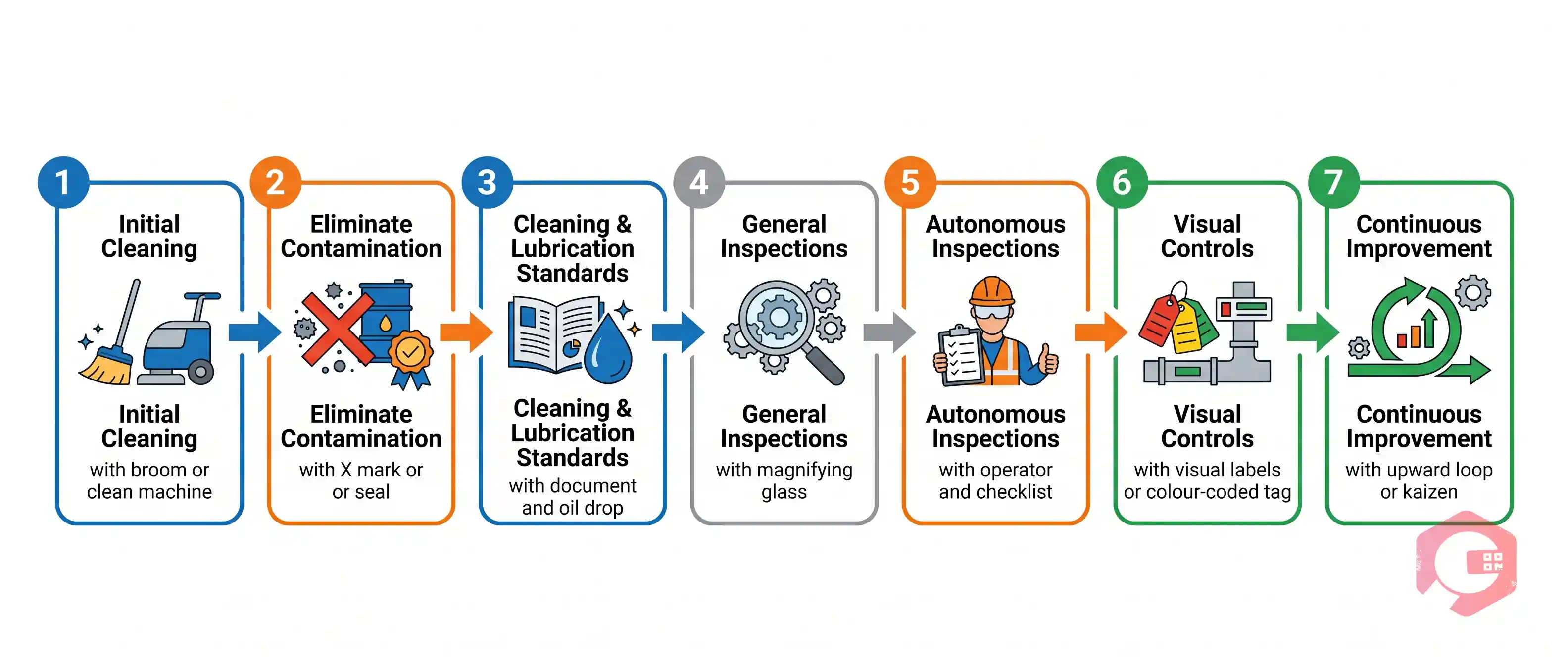
The JIPM-defined autonomous maintenance framework follows seven steps, each building on the last. Progress through these steps is not measured in weeks — a mature AM program typically takes two to three years to reach Step 7. What matters is completing each step thoroughly before moving to the next. Rushing through the steps produces compliance without capability, which defeats the purpose of the program.
The first step is a thorough, hands-on cleaning of the equipment — not the daily wipe-down an operator might do, but a deep clean that returns the machine to near-new condition. Every surface is cleaned, every panel opened, every reachable component inspected. The goal is twofold: restore the machine to its original state, and give the operator their first real inspection of every component they will now be responsible for maintaining.
During Step 1, operators use defect tags — typically red tags for safety and functional issues, blue tags for maintenance department follow-up — to mark every abnormality they find. This is often the most eye-opening part of the entire program. On a typical production floor starting an AM program, the initial deep clean of one machine can produce 20–40 tagged defects that nobody knew existed. This isn't a sign that the program is failing — it's evidence of why it was needed.
Step 2 addresses the root causes of what makes keeping equipment clean difficult in the first place. If a machine leaks hydraulic oil, the answer is not to clean it more frequently — it is to fix the leak. If a filter housing requires removing eight bolts every time it needs checking, the design should be modified to allow quicker access.
This step requires collaboration between operators and maintenance engineers. Operators know exactly which areas are difficult to access and why contamination recurs. Engineers have the technical knowledge to redesign access points and eliminate contamination at source. Together, they reduce the time required for daily AM tasks and make the standard achievable on every shift.
Once the machine is clean and contamination sources are controlled, Step 3 formalises how it stays that way. Operators and maintenance technicians collaboratively develop written standards covering what to clean, where to lubricate, what lubricant to use, how much to apply, and how frequently each task must be done.
These standards should be clear enough that a new operator coming on shift can follow them without asking questions. Visual aids — photos showing correct lubrication points, colour-coded labels on lubricant types, flow arrows on cleaning routes — are built directly into the standard. The output of Step 3 is a one-page visual standard per machine that operators can reference during their daily AM rounds.
Step 4 expands the operator's inspection capability beyond cleaning and lubrication to the mechanical, electrical, hydraulic, and pneumatic systems of their machine. This requires formal training — operators cannot be expected to inspect systems they don't understand. Training at Step 4 typically covers how to read pressure gauges correctly, what normal vibration patterns feel like, how to check belt tension, and how to identify early signs of bearing wear.
The standard developed in Step 3 is updated to include these inspection points. Operators are not being asked to perform maintenance technician tasks — they are being asked to recognise and report deviations from normal. The maintenance team retains responsibility for any corrective work that results from those reports.
By Step 5, operators have the knowledge and established routines to conduct comprehensive inspections without direct supervision or prompting. The cleaning and inspection standards from Steps 3 and 4 are merged into a single, efficient AM daily checklist that each operator completes at the start of their shift.
At this stage, the maintenance department's role shifts from doing routine work to auditing that the AM system is working correctly. Maintenance technicians focus their time on work that genuinely requires technical skill — complex repairs, predictive maintenance analysis, overhauls — while operators own the daily health of their machines.
Step 6 applies 5S principles and visual management across the entire work area — not just individual machines. Colour coding on pipework (which lines carry which fluid), direction indicators on rotating components, min-max marks on fluid levels, shadow boards for tools — all of these make the normal state of the equipment immediately visible to anyone walking the floor, including supervisors, auditors, and other teams.
Visual controls are particularly valuable for shift handovers. When the outgoing operator has followed a standardised AM checklist and every abnormality is visually marked, the incoming operator can assess the machine's status in minutes rather than relying on a verbal briefing that may be rushed or incomplete.
Step 7 is the mature state of autonomous maintenance, where operators are not just executing a checklist but actively contributing to improving it. They analyse their own defect data, identify recurring issues, propose engineering solutions, and participate in KAIZEN improvement activities. The AM program becomes a self-sustaining continuous improvement loop rather than a compliance exercise.
At this stage, OEE data from individual machines is reviewed by operators alongside maintenance data, and operators understand how their AM activities directly affect the performance metrics the business tracks. This level of engagement typically takes 24–36 months to reach from a cold start — but the production floor that achieves it operates fundamentally differently from one that doesn't.
Before beginning an AM program, use this checklist to assess where your facility stands and identify the gaps that need addressing first. A "No" answer on any item doesn't mean you can't proceed — it means you know what to build before you launch.
Autonomous maintenance programs fail for predictable reasons. Knowing these challenges in advance allows you to design around them.
The most common objection from operators is "that's not my job." This is an understandable response when AM is introduced as additional unpaid responsibility without adequate training or recognition. The solution is to frame AM correctly from the start: operators are gaining skills, reducing the emergency breakdowns that disrupt their shifts, and being given authority over the condition of machines they depend on. Piloting with volunteers rather than mandating participation from day one significantly reduces resistance.
Some maintenance technicians resist AM programs because they interpret operator involvement as a threat to their roles. In reality, AM frees maintenance professionals to do the higher-skill work they were trained for — not routine oil-checks and wipe-downs. Communicating this clearly and involving maintenance teams in developing AM standards (rather than having standards imposed on them) makes the difference between a cooperative transition and an adversarial one.
AM training requires time — time that is directly competing with production output. Facilities that rush the training phase to minimise production impact consistently produce operators who can complete a checklist without understanding why. When those operators encounter something unusual that isn't on the checklist, they don't know how to assess it. Proper AM training requires four to eight hours per operator at each step — more for complex equipment. This investment pays back many times over in avoided breakdowns, but it must be made genuinely, not superficially.
Operators who diligently tag defects and see nothing happen for weeks will stop tagging them. A defect tag system without a resolution commitment is worse than no system at all — it trains operators that AM activities are bureaucratic box-ticking. Every defect tag must have a defined owner, a target resolution time, and a feedback loop that tells the operator what was done. According to ISPE research on maintenance effectiveness, facilities with a formal defect resolution SLA resolve issues 60% faster than those with ad hoc processes.
Equipment changes. Operating conditions evolve. New operators join. AM standards written at Step 3 and never updated become inaccurate and then ignored. A formal standard review cycle — at minimum once per year, or whenever significant equipment changes occur — keeps AM checklists current and credible.
A CMMS (Computerized Maintenance Management System) doesn't implement autonomous maintenance for you, but it is the infrastructure that makes AM scalable, trackable, and sustainable. Without a CMMS, AM programs tend to run on paper checklists, whiteboard defect counts, and verbal handovers — all of which fail at scale.
The most immediate CMMS capability an AM program depends on is digital checklists. Operators completing a daily AM round should be able to do so on a mobile device, marking each checklist item as pass or fail, attaching a photo when they identify an abnormality, and submitting the completed inspection with a timestamp and digital signature. This creates a compliant, searchable record of every AM activity without paper.
When an operator identifies a defect — equivalent to placing a physical red or blue tag — the CMMS converts that directly into a work order. The work order captures the defect description, the operator who identified it, the machine and location, and the time of discovery. It is automatically assigned to the appropriate maintenance team with a priority level and target completion date. The operator is notified when the work order is closed, completing the feedback loop that keeps them engaged in the program.
Preventive maintenance schedules in the CMMS can be configured to include AM tasks alongside technician-led PM tasks, giving the maintenance planner a unified view of all scheduled work across both operator and technician responsibilities. This prevents scheduling conflicts — for example, a technician arriving to service a machine at the same time an operator is mid-way through their AM inspection.
Cryotos CMMS is built for the kind of fast-moving, mobile-first maintenance environment that autonomous maintenance requires. Operators can raise defect work orders via voice command or by photographing the problem directly — the system's generative AI analyses the image and pre-populates the work order description, removing the friction that causes AM activities to get deferred. QR codes on each machine give operators instant mobile access to their AM checklist and the machine's full maintenance history without needing to search.
The Cryotos BI Dashboard tracks AM-specific metrics in real time: daily inspection completion rates by machine and shift, open defect tag counts, average defect resolution time, and MTBF trends for machines enrolled in the AM program. This data lets maintenance managers see immediately which machines have AM compliance gaps, which shifts are underperforming on their AM rounds, and whether the AM program is producing the expected improvement in asset reliability.
Cryotos's work order management supports the role separation that AM requires. Operators generate AM-type work orders — tagged as operator-identified defects — while maintenance technicians manage their own PM and corrective work queues. Supervisors see both queues with full prioritisation, ensuring that high-urgency operator-identified defects are not buried under scheduled PM work. Teams using Cryotos report a 30% reduction in unplanned downtime and 25% faster repair times — results that an active autonomous maintenance program directly amplifies by catching problems earlier and reducing the volume of emergency corrective work reaching the maintenance queue.
Integrating Cryotos with IoT sensors takes autonomous maintenance a step further. When a sensor on a machine detects vibration trending above baseline, Cryotos can automatically trigger an AM inspection work order — prompting the operator to physically check the machine before the condition progresses to a fault. This condition-based AM triggering blends the operator-ownership of autonomous maintenance with the predictive capability of sensor data, creating a faster and more reliable detection chain than either approach alone. Book a free Cryotos demo to see how the platform supports autonomous maintenance workflows in practice.
Preventive maintenance is scheduled, technician-executed maintenance carried out at defined time or usage intervals — oil changes, filter replacements, and component overhauls. Autonomous maintenance is daily operator-led care of equipment, covering cleaning, inspection, lubrication, and minor adjustments. PM focuses on planned interventions. AM focuses on continuous monitoring and early defect detection. Both are essential, and they are designed to work together — AM reduces the number of defects that reach PM cycles, and PM handles the technical work that operators identify but cannot complete themselves.
A typical autonomous maintenance rollout takes 18 to 36 months to reach Step 7 (autonomous management) from a cold start. The early steps — particularly Steps 1 and 2 — often take longer than expected because they require genuine deep cleaning, physical modifications to improve access, and cultural change. A pilot program on two to four machines can show measurable OEE improvement within six months, which is usually enough to justify expanding the program across the facility.
At minimum, operators need training in the basics of how their machine works, how to conduct a structured inspection, how to apply the correct lubricant at the correct interval, how to use the defect tagging system, and how to complete the AM checklist correctly. Training at later steps (4 and 5) adds inspection of mechanical, electrical, and pneumatic systems. Each step typically requires four to eight hours of hands-on training per operator, ideally conducted at the machine itself rather than in a classroom.
An AM program can start on paper, and many do. However, paper-based AM systems struggle to scale beyond a few machines. Without digital tracking, it is difficult to verify that AM tasks are being completed, impossible to analyse defect patterns across machines or shifts, and time-consuming to audit compliance. A CMMS that supports operator-generated work orders, digital checklists, and mobile inspection logging is not strictly required for the first few months of an AM pilot, but it becomes essential for a facility-wide program.
A defect tag is a physical or digital marker that an operator places on a machine to flag an identified abnormality. In traditional TPM, red tags signal safety or functional issues that require immediate action, and blue tags indicate items that maintenance should address during the next available window. In a CMMS-enabled AM program, defect tagging is handled digitally — operators log the defect via mobile app, attach a photo, and the system creates a tracked work order with the appropriate priority. This removes the risk of physical tags being lost or ignored and creates a permanent record of every defect identified and resolved.
An autonomous maintenance program works best when it has the right digital infrastructure behind it. Cryotos CMMS gives operators the mobile tools to log inspections, raise defect work orders, and track their machines' daily health — and gives maintenance managers the dashboards to measure AM compliance and its direct impact on MTBF, MTTR, and overall OEE. If you are building or scaling an AM program and want to see how Cryotos supports every step of the process, contact us today for a demonstration tailored to your facility.
Cryotos AI predicts failures, automates work orders, and simplifies maintenance—before problems slow you down.