Predictive, condition-based, and preventive maintenance are the three cornerstone strategies in modern asset management — and choosing the wrong one can cost you in unnecessary downtime, wasted parts, or over-investing in technology you don't need. Preventive maintenance (PM) runs on a fixed schedule; condition-based maintenance (CBM) acts on real-time asset health signals; and predictive maintenance (PdM) uses AI and sensor data to forecast failures before they happen.
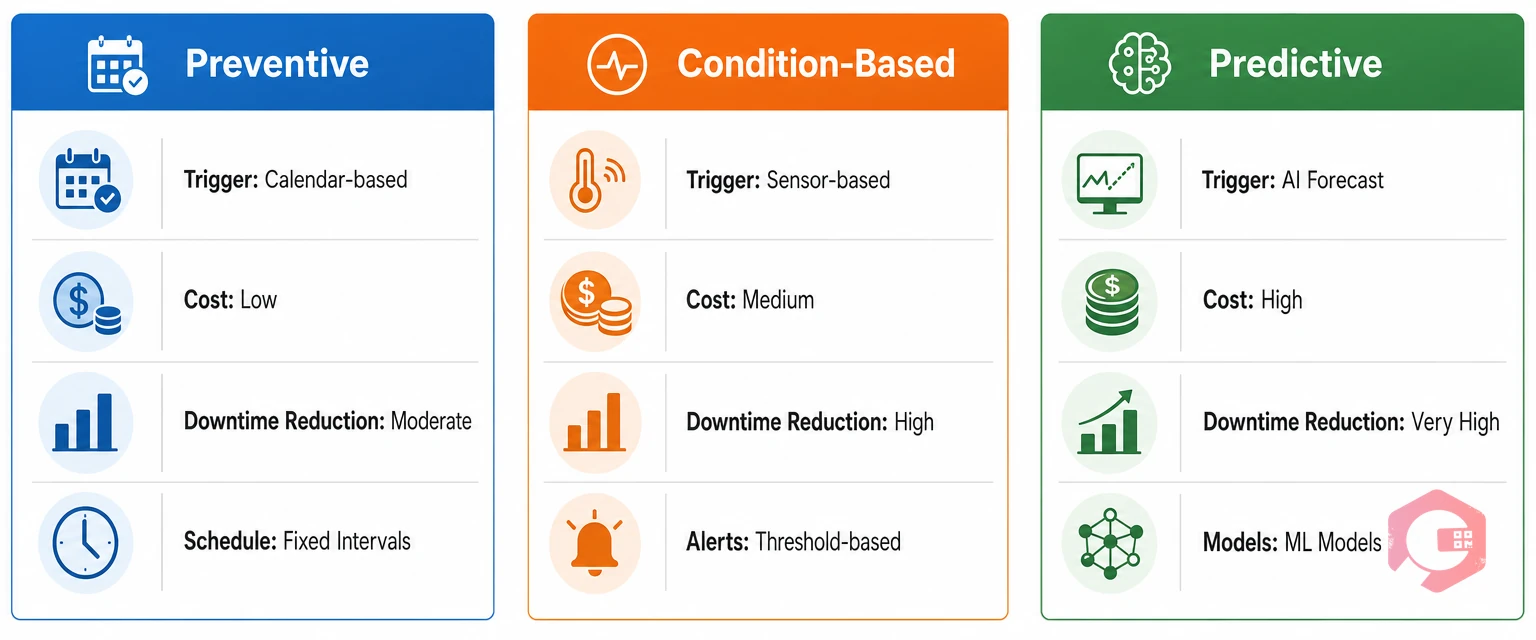
Here's a quick snapshot of how the three compare:
Preventive Maintenance (PM): Scheduled at fixed time or usage intervals — cost-effective and simple to manage, but can result in servicing assets that don't yet need it, or missing failures that occur between service windows.
Condition-Based Maintenance (CBM): Triggered by real-time sensor data when a monitored parameter crosses a predefined threshold — services assets only when they actually need it, reducing unnecessary maintenance by up to 30%.
Predictive Maintenance (PdM): Uses AI and machine learning to forecast failures before they happen — the highest-maturity strategy with the greatest potential for downtime reduction, up to 40% in well-instrumented environments.
This guide breaks down each method, shows you a side-by-side comparison, and helps you pick the right one for your operation — whether you're running a single plant or managing a fleet of assets across multiple sites.
What Is Preventive Maintenance?
Preventive maintenance (PM) is the practice of servicing assets on a fixed schedule — daily, weekly, monthly, or after a set number of operating hours — regardless of the asset's actual condition. Think oil changes every 5,000 km or HVAC filter replacements every quarter.
It's the most widely used strategy because it's easy to plan, budget, and execute. Most CMMS software platforms start here — building PM calendars, auto-generating work orders, and tracking compliance. The downside? You may end up servicing assets that don't need it yet, or, worse, missing a failure that occurs between service intervals.
When PM Works Best
Assets with predictable, age-related wear patterns: Components like filters, belts, seals, and bearings that degrade at consistent rates are ideal PM candidates. Their failure modes are well-understood and calibrated maintenance intervals prevent failures without over-servicing.
Low-to-medium criticality equipment where sensor investment is hard to justify: For assets where a breakdown is inconvenient but not catastrophic — secondary conveyor lines, support equipment, office HVAC — PM delivers reliable protection at the lowest cost per asset.
Early-stage maintenance programmes building toward CBM or PdM: PM is the data-building foundation that makes advanced strategies possible. Systematic PM execution generates the work order history and failure pattern data that CBM thresholds and PdM models are trained on later.
What Is Condition-Based Maintenance?
Condition-based maintenance (CBM) replaces the clock with sensors. Instead of servicing an asset on Tuesday because the calendar says so, CBM triggers maintenance only when a monitored parameter — vibration, temperature, pressure, oil viscosity — crosses a predefined threshold.
CBM sits between PM and full predictive maintenance on the technology spectrum. You need instrumentation on your assets and a system to collect and act on those readings, but you don't need the advanced AI models that PdM requires. The payoff is significant: you service assets only when they actually need it, reducing unnecessary maintenance by up to 30% in well-instrumented environments.
When CBM Works Best
High-value rotating equipment with measurable degradation signals: Motors, pumps, compressors, fans, and gearboxes produce clear vibration, temperature, and current signatures that change as they degrade. CBM catches these signals before they escalate into failures.
Assets in continuous operation where scheduled PM shutdowns disrupt production: When equipment can't be taken offline on a fixed schedule, CBM lets you service it only when sensors indicate it's necessary — minimising both downtime and production disruption.
Facilities with existing IoT sensor infrastructure or SCADA connectivity: If your assets are already instrumented or you have PLC/SCADA data available, CBM is the natural next step. Adding threshold-based alerts to existing sensor feeds is low-cost relative to the downtime reduction benefit.
What Is Predictive Maintenance?
Predictive maintenance (PdM) goes a step further than CBM. Rather than waiting for a threshold to be crossed, PdM uses machine learning models trained on historical sensor data, failure patterns, and environmental context to forecast the probability and timing of a failure — often days or weeks in advance.
PdM is the highest-maturity strategy on the maintenance spectrum. It minimises both unplanned downtime and over-maintenance, and can directly improve downtime KPIs like MTBF (Mean Time Between Failures) and MTTR (Mean Time To Repair). Cryotos clients using PdM-linked workflows have reported up to a 30% reduction in downtime and 25% faster repair times.
When PdM Works Best
Mission-critical assets where failure consequences are severe: Power generation turbines, primary production line drives, large compressors, and assets where a single failure can halt an entire facility or create safety hazards justify the investment in PdM infrastructure and ML model development.
Variable-load or variable-environment assets where fixed thresholds are unreliable: When an asset's operating conditions change significantly day-to-day, a static CBM threshold will either trigger false alarms or miss real degradation. PdM models account for operating context to deliver accurate failure probability regardless of load or environment.
Organisations with 12+ months of sensor data and analytical resources: PdM requires a data foundation. Organisations that have invested in IoT infrastructure and have maintenance engineers comfortable with data analysis will see downtime reductions of 25–40% at full maturity — the highest ROI of any maintenance strategy.
Side-by-Side Comparison: Predictive vs Condition-Based vs Preventive Maintenance
Use this table to benchmark the three strategies against the factors that matter most to your maintenance operation.
Factor
Preventive Maintenance
Condition-Based Maintenance
Predictive Maintenance
Trigger
Fixed time or usage interval
Real-time sensor threshold breach
AI-generated failure probability forecast
Technology Required
CMMS / work order software
IoT sensors + CMMS integration
IoT sensors + ML models + CMMS
Implementation Cost
Low
Medium
High
Data Required
Minimal — asset inventory & schedules
Live sensor readings & alert thresholds
12–18 months of historical sensor data
Maintenance Frequency
Fixed regardless of asset state
Only when thresholds are exceeded
Only when failure window is predicted
Risk of Unnecessary Work
High (over-maintenance common)
Low
Very Low
Risk of Missed Failures
Medium (between intervals)
Low
Very Low
Downtime Reduction
Moderate (~10–15%)
High (~20–25%)
Very High (~25–40%)
Skill Level Required
Basic maintenance technicians
Maintenance + instrumentation skills
Data analysts + senior maintenance staff
Best Asset Types
Low-criticality, uniform wear
High-value rotating equipment
Mission-critical, variable-load assets
ROI Timeline
Immediate (3–6 months)
Medium-term (6–12 months)
Long-term (12–24 months)
Cryotos CMMS Support
✓Full — PM templates, auto work orders, drag-and-drop scheduler, dynamic & static PMs
✓Full — IoT data pipelines, BI dashboards, MTBF/MTTR KPIs, conditional workflows
How to Choose the Right Maintenance Method
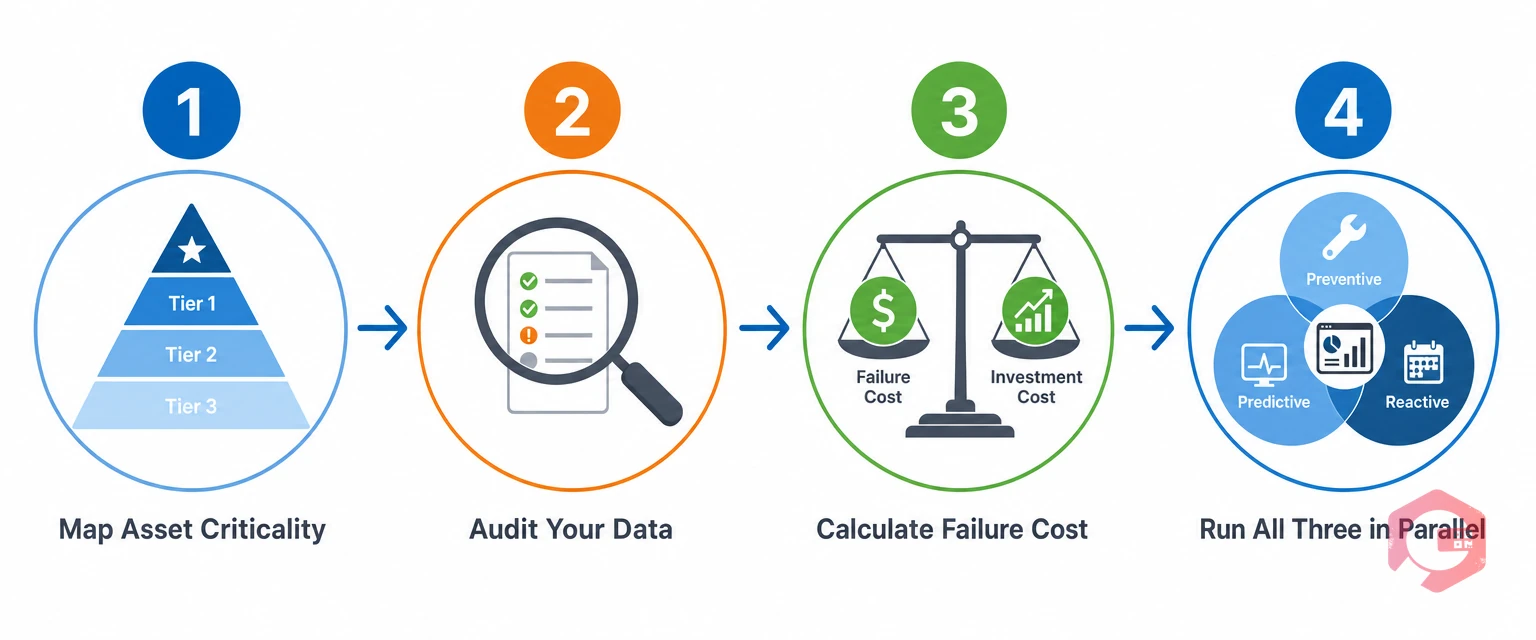
There's no universal right answer — the best strategy depends on your asset criticality, data maturity, team skills, and budget. Here's a practical decision framework:
Step 1: Map Your Asset Criticality
Start by categorising every asset in your asset register into three tiers — critical, important, and non-critical. Apply PdM or CBM only to the top tier. PM handles the rest. This focus keeps your investment targeted where it has the highest return.
Step 2: Audit Your Current Data
PdM requires historical failure data. CBM requires live sensor feeds. If you have neither, start with PM and build your data foundation over 12 months. You can layer CBM on top once instrumentation is in place, then graduate to PdM once your models have enough training data.
Step 3: Calculate Failure Cost vs Implementation Cost
If the cost of one unexpected failure — lost production + repair + safety risk — exceeds the cost of 12 months of PdM infrastructure, the business case writes itself. For lower-value assets where failure costs are manageable, PM or reactive maintenance may still be the most rational choice.
Step 4: Run All Three in Parallel
Most mature facilities don't choose one strategy — they run all three simultaneously, applying each to the asset tier it fits. A world-class preventive maintenance software platform should let you manage PM schedules, CBM alerts, and predictive workflows from a single dashboard.
How Cryotos CMMS Supports All Three Maintenance Strategies
Cryotos CMMS is designed to grow with your maintenance maturity. Whether you're implementing structured PM for the first time or operationalising a full PdM programme, the platform has the tools to support every stage:
Preventive Maintenance: Cryotos automates PM scheduling with both static (calendar) and dynamic (usage-hour) triggers. Drag-and-drop scheduling, bulk PM generation from asset templates, and real-time compliance tracking give maintenance managers full visibility and control — without manual effort or missed service windows.
Condition-Based Maintenance: Cryotos integrates directly with IoT sensors, SCADA systems, and PLC data feeds to monitor asset parameters in real time. When a threshold is crossed, Cryotos automatically creates a work order — ensuring CBM alerts are never missed and technician response is immediate.
Predictive Maintenance: Cryotos's IoT meter reading module captures continuous sensor data and feeds it into BI dashboards and KPI reports. Reliability engineers can track MTBF and MTTR trends, configure conditional workflows that respond to predictive signals, and build the historical data foundation ML-driven failure forecasting requires.
Unified Asset Visibility: All three maintenance strategies are managed from a single asset record in Cryotos — with complete work order history, failure event logs, parts consumption data, and compliance records consolidated in one place, regardless of which strategy triggered the work.
Continuous Improvement Loop: Cryotos's built-in RCA (5 Whys) module, scheduled KPI reporting, and downtime analytics give maintenance teams the feedback loop they need to continuously refine their strategy — moving assets up the maturity curve from PM to CBM to PdM as data and skills develop.
Frequently Asked Questions
What is the main difference between predictive and preventive maintenance?
Preventive maintenance runs on a fixed schedule regardless of asset condition, while predictive maintenance uses real-time sensor data and machine learning to forecast failures before they occur. PdM eliminates unnecessary service intervals, reducing both maintenance costs and unplanned downtime.
Is condition-based maintenance the same as predictive maintenance?
No. Condition-based maintenance reacts when a monitored parameter crosses a preset threshold — it's reactive to current data. Predictive maintenance goes further by using AI models to anticipate when a threshold will be crossed in the future, allowing you to plan maintenance proactively before the alert triggers.
Can a business implement all three maintenance strategies at the same time?
Yes — and most high-performing maintenance organisations do. The key is segmenting by asset criticality: use PM for low-criticality assets, CBM for high-value equipment with sensors, and PdM for mission-critical assets where AI-driven forecasting delivers the highest ROI.
How long does it take to implement predictive maintenance?
Most organisations need 12–24 months to implement a reliable PdM programme. The first 6–12 months are spent deploying sensors and collecting baseline data. ML models are trained and validated in the following phase. CBM and PM typically show ROI much faster, within 3–12 months of deployment.
Which maintenance strategy reduces downtime the most?
Predictive maintenance has the highest ceiling for downtime reduction — up to 40% in well-instrumented, data-rich environments. Condition-based maintenance delivers 20–25% reduction on average, while preventive maintenance typically yields 10–15%. Combining all three strategies in a tiered approach produces the best overall result.
Whether you're starting with structured PM schedules or ready to operationalise predictive maintenance, Cryotos CMMS gives your team the tools to manage every strategy from a single platform — with full IoT integration, AI-powered workflows, and real-time KPI dashboards.