A chiller maintenance checklist is a scheduled list of daily, monthly, and annual tasks that keeps a chiller efficient and prevents breakdowns. It tells your team what to check, how often, and what to record. A structured checklist improves performance and extends equipment life.
Chillers are critical assets in industrial plants, data centers, hospitals, hotels, and commercial buildings. When one fails, cooling stops and so can production or patient care. This guide gives you a full chiller preventive maintenance checklist, a schedule, and a simple method for catching problems early. It also shows how a computerized maintenance management system (CMMS) keeps every task on time.
Key Takeaways

A detailed chiller maintenance checklist pays off in four ways:
Always follow the manufacturer's manual first. Use this checklist to organize the work, not to replace the maker's instructions.
The chiller type decides what goes on your checklist. The biggest difference is how each type rejects heat.
| Attribute | Air-Cooled Chiller | Water-Cooled Chiller |
|---|---|---|
| How it rejects heat | Fans blow outdoor air across condenser coils | Condenser water carries heat to a cooling tower |
| Typical location | Rooftops and outdoor pads | Indoor plant rooms with a nearby tower |
| Main fouling risk | Dirt, leaves, and debris on coils | Scale, sludge, and biofilm in condenser tubes |
| Water treatment | Not needed for the condenser | Needed to control scale, corrosion, and growth |
| Extra equipment to maintain | Condenser fans and coil fins | Cooling tower, condenser pump, and strainers |
| Key monthly check | Coil condition and fan operation | Water quality tests and strainer cleaning |
Many sites run both types, so build a separate checklist template for each one.
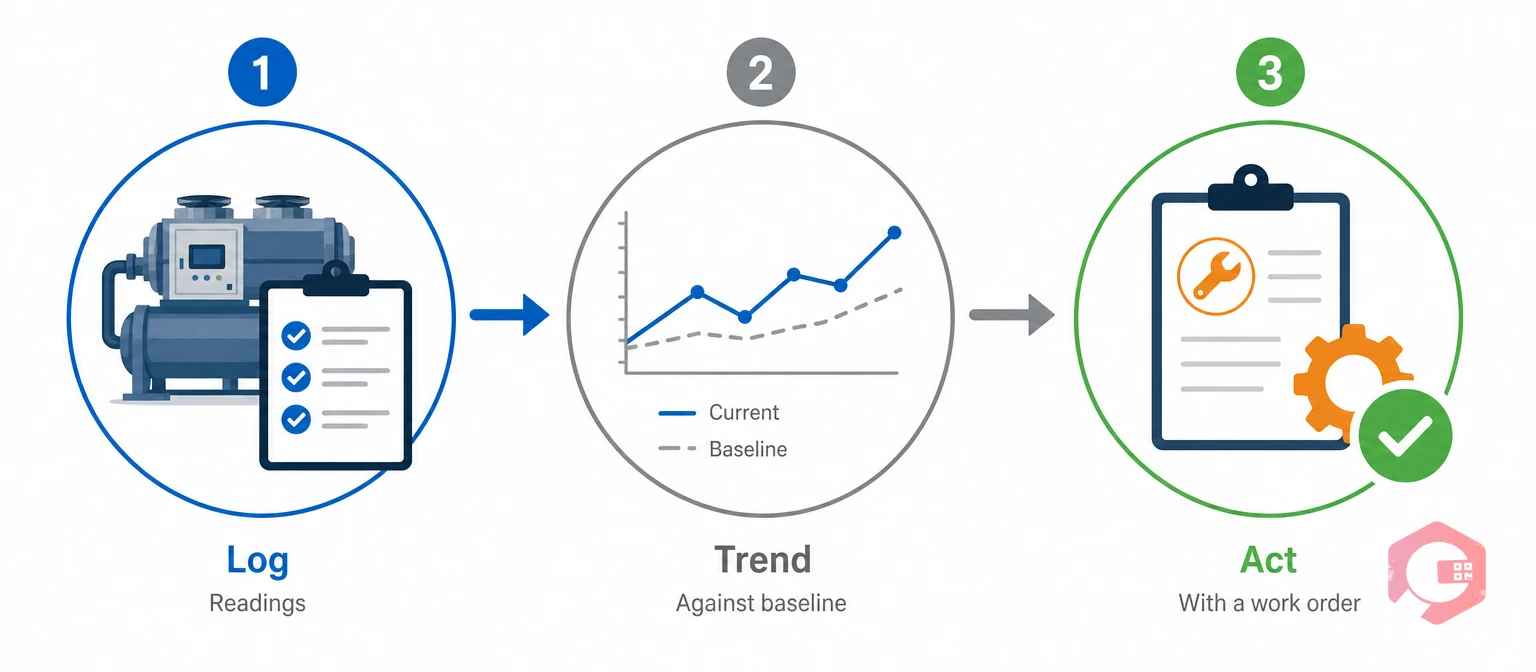
The Log-Trend-Act Method turns routine readings into early warnings. It has three steps:
Illustrative example: on a water-cooled chiller, the condenser approach temperature creeps up a little each week. Every daily reading stays inside alarm limits. Trending exposes the drift, which often points to fouled tubes. The team cleans them before efficiency drops or the unit trips on high pressure.
Daily checks are quick walk-around inspections and readings. Most take a few minutes per chiller. Include these tasks in your daily chiller maintenance checklist:
With the Cryotos mobile maintenance app, technicians open maintenance checklists at the chiller and enter readings on the spot. A reading outside its limit can open a work order right away.
Monthly tasks go deeper. They assess performance and prevent faults. A monthly industrial chiller maintenance checklist should include:
With Cryotos preventive maintenance software, these tasks generate automatically on a set schedule. Technicians get reminders, and managers can track completion.
Some tasks fit best between the monthly and annual rhythms:
Annual maintenance is the time for thorough servicing. It may need long downtime, so schedule it for a low-demand period. Key annual chiller maintenance tasks include:
Refrigerant work should be done by qualified technicians. In the United States, handling refrigerant requires EPA Section 608 certification.

Use this schedule as a starting point. Adjust it using the manufacturer's manual, your operating hours, and your results.
| Frequency | Key Tasks | Usually Done By | Record to Keep |
|---|---|---|---|
| Daily | Readings, alarms, leaks, oil level, water flow | Operator or technician | Daily log sheet |
| Monthly | Refrigerant and oil checks, strainers, water quality, safety control tests, fault log review | Maintenance technician | Monthly PM record |
| Quarterly or seasonal | Starters and contactors, pump checks, insulation, seasonal startup or shutdown | Technician or service contractor | Inspection report |
| Annual | Tube or coil cleaning, oil analysis, leak test, calibration, electrical tests | Qualified service contractor | Service report and test results |
Chillers that run year-round, serve critical loads, or sit in dusty or humid sites often need shorter intervals.
Most chiller failures follow missed warning signs. Maintenance teams that avoid these habits keep cooling reliable:
Fixing these habits costs little and lowers the risk of a hot-weather outage.
A CMMS turns a paper checklist into scheduled work, recorded readings, and audit-ready history. Cryotos helps in six ways:
Maintenance teams using Cryotos have reported up to 30% reduction in unplanned downtime and 25% faster repair turnaround. These are general results across maintenance programs, not chiller-specific figures. For chillers, the practical gain is catching drift early and keeping a complete service history.
Most chillers need daily readings, monthly checks, and a full service at least once a year. Follow the manufacturer's manual, and shorten intervals for critical, year-round, or harsh-environment units.
Record water supply and return temperatures, pressures, oil level, motor current, and water flow. Also check for alarms, leaks, noise, and vibration.
Air-cooled units need clean coils and working fans. Water-cooled units need clean condenser tubes, water treatment, and care of the cooling tower and strainers.
Most sites clean them at least once a year. Poor water quality or rising condenser approach temperature can mean they need cleaning sooner.
Alarm limits only catch problems after they grow. Trending shows slow drift, such as fouling or low refrigerant, so you can fix the cause during planned work.
Keep daily logs, monthly PM records, oil analysis results, leak test results, calibration records, and service reports. Store them against the chiller so they are easy to find in an audit.
A reliable chiller maintenance checklist keeps cooling running when demand is highest. Schedule a free demo to see how Cryotos schedules chiller checks, captures readings, and keeps service records ready for every audit.


Cryotos AI predicts failures, automates work orders, and simplifies maintenance—before problems slow you down.