A cooling tower maintenance checklist is a schedule of daily, weekly, monthly, quarterly and annual tasks that keeps tower water clean, fans and pumps running, and records ready for inspection. Following one cuts surprise shutdowns and keeps you on the right side of Legionella and water safety rules.
This guide gives you tasks by frequency, a one-page schedule, the water limits to watch and a simple method for staying audit-ready.
Key Takeaways
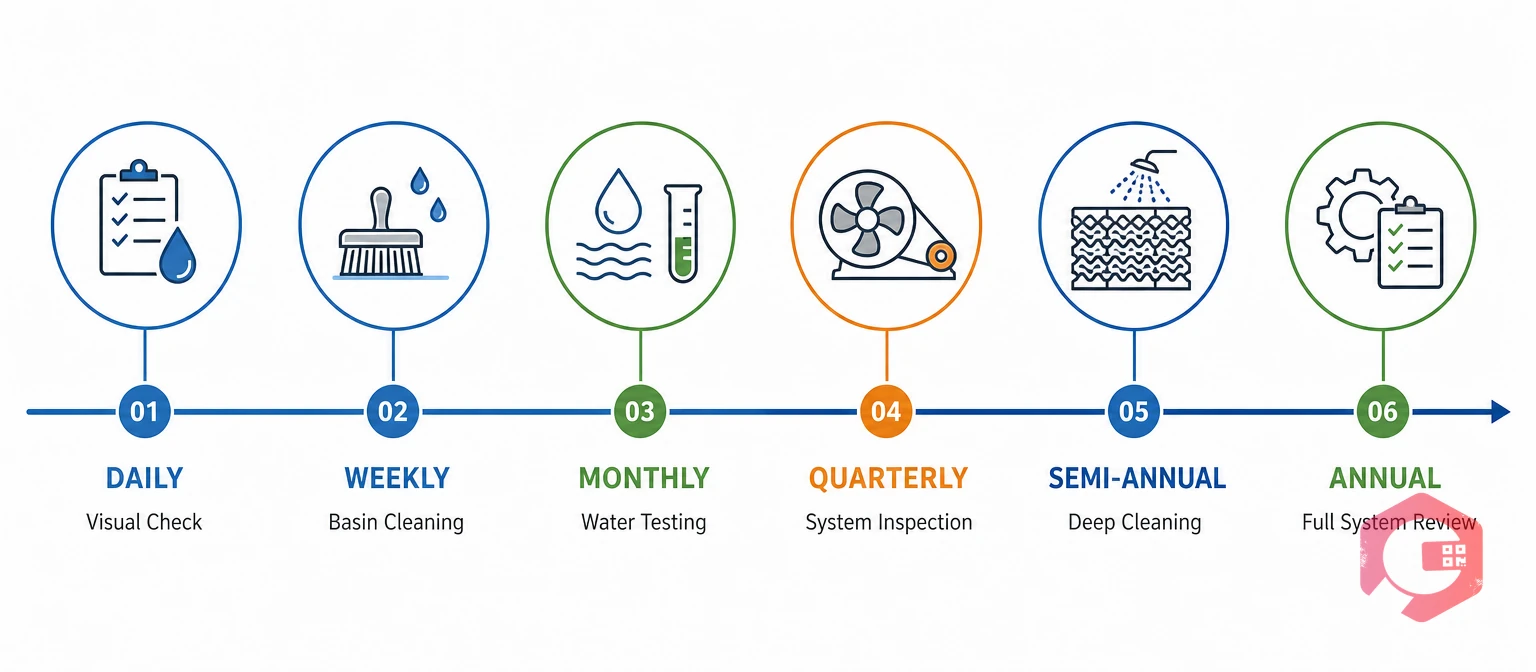
Frequency matters: Split your cooling tower maintenance checklist into daily, weekly, monthly, quarterly, semi-annual and annual checks so nothing depends on memory.
Water is half the job: pH, conductivity, biocide level and Legionella results need written limits and a fixed response when they drift.
Records prove compliance: Inspectors ask to see time-stamped readings, lab reports and corrective actions, not just a promise that work was done.
A CMMS closes the loop: Scheduled jobs, mandatory readings and automatic follow-up work orders turn a checklist into evidence.
What Is a Cooling Tower Maintenance Checklist?
A cooling tower is a heat rejection unit that cools water by letting a small part of it evaporate into moving air. As the water evaporates, minerals stay behind, so the circulating water gets harder and dirtier every day. Every cooling tower needs mechanical and water care.
A cooling tower maintenance checklist is a written set of inspections, readings and cleaning tasks, each tied to a frequency and a record. It usually covers these parts:
Fan assembly: Blades, motor, gearbox or belt drive, drive shaft and couplings.
Water distribution: Hot-water basin, spray nozzles and headers.
Fill and drift eliminators: The media that mixes water with air, and the baffles that stop mist from escaping.
Basin and sump: Where cooled water collects, along with sludge and sediment.
Water treatment: Dosing pumps, biocide feed, the conductivity controller and the blowdown valve.
Standards shape what goes on the list. ANSI/ASHRAE Standard 188 asks owners to run a written water management program, and OSHA's Legionnaires' disease guidance covers cleaning, biocide treatment and sampling. In the UK, the HSE Legionella guidance places a legal duty on the people who control these systems.
Why Cooling Towers Fail: Downtime and Compliance Risks
Most cooling tower failures start small, such as a thin scale layer, a blocked strainer or a gearbox low on oil. Left alone, each one grows into lost cooling, higher energy bills or a health risk.
Common causes of cooling tower downtime
Scaling: Minerals coat the fill and condenser tubes, so chillers work harder and use more power.
Corrosion: Low pH or aggressive water eats into the basin, pipework and frame.
Biofilm: Slime insulates surfaces, clogs the fill and shelters bacteria.
Fan and gearbox failure: Imbalance, misalignment and old oil can stop the fan without warning.
Pump and strainer problems: Clogged strainers starve pumps and can trip the whole loop.
Where cooling tower compliance issues come from
Cooling towers can spread contaminated mist over a wide area, which is why they are a known source of Legionnaires' disease outbreaks. Inspectors ask to see the record.
Missed readings: Blank log sheets suggest the tower was not monitored.
No follow-up: An out-of-range result with no recorded action is a finding on its own.
Scattered reports: Lab results sitting in email inboxes are hard to produce on the day.
Prevention costs far less than a shutdown or an enforcement order. Want to put a number on what one tower trip costs your site? Try the unplanned downtime calculator.
Daily and Weekly Cooling Tower Maintenance Checklist
Daily and weekly checks catch problems while they are still cheap to fix. Most facilities give them to the shift operator, who logs readings on a phone or tablet.
Daily checks for the shift operator
Walkdown: Look for leaks, overflow, splashing, algae, foam, unusual noise or vibration.
Water readings: Record pH, conductivity, biocide residual (free chlorine or ORP) and water temperature.
Basin level: Confirm the make-up valve holds the right level with no overflow.
Dosing system: Check chemical tank levels and confirm each dosing pump is running.
Weekly checks for strainers and blowdown
Strainers and filters: Clean basin strainers and side-stream filters.
Blowdown: Compare the conductivity set point with the actual reading and test the blowdown valve.
Distribution: Check nozzles or the hot-water basin for blockages and dry spots on the fill.
Drift eliminators: Look for gaps, damage or panels out of place.
Meters: Log make-up and blowdown meter readings to track cycles of concentration.
Digital maintenance checklists with mandatory fields stop a technician from closing a job with a blank reading. A daily log nobody can skip is the cheapest insurance a tower can have.
Monthly and Quarterly Cooling Tower Checks
The monthly and quarterly part of a cooling tower maintenance checklist looks deeper at mechanical wear and water biology. These tasks often need a supervisor, a contractor or an outside lab.
Monthly checks for motors and bacteria
Bacteria count: Run a dip slide or heterotrophic plate count (HPC) test.
Fan motor: Record vibration, current draw and bearing temperature, and check mounting bolts.
Gearbox: Check the oil level and look for leaks.
Fill media: Inspect for scale, slime or sagging, and take a photo.
Pumps: Check seals, bearings and discharge pressure.
Sensors: Check pH and conductivity probes against a hand-held meter.
Quarterly checks for Legionella and oil
Legionella sampling: Send a sample to an accredited lab, or test more often if local rules require it.
Gearbox oil analysis: Check for water, dirt and wear metals.
Basin inspection: Measure sludge depth and look for corrosion.
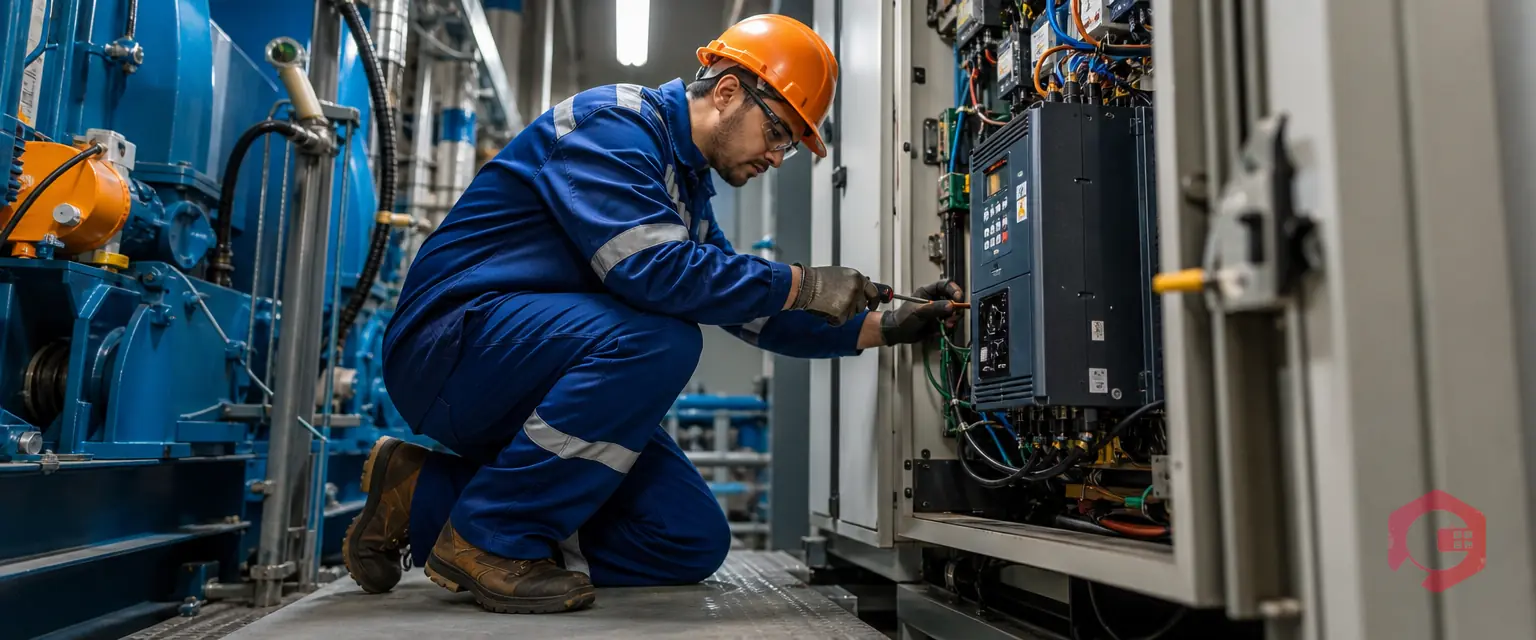
Electrical checks: Inspect motor terminals, cables, isolators and any variable frequency drive.
Treatment review: Go through the water treatment provider's service report and your reading trends.
Quarterly lab results are your strongest proof of control, so file each report against the tower it came from.
Semi-Annual and Annual Cooling Tower Maintenance Tasks
Semi-annual and annual tasks usually need the tower offline, so book them as planned downtime during low cooling demand. Lockout and confined-space rules apply whenever people enter the basin or fan deck.
Every six months: clean and disinfect
Clean and disinfect: Drain the basin, remove sludge, clean reachable surfaces and disinfect to your approved procedure. Repeat before restarting after a long shutdown.
Fan blades: Check pitch, tip clearance, cracks and balance.
Alignment: Check motor-to-gearbox alignment and couplings.
Gearbox oil change: Change oil by date or by run hours, a classic meter-based maintenance trigger.
Every year: inspect, test and review
Mechanical inspection: Bearings, gearbox internals, fan hub, drive shaft and frame.
Fill and eliminators: Replace damaged sections and estimate remaining life.
Safety items: Ladders, handrails, guards and access doors.
Performance test: Compare approach and range temperatures with design values.
Plan review: Review the water management plan, limits and last year's corrective actions.
Certification: Complete any annual sign-off your local authority requires.
Use the annual review to update your cooling tower maintenance checklist based on what the records show.
Cooling Tower Maintenance Schedule at a Glance
The table condenses the full cooling tower maintenance checklist into one schedule. Treat the frequencies as starting points and adjust them to OEM manuals, your risk assessment and local rules.
Frequency
Key tasks
Readings to record
Compliance evidence
Daily
Walkdown, readings, dosing check
pH, conductivity, biocide residual, temperature
Signed daily log
Weekly
Strainers, blowdown, nozzles, eliminators
Set point, make-up and blowdown meters
Completed checklist
Monthly
Motor, gearbox, fill, pumps, sensor check
Bacteria count, vibration, amps
Results with photos
Quarterly
Legionella sample, oil analysis, basin check
Lab results in CFU/mL
Lab report and actions
Semi-annual
Clean and disinfect, blades, alignment, oil change
Chemicals used, alignment values
Procedure record, before and after photos
Annual
Full inspection, performance test, plan review
Approach and range temperatures
Inspection report, signed plan review
Load each row as a recurring job in your preventive maintenance software, so work orders appear on time without anyone tracking dates by hand.
How to Stay Audit-Ready: The Test, Act, Prove Method
Staying audit-ready means every reading has a limit, every breach has an action and every action has a record. Teams that pass inspections easily follow the same three-step loop.
The Test, Act, Prove Method:
Test: Measure each control parameter on schedule against a written limit.
Act: Raise a corrective job the moment a result falls outside its limit, with an owner and a deadline.
Prove: Keep time-stamped readings, lab reports, photos and sign-offs against the tower they belong to.
Typical water control limits to watch
pH: Often held between about 7.0 and 9.0, depending on the treatment program.
Free halogen: Commonly kept around 0.5 to 1.0 ppm, or managed to an ORP target.
Total bacteria: Often kept below about 10,000 CFU/mL.
Legionella: OSHA guidance treats below 100 CFU/mL as acceptable for cooling towers, 100 to 1,000 as a trigger for prompt cleaning or biocide, and above 1,000 as a trigger for immediate action. Some local rules set lower triggers.
Your water treatment provider and water management plan set the real limits, so post them where technicians can see them.
How a CMMS Keeps Your Cooling Tower Maintenance Checklist on Track
A Computerized Maintenance Management System turns a paper log into scheduled, enforced and traceable work. Maintenance teams using Cryotos have reported up to 30% reduction in unplanned downtime and 25% faster repair turnaround.
Scheduled jobs: Time-based and run-hour PMs create work orders for each cooling tower maintenance checklist frequency.
Mandatory readings: Mobile checklists require numbers, photos and signatures, and work offline on the roof.
QR-tagged assets: Technicians scan a tower cell, fan or pump to see its history and open jobs.
Follow-up work orders: A failed check can raise a corrective job for the team or the treatment vendor.
Chemical and spares stock:Inventory management with minimum-level alerts keeps biocide, inhibitor, oil and belts on the shelf.
Live readings: IoT links through SCADA, PLC or edge devices can bring in conductivity, vibration or run hours.
Audit-ready history: Reports show who did what, when, and what was found.
What this looks like on site
In this illustrative example, a technician scans the tag on Cell A, enters a free chlorine reading of 0.2 ppm and marks the check as failed. A corrective job goes to the water treatment vendor, the shock dose is logged with chemical drawn from stock, and a retest closes the job with a timestamp.
Frequently Asked Questions
How often should a cooling tower be cleaned and disinfected?
Many sites clean and disinfect at least twice a year, and always before restarting a tower after a long shutdown. Your risk assessment or test results may call for more.
What should a cooling tower maintenance checklist include?
It should cover water readings, biocide and blowdown control, strainers, nozzles, fill, drift eliminators, fans, gearboxes, pumps and the basin. Each task needs a frequency, a named owner and a place to record the result.
How often should cooling tower water be tested for Legionella?
Quarterly testing is a common baseline, but some cities and countries require monthly or more frequent sampling. Follow your local regulations and your water management plan, and test again after any corrective action.
What causes scale to build up inside a cooling tower?
Scale forms when evaporation concentrates minerals beyond what the water can hold. Poor blowdown control, too many cycles of concentration and low inhibitor dosing are the usual causes.
Who is responsible for cooling tower compliance at a facility?
The building owner or plant operator usually holds the legal duty, even when a contractor does the work. Name a responsible person, and keep contractor reports in the same record as your own checks.
Can a CMMS replace a water treatment provider?
No. The provider sets the chemistry and limits, while a CMMS makes sure checks happen on time, breaches trigger action and every result is stored for audits.
A cooling tower that is checked, treated and documented on schedule rarely surprises anyone. Schedule a free demo to see how Cryotos keeps every tower reading, corrective action and lab report in one audit-ready place.