A diesel generator maintenance checklist is a scheduled list of tasks that keeps a standby generator ready to run. It makes sure the unit can start and carry load the moment utility power fails, and it covers the engine, fuel, cooling, batteries, exhaust, controls, and transfer switch. Most backup generators sit idle for weeks, so the checklist is the only thing standing between a power cut and a dark building.
A standby generator that has not been tested is a hope, not a plan. This guide gives you a 12-point generator maintenance checklist, a schedule from weekly to every three years, and the testing rules that most facilities follow under NFPA 110. It is written for facility managers and maintenance teams responsible for hospitals, data centers, plants, and commercial buildings.
Key Takeaways

Standby generator maintenance is the planned care that keeps a backup generator ready to start and carry load. It also makes sure the unit can run for its rated time. Most commercial units are diesel generators, because diesel engines start reliably and store fuel well on site.
In the United States, NFPA 110, the Standard for Emergency and Standby Power Systems from the National Fire Protection Association, sets the inspection and testing rules for most life safety systems. Hospitals, high-rise buildings, and other critical sites are usually required to follow it, and many insurers expect it everywhere else.
Almost every item on that list is caught by a routine generator maintenance checklist.
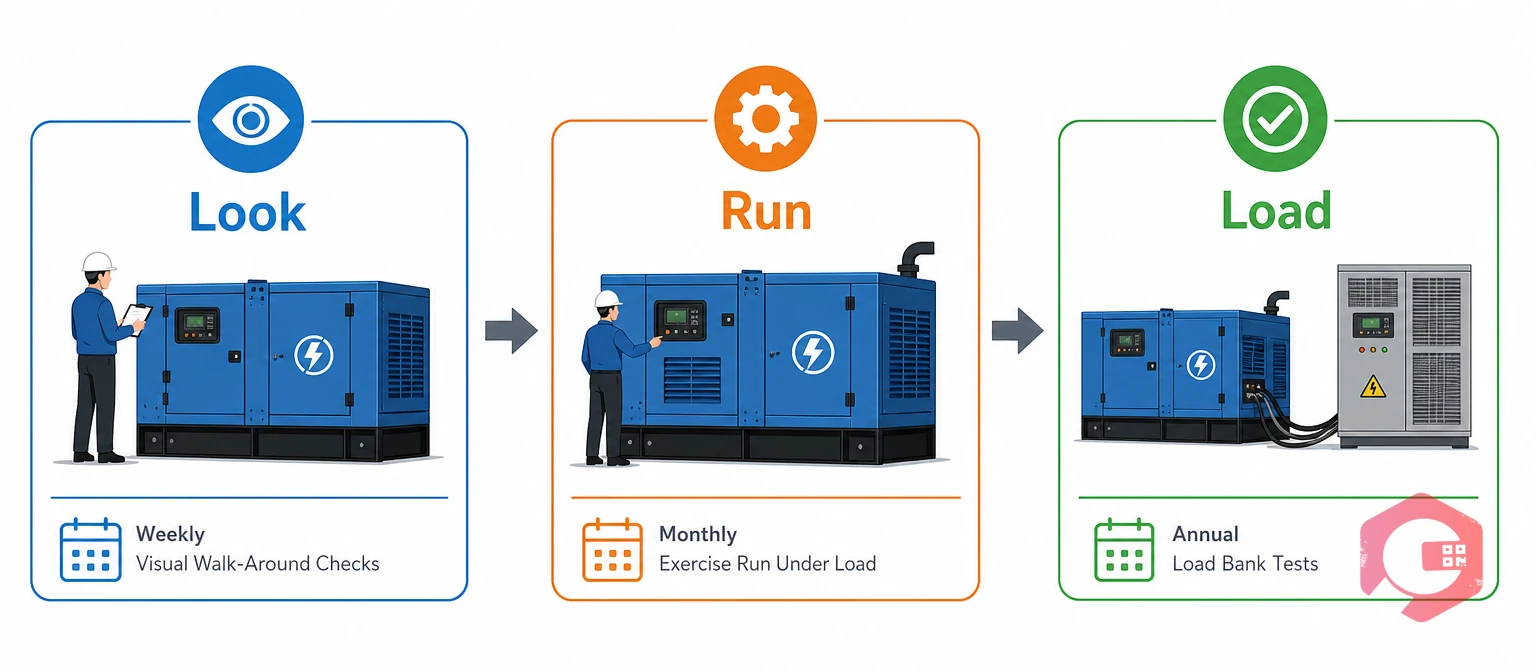
The checklist follows three rhythms: what you look at, what you run, and what you load. Grouping tasks this way makes it clear who does each one and how often.
The Look-Run-Load Approach:
Every point below is tagged with its rhythm, so you can build weekly, monthly, and annual work orders directly from the list.
Ready to stop tracking this on paper? Cryotos maintenance checklists turn each point into a mobile checklist with readings, photos, and pass or fail fields.
Rhythm: Look, weekly. Start every inspection with a walk around the unit. Many problems are visible before they become failures.
Note anything unusual on the generator maintenance checklist, even if it seems minor, because small leaks are early warnings.
Rhythm: Look, weekly. Low or contaminated oil can damage the engine in minutes once it starts under load.
Change oil and filters on the manufacturer's schedule, which is usually set by run hours or time, whichever comes first.
Rhythm: Look, weekly. The cooling system keeps the engine at a safe temperature under load, and the block heater keeps it warm enough to start fast.
NFPA 110 Type 10 systems must restore power within 10 seconds, and a warm engine is a big part of meeting that target.
Rhythm: Look, weekly, with an annual quality test. Stored diesel can degrade, absorb water, and grow microbes, which clog filters exactly when the generator is needed.
Fuel care is one of the most overlooked items on any generator maintenance checklist, yet it causes many failed starts.
Rhythm: Look, weekly, with deeper tests monthly or quarterly. Battery problems are the leading cause of failed generator starts.
Trending battery voltage over time shows decline long before a battery fails a start. Make the voltage reading a required field on every weekly generator maintenance checklist.
Rhythm: Look, weekly. The engine needs clean air in and a clear path for exhaust out.
Exhaust leaks near occupied spaces are a carbon monoxide risk, so treat them as urgent.
Rhythm: Look, weekly or monthly. Rubber parts age even when the generator rarely runs.
Replace rubber parts on age as well as condition, since they can fail without warning after years in a hot enclosure.
Rhythm: Look, weekly. The controller is the brain of the system. If it is not in automatic mode, the generator will not start on its own.
A generator left in manual or off mode after service is a common and easily prevented failure. Add a final "controller in auto" sign-off to the end of every generator maintenance checklist.
Rhythm: Run, monthly. Monthly exercise proves the engine starts, reaches temperature, and carries load. NFPA 110 calls for generator sets to be exercised at least monthly for at least 30 minutes.
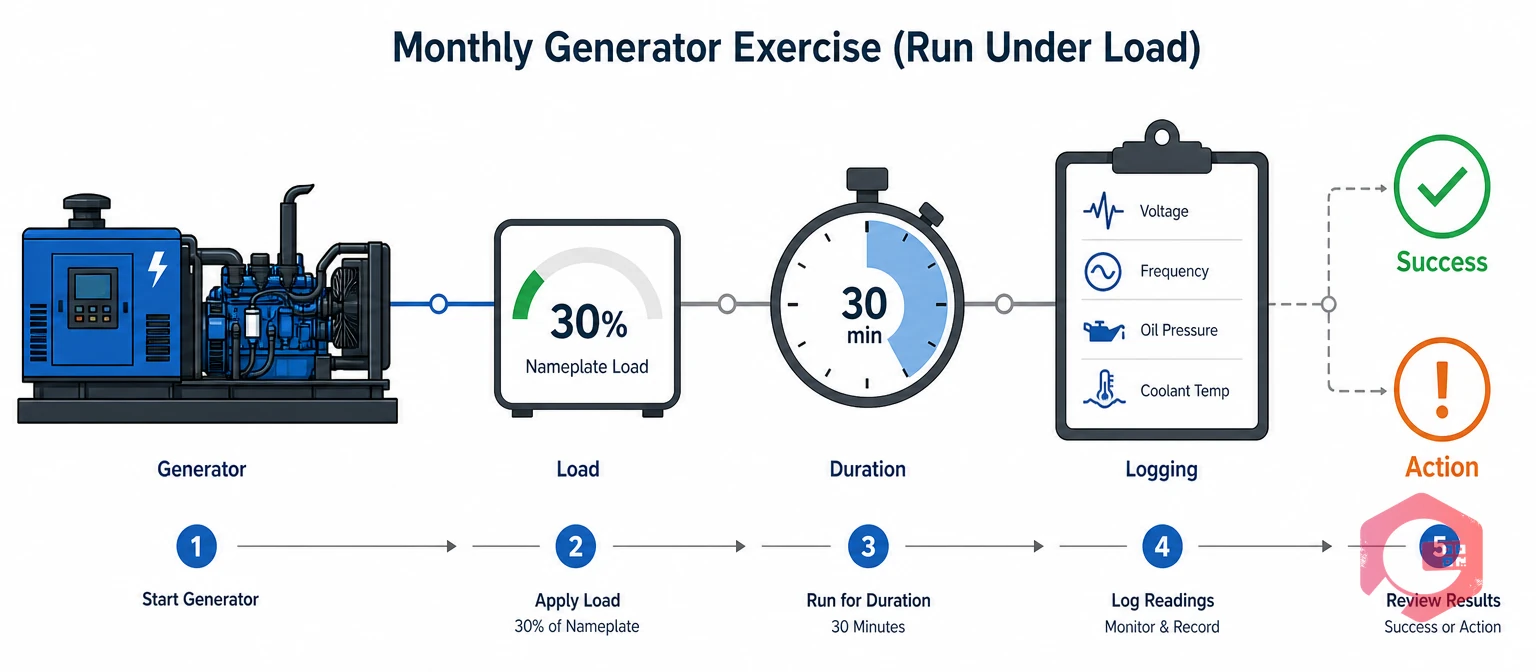
Running with no load, or a light one, does more harm than good, because it encourages wet stacking.
Rhythm: Run, monthly. The transfer switch moves the building from utility power to the generator and back. A healthy generator is useless if the switch does not operate.
Testing the generator and transfer switch together is the only way to prove the full backup power chain works.
Rhythm: Load, annual where needed. Wet stacking happens when a diesel engine runs at light load for long periods, so fuel and soot build up in the exhaust instead of burning. A load bank test burns off these deposits by running the engine at higher load.
Load bank testing is often the most valuable item on a generator maintenance checklist, because it proves the unit can carry real load for hours.
Rhythm: Load, annual or by run hours. Full service keeps the engine in condition to run for days if an outage lasts that long.
Schedule this work by run hours as well as calendar date. A standby unit that rarely runs should still be serviced yearly, because oil and coolant age with time. Learn more about hour-based triggers in meter-based maintenance.
Use this schedule as a starting point for your generator maintenance checklist. Always confirm intervals against the manufacturer's manual, NFPA 110, and any local or healthcare rules that apply to your site.
| Frequency | Key Tasks | Usually Done By |
|---|---|---|
| Weekly | Walk-around, fluid levels, battery and charger check, controller in auto, alarms, leaks. | Facility or maintenance staff. |
| Monthly | Exercise for at least 30 minutes under load, transfer switch test, battery voltage trend. | Maintenance staff |
| Quarterly or semi-annual | Belts and hoses, battery load test, fuel water drain, coolant check. | Maintenance staff or service contractor. |
| Annually | Oil and filters, fuel quality test, coolant test, load bank test if required, transfer switch service. | Certified service contractor. |
| Every 36 months | Long-duration test of at least four hours for Level 1 systems. | Certified service contractor. |
Keep every completed generator maintenance checklist on file. Inspectors and insurers will ask to see these records.
Most generator failures during outages come from a small set of habits. Maintenance teams that successfully keep backup power reliable avoid these:
Fixing these habits costs little and greatly improves the odds that your generator starts when it counts.
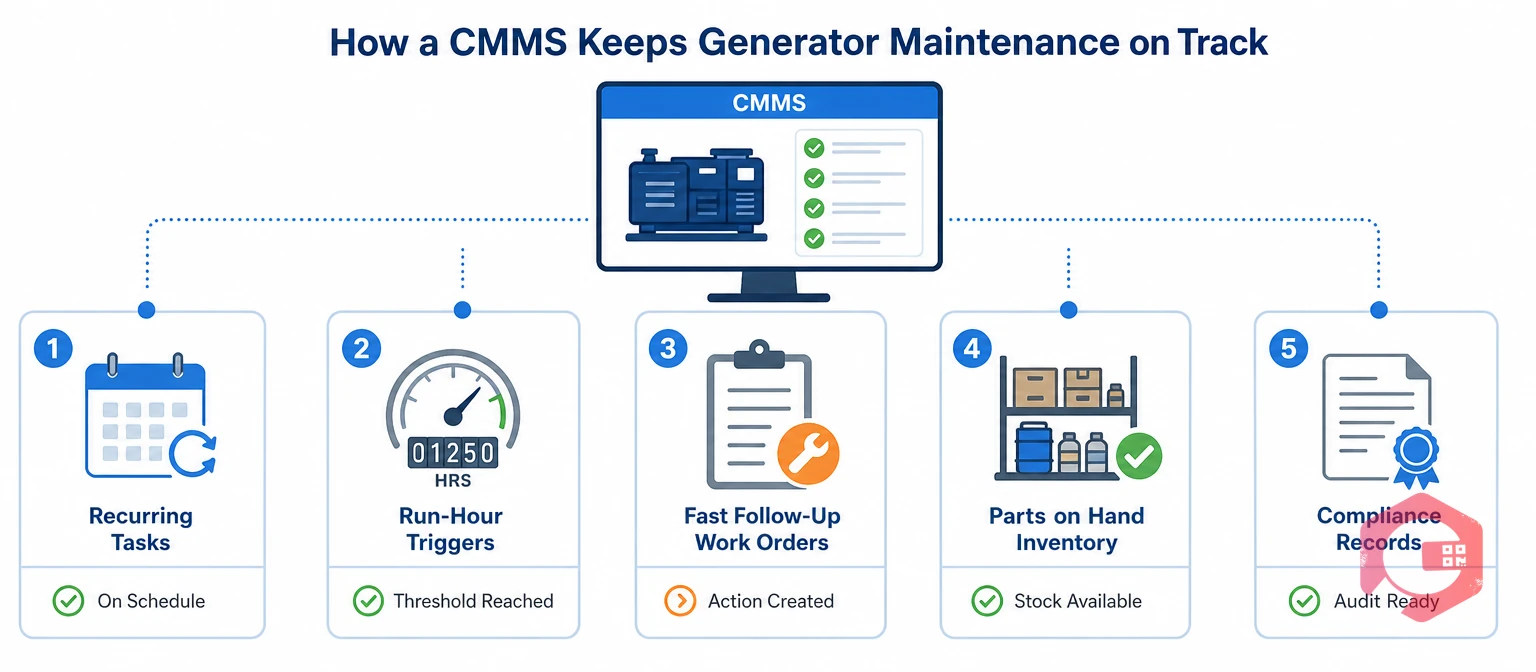
A Computerized Maintenance Management System turns a paper generator maintenance checklist into scheduled work, recorded readings, and audit-ready history.
Reliable records also make problems visible sooner. Maintenance teams using Cryotos have reported up to 30% reduction in unplanned downtime and 25% faster repair turnaround. For backup power, that means fewer surprises when the lights go out.
Most standby generators need weekly inspections, a monthly exercise run under load, and a full service at least once a year. Follow the manufacturer's manual and NFPA 110 for exact intervals.
NFPA 110 calls for generator sets to be exercised at least monthly for at least 30 minutes. The load should be at least 30 percent of the nameplate kW rating, or enough to reach the manufacturer's recommended exhaust temperature.
Wet stacking is a buildup of unburned fuel, oil, and soot in the exhaust. It happens when a diesel engine runs for long periods at light load, and it is usually cleared with a load bank test.
Under NFPA 110, an annual load bank test is needed when monthly exercise runs cannot reach 30 percent load or the manufacturer's exhaust temperature. Many sites run one every year anyway as a check of real load capacity.
Diesel can start to degrade within months, especially if water or microbes get into the tank. Test fuel quality at least once a year and drain water regularly to keep stored fuel usable.
Weak or dead batteries are the most common cause. Other frequent causes include fuel problems, a failed block heater, the controller left in manual mode, and clogged filters.
A reliable generator maintenance checklist is what turns backup power from a hope into a plan. Schedule a free demo to see how Cryotos schedules generator checks, captures readings, and keeps NFPA 110 records ready for every inspection.


Cryotos AI predicts failures, automates work orders, and simplifies maintenance—before problems slow you down.