

OSHA's Process Safety Management standard — 29 CFR 1910.119 — establishes 14 compliance elements designed to prevent catastrophic releases of highly hazardous chemicals at facilities like oil refineries, petrochemical plants, and gas processing facilities. Of those 14 elements, a CMMS directly addresses at least six: Mechanical Integrity (Element 6), Management of Change (Element 8), Safe Work Practices (Element 7), Incident Investigation documentation (Element 11), Contractor safety management (Element 5), and Compliance Audits (Element 10). Without a system that creates tamper-evident maintenance records, automates inspection schedules, and generates audit-ready reports on demand, PSM compliance depends entirely on manual processes — which OSHA consistently finds to be the root cause of the most serious violations.
According to the U.S. Chemical Safety and Hazard Investigation Board (CSB), the majority of catastrophic process safety incidents investigated since 1998 trace back to failures in mechanical integrity programs — missed inspections, inadequate equipment testing, poor deficiency tracking, and documentation gaps that concealed known hazards from safety reviews. These aren't random failures. They're the predictable outcome of running a PSM program on spreadsheets, paper checklists, and tribal knowledge.
This guide explains exactly which PSM elements a CMMS addresses, what OSHA inspectors look for in each, and how Cryotos helps oil refinery maintenance teams build a compliance program that holds up under audit — not just on paper, but in the field.

PSM applies to any facility that uses, stores, manufactures, handles, or moves highly hazardous chemicals above threshold quantities. For oil refineries, that means virtually every process unit — crude distillation, fluid catalytic cracking, hydrotreaters, reformers, and storage systems all fall within scope. A single OSHA PSM inspection can cover hundreds of line items across all 14 elements, and the penalties for serious violations now reach $16,131 per citation, with willful violations up to $161,323 per instance.
The 14 PSM elements are:
Elements 6, 7, 8, 10, and 11 are the ones most frequently cited in OSHA PSM enforcement actions at refineries — and they are precisely the elements where a CMMS creates the most direct, documentable compliance value. The rest of this guide focuses on these elements and explains how Cryotos addresses each one.
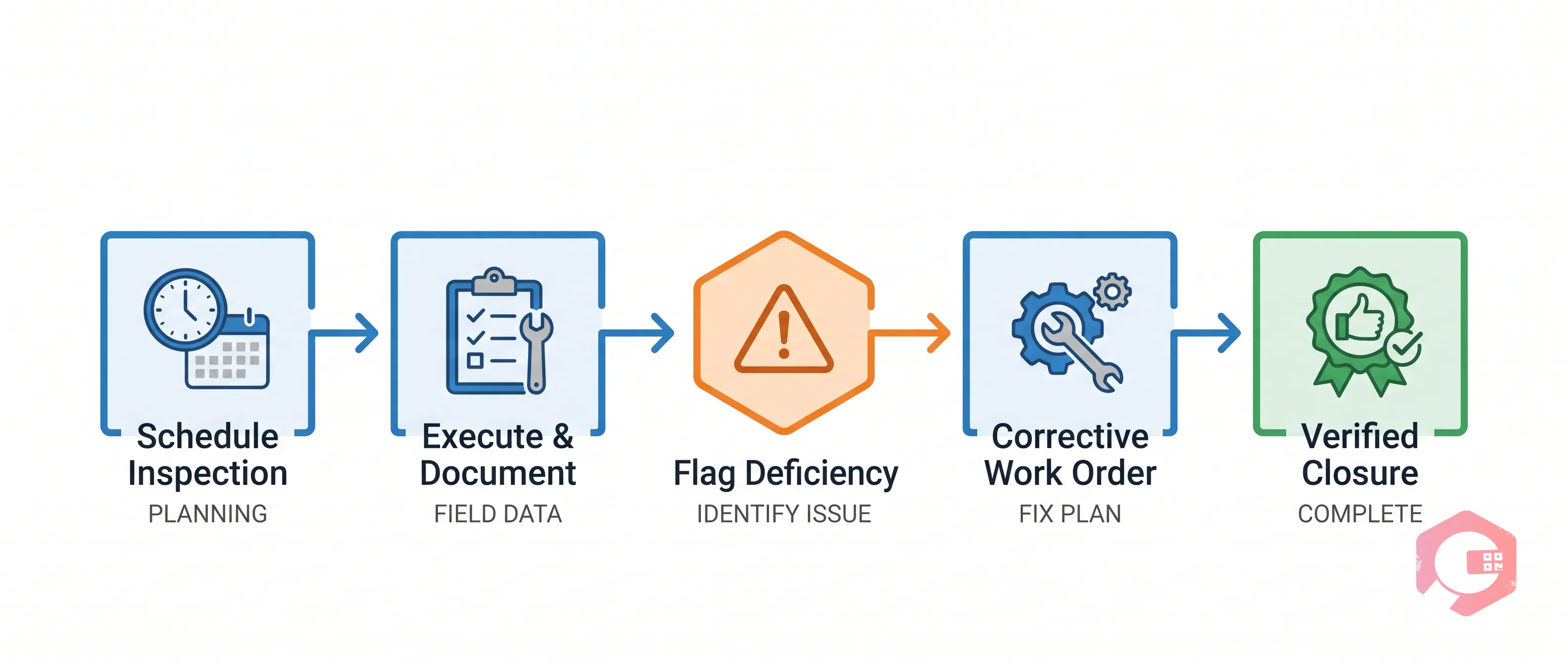
Mechanical Integrity is the PSM element most directly tied to CMMS functionality. OSHA requires that facilities establish written procedures for maintaining the ongoing integrity of process equipment, that inspections and tests follow recognized engineering standards, and that all findings — including deficiencies — are documented and corrected in a timely manner. This isn't a general requirement for good maintenance practice; it's a legal mandate with specific documentation obligations that OSHA inspectors check during every PSM audit.
OSHA requires that inspection and testing frequencies follow applicable industry standards — API 510 for pressure vessels, API 570 for piping systems, API 653 for aboveground storage tanks, and NFPA 70 for electrical systems, among others. Each inspection must be documented with the date performed, the name of the inspector, the results, and the reference standard used. If an inspection is missed or overdue, that gap must be defensible — either with documentation of a risk-based extension or a corrective work order already in progress.
A CMMS addresses this by scheduling inspections automatically based on the applicable standard frequency, generating work orders with embedded checklists that include the reference standard, the acceptance criteria, and fields for inspector name and date. When the work order is completed, the record is permanent, timestamped, and linked directly to the asset — not saved in a folder on a technician's laptop or filed in a paper binder that may not survive the next office move.
Cryotos's preventive maintenance module handles this exactly: calendar-triggered and usage-based PM schedules for every asset in scope, with automatic escalation if a work order is not completed by the due date. OSHA inspectors can be shown a filtered report of all MI inspections for any asset over any date range, with completion status, inspector name, and findings — without any manual data compilation required.
One of the most common PSM Mechanical Integrity violations isn't failing to inspect — it's failing to correct known deficiencies in a timely manner. OSHA 1910.119(j)(5) explicitly requires that deficiencies outside acceptable limits be corrected before further use, or that the equipment be used in a safe and controlled manner until corrections can be made. Facilities that find a deficiency and then lose track of it in a backlog or a shared spreadsheet are creating documented evidence of non-compliance.
A CMMS eliminates this risk by linking deficiency findings directly to corrective work orders at the point of inspection. When a technician completes an inspection work order and marks a finding as out-of-tolerance, the system automatically generates a corrective maintenance work order assigned to the appropriate team, with a priority level and a due date. The deficiency is never orphaned — it exists in the system as an open item until the corrective action is verified complete.
Cryotos's work order management module tracks the full lifecycle of every deficiency: when it was found, who owns the corrective action, current status, and when it was closed. This creates the documented evidence trail OSHA requires — and more importantly, it prevents the pattern of found-but-forgotten deficiencies that leads to incidents.
OSHA PSM also requires that maintenance materials, spare parts, and equipment used in PSM-covered processes meet the appropriate specifications for the process. This is the Quality Assurance (QA) requirement under Mechanical Integrity, and it's frequently overlooked until an incident or audit reveals that a replacement part didn't meet the original design specification.
Cryotos's inventory management module supports QA compliance by linking spare parts to their specifications and approved vendors, requiring documentation fields for material traceability, and maintaining a history of which parts were used in which work orders. When an OSHA inspector asks how you ensure that replacement gaskets on a flammable service line meet the original design specification, the answer is in the system — not in someone's memory.

OSHA's Management of Change requirement mandates that any change to process chemicals, technology, equipment, or procedures be reviewed and authorized before implementation. The review must consider the technical basis for the change, the safety and health impacts, modifications to operating procedures, and the time period for the change. All of this must be documented.
Where MOC intersects with CMMS is in the maintenance execution of approved changes. When an approved MOC requires physical modifications to process equipment, the CMMS creates the work orders for that work, links them to the MOC reference number, and ensures the modifications are carried out by qualified personnel following the approved scope. The work order completion record becomes part of the MOC documentation package — providing documented evidence that the physical change matched the approved design, not a variation that appeared in the field.
Cryotos supports MOC workflows by allowing maintenance work orders to be tagged with MOC reference numbers, requiring supervisor sign-off before closure, and generating completion reports that can be attached to the formal MOC package. This closes the loop between the paper approval and the physical execution — a gap that CSB investigations have identified repeatedly as a contributing factor in process safety incidents.
Hot work — welding, cutting, grinding, and any activity that produces a source of ignition — in or near a process unit containing flammable or combustible materials requires a formal permit under PSM. The permit must verify that the area has been properly isolated, atmospheric testing has been completed, fire watch has been assigned, and all safety controls are in place. Every hot work permit must be documented.
Cryotos's work order platform handles hot work permit integration by embedding the permit requirements directly into the work order for any job classified as hot work. Before the technician can mark the job as started, the permit checklist must be completed — atmospheric gas reading recorded, fire watch assigned, isolation verified. The completed permit is linked to the work order and stored permanently against the asset record. If OSHA asks for all hot work permits issued in the last 12 months on any process unit, the query takes seconds.
The same logic applies to Lockout/Tagout, confined space entry, and other safe work practices. Cryotos embeds these procedural requirements as mandatory checklist steps within the applicable work order types, ensuring they aren't bypassed under schedule pressure — which is precisely when PSM incidents are most likely to occur.
OSHA requires that incidents — and near misses with the potential for catastrophic consequences — be investigated promptly, that a written investigation report be produced, and that findings be resolved and documented. The investigation must determine the contributing factors, not just the immediate cause.
A CMMS supports incident investigation by providing complete asset maintenance history at the time of the investigation. If a heat exchanger fails catastrophically, the CMMS record shows: when it was last inspected, what the findings were, whether any deficiencies were open at the time of failure, which parts were used in the last repair, and who performed each maintenance action. This data is the foundation of a credible root cause analysis — and its absence is one of the key factors that turns an incident investigation into an OSHA enforcement action.
Cryotos's downtime tracking module captures failure events with timestamps, affected assets, and immediate corrective actions taken. Combined with the full work order history, this gives investigation teams everything they need to reconstruct the maintenance timeline without relying on recollections that may be unreliable or self-serving under the stress of an incident response.
PSM Element 5 requires that employers who use contractors for PSM-covered work inform the contractors about known process hazards, verify that contractors have trained their employees on the applicable hazards, and maintain injury and illness logs for contract workers. The facility is ultimately responsible for ensuring contractor work on PSM-covered equipment meets the same quality and documentation standards as in-house maintenance.
Cryotos supports contractor management within the work order system by requiring that contractor-assigned jobs include the assigned contractor company, the scope of work, and any required safety documentation before the work order can be issued. Contractor work orders follow the same completion documentation requirements as internal jobs — inspection results, materials used, photos of completed work, and supervisor sign-off. This ensures that contractor work leaves the same auditable paper trail as work performed by facility employees.
OSHA PSM penalties are significant, but they represent only a fraction of the actual cost of a compliance failure. The 2010 Tesoro Anacortes refinery explosion — which killed seven workers — resulted in a $2.79 million OSHA penalty. The BP Texas City refinery explosion in 2005 resulted in $87 million in OSHA penalties, the largest in the agency's history at the time. Both incidents were preceded by years of identified but unresolved mechanical integrity deficiencies that a functional CMMS would have made impossible to overlook.
Beyond penalties, a PSM incident at a refinery typically results in process unit shutdown lasting months, third-party liability exposure in the hundreds of millions, loss of community operating license in some jurisdictions, and — most critically — worker fatalities that no financial settlement can address. According to Reliable Plant, the total direct and indirect cost of a single major process safety incident at a refinery routinely exceeds $500 million when all factors are included.
The pattern identified by the CSB and OSHA in nearly every major refinery incident is consistent: the physical failure that caused the incident was preceded by a management system failure — specifically, a failure to act on known information about equipment condition. A CMMS does not prevent equipment from degrading. What it does is ensure that no one in the organization can claim ignorance of the equipment's condition, because the data is always current, always accessible, and always attached to a named owner who is accountable for the corrective action.

Cryotos is designed for the operational complexity of industrial facilities — including the multi-unit, multi-contractor, shift-based maintenance environment of a working refinery. Here is how each major platform capability maps directly to PSM compliance requirements:
Asset hierarchy and equipment register: Every PSM-covered asset is registered in Cryotos with its tag number, P&ID reference, applicable inspection standard, and maintenance history. This serves as the equipment database foundation that OSHA inspectors check first — and it eliminates the fragmented, version-controlled spreadsheet problem that plagues most facilities.
Inspection scheduling by standard: Cryotos's preventive maintenance module schedules inspections at the frequency required by the applicable standard (API 510, API 570, API 653, etc.) and escalates overdue items to supervisors automatically. No inspection falls through the cracks because someone forgot to update a spreadsheet.
Digital work orders with embedded safety procedures: Every work order in Cryotos includes the applicable safety procedure steps — LOTO, hot work permit, confined space, radiation work permit — as mandatory checklist items that must be completed before the job status can be advanced. The signed checklist is part of the permanent work order record.
Deficiency tracking to closure: Findings from inspections automatically generate corrective work orders with priority, owner, and due date. Open deficiencies are visible on the supervisor dashboard and escalate if overdue. Nothing is closed without a verified completion record.
Audit-ready reporting: Cryotos's BI Dashboard generates PSM audit packages on demand — inspection compliance rate by asset class, open deficiency aging report, work order completion history by technician, and hot work permit log. What previously took a week of manual compilation can be produced in minutes.
Mobile access for field execution: Technicians in a refinery environment work in areas with limited fixed workstation access. Cryotos's mobile app allows technicians to receive work orders, access asset history, complete checklists, record inspection findings, and close work orders from the field using a smartphone or tablet.
Multi-site management: Refinery groups operating multiple facilities can manage PSM compliance across all sites from a single Cryotos instance, with site-level dashboards showing compliance status by plant. Corporate EHS teams can monitor MI completion rates, open deficiency aging, and permit compliance without waiting for site-level reports.
PSM compliance is not a documentation exercise — it is a management system that must function every day, in every shift, across every unit. The maintenance management software that supports it must be reliable, auditable, and used consistently by the people doing the work. Cryotos is built to meet that standard. Request a demo to see how Cryotos maps to your facility's PSM program and OSHA inspection requirements.
A CMMS most directly addresses PSM Element 6 (Mechanical Integrity), Element 7 (Hot Work Permits), Element 8 (Management of Change — execution documentation), Element 5 (Contractors), Element 11 (Incident Investigation — by providing asset maintenance history), and Element 10 (Compliance Audits — by generating audit-ready reports). Element 6 is typically where CMMS delivers the highest compliance value because OSHA's Mechanical Integrity requirements are the most specific and documentation-intensive of all PSM elements.
OSHA inspectors typically request the equipment list for PSM-covered assets, the written MI procedures, inspection records for a sample of equipment items, documentation showing how inspection frequencies were determined, records of any deficiencies found and how they were resolved, and QA documentation for replacement parts. The most common violations involve missing inspection records, overdue inspections with no documented basis for the extension, and deficiency findings that were never corrected or tracked to closure.
A CMMS supports the written procedure requirement but does not replace it. OSHA requires written procedures for maintaining the integrity of process equipment — these must be separate documents that describe how inspections are conducted, what standards apply, and how deficiencies are managed. However, the CMMS is where those procedures are operationalized: inspection checklists based on the written procedures are embedded in work orders, and the completed work orders become the documented proof that the procedures were followed. The two work together — one defines what to do, the other proves it was done.
Cryotos's inventory management module allows spare parts to be catalogued with their applicable specifications, approved vendors, and material certification requirements. When a part is used in a work order, the link between the work order and the specific part (including lot number or certification number, if recorded) is maintained in the system. This satisfies OSHA's requirement that maintenance materials and equipment meet the specifications required for the process — and provides the traceability record that investigators and auditors look for when a part failure is suspected.



Cryotos AI predicts failures, automates work orders, and simplifies maintenance—before problems slow you down.



