

Condition-based maintenance (CBM) in power generation is a maintenance strategy that triggers service and repair activities based on the actual real-time condition of equipment — not on fixed time intervals or calendar schedules. For power generation facilities, where a single unplanned turbine failure can cost between $50,000 and $300,000 per hour in lost generation revenue, CBM is no longer a nice-to-have. It is the strategy that separates facilities with predictable reliability from those trapped in a cycle of emergency breakdowns.
Power plants that implement condition-based maintenance programs consistently achieve measurable results. A 2023 industry report from Deloitte found that facilities using condition monitoring technologies reduce unplanned downtime by 25 to 40 percent, extend critical asset lifespan by 15 to 20 percent, and lower total maintenance costs by 10 to 15 percent compared to time-based approaches. The key outcomes include:
Condition-based maintenance is a maintenance approach that uses real-time data from sensors, instrumentation, and inspection tools to monitor the health of equipment continuously. Maintenance tasks are triggered when monitored parameters — vibration, temperature, oil condition, electrical output — deviate from established baselines, signaling that an asset is developing a fault.
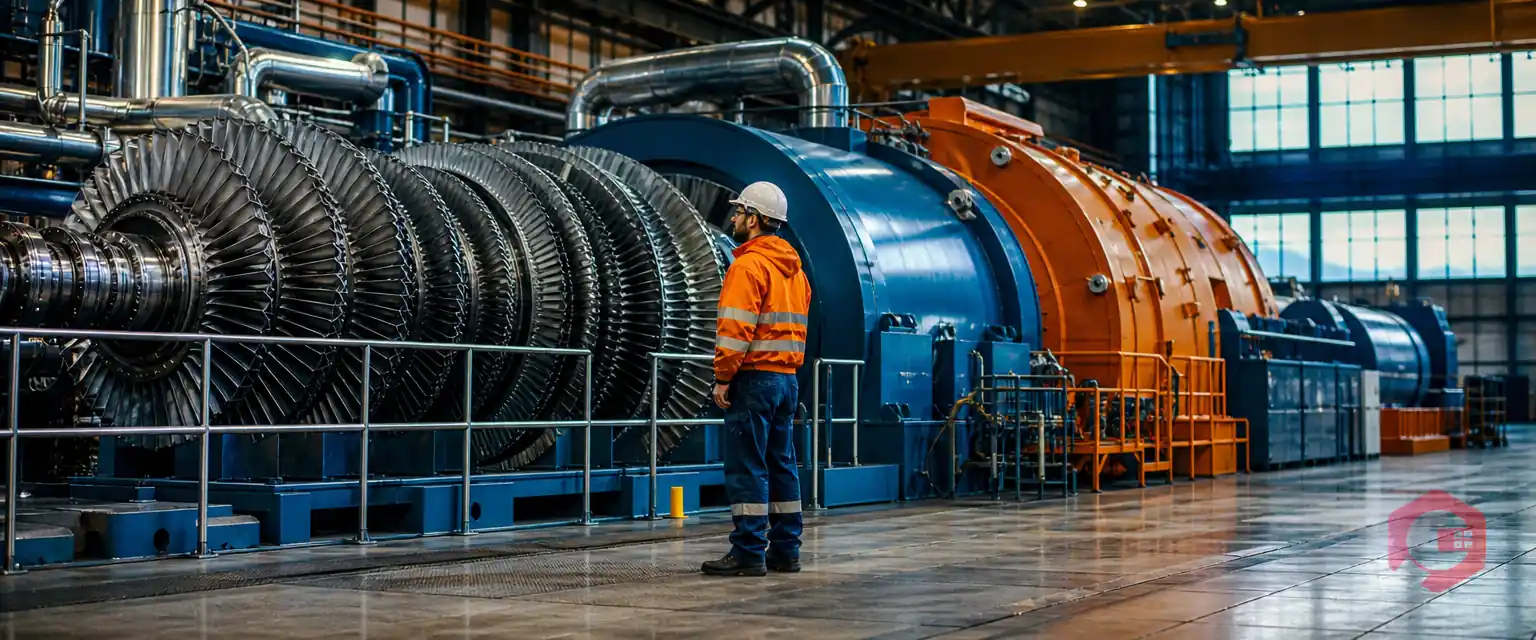
In a power generation context, CBM applies to the full range of rotating and static equipment: gas turbines, steam turbines, generators, transformers, cooling water pumps, heat exchangers, and auxiliary systems. The underlying principle is simple — every developing fault produces a physical signature before it causes a failure, and CBM captures that signature early enough to act.
These three maintenance strategies are often confused. The distinction matters because applying the wrong strategy to an asset wastes money or leaves reliability gaps. Time-based maintenance services equipment on fixed schedules regardless of its condition — monthly lubrication, annual overhauls — which can lead to over-maintaining healthy assets and under-maintaining ones that degrade faster than expected. Predictive maintenance uses advanced analytics, machine learning, and AI to forecast when a failure will occur, often weeks or months in advance. Condition-based maintenance sits between these two: it monitors real-time condition continuously and triggers maintenance when a defined threshold is crossed, without necessarily predicting the exact time to failure.
According to the ISO 13381-1 standard for machinery condition monitoring, condition-based maintenance and predictive maintenance share data collection infrastructure but differ in how they use that data. Most practical power plant programs combine both approaches: CBM for day-to-day threshold alerting and predictive analytics for longer-horizon failure forecasting on the highest-criticality assets.
Power generation equipment operates under conditions that make time-based maintenance inadequate. Turbines, generators, and rotating machinery experience loads that vary with grid demand, ambient temperature, and fuel mix — meaning calendar-based intervals miss the actual wear patterns of the equipment. A gas turbine running 18 hours per day during peak summer demand ages far faster than the same turbine running 6 hours per day in shoulder months. A fixed annual overhaul schedule treats both identically.
The shift toward renewable generation has compounded this challenge. As solar and wind capacity displaces baseload generation, thermal and hydro plants increasingly operate in flexible modes — starting and stopping more frequently, ramping output up and down — which accelerates fatigue on critical components. The U.S. Department of Energy’s Grid Modernization program identifies asset health management as a critical capability for the flexible grid, calling for condition monitoring as a baseline practice across all dispatchable generation assets.
Condition-based maintenance in a power plant operates as a closed loop: sensors collect data continuously, a monitoring platform evaluates that data against defined thresholds, an alert fires when a threshold is crossed, and a maintenance management system converts that alert into a work order that is assigned, executed, and documented. Each step in this chain must function reliably for the program to deliver its benefits.
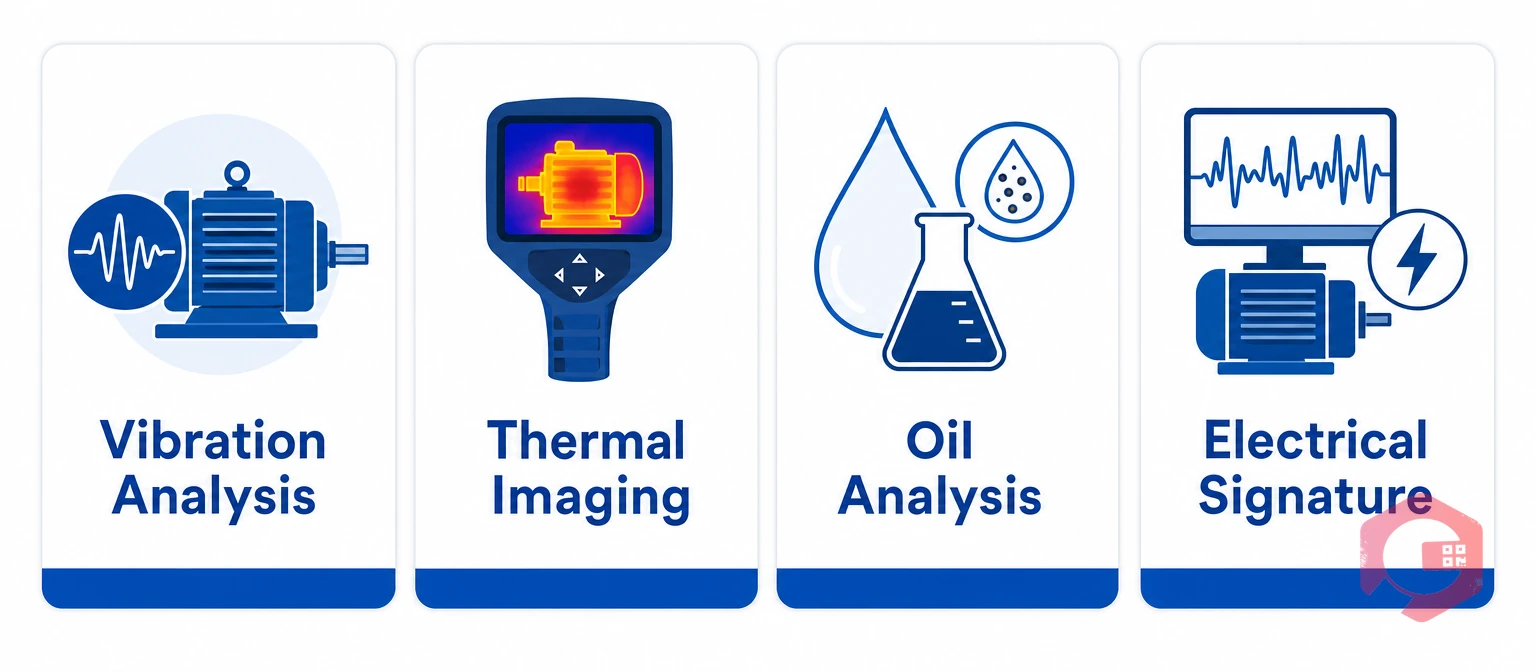
Four technologies form the foundation of most power plant CBM programs. Each targets specific failure modes and applies to specific asset classes. Understanding which technology to deploy on which asset is the starting point for any CBM implementation.
Vibration monitoring is the most widely deployed CBM technology in power generation because rotating equipment represents the highest concentration of critical failure risk. Gas turbine bearing failures, generator rotor unbalance, and cooling pump impeller wear are all detectable through vibration analysis well before they cause forced outages.
A modern vibration monitoring system places accelerometers at each bearing housing on critical rotating equipment and transmits readings continuously to a condition monitoring platform. The platform compares live readings to ISO 10816 vibration severity thresholds — the international standard for evaluating machine vibration — and flags deviations. When overall vibration levels trend upward or specific frequency components appear that match known fault signatures, the system generates an alert. A well-configured CMMS receives this alert and automatically creates a high-priority work order with the asset details, fault description, and relevant vibration trend data attached.
Electrical failures are one of the leading causes of unplanned generation outages, and most develop slowly through insulation degradation that is invisible to visual inspection. Thermography converts these invisible heat signatures into actionable maintenance data. In a power plant context, thermographic surveys typically target generator exciter systems, transformer connections, switchgear panels, cable terminations, and motor control centres.
Online thermal monitoring systems — fixed infrared cameras connected to the plant’s condition monitoring network — have largely replaced periodic manual thermographic surveys on the highest-criticality electrical assets. These systems stream thermal images continuously, with software algorithms flagging temperature differentials above defined thresholds for immediate review. For assets where continuous monitoring is cost-prohibitive, scheduled quarterly thermographic surveys remain the standard, with findings feeding directly into the CMMS maintenance history.
Lubricating oil is often described as the lifeblood of a turbine. It cools bearings, removes wear particles, and protects metal surfaces from corrosion. Oil analysis reveals the condition of both the fluid itself and the machinery it lubricates — making it one of the most information-dense CBM tools available to power plant maintenance teams.
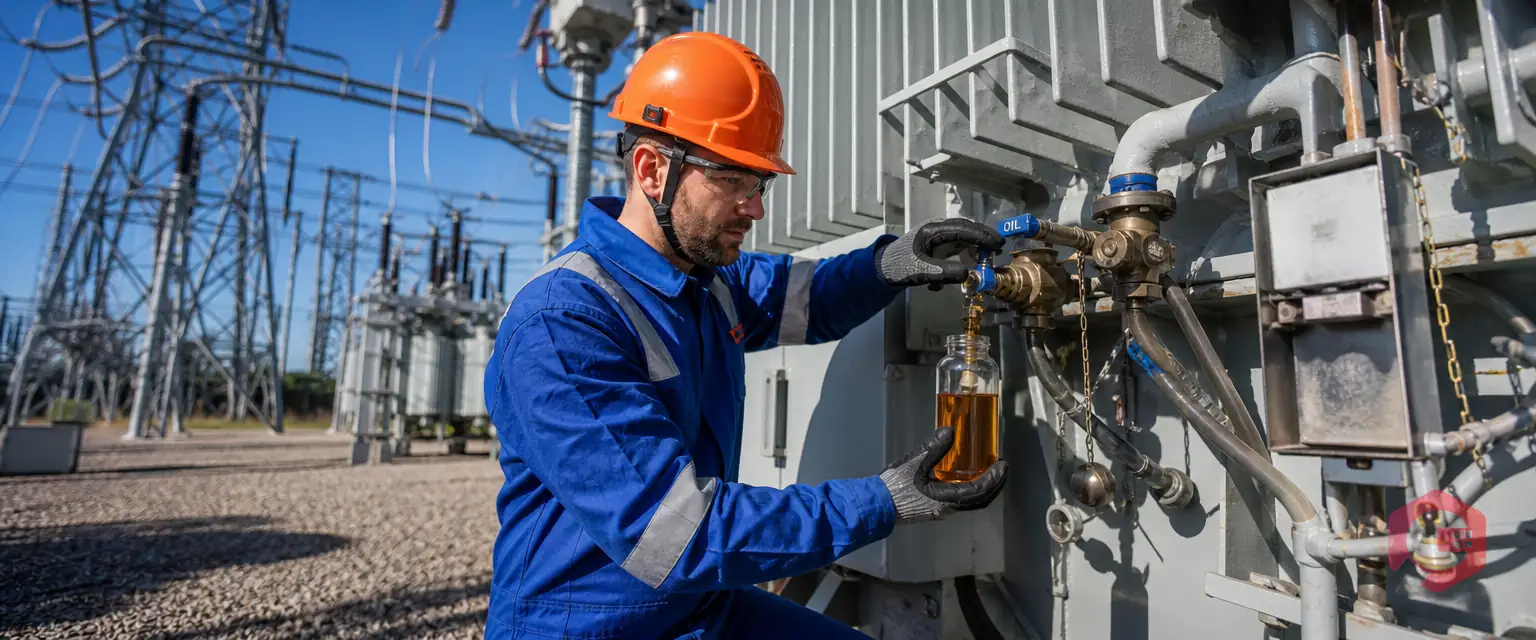
A comprehensive oil analysis program samples turbine lube oil and transformer insulating oil on a defined schedule — typically monthly for turbines and quarterly for transformers — and tests for particle count, viscosity, oxidation, water content, and elemental analysis. The elemental breakdown tells technicians specifically which components are shedding metal: elevated iron indicates bearing surfaces wearing; elevated copper points to thrust bearing shells; elevated silicon suggests external contamination. The Reliable Plant oil analysis program guide recommends that power plants establish individual baseline values for each turbine-oil system combination rather than applying generic industry averages, because operating conditions vary significantly between units.

Deploying condition monitoring on every asset in a power plant simultaneously is neither practical nor cost-effective. An effective CBM program starts by classifying assets by criticality and applying monitoring resources to the equipment where failure consequences are highest. A structured prioritization framework avoids the common mistake of instrumenting non-critical pumps before addressing turbine bearing health.
Turbines are the highest-criticality assets in any thermal power plant. A gas turbine forced outage at a combined-cycle facility typically costs $150,000 to $300,000 per day in lost generation revenue plus repair costs that run from $500,000 for a bearing replacement to several million for a hot section overhaul. The failure modes most amenable to CBM detection are bearing degradation (vibration and oil analysis), combustion instability (pressure pulsation and exhaust temperature spread), and compressor fouling (differential pressure and performance degradation).
Generator failures are particularly costly because replacement components have lead times of 6 to 18 months. Condition monitoring of generators focuses on insulation system health (partial discharge monitoring and thermography), rotor winding condition (shaft voltage and flux monitoring), and bearing health (vibration analysis). Partial discharge monitoring in particular has proven highly effective at detecting insulation degradation in high-voltage generator stator windings months before failure.
Cooling water systems are among the most failure-prone systems in power plants because they operate in corrosive, fouling-prone environments. Condenser tube fouling reduces thermal efficiency and increases back pressure on steam turbines, directly reducing output. Cooling tower fan bearing failures can take an entire cooling circuit offline within hours. CBM for cooling systems focuses on pump vibration monitoring, heat exchanger performance trending (inlet/outlet temperature differentials), and tube bundle inspection using eddy current testing on a condition-triggered basis rather than fixed annual intervals.
While individual auxiliary pump or fan failures rarely cause full plant outages, they create the operational complexity and resource drain that prevents maintenance teams from focusing on higher-criticality work. Vibration monitoring on critical pumps and fans — boiler feed pumps, circulating water pumps, induced and forced draft fans — provides early warning of impeller wear, cavitation damage, and bearing degradation. For plants with dozens of auxiliary rotating machines, wireless vibration sensors with route-based data collection represent a cost-effective middle ground between full online monitoring and periodic manual inspection.
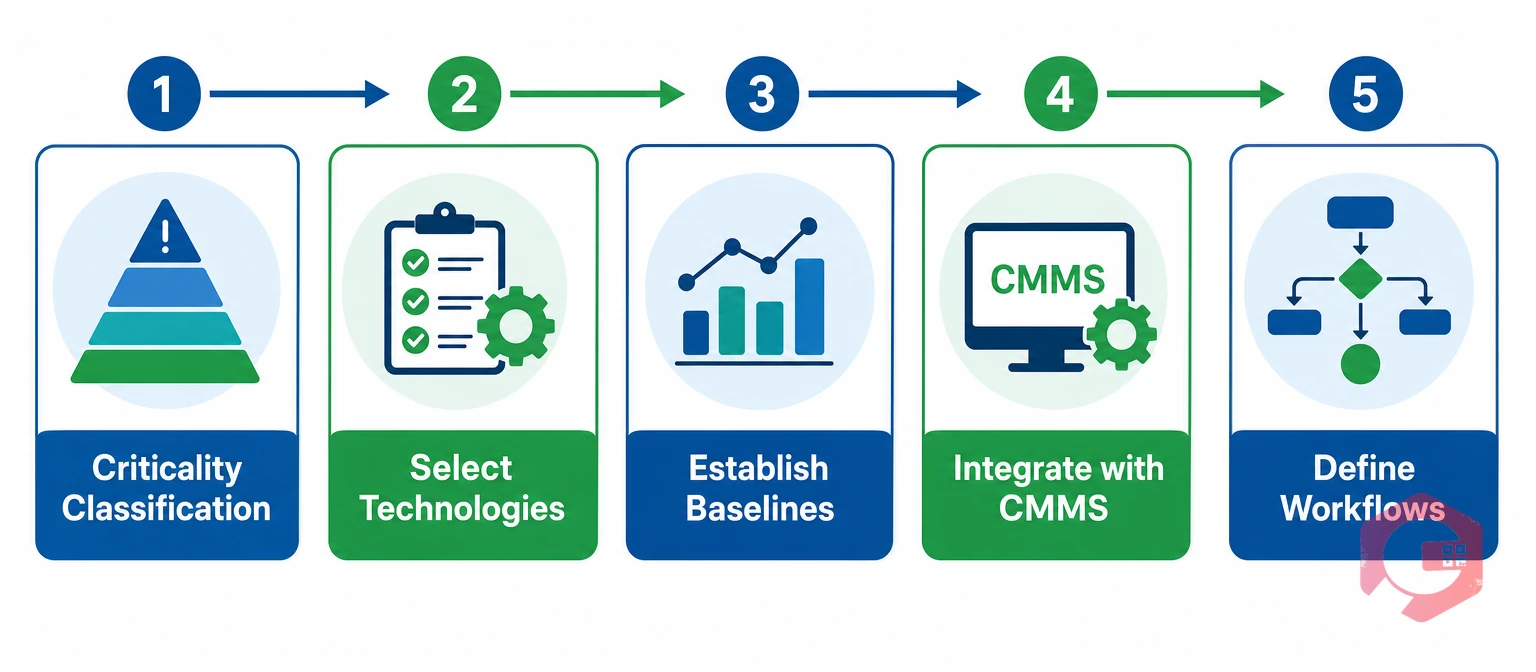
Implementing CBM in a power generation facility is a structured process that typically takes 6 to 18 months for full deployment, depending on plant size and starting point. The facilities that achieve the strongest results follow a deliberate sequence rather than deploying sensors and software all at once without clear priorities or workflows. Here is the implementation framework that consistently delivers measurable outcomes.
The foundation of any CBM program is knowing which assets matter most. Criticality classification assigns each asset a tier based on the consequences of its failure — production impact, safety risk, environmental exposure, and lead time for replacement or repair. A Tier 1 asset is one whose failure stops generation entirely: the gas turbine, main transformer, and generator fall here for most plants. Tier 2 assets reduce output or degrade efficiency without causing a full outage. Tier 3 assets create operational complexity but have available redundancy or short recovery paths.
CBM investment follows this hierarchy. Tier 1 assets get continuous online monitoring with direct CMMS integration. Tier 2 assets get periodic monitoring with defined inspection intervals. Tier 3 assets use traditional time-based maintenance unless failure data over time suggests reclassification is warranted.
Each asset in your Tier 1 and Tier 2 classification needs a monitoring technology matched to its specific failure modes. Rotating equipment gets vibration analysis. Electrical assets get thermography and partial discharge monitoring. Turbines get vibration, performance monitoring, and oil analysis. The selection process starts with failure mode documentation: for each critical asset, list the three to five most likely failure modes, identify what physical change precedes each failure, and select the monitoring technology that detects that change earliest.
Condition monitoring only produces actionable alerts if baselines and alert thresholds reflect the actual normal operating range of each specific asset under its actual operating conditions. Generic industry values — ISO vibration severity limits, for example — provide a starting point but should be refined over 60 to 90 days of baseline measurement after sensor installation. A gas turbine bearing running 0.5 mm/s RMS vibration under normal load is healthy; the same bearing at 1.2 mm/s RMS is not — and the threshold between the two is specific to that machine, not a generic standard.
This is the step that transforms raw sensor data into maintenance actions. Without CMMS integration, condition monitoring produces alerts that get reviewed in a separate system, sometimes actioned and sometimes not, with no connection to the asset’s maintenance history or parts inventory. With CMMS integration, a threshold breach in the sensor network automatically creates a work order in the maintenance system, pre-populated with the asset ID, fault description, sensor trend data, and relevant historical maintenance records. Cryotos CMMS integrates directly with SCADA systems, PLCs, and IoT data feeds, enabling this sensor-to-work-order automation without manual intervention. The IoT meter reading module configures threshold-based alert rules per asset, so each turbine bearing, transformer, or pump has its own trigger criteria rather than a generic plant-wide default.
A CBM alert is only as valuable as the response it generates. Defining the workflow from trigger to resolution before you go live is critical. For each alert type — vibration threshold breach, DGA exceedance, thermal anomaly — define the priority level (Critical, High, Medium), the assigned team or individual, the response time target, and the initial diagnostic steps the technician should perform. These workflow definitions are configured in the CMMS so that the auto-generated work order arrives at the right technician with the right instructions and the right priority — automatically, every time.
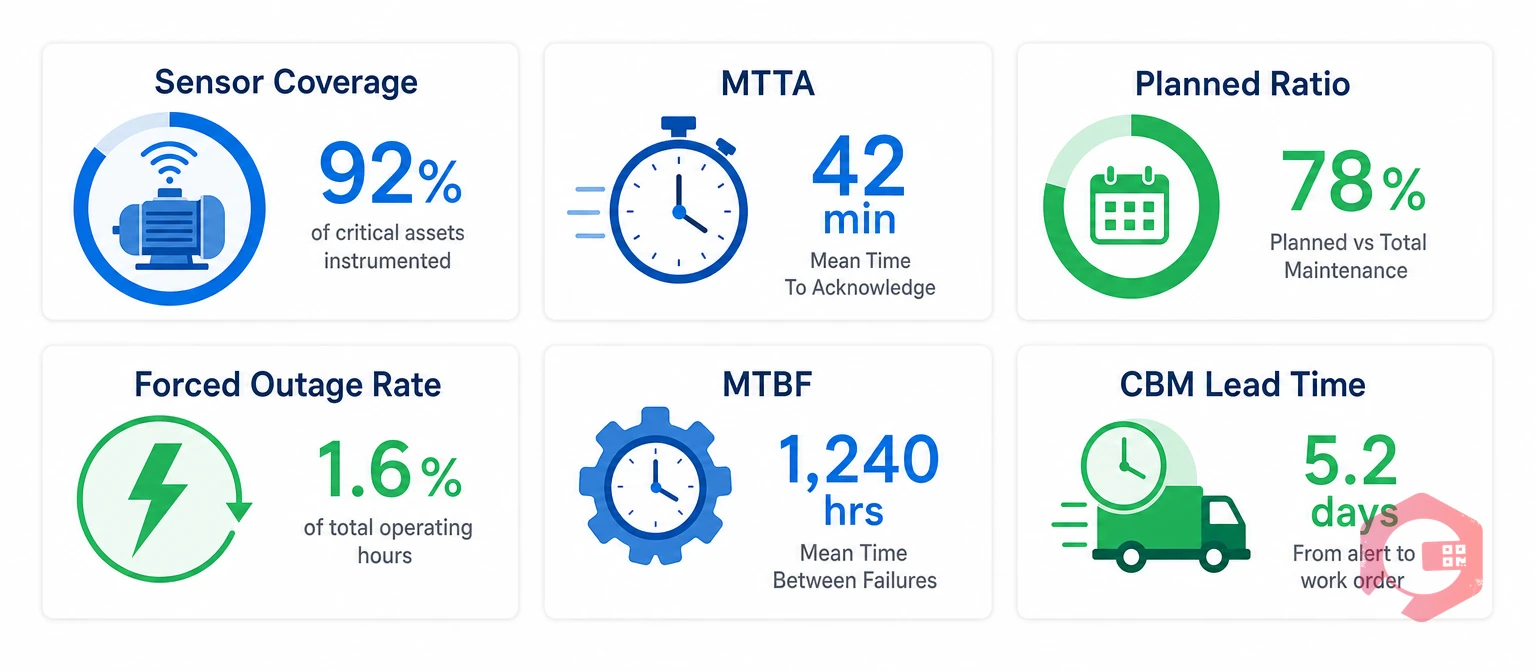
Measuring the performance of your condition-based maintenance program requires tracking both the health of your monitoring infrastructure and the operational outcomes it drives. Six KPIs provide a complete picture.
Running a condition-based maintenance program without a connected CMMS creates a critical gap: sensor data generates alerts, but those alerts sit in a monitoring platform that has no connection to your maintenance team’s workflow, no access to the asset’s history, and no mechanism for tracking whether the response was timely, effective, or complete. Cryotos CMMS closes that gap by serving as the operational backbone of your CBM program — connecting real-time condition data to maintenance execution, parts availability, and performance reporting in a single platform.
On the asset management side, Cryotos maintains a complete asset maintenance record for every piece of equipment in your plant: specifications, maintenance history, downtime events, and cost of ownership. When a CBM alert fires on a gas turbine bearing, the auto-generated work order in Cryotos includes the full bearing history — previous vibration trends, last lubrication date, bearing type and part number — so the technician arrives with context rather than starting blind.
The preventive maintenance module supports both time-based and condition-based PM triggers. For assets where CBM thresholds drive maintenance timing, Cryotos generates condition-triggered work orders automatically when sensor data crosses defined limits. For assets where periodic inspection remains appropriate, calendar-based PMs run alongside the CBM program in the same system — giving maintenance managers a unified view of all scheduled and condition-triggered work without switching between tools.
Cryotos’s downtime tracking module records every forced and planned outage against the relevant asset, calculating MTBF, MTTR, and availability percentage in real time. Over months, this data reveals which monitored assets drive the most downtime cost, where CBM thresholds need tightening, and which failure modes are still slipping through — allowing the program to evolve and improve continuously.
For compliance-critical environments, Cryotos’s permit-to-work module embeds safety authorization directly into every work order generated by CBM alerts. Before a technician can accept a condition-triggered work order on an energized turbine or transformer, the permit must be approved and all lockout/tagout steps confirmed digitally — with every action timestamped and audit-ready. Plants using Cryotos report an average 30% reduction in unplanned downtime and 25% faster repair times within the first 12 months of deployment — results that map directly to the goals of any condition-based maintenance program.
If your power generation facility is ready to move from time-based maintenance schedules to a data-driven CBM program, Cryotos CMMS provides the SCADA integration, automated work order generation, and asset health reporting you need to make that transition effective and measurable.
Condition-based maintenance in a power plant is a maintenance strategy that triggers service activities based on real-time data from sensors monitoring equipment health — vibration levels, temperature readings, oil condition, and electrical signatures — rather than fixed time intervals. When a monitored parameter crosses a defined threshold, a maintenance alert fires and a corrective work order is generated, enabling intervention before the fault causes a failure.
The four core technologies are vibration analysis (for rotating equipment like turbines and generators), thermal imaging and thermography (for electrical assets and insulation systems), oil and lubricant analysis (for turbine lube systems and transformers), and electrical signature analysis (for motor-driven auxiliary equipment). Most power plants deploy all four, targeting each technology at the asset classes where it detects the relevant failure modes earliest.
Condition-based maintenance triggers intervention when a monitored parameter crosses a defined threshold — a reactive response to a measured condition. Predictive maintenance uses analytical models to forecast when a failure will occur in the future, based on trends in condition data, and triggers intervention before the threshold is crossed. In practice, modern power plant maintenance programs combine both: CBM provides the real-time alert layer and predictive analytics provides the longer-horizon planning layer for the highest-criticality assets.
The primary benefits are a 25 to 40% reduction in unplanned downtime, a 10 to 15% reduction in total maintenance costs, and a 15 to 20% extension of critical asset lifespans. Secondary benefits include improved plant availability and capacity factor, better resource planning for maintenance teams, reduced emergency parts procurement costs, and a full digital audit trail of condition data and maintenance actions that supports regulatory compliance inspections.
Start with asset criticality classification — identify your Tier 1 assets whose failure stops generation, and focus your first monitoring deployment there. Select condition monitoring technologies matched to the specific failure modes of those assets. Install sensors and establish baselines over 60 to 90 days of operation. Then integrate your condition monitoring data with a CMMS that can receive threshold alerts and convert them automatically into assigned work orders with relevant asset history attached. The implementation framework in this article covers all five steps in detail.


Cryotos AI predicts failures, automates work orders, and simplifies maintenance—before problems slow you down.



