SCADA Integration for Solar Power Plant Monitoring: The Complete O&M Guide

Created On:

April 2, 2026

SCADA integration for solar power plant monitoring connects your plant's sensors, inverters, and field devices to a centralized control system that collects, visualizes, and acts on real-time operational data. A well-integrated SCADA system lets your O&M team catch performance drops before they become failures — turning raw telemetry into scheduled work orders, dispatched technicians, and resolved faults.

SCADA Integration for Solar Power Plant Monitoring: The Complete O&M Guide

SCADA integration for solar power plant monitoring connects your plant's sensors, inverters, and field devices to a centralized control system that collects, visualizes, and acts on real-time operational data. A well-integrated SCADA system lets your O&M team catch performance drops before they become failures - turning raw telemetry into scheduled work orders, dispatched technicians, and resolved faults. According to the International Renewable Energy Agency (IRENA), O&M costs account for 20-25% of a solar plant's total lifetime cost, and undetected faults are the leading driver of unplanned downtime. This guide covers everything your team needs to know: what solar SCADA monitors, which protocols to use, how to connect SCADA to a CMMS, and the step-by-step process for building a monitoring setup that actually reduces downtime.


What Is SCADA Integration for Solar Power Plants?

SCADA - Supervisory Control and Data Acquisition - is the backbone of modern solar power plant monitoring. It collects real-time data from every connected device in the plant (inverters, meters, sensors, trackers), aggregates that data in a central server, and presents it to operators through dashboards, alarms, and reports. Integration means connecting those data streams not just to a display screen, but to the systems your team actually uses to act - your CMMS, your ticketing workflow, your maintenance schedule.

For a utility-scale solar plant, a SCADA system typically handles data from hundreds or thousands of endpoints simultaneously. At a 50 MW plant, that might mean monitoring 12,500 solar panels across 500 string inverters, 20 central inverters, multiple weather stations, and transformer substations - all in real time. Without SCADA, this volume of equipment is simply unmanageable with manual inspections.

How SCADA Systems Collect Solar Plant Data

SCADA systems collect data through a layered architecture. Field devices (inverters, sensors, meters) sit at the bottom layer. A data concentrator or Remote Terminal Unit (RTU) aggregates readings from multiple field devices and forwards them to the SCADA server over a communication network (fiber, cellular, or RF). The SCADA server stores, processes, and serves data to the Human-Machine Interface (HMI) where operators monitor the plant.

Data polling intervals typically range from 1 second to 15 minutes depending on the parameter. Inverter power output and fault codes are polled every 1-5 seconds. Energy yield and environmental data update every 15 minutes. This granularity is what makes SCADA the foundation of predictive maintenance - you can spot a 3% drop in string output before it compounds into a full outage.

Key SCADA Protocols for Solar: Modbus, OPC-UA, and DNP3

Three communication protocols dominate solar SCADA deployments, and choosing the right one - or supporting all three - determines how well your system integrates with diverse equipment:

  • Modbus RTU/TCP - The most widely used protocol in solar. Nearly every inverter manufacturer supports it. Simple, reliable, and low-cost to implement. The limitation is that it's a polling protocol - the master queries each device in sequence, which can introduce latency at scale.
  • OPC-UA (OPC Unified Architecture) - The modern standard for industrial IoT and SCADA. It supports both polling and subscription (event-driven) models, encrypts data in transit, and provides a standardized information model. Increasingly required for utility-scale plants and grid operator reporting.
  • DNP3 (Distributed Network Protocol) - Widely used in North America for utility-grade plants where the SCADA system must communicate with the grid operator or substation automation equipment. More complex to configure than Modbus but essential for grid compliance in many markets.

Most modern solar SCADA platforms support all three. If you're evaluating vendors, confirm multi-protocol support - especially if you have mixed inverter brands or plan to connect to grid operator systems.

What Data Does a Solar SCADA System Monitor?

A solar SCADA system is only as useful as the data it collects. Plants that monitor only total AC output miss the early fault signals buried in string-level and inverter-level data. Here's a breakdown of what a fully instrumented solar plant should be monitoring:

Inverter-Level and String-Level Monitoring

Inverter monitoring tracks AC power output, DC input voltage and current per string, inverter temperature, operating state, and fault codes. This is the most critical data layer - inverter faults account for the majority of unplanned downtime events in solar plants. According to a National Renewable Energy Laboratory (NREL) report on PV system reliability, inverter failures represent roughly 37% of all corrective maintenance events at utility-scale sites.

String monitoring goes one level deeper. Each string of series-connected panels produces a DC current that flows into the inverter's input. If one panel in a string is shaded, soiled, or failing, the entire string's output drops. String-level monitoring lets you isolate exactly which string - and often which panel - is underperforming, without deploying a technician to walk the entire row. This turns a half-day inspection into a 10-minute targeted fix.

Environmental Sensors: Irradiance, Temperature, and Wind

Environmental monitoring provides the reference data you need to distinguish a real underperformance event from a weather-related dip. The three essential sensors are:

  • Pyranometer (irradiance sensor) - Measures solar irradiance in W/m². Without this, you can't calculate Performance Ratio or tell whether a power drop is caused by clouds or a fault.
  • Module temperature sensor - Solar panel output decreases by approximately 0.3-0.5% for every 1°C rise above 25°C (STC). Tracking module temperature lets you apply temperature correction to yield calculations and flag abnormally hot cells that indicate hotspot defects.
  • Wind speed / soiling sensor - Relevant at sites with significant dust, bird activity, or pollen. Soiling losses of 2-5% per month are common in arid climates, and a soiling sensor helps schedule cleaning at the optimal cost-benefit point.

How SCADA Integration Enables Predictive Maintenance

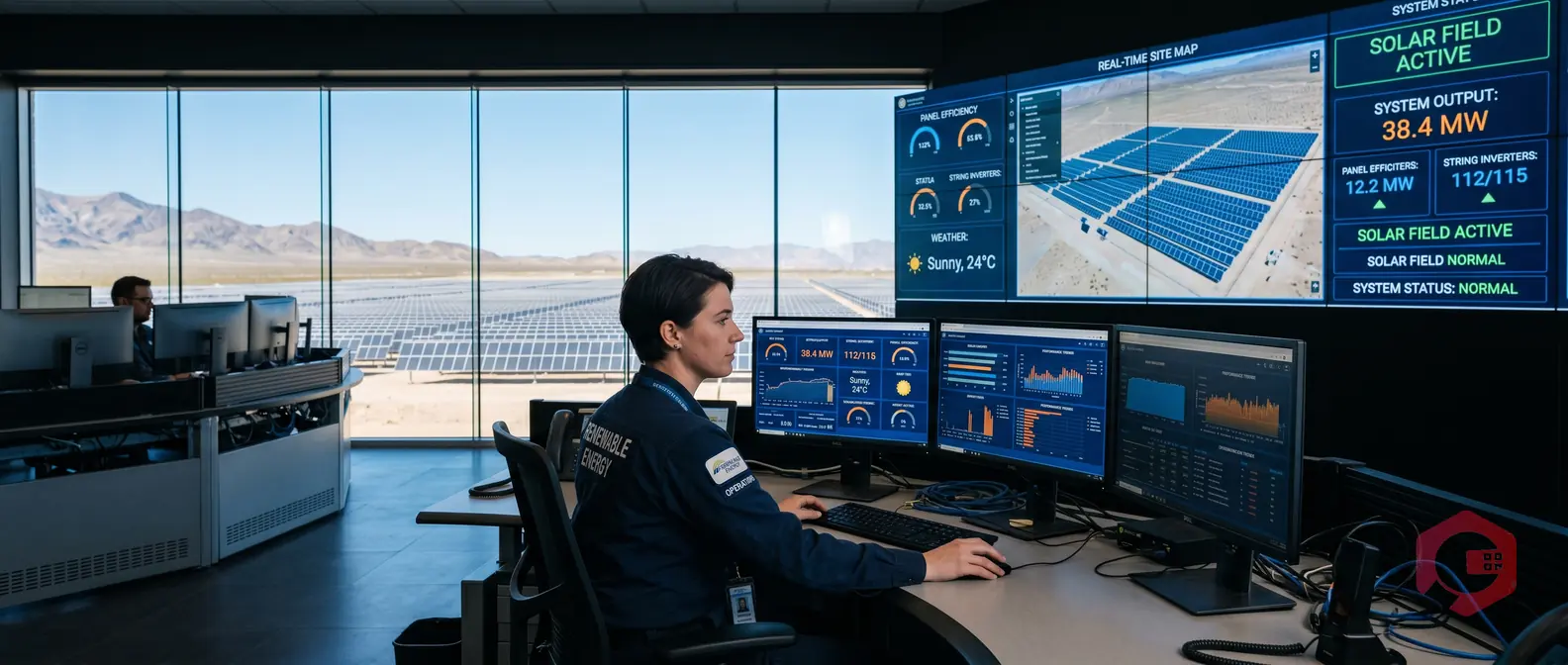
Solar O&M team using SCADA + CMMS for predictive maintenance | Cryotos

Predictive maintenance for solar plants means using real-time and historical SCADA data to predict when a component is likely to fail - and scheduling maintenance before that failure happens. It's the evolution beyond time-based preventive maintenance schedules, which service equipment whether it needs it or not, and far beyond reactive maintenance, which waits for failures to occur.

A plant running predictive maintenance on SCADA data can realistically target 30% fewer unplanned outages and 20-25% lower O&M costs compared to a purely reactive approach - figures consistent with IRENA's benchmarks for optimized solar O&M programs.

From Real-Time Alerts to Maintenance Work Orders

The key step most solar O&M teams get wrong is the gap between a SCADA alert and a resolved work order. The alert fires. Someone sees it on the dashboard. Someone else gets a call. A ticket gets created manually. A technician is dispatched two days later. By then, the fault has either cascaded or the trail has gone cold.

A properly integrated SCADA-to-CMMS workflow eliminates this gap. When SCADA detects an anomaly - say, String 4 of Inverter Block 7 drops 15% below the irradiance-corrected expected output - it automatically triggers a work order in the CMMS with the asset ID, fault description, GPS coordinates, priority level, and relevant historical data pre-populated. The work order routes to the right technician based on availability and location. The technician receives a mobile notification. The fix is logged, and the data feeds back into the asset's maintenance history.

This closed-loop workflow - from sensor to work order to resolution - is what separates plants with 98%+ availability from those stuck at 92%. Tools like Cryotos CMMS support SCADA data ingestion through IoT integrations, enabling this automated alert-to-work-order flow without manual intervention.

AI and ML Anomaly Detection in Solar SCADA

The next evolution of solar SCADA is applying machine learning models to the data stream. Rather than simple threshold-based alerts, ML models learn the normal operating signature of each inverter under a given set of environmental conditions. When the actual output deviates from the predicted signature by more than a confidence interval, the model flags it as an anomaly - even if the absolute output hasn't crossed any threshold.

This catches early-stage degradation that rule-based systems miss. A study published in Applied Energy found that ML-based anomaly detection in PV systems identified faults an average of 11 days earlier than threshold-based monitoring, reducing MTTR (Mean Time to Repair) by 28%. For a 100 MW plant, that difference can translate to hundreds of thousands of dollars in recovered energy yield annually.

Common ML use cases in solar SCADA include: soiling rate prediction, inverter degradation modeling, hotspot detection from thermal imaging integrated with SCADA timestamps, and clipping loss identification under high-irradiance conditions.

Connecting SCADA to Your CMMS: The Missing Link in Solar O&M

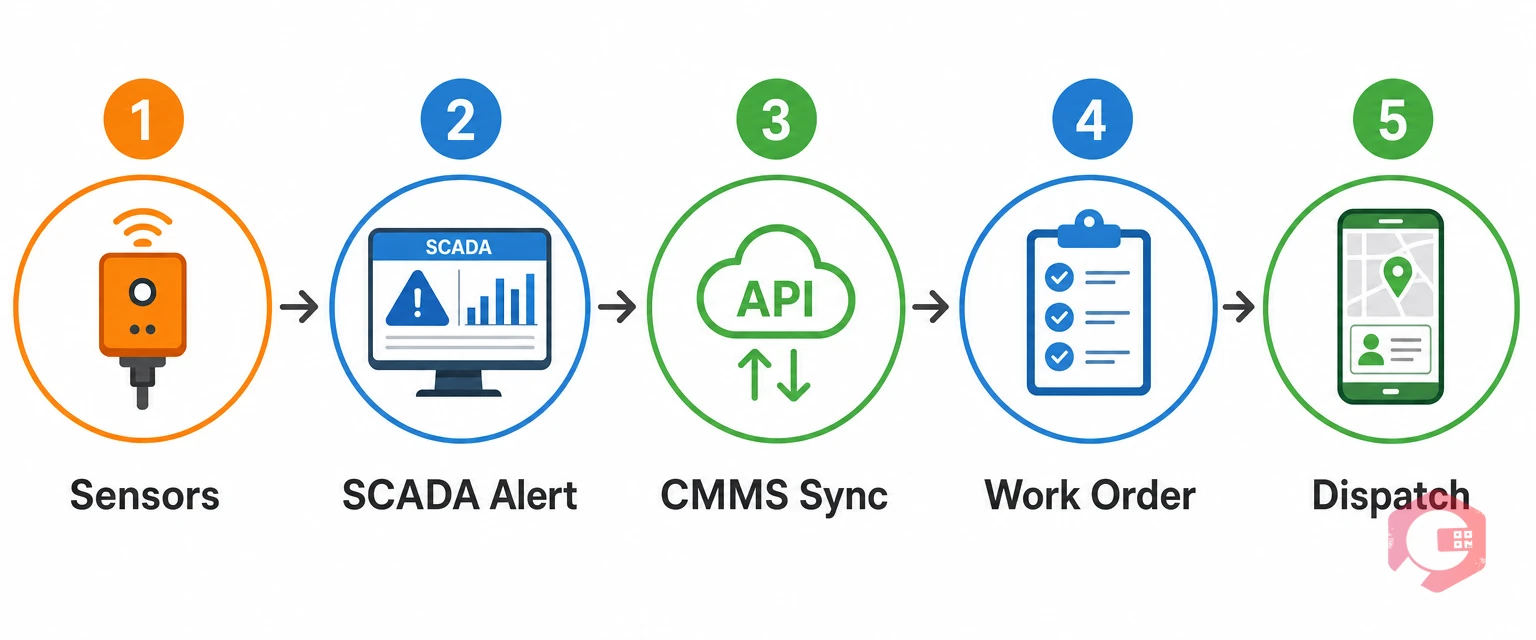
SCADA-to-CMMS data lifecycle — Sense → Transmit → Trigger → Resolve

Most solar SCADA guides stop at the monitoring layer. They explain dashboards, KPIs, and alert thresholds - but they don't address how the data flows into the execution layer where actual maintenance happens. That execution layer is your CMMS (Computerized Maintenance Management System), and connecting the two is the single highest-leverage improvement most solar O&M teams can make.

Why SCADA Alone Is Not Enough

SCADA tells you what is happening. It doesn't manage what to do about it. Without a CMMS connection, your O&M team is manually translating SCADA alerts into maintenance actions - a process that introduces delays, loses context, and leaves no auditable trail. You can't track which technician fixed which fault, how long it took, what parts were used, or whether the fix held. That missing data is exactly what you need to spot recurring failures, optimize maintenance intervals, and justify O&M budget to plant owners.

Consider a common scenario: SCADA flags an inverter fault at 9:15 AM. The operations manager sees it at 10:30 AM after finishing another call. They send a WhatsApp to the site supervisor. The supervisor dispatches a technician at 1 PM. The technician fixes the fault but doesn't log the cause. The same fault recurs in six weeks. None of this is captured - not the response time, not the root cause, not the parts consumed. A SCADA-CMMS integration would have auto-created the work order at 9:15, tracked every minute of the response, and tagged the fault code for pattern analysis.

How SCADA + CMMS Integration Closes the Maintenance Loop

A SCADA-CMMS integration works through one of three mechanisms: API connection (real-time bidirectional data exchange), middleware / IoT gateway (edge device translates SCADA data into CMMS-readable events), or scheduled data export (batch file transfer - the least real-time but simplest to implement).

The data flow looks like this:

  • SCADA detects anomaly → generates event with asset ID, fault code, timestamp, and telemetry snapshot
  • Event triggers CMMS API call → creates work order pre-filled with asset data, fault description, and GPS location
  • CMMS routes work order → assigns technician based on skill, shift schedule, and proximity
  • Technician receives mobile alert → accesses work order on CMMS mobile app with full asset history and procedure checklist
  • Technician completes work → logs repair, parts used, time spent, and root cause in CMMS
  • CMMS updates asset record → maintenance history feeds back into predictive models and compliance reports

Cryotos CMMS supports this integration natively through its IoT module, which connects to SCADA, PLC, and edge device data streams. IoT sensor thresholds can trigger work orders automatically, assign them to the right technician, and track resolution - all without manual intervention. Plants using Cryotos report a 30% reduction in unplanned downtime and 25% faster repair times after activating automated work order triggers.

Key Performance Indicators to Track via Solar SCADA

SCADA data is only useful if you're measuring the right things. Here are the KPIs every solar O&M team should track - and what good looks like for each:

Performance Ratio (PR) and Specific Yield

Performance Ratio (PR) is the most important single metric for a solar plant. It compares actual energy output to the theoretical output based on the irradiance received, expressed as a percentage. A PR of 80% means the plant is producing 80% of what it theoretically could given the sunlight available - with the 20% gap attributable to losses from heat, soiling, wiring resistance, inverter inefficiency, and downtime. According to IEA PVPS Task 13 guidelines, a well-maintained utility-scale plant should maintain a PR above 75-80%.

Specific Yield (kWh/kWp) normalizes energy output by installed capacity, making it possible to compare plants of different sizes in different locations. Track both on a daily, monthly, and cumulative basis through your SCADA dashboard.

MTTR, MTBF, and Availability Metrics

These three maintenance KPIs require SCADA + CMMS data combined - SCADA provides the fault timestamps, and the CMMS provides the repair completion timestamps:

  • MTTR (Mean Time to Repair) - Average time from fault detection to fault resolution. Industry benchmark for inverter faults: under 4 hours for on-site teams, under 24 hours for remote sites. If your MTTR is consistently above 8 hours, your alert-to-dispatch workflow needs attention.
  • MTBF (Mean Time Between Failures) - Average operating time between failures for a specific component type. Rising MTBF over time is a sign your preventive maintenance program is working. Declining MTBF signals aging equipment or an emerging systemic issue. Use downtime tracking software to calculate this automatically from SCADA event logs.
  • Availability - Percentage of scheduled operating hours during which the plant (or a specific asset) was operational. Contractual availability guarantees at utility-scale plants typically specify 97-98%. Track both technical availability (excluding grid curtailment) and contractual availability (as defined in your O&M agreement).

Step-by-Step: Setting Up SCADA Integration for a Solar Power Plant

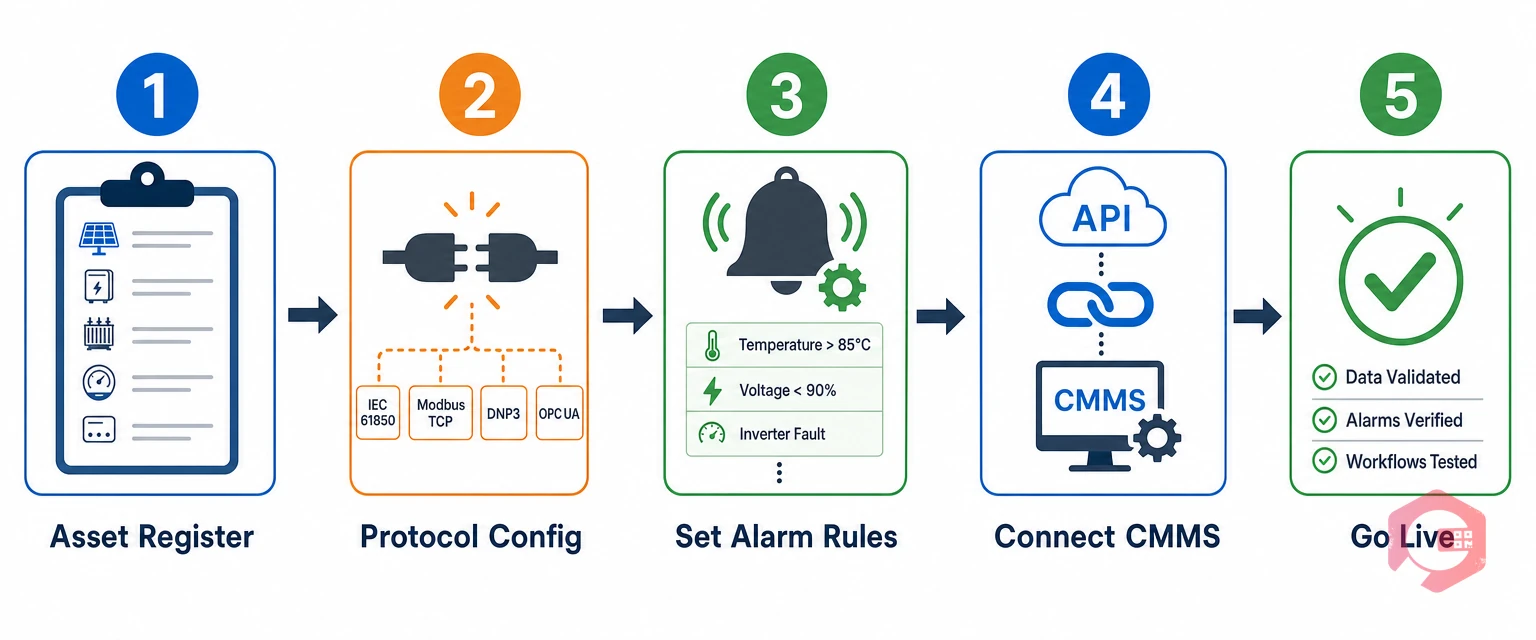
Solar SCADA integration workflow — audit, protocol, connect, CMMS, validate

Here's a practical setup framework for teams either deploying a new solar SCADA system or integrating an existing one with their maintenance workflow:

  • Step 1 - Asset inventory and tagging - Create a complete asset register: every inverter, combiner box, weather station, tracker controller, and meter with a unique asset ID. This ID is the linking key between your SCADA data and your CMMS work orders. Without consistent asset tagging, automation breaks down at the integration layer.
  • Step 2 - Define communication protocol per device type - Map each device to its supported protocol (Modbus, OPC-UA, DNP3). Mixed-brand plants often require a protocol converter or data concentrator at the inverter string level.
  • Step 3 - Configure data points and polling intervals - For each device type, define which registers to poll, at what interval, and with what engineering units. Over-polling (too frequent) saturates your network; under-polling (too infrequent) misses fast transients. Inverter fault codes: every 5 seconds. Energy yield: every 15 minutes. Environmental data: every 1-5 minutes.
  • Step 4 - Set up alarm rules and thresholds - Define the conditions that trigger alerts: output deviation > 10% from irradiance-corrected expected value; inverter temperature > 65°C; communication loss > 30 seconds; PR drop > 5 percentage points over 7-day rolling average.
  • Step 5 - Connect SCADA to your CMMS via API or IoT gateway - Map SCADA alarm types to work order categories in your CMMS. Confirm that asset IDs are consistent between systems. Test the end-to-end flow: trigger a test alarm in SCADA, verify the work order is created in CMMS, confirm it routes to the right technician.
  • Step 6 - Train the O&M team on the closed-loop workflow - The technology is only as good as adoption. Train technicians on the mobile CMMS app, the work order completion process, and the importance of logging root causes. Root cause data is the raw material for predictive models.
  • Step 7 - Establish KPI baselines and review cadence - In the first 30 days post-integration, baseline your PR, MTTR, MTBF, and availability numbers. Set a monthly review cadence to track improvement. Most plants see measurable MTTR improvement within 60 days of activating automated work order triggers.

Common Challenges in Solar SCADA Integration (and How to Solve Them)

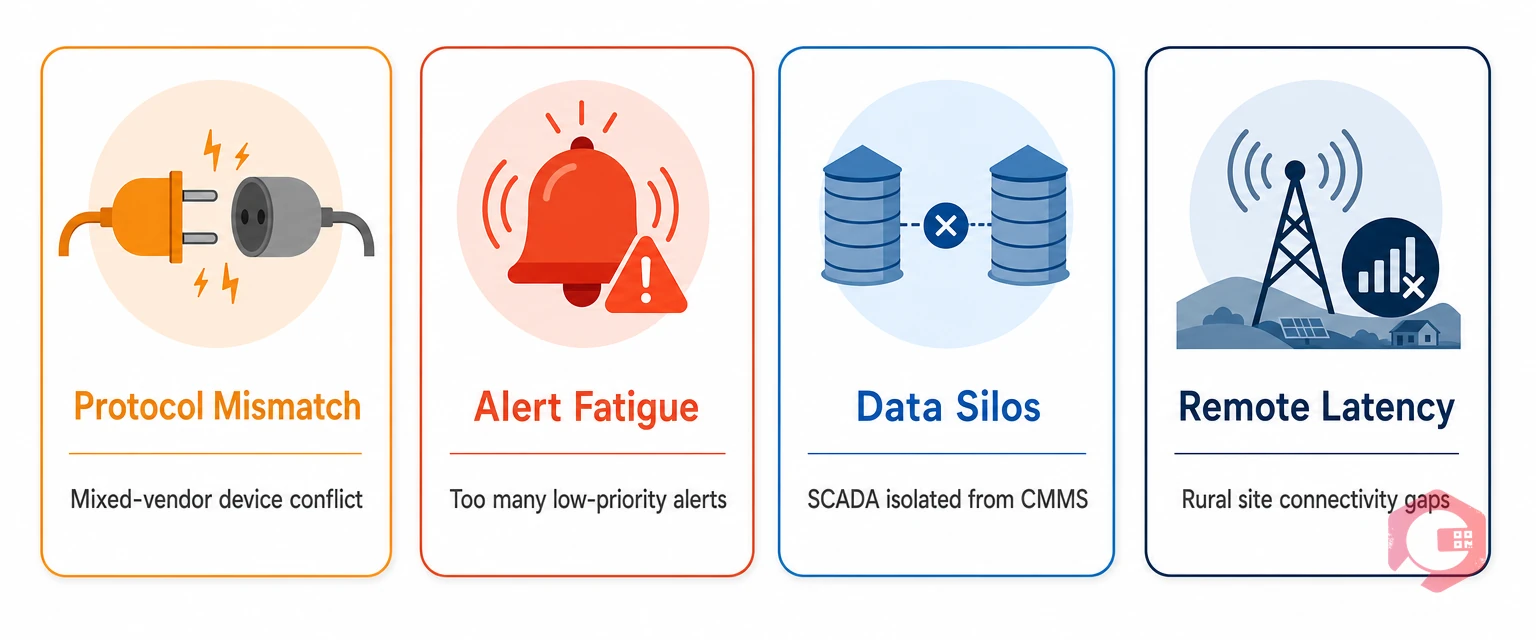
Four common challenges in solar SCADA integration — protocols, drift, connectivity, data overload

Even well-planned SCADA deployments run into the same recurring problems. Here are the most common ones and how to address them:

  • Protocol mismatch between inverter brands - A plant with Huawei inverters, SMA inverters, and a third-party tracker controller may require three different protocol drivers. Solve this with a universal data concentrator (like a Moxa gateway or Kepware OPC server) that normalizes all device data into a single OPC-UA feed for the SCADA server.
  • Alert fatigue from poorly tuned thresholds - A SCADA system that fires 200 alerts per day trains operators to ignore them. Solve this by starting with wide thresholds and tightening them progressively using 30-day baseline data. Classify alerts by severity (critical / warning / informational) and only auto-create CMMS work orders for critical and warning levels.
  • Data silos between SCADA and CMMS - When SCADA and CMMS use different asset ID conventions, automation breaks and data must be reconciled manually. Solve this at the start: enforce a single asset ID standard across all systems before integration begins. Retrofitting ID alignment is far more expensive than doing it correctly upfront.
  • Cybersecurity exposure - Solar SCADA systems connected to corporate networks or the internet are exposed to industrial cyber threats. NERC CIP standards (for grid-connected assets in North America) and IEC 62443 provide the security framework. At minimum: network segmentation between OT and IT networks, encrypted communications (OPC-UA over TLS), role-based access control, and regular firmware patching of field devices.
  • Latency and connectivity at remote sites - Rural solar sites with cellular connectivity can experience latency or connectivity gaps that affect SCADA data quality. Address this with edge computing: deploy a local data historian at the site that buffers data during connectivity loss and syncs to the cloud SCADA server when the connection resumes. Your CMMS should also support offline mode for technicians working in areas without signal - Cryotos' mobile app includes offline sync for exactly this scenario.

Frequently Asked Questions

What is the role of SCADA in solar power plant monitoring?

SCADA (Supervisory Control and Data Acquisition) collects real-time operational data from every device in a solar plant - inverters, meters, sensors, and trackers - and centralizes it for monitoring, alarming, and analysis. Its role is to give O&M teams complete visibility into plant performance so they can detect faults early, track KPIs like Performance Ratio and availability, and respond to issues faster than any manual inspection process allows.

Which protocols are used in solar SCADA systems?

The three dominant protocols are Modbus RTU/TCP (most widely supported by inverter manufacturers), OPC-UA (the modern standard for secure, interoperable industrial communication), and DNP3 (used in utility-grade and grid-connected plants, particularly in North America). Most commercial solar SCADA platforms support all three. OPC-UA is increasingly preferred for new deployments because of its built-in security and standardized data model.

How does SCADA integration reduce solar plant downtime?

SCADA reduces downtime by detecting fault conditions in real time - often before they cause a full outage - and triggering immediate maintenance responses. When integrated with a CMMS, SCADA alerts automatically create work orders, assign technicians, and track resolution without manual steps. This compresses the time from fault detection to fix, reducing Mean Time to Repair (MTTR) and preventing minor faults from escalating into major failures. Plants with automated SCADA-to-CMMS workflows typically see 25-30% reductions in unplanned downtime.

Can SCADA connect to a CMMS for work order management?

Yes - and this integration is one of the most impactful upgrades an O&M team can make. The integration typically works via API (real-time) or IoT gateway. When SCADA detects an alarm condition, it sends the asset ID, fault type, and telemetry data to the CMMS, which automatically creates and routes a work order. CMMS platforms like Cryotos support IoT integration natively, allowing SCADA event data to trigger work orders, assign technicians, and update asset history without manual input.

What is a good Performance Ratio for a solar plant?

A Performance Ratio (PR) above 75-80% is considered good for a utility-scale solar plant under IEA PVPS guidelines. New plants often achieve 80-85% PR in their first year. PR typically declines slightly with panel degradation (0.5-0.7% per year) and can be affected by soiling, shading, and inverter efficiency losses. Tracking PR monthly via SCADA and investigating any drop greater than 3 percentage points is standard O&M practice.

Managing a solar plant's SCADA data is one thing. Turning that data into faster repairs, complete audit trails, and measurable uptime improvements is another. Cryotos CMMS bridges the gap - connecting your SCADA alerts directly to automated work orders, mobile technician dispatch, and real-time downtime tracking. Your SCADA system sees the problem. Cryotos makes sure it gets fixed - fast, documented, and permanently. Book a free demo to see how solar O&M teams use Cryotos to close the loop between monitoring and maintenance.

Want to Try Cryotos CMMS Today? Lets Connect!
Thank you! Your submission has been received!
Oops! Something went wrong while submitting the form.
Related Post

SCADA Integration for Solar Power Plant Monitoring: The Complete O&M Guide

Calendar
Duration:
17 min read
calendar today
Published on
April 2, 2026
Featured Image

SCADA integration for solar power plant monitoring connects your plant's sensors, inverters, and field devices to a centralized control system that collects, visualizes, and acts on real-time operational data. A well-integrated SCADA system lets your O&M team catch performance drops before they become failures - turning raw telemetry into scheduled work orders, dispatched technicians, and resolved faults. According to the International Renewable Energy Agency (IRENA), O&M costs account for 20-25% of a solar plant's total lifetime cost, and undetected faults are the leading driver of unplanned downtime. This guide covers everything your team needs to know: what solar SCADA monitors, which protocols to use, how to connect SCADA to a CMMS, and the step-by-step process for building a monitoring setup that actually reduces downtime.


What Is SCADA Integration for Solar Power Plants?

SCADA - Supervisory Control and Data Acquisition - is the backbone of modern solar power plant monitoring. It collects real-time data from every connected device in the plant (inverters, meters, sensors, trackers), aggregates that data in a central server, and presents it to operators through dashboards, alarms, and reports. Integration means connecting those data streams not just to a display screen, but to the systems your team actually uses to act - your CMMS, your ticketing workflow, your maintenance schedule.

For a utility-scale solar plant, a SCADA system typically handles data from hundreds or thousands of endpoints simultaneously. At a 50 MW plant, that might mean monitoring 12,500 solar panels across 500 string inverters, 20 central inverters, multiple weather stations, and transformer substations - all in real time. Without SCADA, this volume of equipment is simply unmanageable with manual inspections.

How SCADA Systems Collect Solar Plant Data

SCADA systems collect data through a layered architecture. Field devices (inverters, sensors, meters) sit at the bottom layer. A data concentrator or Remote Terminal Unit (RTU) aggregates readings from multiple field devices and forwards them to the SCADA server over a communication network (fiber, cellular, or RF). The SCADA server stores, processes, and serves data to the Human-Machine Interface (HMI) where operators monitor the plant.

Data polling intervals typically range from 1 second to 15 minutes depending on the parameter. Inverter power output and fault codes are polled every 1-5 seconds. Energy yield and environmental data update every 15 minutes. This granularity is what makes SCADA the foundation of predictive maintenance - you can spot a 3% drop in string output before it compounds into a full outage.

Key SCADA Protocols for Solar: Modbus, OPC-UA, and DNP3

Three communication protocols dominate solar SCADA deployments, and choosing the right one - or supporting all three - determines how well your system integrates with diverse equipment:

  • Modbus RTU/TCP - The most widely used protocol in solar. Nearly every inverter manufacturer supports it. Simple, reliable, and low-cost to implement. The limitation is that it's a polling protocol - the master queries each device in sequence, which can introduce latency at scale.
  • OPC-UA (OPC Unified Architecture) - The modern standard for industrial IoT and SCADA. It supports both polling and subscription (event-driven) models, encrypts data in transit, and provides a standardized information model. Increasingly required for utility-scale plants and grid operator reporting.
  • DNP3 (Distributed Network Protocol) - Widely used in North America for utility-grade plants where the SCADA system must communicate with the grid operator or substation automation equipment. More complex to configure than Modbus but essential for grid compliance in many markets.

Most modern solar SCADA platforms support all three. If you're evaluating vendors, confirm multi-protocol support - especially if you have mixed inverter brands or plan to connect to grid operator systems.

What Data Does a Solar SCADA System Monitor?

A solar SCADA system is only as useful as the data it collects. Plants that monitor only total AC output miss the early fault signals buried in string-level and inverter-level data. Here's a breakdown of what a fully instrumented solar plant should be monitoring:

Inverter-Level and String-Level Monitoring

Inverter monitoring tracks AC power output, DC input voltage and current per string, inverter temperature, operating state, and fault codes. This is the most critical data layer - inverter faults account for the majority of unplanned downtime events in solar plants. According to a National Renewable Energy Laboratory (NREL) report on PV system reliability, inverter failures represent roughly 37% of all corrective maintenance events at utility-scale sites.

String monitoring goes one level deeper. Each string of series-connected panels produces a DC current that flows into the inverter's input. If one panel in a string is shaded, soiled, or failing, the entire string's output drops. String-level monitoring lets you isolate exactly which string - and often which panel - is underperforming, without deploying a technician to walk the entire row. This turns a half-day inspection into a 10-minute targeted fix.

Environmental Sensors: Irradiance, Temperature, and Wind

Environmental monitoring provides the reference data you need to distinguish a real underperformance event from a weather-related dip. The three essential sensors are:

  • Pyranometer (irradiance sensor) - Measures solar irradiance in W/m². Without this, you can't calculate Performance Ratio or tell whether a power drop is caused by clouds or a fault.
  • Module temperature sensor - Solar panel output decreases by approximately 0.3-0.5% for every 1°C rise above 25°C (STC). Tracking module temperature lets you apply temperature correction to yield calculations and flag abnormally hot cells that indicate hotspot defects.
  • Wind speed / soiling sensor - Relevant at sites with significant dust, bird activity, or pollen. Soiling losses of 2-5% per month are common in arid climates, and a soiling sensor helps schedule cleaning at the optimal cost-benefit point.

How SCADA Integration Enables Predictive Maintenance

Solar O&M team using SCADA + CMMS for predictive maintenance | Cryotos

Predictive maintenance for solar plants means using real-time and historical SCADA data to predict when a component is likely to fail - and scheduling maintenance before that failure happens. It's the evolution beyond time-based preventive maintenance schedules, which service equipment whether it needs it or not, and far beyond reactive maintenance, which waits for failures to occur.

A plant running predictive maintenance on SCADA data can realistically target 30% fewer unplanned outages and 20-25% lower O&M costs compared to a purely reactive approach - figures consistent with IRENA's benchmarks for optimized solar O&M programs.

From Real-Time Alerts to Maintenance Work Orders

The key step most solar O&M teams get wrong is the gap between a SCADA alert and a resolved work order. The alert fires. Someone sees it on the dashboard. Someone else gets a call. A ticket gets created manually. A technician is dispatched two days later. By then, the fault has either cascaded or the trail has gone cold.

A properly integrated SCADA-to-CMMS workflow eliminates this gap. When SCADA detects an anomaly - say, String 4 of Inverter Block 7 drops 15% below the irradiance-corrected expected output - it automatically triggers a work order in the CMMS with the asset ID, fault description, GPS coordinates, priority level, and relevant historical data pre-populated. The work order routes to the right technician based on availability and location. The technician receives a mobile notification. The fix is logged, and the data feeds back into the asset's maintenance history.

This closed-loop workflow - from sensor to work order to resolution - is what separates plants with 98%+ availability from those stuck at 92%. Tools like Cryotos CMMS support SCADA data ingestion through IoT integrations, enabling this automated alert-to-work-order flow without manual intervention.

AI and ML Anomaly Detection in Solar SCADA

The next evolution of solar SCADA is applying machine learning models to the data stream. Rather than simple threshold-based alerts, ML models learn the normal operating signature of each inverter under a given set of environmental conditions. When the actual output deviates from the predicted signature by more than a confidence interval, the model flags it as an anomaly - even if the absolute output hasn't crossed any threshold.

This catches early-stage degradation that rule-based systems miss. A study published in Applied Energy found that ML-based anomaly detection in PV systems identified faults an average of 11 days earlier than threshold-based monitoring, reducing MTTR (Mean Time to Repair) by 28%. For a 100 MW plant, that difference can translate to hundreds of thousands of dollars in recovered energy yield annually.

Common ML use cases in solar SCADA include: soiling rate prediction, inverter degradation modeling, hotspot detection from thermal imaging integrated with SCADA timestamps, and clipping loss identification under high-irradiance conditions.

Connecting SCADA to Your CMMS: The Missing Link in Solar O&M

SCADA-to-CMMS data lifecycle — Sense → Transmit → Trigger → Resolve

Most solar SCADA guides stop at the monitoring layer. They explain dashboards, KPIs, and alert thresholds - but they don't address how the data flows into the execution layer where actual maintenance happens. That execution layer is your CMMS (Computerized Maintenance Management System), and connecting the two is the single highest-leverage improvement most solar O&M teams can make.

Why SCADA Alone Is Not Enough

SCADA tells you what is happening. It doesn't manage what to do about it. Without a CMMS connection, your O&M team is manually translating SCADA alerts into maintenance actions - a process that introduces delays, loses context, and leaves no auditable trail. You can't track which technician fixed which fault, how long it took, what parts were used, or whether the fix held. That missing data is exactly what you need to spot recurring failures, optimize maintenance intervals, and justify O&M budget to plant owners.

Consider a common scenario: SCADA flags an inverter fault at 9:15 AM. The operations manager sees it at 10:30 AM after finishing another call. They send a WhatsApp to the site supervisor. The supervisor dispatches a technician at 1 PM. The technician fixes the fault but doesn't log the cause. The same fault recurs in six weeks. None of this is captured - not the response time, not the root cause, not the parts consumed. A SCADA-CMMS integration would have auto-created the work order at 9:15, tracked every minute of the response, and tagged the fault code for pattern analysis.

How SCADA + CMMS Integration Closes the Maintenance Loop

A SCADA-CMMS integration works through one of three mechanisms: API connection (real-time bidirectional data exchange), middleware / IoT gateway (edge device translates SCADA data into CMMS-readable events), or scheduled data export (batch file transfer - the least real-time but simplest to implement).

The data flow looks like this:

  • SCADA detects anomaly → generates event with asset ID, fault code, timestamp, and telemetry snapshot
  • Event triggers CMMS API call → creates work order pre-filled with asset data, fault description, and GPS location
  • CMMS routes work order → assigns technician based on skill, shift schedule, and proximity
  • Technician receives mobile alert → accesses work order on CMMS mobile app with full asset history and procedure checklist
  • Technician completes work → logs repair, parts used, time spent, and root cause in CMMS
  • CMMS updates asset record → maintenance history feeds back into predictive models and compliance reports

Cryotos CMMS supports this integration natively through its IoT module, which connects to SCADA, PLC, and edge device data streams. IoT sensor thresholds can trigger work orders automatically, assign them to the right technician, and track resolution - all without manual intervention. Plants using Cryotos report a 30% reduction in unplanned downtime and 25% faster repair times after activating automated work order triggers.

Key Performance Indicators to Track via Solar SCADA

SCADA data is only useful if you're measuring the right things. Here are the KPIs every solar O&M team should track - and what good looks like for each:

Performance Ratio (PR) and Specific Yield

Performance Ratio (PR) is the most important single metric for a solar plant. It compares actual energy output to the theoretical output based on the irradiance received, expressed as a percentage. A PR of 80% means the plant is producing 80% of what it theoretically could given the sunlight available - with the 20% gap attributable to losses from heat, soiling, wiring resistance, inverter inefficiency, and downtime. According to IEA PVPS Task 13 guidelines, a well-maintained utility-scale plant should maintain a PR above 75-80%.

Specific Yield (kWh/kWp) normalizes energy output by installed capacity, making it possible to compare plants of different sizes in different locations. Track both on a daily, monthly, and cumulative basis through your SCADA dashboard.

MTTR, MTBF, and Availability Metrics

These three maintenance KPIs require SCADA + CMMS data combined - SCADA provides the fault timestamps, and the CMMS provides the repair completion timestamps:

  • MTTR (Mean Time to Repair) - Average time from fault detection to fault resolution. Industry benchmark for inverter faults: under 4 hours for on-site teams, under 24 hours for remote sites. If your MTTR is consistently above 8 hours, your alert-to-dispatch workflow needs attention.
  • MTBF (Mean Time Between Failures) - Average operating time between failures for a specific component type. Rising MTBF over time is a sign your preventive maintenance program is working. Declining MTBF signals aging equipment or an emerging systemic issue. Use downtime tracking software to calculate this automatically from SCADA event logs.
  • Availability - Percentage of scheduled operating hours during which the plant (or a specific asset) was operational. Contractual availability guarantees at utility-scale plants typically specify 97-98%. Track both technical availability (excluding grid curtailment) and contractual availability (as defined in your O&M agreement).

Step-by-Step: Setting Up SCADA Integration for a Solar Power Plant

Solar SCADA integration workflow — audit, protocol, connect, CMMS, validate

Here's a practical setup framework for teams either deploying a new solar SCADA system or integrating an existing one with their maintenance workflow:

  • Step 1 - Asset inventory and tagging - Create a complete asset register: every inverter, combiner box, weather station, tracker controller, and meter with a unique asset ID. This ID is the linking key between your SCADA data and your CMMS work orders. Without consistent asset tagging, automation breaks down at the integration layer.
  • Step 2 - Define communication protocol per device type - Map each device to its supported protocol (Modbus, OPC-UA, DNP3). Mixed-brand plants often require a protocol converter or data concentrator at the inverter string level.
  • Step 3 - Configure data points and polling intervals - For each device type, define which registers to poll, at what interval, and with what engineering units. Over-polling (too frequent) saturates your network; under-polling (too infrequent) misses fast transients. Inverter fault codes: every 5 seconds. Energy yield: every 15 minutes. Environmental data: every 1-5 minutes.
  • Step 4 - Set up alarm rules and thresholds - Define the conditions that trigger alerts: output deviation > 10% from irradiance-corrected expected value; inverter temperature > 65°C; communication loss > 30 seconds; PR drop > 5 percentage points over 7-day rolling average.
  • Step 5 - Connect SCADA to your CMMS via API or IoT gateway - Map SCADA alarm types to work order categories in your CMMS. Confirm that asset IDs are consistent between systems. Test the end-to-end flow: trigger a test alarm in SCADA, verify the work order is created in CMMS, confirm it routes to the right technician.
  • Step 6 - Train the O&M team on the closed-loop workflow - The technology is only as good as adoption. Train technicians on the mobile CMMS app, the work order completion process, and the importance of logging root causes. Root cause data is the raw material for predictive models.
  • Step 7 - Establish KPI baselines and review cadence - In the first 30 days post-integration, baseline your PR, MTTR, MTBF, and availability numbers. Set a monthly review cadence to track improvement. Most plants see measurable MTTR improvement within 60 days of activating automated work order triggers.

Common Challenges in Solar SCADA Integration (and How to Solve Them)

Four common challenges in solar SCADA integration — protocols, drift, connectivity, data overload

Even well-planned SCADA deployments run into the same recurring problems. Here are the most common ones and how to address them:

  • Protocol mismatch between inverter brands - A plant with Huawei inverters, SMA inverters, and a third-party tracker controller may require three different protocol drivers. Solve this with a universal data concentrator (like a Moxa gateway or Kepware OPC server) that normalizes all device data into a single OPC-UA feed for the SCADA server.
  • Alert fatigue from poorly tuned thresholds - A SCADA system that fires 200 alerts per day trains operators to ignore them. Solve this by starting with wide thresholds and tightening them progressively using 30-day baseline data. Classify alerts by severity (critical / warning / informational) and only auto-create CMMS work orders for critical and warning levels.
  • Data silos between SCADA and CMMS - When SCADA and CMMS use different asset ID conventions, automation breaks and data must be reconciled manually. Solve this at the start: enforce a single asset ID standard across all systems before integration begins. Retrofitting ID alignment is far more expensive than doing it correctly upfront.
  • Cybersecurity exposure - Solar SCADA systems connected to corporate networks or the internet are exposed to industrial cyber threats. NERC CIP standards (for grid-connected assets in North America) and IEC 62443 provide the security framework. At minimum: network segmentation between OT and IT networks, encrypted communications (OPC-UA over TLS), role-based access control, and regular firmware patching of field devices.
  • Latency and connectivity at remote sites - Rural solar sites with cellular connectivity can experience latency or connectivity gaps that affect SCADA data quality. Address this with edge computing: deploy a local data historian at the site that buffers data during connectivity loss and syncs to the cloud SCADA server when the connection resumes. Your CMMS should also support offline mode for technicians working in areas without signal - Cryotos' mobile app includes offline sync for exactly this scenario.

Frequently Asked Questions

What is the role of SCADA in solar power plant monitoring?

SCADA (Supervisory Control and Data Acquisition) collects real-time operational data from every device in a solar plant - inverters, meters, sensors, and trackers - and centralizes it for monitoring, alarming, and analysis. Its role is to give O&M teams complete visibility into plant performance so they can detect faults early, track KPIs like Performance Ratio and availability, and respond to issues faster than any manual inspection process allows.

Which protocols are used in solar SCADA systems?

The three dominant protocols are Modbus RTU/TCP (most widely supported by inverter manufacturers), OPC-UA (the modern standard for secure, interoperable industrial communication), and DNP3 (used in utility-grade and grid-connected plants, particularly in North America). Most commercial solar SCADA platforms support all three. OPC-UA is increasingly preferred for new deployments because of its built-in security and standardized data model.

How does SCADA integration reduce solar plant downtime?

SCADA reduces downtime by detecting fault conditions in real time - often before they cause a full outage - and triggering immediate maintenance responses. When integrated with a CMMS, SCADA alerts automatically create work orders, assign technicians, and track resolution without manual steps. This compresses the time from fault detection to fix, reducing Mean Time to Repair (MTTR) and preventing minor faults from escalating into major failures. Plants with automated SCADA-to-CMMS workflows typically see 25-30% reductions in unplanned downtime.

Can SCADA connect to a CMMS for work order management?

Yes - and this integration is one of the most impactful upgrades an O&M team can make. The integration typically works via API (real-time) or IoT gateway. When SCADA detects an alarm condition, it sends the asset ID, fault type, and telemetry data to the CMMS, which automatically creates and routes a work order. CMMS platforms like Cryotos support IoT integration natively, allowing SCADA event data to trigger work orders, assign technicians, and update asset history without manual input.

What is a good Performance Ratio for a solar plant?

A Performance Ratio (PR) above 75-80% is considered good for a utility-scale solar plant under IEA PVPS guidelines. New plants often achieve 80-85% PR in their first year. PR typically declines slightly with panel degradation (0.5-0.7% per year) and can be affected by soiling, shading, and inverter efficiency losses. Tracking PR monthly via SCADA and investigating any drop greater than 3 percentage points is standard O&M practice.

Managing a solar plant's SCADA data is one thing. Turning that data into faster repairs, complete audit trails, and measurable uptime improvements is another. Cryotos CMMS bridges the gap - connecting your SCADA alerts directly to automated work orders, mobile technician dispatch, and real-time downtime tracking. Your SCADA system sees the problem. Cryotos makes sure it gets fixed - fast, documented, and permanently. Book a free demo to see how solar O&M teams use Cryotos to close the loop between monitoring and maintenance.

Want to Try Cryotos CMMS Today?

Get Free Demo

Let AI Take Control of Your Maintenance

Cryotos AI predicts failures, automates work orders, and simplifies maintenance—before problems slow you down.

Try AI-Powered CMMS
🡢