

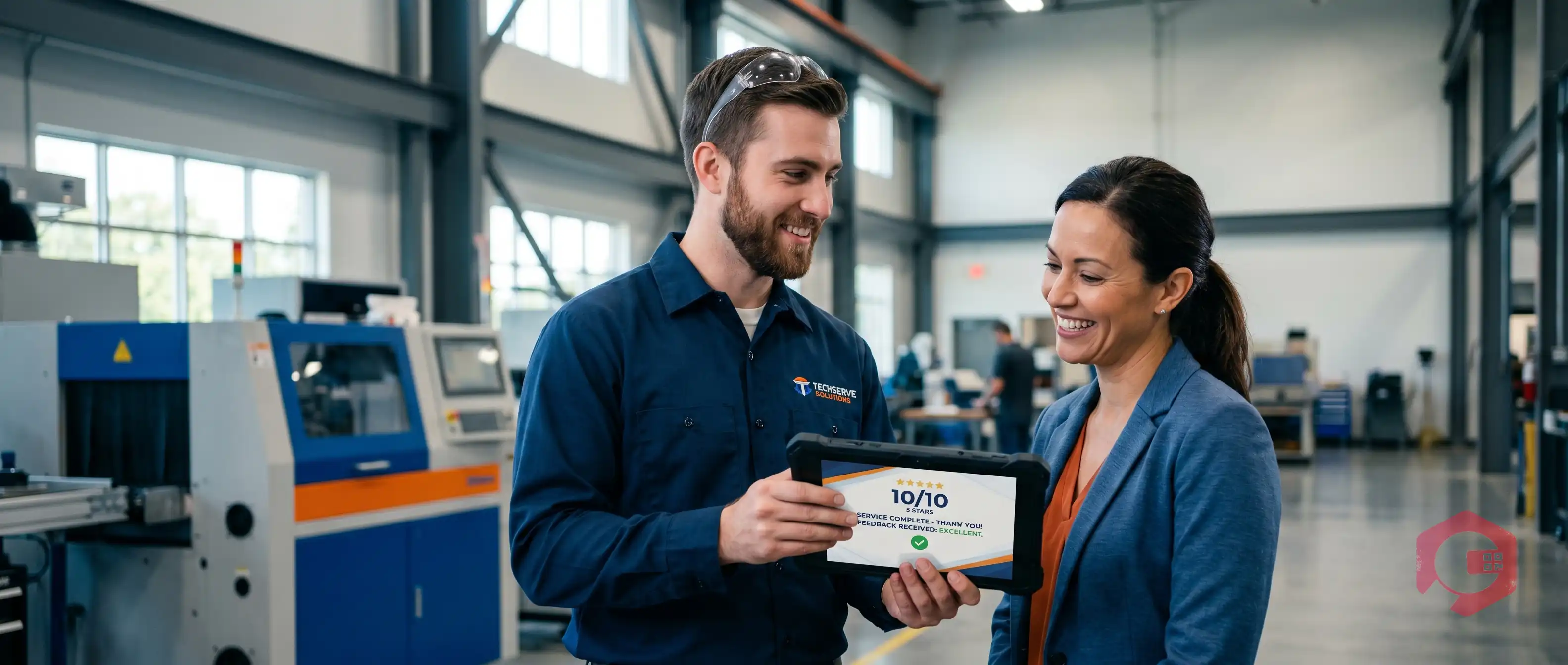
Cryotos CMMS captures customer feedback through a simple smiley-face rating system that converts responses into percentage scores, breaks them down by location and user, and surfaces everything on a live management dashboard.
Customer feedback in field service management is not just a nice-to-have — it is the clearest signal your team has about whether the job was actually done right. Cryotos CMMS now captures customer feedback through a simple smiley-face rating system that converts responses into percentage scores, breaks them down by location and user, and surfaces everything on a live management dashboard. This gives field service managers, operations heads, and client success teams the real-time visibility they need to act fast, fix gaps, and keep clients satisfied.
A smiley-based feedback system replaces long survey forms with a three-to-five point visual scale — typically ranging from a frowning face (very dissatisfied) through a neutral face to a broad smile (very satisfied). In the context of a CMMS software like Cryotos, this feedback is collected directly at the point of service closure — the moment a field technician marks a work order as complete and the client confirms the outcome.
The simplicity is the point. A customer at a facility — whether it is a plant manager, a hospital administrator, or a retail store owner — can tap a smiley in under five seconds. That single tap generates a data point that feeds into your reporting engine and aggregates across hundreds of work orders into a clear picture of service quality.
Unlike Net Promoter Score surveys or lengthy satisfaction forms, smiley feedback has a response rate several times higher. Studies in service management consistently show that short, visual feedback tools achieve response rates of 60–80%, compared to 10–20% for traditional surveys. When you multiply that response rate across your entire field service portfolio, you go from guessing about client satisfaction to actually measuring it.
Field service environments are fast-paced. The technician has closed the job and is moving to the next site. The client contact is busy and unlikely to fill out a multi-question form. A smiley widget embedded in the work order management closure notification — sent via mobile app, email, or WhatsApp — captures honest, in-the-moment feedback before the experience fades. That immediacy makes the data far more reliable than retrospective satisfaction calls.

Cryotos is designed to embed feedback collection directly into the work order lifecycle. Here is the end-to-end flow:
Because Cryotos supports notifications via mobile push, email, and WhatsApp, the feedback request reaches the client on whatever channel they prefer. This multi-channel delivery further boosts response rates and ensures no closure goes unrated simply because the client missed a notification.
Raw smiley counts are not useful for management reporting. Cryotos converts them into a Customer Satisfaction Score (CSAT) percentage using a straightforward formula:
CSAT % = (Number of Positive Responses ÷ Total Responses) × 100
Positive responses are defined as Satisfied and Very Satisfied taps. This gives you a clean, comparable percentage that management can track over time and benchmark across teams.
One of the most powerful features of the Cryotos feedback module is its ability to segment scores by location. If you operate across multiple facilities — a manufacturing plant in Chennai, a hospital in Bangalore, and a retail chain across Hyderabad — you get a separate CSAT percentage for each site. This location-level granularity answers questions that an aggregate score cannot:
Alongside location scores, Cryotos tracks CSAT at the individual technician level. Each work order closed by a technician carries a feedback rating, and the system aggregates those ratings into a personal CSAT score for that user. This serves several purposes:
The Cryotos BI Dashboard is built for management visibility, and the customer feedback module integrates natively into it. Here is what appears on the dashboard:
A large percentage gauge at the top of the dashboard shows your organization-wide CSAT score for the selected time period (today, this week, this month, or custom). This is the number your leadership team sees first — and it is the number that matters most to your clients.
A visual heatmap overlays your facility locations on a map, color-coded by CSAT performance: green for high-performing sites, amber for medium, and red for sites needing intervention. Operations heads can spot geographic clusters of dissatisfaction instantly — no need to run manual reports.
Line charts show CSAT trends over time for each location and each technician. A downward trend at a particular site over three months is far more actionable than a single data point — it signals a systemic issue rather than a one-off bad day.
The dashboard also shows the number of feedback responses received alongside the CSAT score. A 95% CSAT based on 3 responses means very little. A 95% CSAT based on 300 responses is a strong signal. Cryotos surfaces both numbers so management does not misread low-volume scores as reliable indicators.
Clicking any location, technician, or time period on the dashboard drills down to the individual work orders that generated those scores. Management can read the actual client comments, review the job details, and trace any dissatisfaction back to a specific event. This is the difference between knowing you have a problem and knowing exactly what the problem is.

Client satisfaction in field service is not a soft metric — it is a revenue driver. Research from the Service Council shows that organizations with strong field service satisfaction scores retain clients at rates 15–20% higher than those with poor or unmeasured satisfaction. In industries like facilities management, healthcare, and manufacturing, where service contracts are renewed annually and client relationships are the primary growth engine, a one-percentage-point improvement in CSAT can translate directly to contract renewals and upsells.
The problem most organizations face is not that they don't care about satisfaction — it is that they cannot see it clearly enough to manage it. Management gets complaints after they have already escalated. They hear about dissatisfied clients from account managers who heard it from the client three weeks after the fact. By then, the damage is done and the contract is at risk.
Cryotos changes that dynamic entirely. When a negative smiley triggers an automatic alert to the account manager within minutes of the work order closure, that manager can call the client the same day, before frustration hardens into a formal complaint. That speed of response is what clients remember — and what turns a potential churn event into a demonstration of how seriously you take their satisfaction.
Beyond day-to-day operations, the feedback data in Cryotos feeds into scheduled reports that can be delivered automatically to leadership inboxes — daily, weekly, or monthly summaries of CSAT by region, by client account, or by service category. Leadership no longer needs to request data from operations teams; it arrives in their inbox as a formatted report, ready for board presentations or client review meetings.
The value of smiley feedback extends far beyond the score itself. When feedback data is integrated into the operational workflow of Cryotos CMMS, it creates a continuous improvement loop across every aspect of field service delivery.
When a work order receives a negative rating, the operations team can use Cryotos's built-in "5 Whys" root cause analysis framework directly within that work order. Was the dissatisfaction caused by a long response time? A repair that didn't hold? A technician who didn't communicate clearly? The feedback data, combined with the work order details, gives you the inputs to run a structured analysis and prevent the same issue from recurring.
Cryotos allows you to correlate CSAT scores with SLA compliance data. If work orders that breach their response-time SLA consistently generate lower satisfaction scores, you have quantitative evidence to invest in faster dispatch processes or additional technician capacity. This correlation makes the business case for operational investments far more compelling in leadership discussions.
Sites that generate frequent dissatisfied feedback often have underlying asset reliability issues — aging equipment, deferred maintenance, or insufficient preventive maintenance coverage. Cryotos can surface these patterns by overlaying CSAT scores with PM completion rates and asset downtime data. If a facility shows low CSAT and low PM adherence simultaneously, that is a clear signal to review and strengthen the maintenance schedule at that site.
Armed with CSAT data, your account management team walks into contract renewal conversations with evidence, not assumptions. Showing a client a dashboard that demonstrates consistent 88% satisfaction over the past 12 months — with specific improvements from 75% in Q1 to 88% by Q4 — is a powerful argument for renewal and price retention. It converts service quality from an intangible claim into a documented track record.
Implementing smiley feedback is easy. Running it effectively requires some deliberate habits across your operations and management teams:
Search trends confirm what field service leaders are experiencing firsthand. Queries around "customer satisfaction field service software," "CMMS client feedback," and "field service CSAT dashboard" have grown consistently over the past three years, reflecting a market-wide shift toward data-driven client experience management. Businesses that invest in structured feedback collection are not just improving operations — they are differentiating themselves in a competitive market where clients expect their service providers to be accountable, transparent, and proactive.
The case for CMMS-integrated feedback is especially strong in industries with multi-site operations: facilities management companies running dozens of client buildings, healthcare equipment service providers managing thousands of medical devices across hospital networks, and manufacturing service contractors operating across geographically dispersed plants. In all of these environments, asset management and client experience are intertwined — when assets fail too often or too slowly, clients feel it immediately, and their satisfaction scores reflect it.
Cryotos addresses this connection directly by making feedback a native feature of the work order lifecycle rather than an afterthought. The data lives in the same platform as your downtime records, your PM schedules, your inventory levels, and your technician assignments. That integration means you can draw correlations across all of these dimensions — and build a genuinely data-driven case for every operational investment you make.
As AI-powered search and digital reputation become more important in B2B procurement, the organizations that can demonstrate measurable client satisfaction outcomes — not just claim them — will win more contracts and retain them longer. A CMMS with built-in, dashboard-visible CSAT measurement is no longer a nice feature. It is a competitive requirement.
When a work order is marked complete, Cryotos automatically sends a closure notification containing the smiley feedback widget. The notification is delivered through the client's preferred channel — mobile push notification, email, or WhatsApp — based on the contact preferences configured in the system. The customer taps one smiley face to rate the service and can optionally add a comment.
Yes. Cryotos supports multi-location tracking within a single client account. Each facility or site generates its own CSAT score, and all sites are visible on the dashboard simultaneously. You can drill down into any specific location to see the work orders and individual ratings that make up that site's score.
The system immediately logs the negative response and can trigger an automated alert to the relevant supervisor or account manager. This alert can be configured to arrive via email, mobile notification, or WhatsApp, ensuring the responsible person sees it quickly. The goal is to enable a same-day follow-up call before the client's frustration escalates.
Yes. The Cryotos dashboard tracks CSAT at the individual technician level, aggregating ratings from every work order that technician has closed. Managers can view ranked lists of technicians by satisfaction score, see trend lines for each person over time, and drill into specific work orders where negative feedback was received.
Yes. Customer satisfaction scores are available in the Cryotos Report Builder, which includes 50+ predefined reports and custom reports. You can schedule automatic CSAT reports to be emailed to management and leadership on a daily, weekly, or monthly basis.
The feedback workflow is fully integrated into the Cryotos mobile app. Technicians close work orders from the app, which automatically triggers the feedback request to the client. The app also works in offline mode — feedback sent while a technician is offline is synced as soon as connectivity is restored.
If you're ready to give your management team real-time visibility into client satisfaction — broken down by location, technician, and service category — Cryotos CMMS is built for exactly this. The smiley feedback module is part of the same platform you use for work order management, preventive maintenance, downtime tracking, and inventory management — so you never have to switch tools to understand how well your field service operation is performing. Book a demo today and see how satisfied your clients really are.


Cryotos AI predicts failures, automates work orders, and simplifies maintenance—before problems slow you down.



