
Shift compliance monitoring is the process of tracking whether field workers start, complete, and close their assigned shifts and tasks within defined schedules, safety protocols, and service level requirements. According to SHRM research, organizations with structured workforce compliance programs reduce shift-related incidents by up to 35% and improve service delivery consistency by 28%. For field operations teams managing technicians, inspectors, and maintenance crews across multiple sites, shift compliance is no longer a nice-to-have — it's a core operational discipline that directly affects safety, regulatory standing, and client satisfaction.

Shift compliance monitoring tracks whether your field workforce follows assigned schedules, completes required tasks within each shift, adheres to safety protocols, and meets documented service standards. It goes beyond simple timekeeping. A compliant shift means the right technician arrived at the right site on time, completed the required checklist items, followed the correct procedures, and closed the shift with a documented record.
In field service and maintenance environments, three compliance layers matter simultaneously. Schedule compliance measures whether workers start and end shifts at the right times and locations. Task compliance tracks whether all assigned work orders, inspections, and checklist items were completed within the shift window. Safety and regulatory compliance confirms that permit-to-work procedures, lockout/tagout protocols, and industry regulations were followed throughout the shift.
When all three layers are tracked together — in real time — operations managers gain the visibility needed to catch compliance gaps before they become safety incidents, SLA breaches, or regulatory violations. Traditional approaches, relying on paper sign-in sheets and end-of-shift reports, leave too large a window between a compliance failure and its discovery.
Office teams are easy to monitor. They work in a fixed location, on a common network, within sight of their supervisors. Field workforce compliance involves none of these conveniences. Technicians and maintenance crews operate across dozens or hundreds of sites, often in areas with intermittent connectivity, under conditions that change hour to hour. A compliance gap in a field shift can go undetected for hours — or until a client complaint or safety incident surfaces it.
Five factors make field shift compliance uniquely challenging. Geographic dispersion means no single supervisor can physically verify compliance across all sites simultaneously. Multi-site coordination requires each site to have consistent procedures even when local conditions vary. Shift handover gaps — the window between one technician leaving and the next arriving — are a common source of undocumented non-compliance. Offline environments break digital tracking when teams work in basements, tunnels, or remote facilities without reliable internet access. And equipment variability means the same compliance procedure may take significantly different amounts of time depending on the asset's condition on any given day.
Field service management software specifically built for these conditions — with offline capability, GPS tracking, and digital checklist enforcement — addresses all five barriers in ways that paper-based or generic HR systems simply cannot. The compliance data is collected at the point of work, not reconstructed from memory at the end of a shift.
Non-compliance in field workforce management carries three categories of cost that rarely appear on the same spreadsheet but are all attributable to the same underlying monitoring gap.
Direct financial costs include regulatory penalties for missed safety procedures, SLA breach penalties that trigger contractual deductions, and the cost of rework when a non-compliant shift leaves tasks incomplete or incorrectly executed. In industries such as oil and gas, healthcare facilities management, and food and beverage manufacturing, a single missed safety compliance step can trigger shutdown orders that dwarf the cost of the monitoring tools that would have prevented it.
Operational costs accumulate more quietly. When shift compliance data is poor, maintenance managers cannot accurately measure wrench time or productivity, making it impossible to distinguish between an understaffed site and an inefficient one. Poor shift data also corrupts root cause analysis when equipment failures occur — if you can't confirm what maintenance tasks were completed in the preceding shift, your failure investigation starts from a factual gap.
Reputational costs are the hardest to quantify but the most durable. Clients who experience SLA breaches tied to untracked shift gaps are significantly harder to retain than those who receive proactive compliance reports showing exactly when and how service was delivered. According to McKinsey research on operational transparency, organizations that provide real-time performance visibility to clients retain accounts at a 40% higher rate than those relying on monthly summary reports.

Effective shift compliance monitoring is built on a small set of metrics that together describe the health of your field workforce compliance program. Tracking all of them in isolation gives a partial picture; tracking them together reveals the patterns that drive improvement.
Shift start compliance rate measures what percentage of technicians begin their shifts within an acceptable window of their scheduled start time. A rate below 90% consistently indicates a scheduling problem, a logistics issue, or a site access barrier — all of which can be addressed once the data makes them visible. Task completion rate tracks the percentage of assigned work orders and checklist items finished within the shift, giving a direct measure of whether shift planning accurately reflects field reality. Safety checklist compliance rate is the percentage of mandatory safety checks completed and signed off — the metric most directly tied to regulatory risk and the one that should trigger immediate escalation when it falls below 100% for high-risk tasks.
Shift handover compliance measures whether critical information — open tasks, asset conditions, safety alerts — is formally transferred between outgoing and incoming technicians rather than passed informally or lost entirely. And mean time to report captures how long it takes for field events — equipment faults, near misses, task deviations — to enter the management system. A mean time to report above four hours typically indicates that reporting is manual, burdensome, or deprioritized in favor of the next task.
The BI Dashboard in a well-configured CMMS presents all five of these metrics in real time across all sites, giving field operations managers the visibility to identify which teams, sites, or shift patterns carry the highest compliance risk — and act on that intelligence before incidents occur.
The gap between manual and digital shift compliance monitoring is not just a matter of convenience — it determines the speed at which compliance gaps are detected, the accuracy of the data captured, and the organization's ability to demonstrate compliance to regulators and clients. The comparison below maps both approaches across the dimensions that matter most in field operations.
| Dimension | Manual Monitoring | Digital Monitoring (CMMS) |
|---|---|---|
| Shift start verification | Paper sign-in sheets; supervisor visual confirmation | GPS-verified clock-in from the work site; timestamped mobile log |
| Task completion tracking | End-of-shift paper report; data often retrospective or incomplete | Real-time work order updates from mobile; mandatory checklist fields enforce completion |
| Safety compliance evidence | Physical permit copies; manually filed after shift | Digital permit signatures at the asset; linked to work order and stored automatically |
| Gap detection speed | Hours to days — typically at end-of-shift report or next supervisor review | Minutes — automated alerts trigger when task deadlines or safety steps are missed |
| Multi-site visibility | Requires individual site reports aggregated manually; slow and error-prone | Portfolio dashboard shows all sites simultaneously with drill-down by shift or technician |
| Handover quality | Verbal or written handover; no enforcement of information transfer | Digital handover checklist linked to open work orders; incoming technician confirms receipt |
| Audit readiness | Physical files; risk of lost documents; retrospective compilation for audits | Timestamped records automatically stored against asset and shift; audit report generated in minutes |
| Offline environments | Paper works without connectivity but creates a digital gap | Offline-capable mobile app syncs all data when connectivity is restored; no gap |
A Computerized Maintenance Management System built for field operations closes the compliance monitoring gap at every point in the shift lifecycle — from the moment a technician clocks in to the final sign-off that closes the shift record.
At shift start, mobile CMMS apps with GPS verification confirm that the technician is physically on-site before the shift log opens. QR code scanning at the asset location adds a second layer of confirmation — the technician must be within range of the specific asset to initiate the work order, eliminating the possibility of remote check-ins that don't reflect actual site presence.
During the shift, digital maintenance checklists enforce compliance in real time. Mandatory fields cannot be skipped. Photo evidence requirements ensure that inspections are documented at the point of completion, not reconstructed afterward. When a safety-critical step is due, the system prompts the technician and requires confirmation before the next task can be opened. If a task is approaching its SLA deadline without being closed, automated alerts notify both the technician and the supervisor — giving the team time to respond before a breach occurs.
At shift handover, the outgoing technician's open work orders, asset status notes, and any safety alerts are formally transferred to the incoming technician's queue through the CMMS. The incoming technician confirms receipt digitally, creating a timestamped handover record that eliminates the information loss that commonly occurs in verbal handovers. For operations using WhatsApp integration, handover alerts and task confirmations reach technicians on the devices they already carry, without requiring login to a separate portal.
Across all sites, the operations manager sees a live compliance dashboard showing shift start compliance rates, open work orders by site and technician, overdue tasks by priority, and safety checklist completion rates — updated in real time rather than at end-of-day report generation. Cryotos CMMS customers report a 30% reduction in unplanned downtime and 25% faster repair times, outcomes that trace directly to the real-time visibility that digital shift compliance monitoring provides.
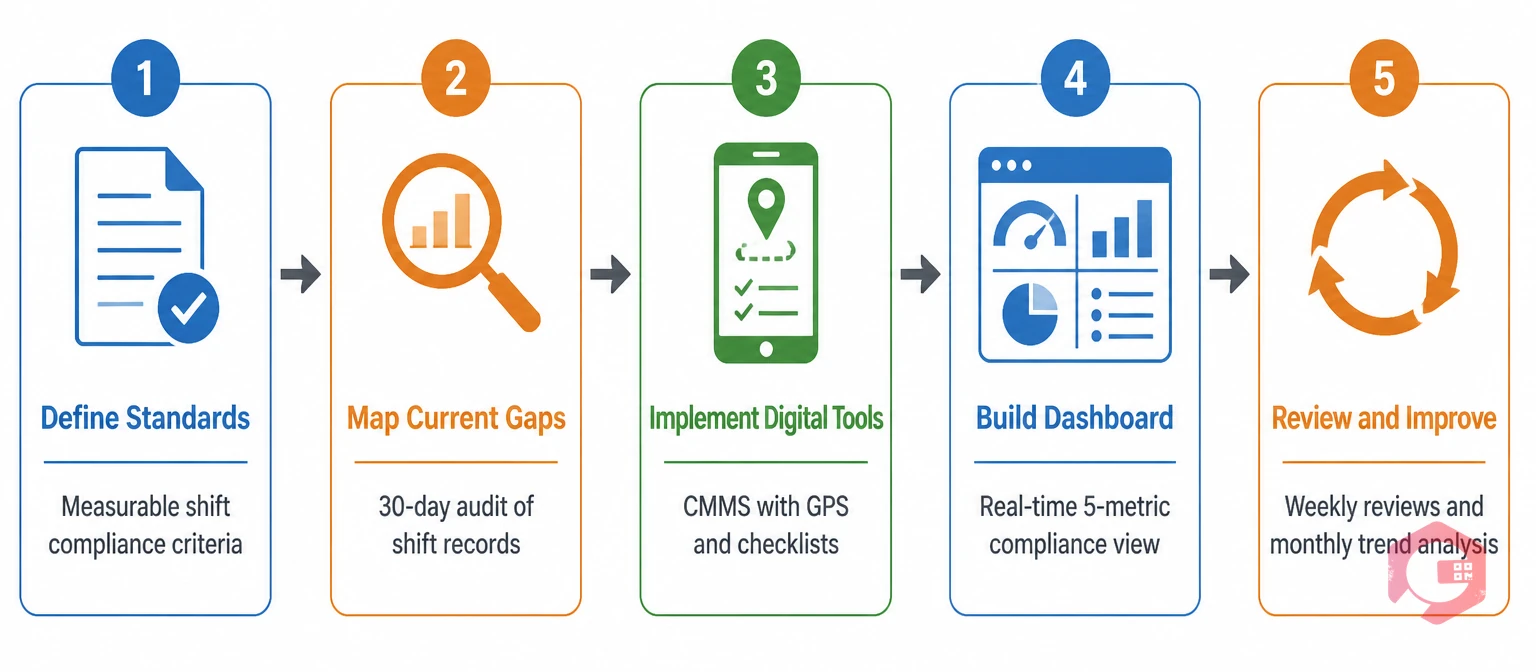
Moving from reactive shift tracking to a proactive compliance monitoring program is a structured process. These five steps apply to field operations teams regardless of industry or current technology maturity.
Step 1 — Define your compliance standards. Document what a compliant shift looks like in measurable terms: expected start time windows, mandatory safety checks, task completion requirements, and handover information standards. Without documented standards, compliance cannot be objectively measured — and individual interpretation of "close enough" creates inconsistency across sites and shifts.
Step 2 — Map your current compliance gaps. Before implementing new tools, audit your current shift records for a 30-day period. Where are shifts starting late? Which tasks are consistently incomplete at shift close? Which sites have the highest non-compliance rates? This baseline makes it possible to measure improvement objectively once digital monitoring is in place. The safety compliance checklist is a useful starting point for structuring this audit.
Step 3 — Implement digital work order and checklist management. Deploy a mobile-capable CMMS that enforces checklist completion, captures GPS-verified shift start data, and creates automatic alerts for overdue tasks. Configure mandatory fields for safety steps so technicians cannot close work orders without completing them. The workflow automation software module handles escalation routing so that compliance failures trigger the right notifications to the right people automatically.
Step 4 — Build the compliance dashboard. Configure your CMMS reporting layer to show the five core metrics — shift start compliance, task completion rate, safety checklist rate, handover compliance, and mean time to report — across all sites, updated in real time. Share a simplified view with site supervisors and a full analytics view with operations management. When compliance data is visible to the people who can act on it, behavior changes faster than any training program alone can achieve.
Step 5 — Review, adjust, and improve. Treat shift compliance monitoring as a continuous improvement program rather than a one-time implementation. Weekly reviews of the compliance dashboard reveal which sites, shifts, or task categories require additional attention. Monthly trend analysis identifies whether compliance rates are improving or if structural changes — in staffing, scheduling, or asset maintenance — are needed. Use the regulatory compliance checklist to verify that your monitoring framework continues to meet applicable industry standards as those standards evolve.
Workforce scheduling defines when and where employees should work. Shift compliance monitoring verifies whether they actually followed that schedule — and whether the required tasks, safety steps, and documentation were completed correctly during that shift. Scheduling is planning; compliance monitoring is verification. Both are necessary, but organizations that invest only in scheduling tools without monitoring compliance have no way to know whether their plans translate into consistent field execution.
A CMMS helps by creating a real-time digital record of every step in the shift lifecycle — GPS-verified start times, mandatory checklist completions, work order updates, safety protocol confirmations, and formal handover records. It automates alerts when compliance gaps occur, so managers can respond within minutes rather than discovering non-compliance hours later. The accumulated shift compliance data also feeds into analytics that show which sites, shifts, or task types carry the highest compliance risk over time.
Any industry where field workers operate across multiple sites under safety-critical or regulatory obligations benefits significantly from structured shift compliance monitoring. Oil and gas, healthcare facilities, manufacturing, and facility management face particularly high compliance stakes because a single non-compliant shift can trigger safety incidents, regulatory penalties, or major client contract breaches.
Yes — modern CMMS platforms with offline-capable mobile apps allow technicians to complete checklists, update work orders, and capture signatures without an active internet connection. The data syncs automatically when connectivity is restored, ensuring that remote or basement-level field sites don't create gaps in the compliance record. This offline capability is essential for industries like mining, tunneling, and large industrial facilities where network coverage is inconsistent.
Shift compliance monitoring is moving from a reactive reporting function to a real-time operational discipline — and the field workforce teams that make this transition gain a measurable advantage in safety performance, SLA consistency, and client transparency. Cryotos CMMS provides the work order management, digital checklists, GPS-verified mobile logging, and real-time BI reporting that field operations teams need to build and sustain a shift compliance program that actually works. Book a free demo to see how Cryotos brings shift compliance visibility to your field workforce.


Cryotos AI predicts failures, automates work orders, and simplifies maintenance—before problems slow you down.