A daily heavy equipment inspection checklist is a structured set of pre-shift and post-shift checks that construction operators complete before and after operating machinery on a job site. These inspections verify that equipment — excavators, cranes, bulldozers, loaders, and dump trucks — is safe to operate, mechanically sound, and compliant with OSHA 29 CFR 1926.600 standards.
Skipping daily inspections is one of the leading causes of equipment-related accidents and unplanned downtime on construction sites. According to a U.S. Bureau of Labor Statistics report, equipment failures and malfunction-related incidents account for a significant share of construction fatalities each year.
Downtime cost: Equipment breakdowns cost construction projects $1,500–$2,500 per idle hour
Compliance: OSHA 29 CFR 1926.600 mandates pre-use equipment inspections on all construction sites
Prevention: Regular pre-shift checks identify 85% of mechanical faults before they cause failures
What Is a Daily Heavy Equipment Inspection?
A daily heavy equipment inspection is a systematic check carried out by the equipment operator at the start (and end) of each working shift. It covers safety systems, fluid levels, structural integrity, controls, and operational components to confirm the machine is fit for use.
Unlike a full preventive maintenance service — which involves lubrication, part replacement, and scheduled intervals — a daily inspection takes 10 to 20 minutes and requires no tools. It is the operator's first line of defence against unsafe equipment and unexpected breakdowns.
Pre-Shift Inspection vs Preventive Maintenance: Key Difference
Pre-Shift Inspection: Operator-led visual and functional check before each use. Takes 10–20 minutes. Goal: confirm the machine is safe to operate today.
Preventive Maintenance (PM): Technician-led scheduled service at defined intervals. Goal: prevent wear, replace parts proactively, extend machine life.
Who Is Responsible for Daily Inspections on a Construction Site?
The equipment operator is primarily responsible for completing daily inspections before starting a shift. However, the site supervisor or safety officer is accountable for ensuring inspections are completed, documented, and acted upon. OSHA places the compliance burden on the employer, not the operator.
Why Daily Inspections Matter: Cost of Skipping Pre-Start Checks
Daily inspections are not a box-ticking exercise. They directly affect project timelines, worker safety, and operating costs. Construction teams that skip pre-shift checks face predictable and avoidable consequences.
Equipment Failure Costs on Construction Projects
Direct cost: $1,500–$2,500/hour in idle equipment and crew time
Repair cost: Emergency breakdown repairs cost 3–5x more than planned maintenance
Project delay: A single unexpected equipment failure delays the average project by 2–4 days
Safety liability: Equipment-related incidents expose the employer to OSHA fines up to $156,259 per violation
OSHA Compliance Requirements for Construction Equipment (29 CFR 1926.600)
OSHA 29 CFR 1926.600 requires that all equipment used in construction is inspected before each shift. Non-compliance is not just a financial risk — in 2023, OSHA cited construction employers over 34,000 times for equipment-related violations.
Daily Heavy Equipment Inspection Checklist: What to Check Before Every Shift
Engine oil level — Check dipstick; top up if below minimum mark
Coolant level — Inspect radiator reservoir; look for leaks under machine
Hydraulic fluid level — Check reservoir sight glass or dipstick
Fuel level — Confirm sufficient fuel for the shift; check for fuel leaks
Battery condition — Check terminals for corrosion; confirm secure connections
Tyres / tracks — Check tyre pressure and condition; check track tension and pad wear
Lights and warning devices — Test headlights, reversing alarm, beacon, and horn
Seat belt and restraints — Confirm functional; inspect for fraying or damage
Attachment condition — Inspect bucket, blade, or hook for cracks, wear, or damage
Structural integrity — Walk around the full machine looking for cracks, bent frames, loose bolts
Leak check — Check ground under machine for oil, fuel, coolant, or hydraulic fluid puddles
Fire extinguisher — Confirm present, charged, and accessible in cab
Post-Shift Inspection Checklist
Park on stable, level ground — Never leave equipment on a slope without blocking
Lower all attachments — Buckets, blades, and booms must be lowered to rest position
Clean the machine — Remove mud, debris, and material build-up
Note any new issues found during the shift — Unusual noises, sluggish hydraulics, warning lights
Log the inspection — Complete the daily inspection form and hand it to the site supervisor
Machine-Specific Daily Inspection Checklists
Excavator Daily Inspection Checklist
Boom, arm, and bucket pins — Check for play, wear, and lubrication
Hydraulic hoses — Inspect for cuts, abrasion, and fitting leaks along the full length
Swing bearing — Check for abnormal play or noise when slewing
Track tension — Measure sag; adjust if outside manufacturer's specified range
Crane Daily Inspection Checklist
Wire rope / slings — Inspect for kinks, broken wires, corrosion, and diameter reduction
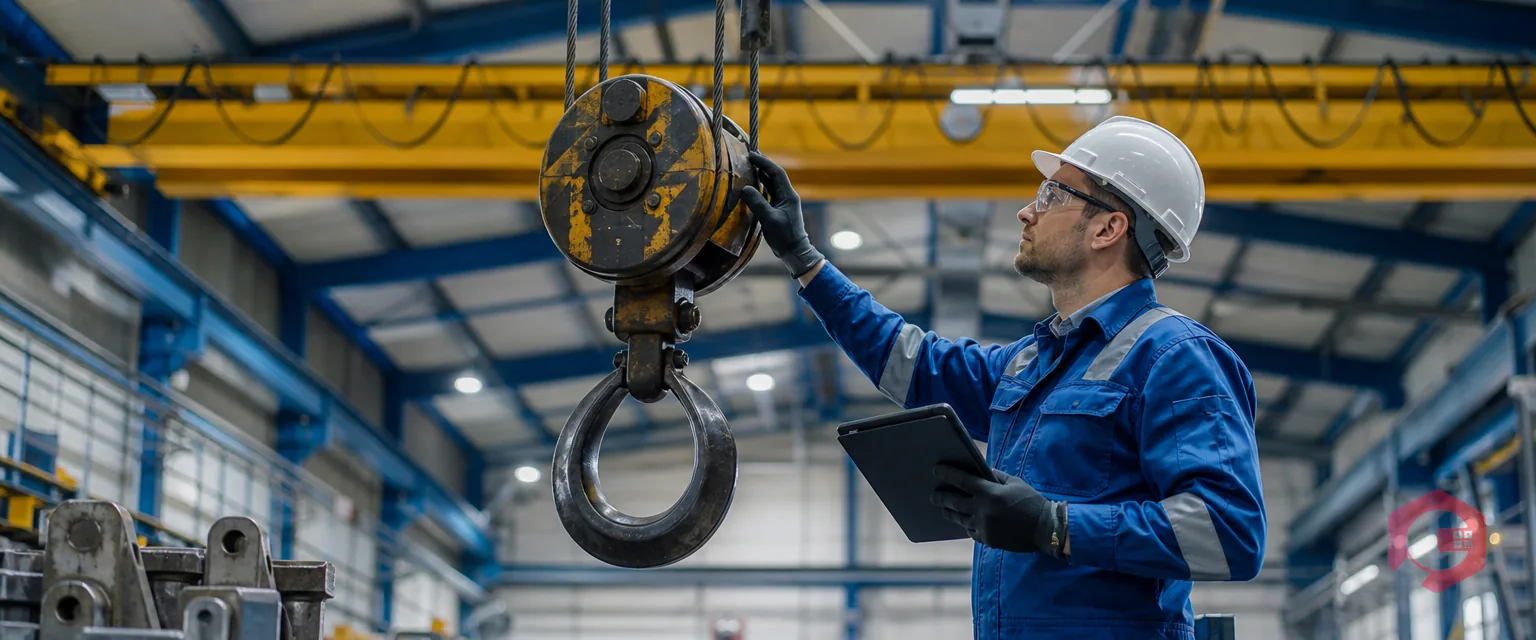
Hook and latch — Check for cracks, deformation, and safety latch function
Outrigger pads — Confirm fully extended and load-bearing pads in place
Anti-two-block device — Test function before lifting
Bulldozer Daily Inspection Checklist
Blade condition and angle — Check for cracks, bent cutting edge, worn end bits
Track rollers and idlers — Check for oil leaks and wear
ROPS / FOPS cab — Inspect rollover and falling-object protection structure for damage
Wheel Loader Daily Inspection Checklist
Tyre condition and pressure — Check all four tyres; look for cuts, bulges, and embedded debris
Articulation joint — Check for excessive play and lubrication
Brake function — Test service and parking brakes before moving
Dump Truck Daily Inspection Checklist
Brake system — Test service brakes, emergency brakes, and air pressure build-up
Tipping body and hoist — Inspect for cracks; test hoist operation unloaded
Wheel nuts — Walk-around check; tap test or use wheel nut indicators
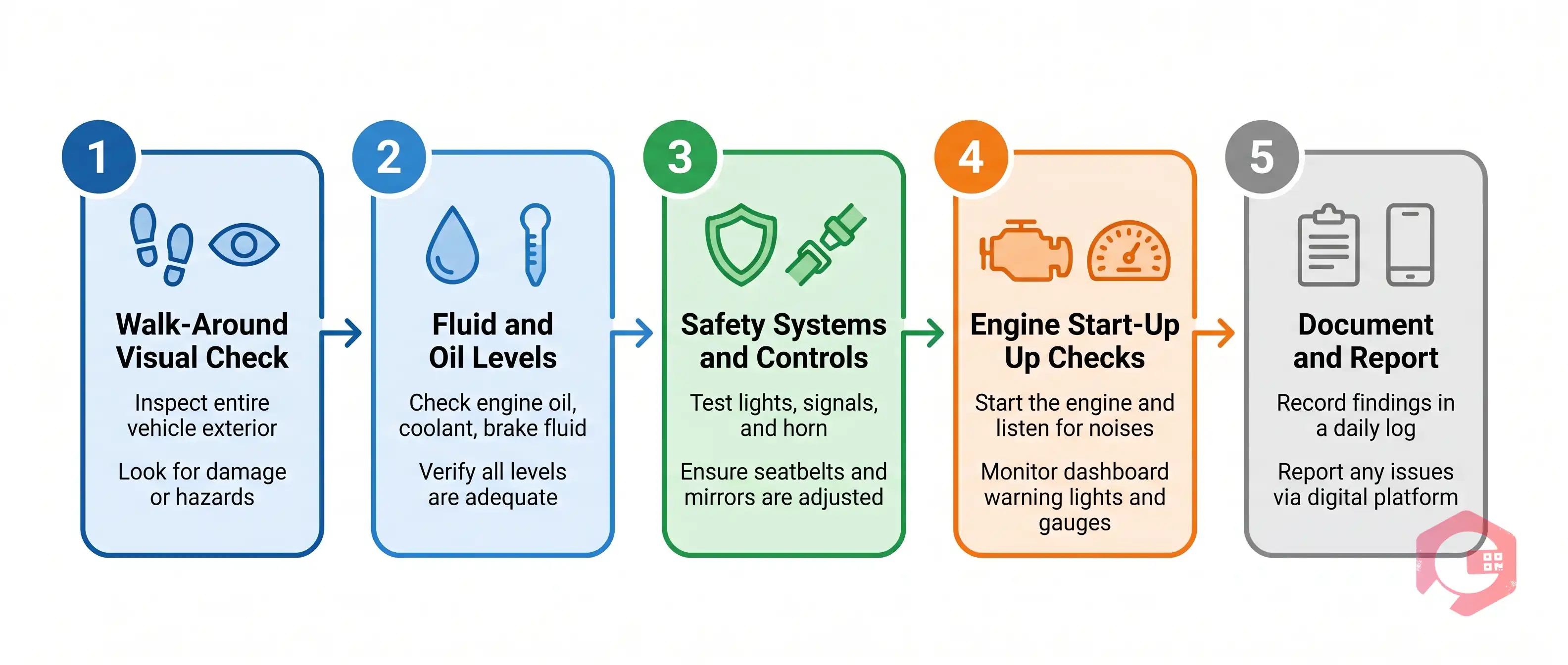
How to Conduct a Daily Heavy Equipment Inspection: Step-by-Step
Step 1 — Walk-Around Visual Check
Start at the front-left of the machine and walk clockwise. Look for fluid puddles under the machine, structural damage, missing guards, and anything that looks different from the previous shift.
Step 2 — Fluid and Oil Level Checks
With the engine off and cooled where safe, check engine oil, coolant, hydraulic fluid, transmission fluid, and fuel. Always check in the same order to build the habit and avoid missing a check.
Step 3 — Safety Systems and Controls Verification
Before starting the engine, test seat belt function, check that all safety guards are in place, verify ROPS/FOPS structures are undamaged, and confirm the fire extinguisher is charged and accessible.
Step 4 — Engine Start-Up Checks
Start the engine and allow it to idle for 3–5 minutes. During this period, check for warning lights on the instrument panel, unusual exhaust smoke colour, and abnormal noises.
Step 5 — Document and Report Findings
Complete the inspection form immediately. Record any defects with a brief description and photos. If the machine has a fault that affects safe operation, tag it out immediately and notify the site supervisor before the shift begins.
Going Digital: Replacing Paper Inspection Forms with a CMMS
A Computerised Maintenance Management System (CMMS) eliminates paper-based inspection problems by digitising the entire inspection workflow. Construction teams that switch from paper to digital inspection checklists consistently report measurable improvements.
100% inspection completion tracking — Supervisors see in real time which machines have been inspected
Photo evidence attached to defect reports — No ambiguity about the nature of a fault
Automatic work order generation — A failed inspection item instantly creates a maintenance work order
Audit trail for OSHA compliance — Every inspection is timestamped, operator-signed, and retrievable in seconds
How Cryotos Automates Daily Equipment Inspections
Cryotos CMMS provides construction maintenance teams with a mobile-first inspection workflow purpose-built for heavy equipment fleets. When an operator marks a checklist item as failed, Cryotos automatically raises a corrective maintenance work order and notifies the maintenance supervisor. Construction teams using Cryotos have reduced equipment-related downtime by up to 35% within the first six months of deployment.
Frequently Asked Questions
What should be checked on heavy equipment before use?
Before using any heavy equipment, operators should check engine oil, coolant, hydraulic fluid, fuel levels, tyre or track condition, lights and alarms, seat belts, structural integrity, and any attachment condition. A complete pre-shift inspection takes 10–20 minutes and must be documented before the machine is used.
How often should heavy equipment be inspected?
Heavy equipment on active construction sites must be inspected at minimum once per shift. Cranes require a documented inspection before each lift under OSHA 29 CFR 1926.1412.
What happens if a daily equipment inspection is skipped?
Skipping a daily inspection creates multiple risks: mechanical failures turn into expensive breakdowns; unsafe equipment may be operated unknowingly; and the employer becomes non-compliant with OSHA standards, exposing the company to fines of up to $156,259 per wilful violation.
Managing daily inspections across a construction fleet manually is slow, error-prone, and impossible to scale. Cryotos CMMS gives your maintenance team a smarter way to run equipment inspections. Book a free demo today and see Cryotos in action.