To report a workplace incident, secure the area first. Get injured workers medical attention. Notify your shift supervisor right away. Then complete a written report within your site's required window — often within hours for serious events. Energy plants carry higher-consequence risks than a typical facility. High voltage, rotating equipment, confined spaces, and combustible fuel all raise the stakes. That's why most sites layer strict internal deadlines on top of OSHA's federal rules. This guide walks through exactly what to report, how fast, and how a CMMS keeps the paper trail from falling apart.
Key Takeaways

A reportable workplace incident is any event causing injury, damage, or a credible near-miss. In an energy plant, that list runs wider than most industries. A voltage flashover with no injury still counts. So does an ignored control room alarm that could have caused a turbine trip. Even a small oil sheen near a transformer counts, because the environmental exposure risk is real even when the volume is small.
Most sites classify incidents into four buckets: near-miss, first-aid case, recordable injury, and major event. A major event covers a fatality, fire, explosion, or serious environmental release. OSHA's injury and illness reporting rules set the federal floor. Fatalities are due within 8 hours. Hospitalizations are due within 24. Most energy operators set tighter internal deadlines than that federal minimum.
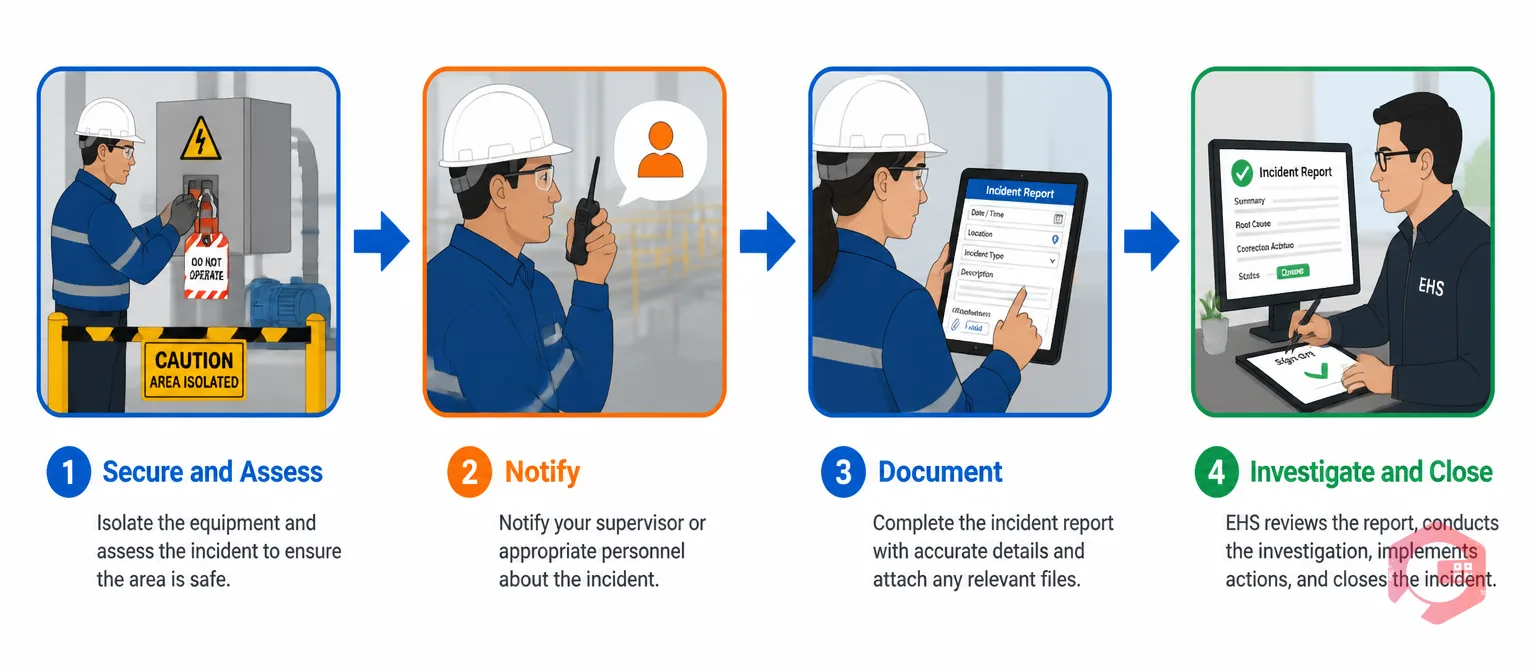
Every credible workplace incident reporting program follows the same backbone. It doesn't matter if the site runs on paper or a CMMS.
The Four-Step Workplace Incident Reporting Sequence:
Skipping straight to "Document" without an immediate verbal notice is the most common failure point. A report filed hours after the event, at the end of a 12-hour shift, is both a compliance risk and a data-quality problem.
Not every incident needs the same notification chain. The matrix below shows how severity sets who gets notified and how fast the report is due.
| Severity | Example Incident | Who to Notify | Reporting Window |
|---|---|---|---|
| Near-Miss | Dropped tool near an energized panel, no contact | Shift supervisor | Same shift |
| First-Aid Case | Minor cut requiring only basic first aid | Shift supervisor, EHS | Within 4 hours |
| Recordable Injury | Injury requiring medical treatment beyond first aid | EHS, plant manager, OSHA log | Within 8 hours |
| Major Event | Fatality, fire, explosion, major environmental release | Executive leadership, regulators | Immediately, then within regulatory deadline |
Plant operators who treat every incident as equally urgent burn out their EHS team. Worse, they slow down response to the events that actually need it. The matrix exists to route attention, not to downplay smaller events. It also gives new shift leads a quick reference instead of guessing, which matters most during a busy overnight shift when senior staff aren't on site.

Incident reporting is the process of capturing, classifying, and routing a workplace event. The goal is getting the right people to act within a defined deadline. A missed 8-hour window isn't just paperwork — it's regulatory exposure and a missed chance to prevent a repeat.
Manual reporting struggles for three reasons. Paper forms sit in a control room binder until someone remembers to transcribe them. Verbal handoffs between shifts lose detail along the way. And nothing reminds anyone when a deadline is close, so reports slip past their window unnoticed until an audit finds the gap.
Mobile CMMS reporting fixes the first two problems directly. A technician files the workplace incident report from the field, photos attached, the moment the event happens. No transcription step, no lost detail. Workflow automation solves the third problem. The severity classification on submission triggers the right notification chain and starts an SLA countdown automatically.
Maintenance teams using Cryotos have reported up to 30% reduction in unplanned downtime and 25% faster repair turnaround. Part of that gain comes from incident reports tied to equipment routing straight into a work order, instead of sitting in a separate system. A BI dashboard then tracks reporting-window compliance across shifts. A plant manager can see at a glance which crews file on time and which need a refresher.
For sites managing electrical isolation or hot work, pairing this with a permit to work process adds the same rigor before an incident happens, not just after. Larger operations often formalize the whole process against a safety compliance checklist to stay audit-ready year-round.
Consider a combined-cycle power plant running three shifts. A first-aid case at 2 a.m. on the night shift, filed on paper, historically wasn't seen by EHS until the day shift arrived at 7 a.m. That's five hours past when the internal 4-hour window closed.
After moving reporting into a Computerized Maintenance Management System, the same report reaches EHS and the plant manager within minutes. It stays well inside the window. A photo of the affected equipment attaches automatically. This is a common pattern across power plant and broader energy operations. The reporting process was never the weak link in principle. The weak point was always the mechanics of getting information from the field to the right desk fast enough. Reliability standards bodies like NERC expect this kind of traceable process for events touching grid reliability. That expectation alone makes the digital paper trail worth the switch.

Most reporting failures aren't dramatic. They're small habits that add up to a missed deadline or a thin investigation. Watch for these five.
Verbal notification to a supervisor should happen within minutes. The written report typically follows within your site's internal deadline. That's commonly 4 to 8 hours depending on severity. Fatalities and hospitalizations follow OSHA's stricter federal timelines.
The worker who witnesses or experiences the incident reports it first, to their shift supervisor. From there, EHS and the equipment owner take over documentation, investigation, and closure. Responsibility for the initial report never shifts to whoever notices it later.
Yes, though the notification chain is lighter. A near-miss still needs to be logged the same shift so patterns can be tracked. It just doesn't trigger the same escalation as a recordable injury or major event.
At minimum: date, time, location, people involved, equipment affected, a factual description of what happened, and an initial severity rating. Root cause and corrective action get added during investigation, not at first report. See standard incident report conventions for a broader reference on what fields are typically expected.
Yes, and most energy plants are moving that way. A digital form on a phone or tablet captures the same fields as paper. It adds a timestamp, GPS location, and photo attachment automatically. Nothing gets lost in transit between the field and the EHS office, and nobody has to retype a handwritten note days later.
A fast, consistent workplace incident reporting process is one of the clearest signals of a mature safety culture at any energy plant. Schedule a free demo to see how Cryotos gets incident reports from the field to the right desk within your reporting window, every time.


Cryotos AI predicts failures, automates work orders, and simplifies maintenance—before problems slow you down.