

SHE is the Safety, Health & Environment framework maintenance teams use to prevent injury, long-term health harm, and environmental damage. In maintenance operations, SHE covers everything from lockout/tagout on live equipment to spill containment during a repair. Most facilities run SHE alongside their Computerized Maintenance Management System (CMMS), so every permit, checklist, and inspection leaves a clear audit trail.
Key Takeaways

SHE stands for Safety, Health & Environment. It is the umbrella term for managing risks that could injure people, damage their health over time, or harm the environment. You will also see the same idea written as HSE (Health, Safety & Environment) or EHS (Environment, Health & Safety). The order changes by region and industry, but the scope stays the same.
Whichever term a facility uses, the goal stays the same: protect people and the environment while equipment gets serviced, repaired, or inspected.
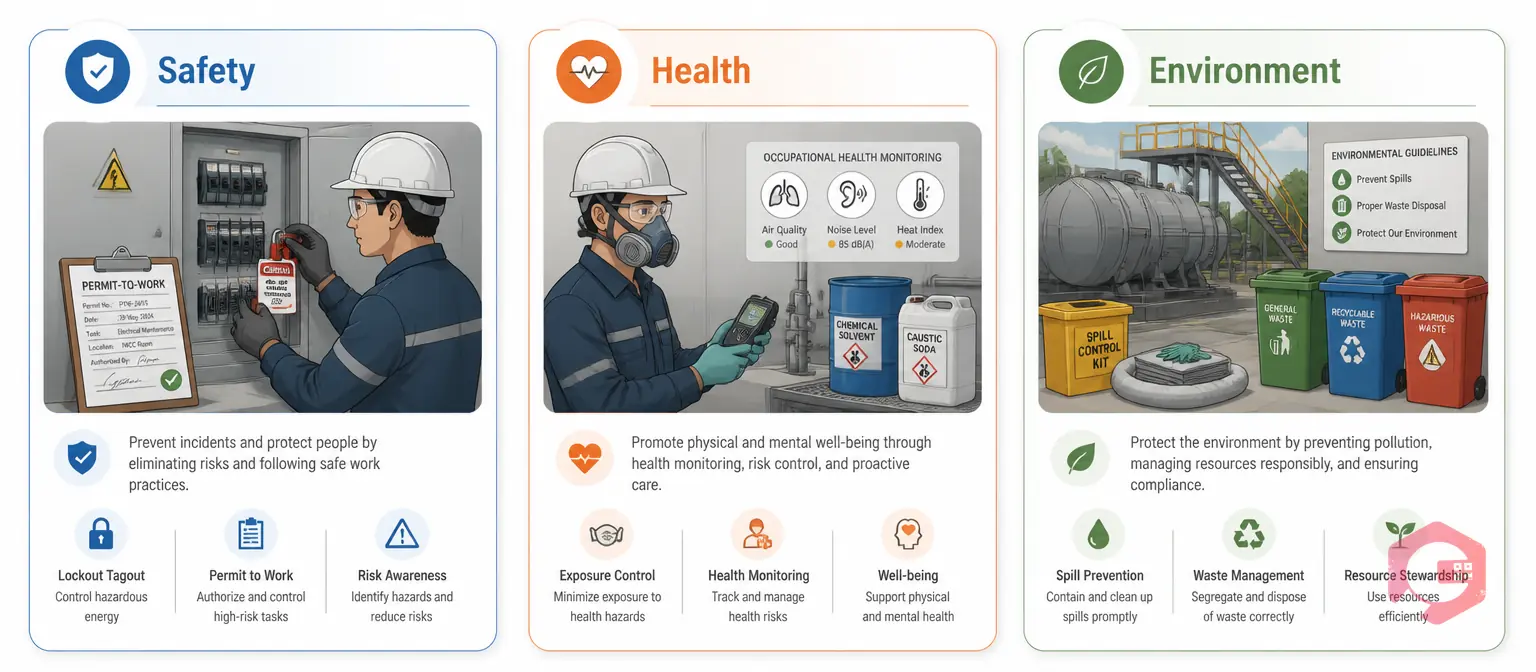
SHE in maintenance operations breaks down into three connected pillars. Each one shows up differently on a maintenance floor than it does in a general office safety policy.
Lockout/tagout is the process of isolating hazardous energy before maintenance work begins. Safety also covers permit-to-work systems for high-risk jobs, working-at-height procedures, confined-space entry, and machine guarding. Most injuries in maintenance happen when one of these steps gets skipped.
Health covers harm from occupational exposure that builds up over time. This includes noise-induced hearing loss, chemical and solvent exposure, hand-arm vibration syndrome, dust inhalation, and the strain caused by repetitive tasks or long shifts.
Environment covers harm caused by maintenance activity itself. Think oil and fluid spills during repairs, refrigerant leaks, improper disposal of used oil and batteries, and water contamination from equipment cleaning.
Most SHE incidents in maintenance trace back to one of these three pillars breaking down under time pressure. A rushed pump repair, for example, can touch all three at once: a skipped lockout step (Safety), a chemical splash during disassembly (Health), and a fluid spill left uncontained (Environment).

SHE matters in maintenance operations because maintenance work carries more risk than most other plant floor roles. Technicians work directly with live circuits, pressurized systems, rotating machinery, and hazardous chemicals. These are the exact conditions most workplace incidents start from.
Teams that treat SHE and reliability as one program, not two separate concerns, tend to see fewer incidents on both sides. The cost of prevention is almost always lower than the cost of a single serious incident, once lost production, fines, and legal fees are added up.
A structured safety compliance checklist is usually the fastest way to close the gap between a SHE policy on paper and what actually happens on the floor.
A handful of standards anchor most SHE programs used in maintenance operations today.
Most facilities map their own regulatory compliance checklist against whichever of these standards fits their industry and location.
SHE responsibility in a maintenance department is shared across four roles. No single person owns it alone.
When any one of these roles treats SHE as someone else's job, compliance gaps open up fast.
Most maintenance teams track SHE performance with a small set of leading and lagging indicators. Incident counts alone tell only part of the story.
Teams that track these five metrics consistently tend to catch SHE gaps weeks before they turn into an actual incident. Most facilities review these numbers monthly, then feed the trend back into training and permit design.

The Plan-Permit-Perform-Verify Framework:
Most SHE breakdowns happen when a team jumps straight from Plan to Perform and skips the Permit and Verify steps entirely.

A CMMS supports SHE compliance by turning paper-based policy into a system that gets followed and documented every time. Digital permit-to-work software forces the Plan-Permit-Perform-Verify sequence instead of letting technicians skip steps under time pressure.
Maintenance teams using Cryotos have reported up to 30% reduction in unplanned downtime and 25% faster repair turnaround. Fewer jobs get rushed past their SHE steps in the first place.
SHE stands for Safety, Health & Environment. It is the framework organizations use to prevent injury, long-term health harm, and environmental damage from operational activities, including maintenance work.
SHE and HSE cover the same three areas — safety, health, and environment — just in a different word order. The choice usually comes down to regional or industry habit, not a real difference in scope.
SHE is important in maintenance because technicians work directly with hazardous energy, chemicals, height, and confined spaces more than almost any other role. This makes the risk of injury or environmental harm much higher without a strong SHE program.
Responsibility is shared. Leadership sets policy, the EHS/SHE officer manages the program, supervisors enforce it on every job, and technicians carry out the actual safety steps in the field.
Most teams track incident rate, near-miss reporting rate, LOTO compliance rate, permit closure time, and PPE audit scores rather than relying on incident counts alone.
A CMMS enforces the permit-to-work process digitally, attaches safety checklists directly to work orders, and keeps a timestamped audit trail of every step. This replaces paper forms that are easy to skip or lose.
Getting SHE right in maintenance comes down to making the safe way also the fast way to do a job. Schedule a free demo to see how Cryotos turns SHE policy into permits, checklists, and audit trails your maintenance team will actually use.
Cryotos AI predicts failures, automates work orders, and simplifies maintenance—before problems slow you down.



