Digitizing safety approvals for high-risk maintenance jobs with PTW software means replacing paper-based permit-to-work systems with a digital workflow that controls, documents, and enforces every safety authorization before a technician begins hazardous work. According to OSHA injury data, maintenance and repair workers account for a disproportionate share of industrial fatalities — and a large proportion of those incidents involve tasks that lacked proper isolation or authorization. PTW software eliminates the gaps that paper permits create: approvals that never reached the right person, permits completed after the fact, and LOTO steps skipped under production pressure.
If your team still issues permits on paper forms or chases signatures via WhatsApp, this guide explains how digital PTW systems work, what features matter most, and how integrating PTW into your CMMS transforms safety compliance from a documentation burden into an operational control.

A Permit to Work system is a formal safety procedure that controls high-risk maintenance tasks. Before any work begins on energized equipment, confined spaces, working at height, or areas with hazardous materials, the PTW process requires the job to be defined, the risks assessed, and safety controls confirmed — all by authorized personnel in a documented sequence.
The permit itself is not just a form — it is a legal and operational contract between the issuer (the site authority) and the performer (the technician). It specifies what work will be done, what hazards exist, what isolations are in place, what PPE is required, and who is accountable at each step. Without that contract being properly completed and signed, no work should begin.
Different hazard types require different permit classes. Most industrial facilities use several in parallel:
The rule of thumb used by most HSE professionals: any maintenance task that involves a risk that could cause a fatality or serious irreversible injury without the control measure in place requires a permit. That includes — but is not limited to — work on pressurized systems, electrical isolation above low voltage, any entry into a space with limited ventilation, and any use of open flame near process materials. Many organizations also require permits for routine maintenance on safety-critical assets such as fire suppression systems, emergency shutdown valves, and lifting equipment.

Paper PTW processes fail in predictable ways. The permit form is completed after the fact because the shift supervisor was in a meeting. The signature from the area authority is missing because no one could find them on the floor. The isolation confirmation is checked but the isolating technician is not the one who will perform the work. None of these failures are intentional — they happen because paper processes depend entirely on human memory, physical presence, and manual coordination.
According to a UK Health and Safety Executive review of major industrial incidents, inadequate permit-to-work systems are a contributing factor in a significant share of major maintenance-related accidents. In many cases, the permits existed on paper — they were just incomplete, inconsistently applied, or bypassed under time pressure.
The consequences of PTW failures are not hypothetical. Plants have experienced serious injuries and fatalities when energized equipment was accessed without confirmed LOTO, when confined space entry proceeded without atmospheric testing, and when hot work was conducted near undisclosed flammable materials. Beyond the human cost, the financial consequences include regulatory shutdown, legal liability, insurance claims, and reputational damage that outlasts any individual incident.
A digital PTW system does not make risk disappear — but it removes the process failures that allow risk to become harm.
The difference between paper and digital PTW is not just convenience. It is the difference between a system where compliance depends on individual discipline and one where compliance is enforced by design:
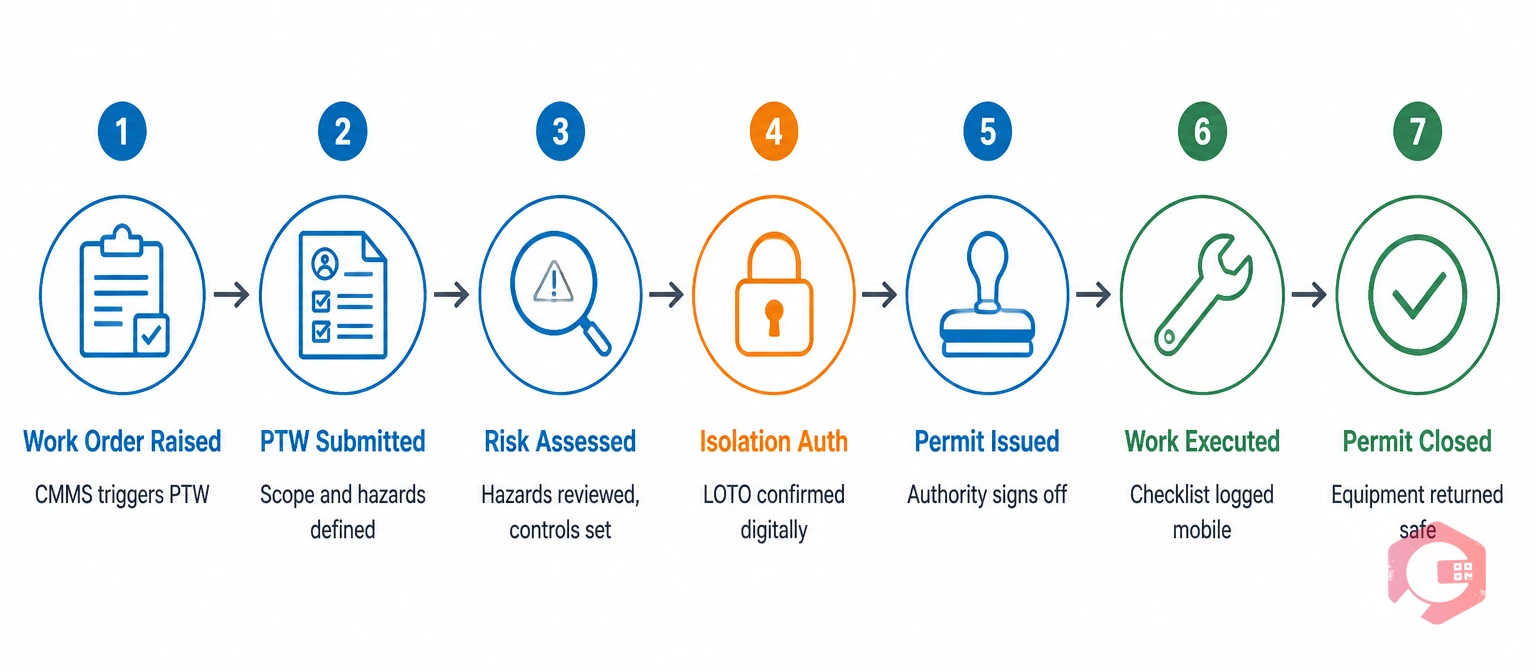
PTW software replaces the paper form with a structured digital workflow that routes safety approvals to the right people, enforces completion at each step, and creates a permanent record that cannot be altered after the fact. The workflow is typically triggered by a maintenance work order — which means the permit is always linked to a specific job, a specific asset, and a specific time window.
A well-designed digital PTW process follows a defined sequence that no step can skip:
One of the most important features of digital PTW systems is the ability to configure mandatory sign-off gates. No step in the workflow can be bypassed — the system simply does not allow the work order to advance until the required digital signature has been captured. For high-risk tasks like confined space entry or work on live electrical systems, multiple approver levels can be configured: the requesting supervisor, the area authority, and the site safety manager all provide independent confirmations before the permit is active.
This multi-level structure is not bureaucracy for its own sake. It is the same principle that makes aviation pre-flight checklists effective: the value is not in the form, it is in the mandatory sequential confirmation that nothing has been missed.
Not all PTW tools are equal. A basic digital form that replaces paper without enforcing the workflow gives you documentation but not control. The features below are what separate genuine PTW software from a digitized clipboard:
Lockout/Tagout is the physical safety procedure; PTW is the authorization system. They must work together. A PTW system that requires a separate manual LOTO log creates the same gap as paper permits — the isolation and the authorization are not linked. Good PTW software embeds LOTO steps directly into the permit workflow, with a dedicated isolation certificate that lists every energy source, the lock applied, and the individual responsible for each lock. The permit cannot be issued until all isolation certificates are complete and signed.
Maintenance technicians do not work at desks. A PTW system that requires desktop access for any step will be bypassed the moment it becomes inconvenient. Mobile access with offline capability — so permits can be accessed and confirmed in areas with poor connectivity, syncing when signal returns — is a non-negotiable requirement for plants with large footprints or areas of limited coverage.
In facilities using IoT sensor monitoring, the most advanced PTW implementations automatically initiate the permit process when a sensor alert exceeds a threshold that requires human intervention. A vibration alert on a critical motor that predicts bearing failure within 72 hours can automatically create a work order and trigger the PTW process — so by the time a technician is assigned and ready to work, the safety authorization process is already underway. This closes the gap between detection and action that manual monitoring can never reliably close.
PTW software is not just an operational tool — it is a compliance infrastructure. Three regulatory frameworks are directly relevant to most industrial facilities implementing digital permit systems.
ISO 45001 requires organizations to establish, implement, and maintain processes for controlling work activities that pose significant hazards. A digital PTW system with documented workflows, audit trails, and multi-level approvals provides the evidence of control that ISO 45001 auditors look for. ISO 45001 Clause 8.1.3 specifically addresses management of change — and every maintenance work order on a safety-critical asset is a change event that requires controlled authorization.
OSHA's Lockout/Tagout Standard (29 CFR 1910.147) requires documented energy control procedures for every equipment type and specific employee authorization before any maintenance on energized equipment. A CMMS with integrated LOTO workflows generates the documentation OSHA requires — timestamped, employee-identified, and traceable to the specific work order — automatically, without anyone having to maintain a separate compliance log.
Confined Space Entry (29 CFR 1910.146) requires permit documentation for entry into permit-required confined spaces, including atmospheric testing results, rescue procedures, and authorized entrant rosters. A digital PTW system can capture all of these elements within the permit record, ensuring nothing is missing when a regulatory inspector asks for the documentation.
The practical value of digital PTW for compliance is the audit experience. When a regulator arrives for an inspection and asks for PTW records for the past 12 months on your steam boiler, a digital system produces that report in seconds. A paper system requires someone to locate 52 permits from 12 filing cabinets — and hope none are missing.
Cryotos Permit to Work software is built directly into the CMMS work order workflow — not as a separate module that needs to be manually linked, but as an integrated gate within the maintenance execution process. When a work order is classified as high-risk, the PTW process initiates automatically, and the work order cannot advance to "In Progress" until every required authorization step is completed and digitally signed.
The PTW configuration in Cryotos allows safety managers to define permit types, required approver levels, mandatory checklist steps, and LOTO isolation certificates for each asset class or hazard category. A confined space entry on a cooling water tank requires a different permit structure than a hot work permit in the electrical switchroom — and Cryotos maintains both as distinct templates, automatically applied based on asset type and task classification.
Cryotos's workflow automation routes permit requests to the designated approvers via mobile push notification, email, or WhatsApp. Approvers can review the permit scope, hazard assessment, and isolation plan from their mobile device and provide a digital sign-off without needing to be physically present at the permit office. This is particularly valuable in multi-shift operations where the area authority may not be on site at the time the permit is requested.
For maintenance teams managing assets across multiple sites, Cryotos's multiple organization management gives safety managers visibility over all active permits across all locations in a single dashboard. No permit goes unnoticed. No work proceeds without authorization. Every closure is documented. The safety compliance checklist built into each permit type ensures technicians confirm every required step before closing the work order.
Plants using Cryotos report a 30% reduction in unplanned downtime and 25% faster repair times — not just because maintenance becomes more efficient, but because fewer incidents disrupt production, and faster PTW processing means authorized work begins sooner without compromising the safety controls that protect the workforce. If your team is ready to replace paper permits with a system that enforces safety approvals automatically, book a free demo today and see how Cryotos PTW works in your environment.
PTW (Permit to Work) software is a digital system that manages the authorization process for high-risk maintenance tasks. It replaces paper permit forms with a structured electronic workflow that routes the permit to required approvers, enforces completion of each step before work can begin, links LOTO isolation certificates to the permit record, and generates a timestamped audit trail of every action from issuance to closure.
PTW software can be a standalone tool, but it works best when integrated directly into a CMMS. A standalone PTW system still requires manual linking to work orders and asset histories. When PTW is built into the CMMS — as it is in Cryotos — the permit is automatically initiated by the work order, linked to the asset's maintenance history, and enforced as a gate before any work can proceed. This eliminates the administrative overhead of managing two separate systems.
Most industrial facilities require permits for hot work, confined space entry, electrical isolation work, work at height, work on pressurized systems, and any maintenance on safety-critical assets such as fire suppression, emergency shutdowns, or lifting equipment. The specific scope depends on the facility's risk assessment and applicable regulatory framework, but the principle is consistent: any task where failure of a safety control could cause a fatality or serious irreversible injury requires a formal permit.
Digital PTW improves compliance by enforcing the process rather than relying on individual discipline. A paper permit can be backdated, incompletely filled, or physically lost. A digital permit cannot be issued without all required fields being completed and all required approvers providing digital sign-off. Every action is timestamped and attributed to a specific user. The audit trail is automatically generated and permanently stored — making compliance reporting for ISO 45001, OSHA, or internal safety audits a matter of seconds, not days.
Quality PTW software includes offline capability so technicians can access permits, complete checklists, and confirm LOTO steps in areas with limited or no connectivity. All changes sync automatically when the device reconnects. This is critical for large industrial facilities where underground areas, shielded electrical rooms, and remote equipment locations may have poor signal coverage.
The primary regulatory frameworks are ISO 45001 (occupational health and safety management), OSHA 29 CFR 1910.147 (lockout/tagout), OSHA 29 CFR 1910.146 (confined space entry), and sector-specific standards such as NFPA 70E for electrical safety and API RP 2026 for petroleum industry hot work. Most national jurisdictions also have equivalent local regulations. A digital PTW system with configurable permit templates can be configured to enforce the specific documentation requirements of any applicable standard.



Cryotos AI predicts failures, automates work orders, and simplifies maintenance—before problems slow you down.