
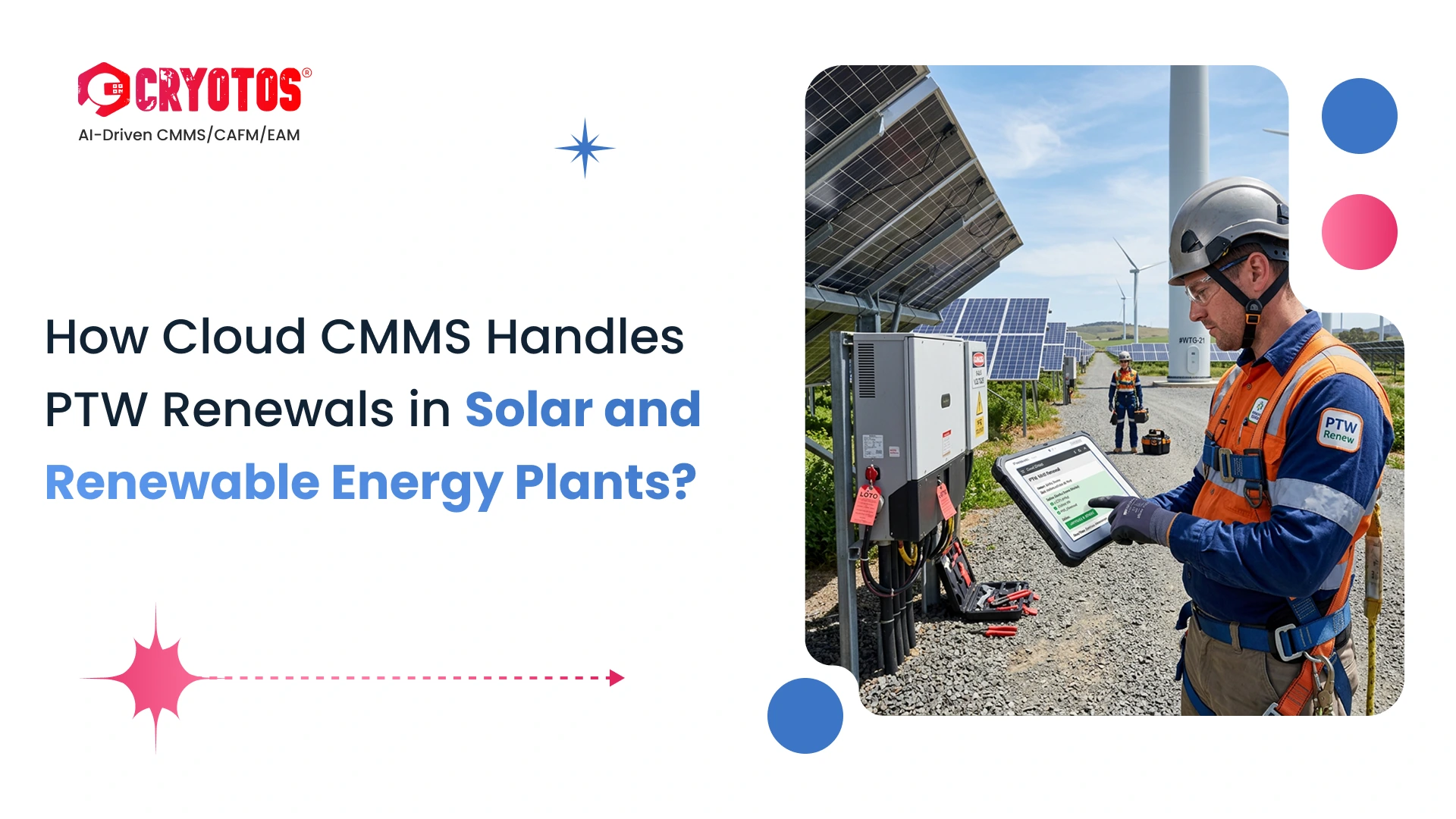
Solar and renewable energy plants have unique maintenance conditions that make permit management harder than in traditional industrial facilities. The challenge isn't complexity — it's scale and geography.
A utility-scale solar plant can span hundreds of acres. A maintenance technician servicing a PV tracker in the east field may be a 15-minute walk from the control room. When their permit expires mid-job, stopping work, walking back, finding the shift supervisor, getting a signature, and returning costs real productive time — and in high-heat environments, it's a safety hazard in itself.
Solar plants also run shift-based operations. Permits issued during one shift may need renewal under a different supervisor. Without a digital handoff, there's no easy way to verify what the previous supervisor approved and whether anything has changed — dust conditions, wind speed, equipment state — since the permit was first issued.
According to IRENA, utility-scale solar capacity additions are growing at over 30% annually. As plants get larger and more complex, manual safety permit systems that were never designed for this scale become the weakest link in operations.
Most solar plant safety incidents aren't caused by unknown hazards — they're caused by known hazards that weren't tracked. Manual PTW renewal systems have four recurring failure points:
A paper permit stuck in a technician's pocket offers no visibility to the control room. When a job overruns its permitted window, the control room often doesn't know until the technician walks back. A cloud CMMS sends automatic alerts to both the technician and the supervisor when a permit is approaching expiry — so renewals happen before work stops, not after.
A supervisor signing a paper renewal form has no quick way to verify whether the requesting technician's certifications are still valid. With a digital system, the CMMS blocks renewal requests for any technician whose safety certifications have lapsed — automatically, not manually.
Paper permits handed between shifts create documentation gaps. Digital PTW systems maintain a complete, timestamped audit trail — every approval, every renewal, every checklist sign-off — accessible in seconds from any device, even during a regulatory inspection.
When pressure is on to finish a job, permit renewals tend to become rubber-stamp exercises. A CMMS enforces mandatory re-checks as a built-in condition of every renewal — a technician cannot submit a renewal for a working-at-height job without confirming current wind speed readings and PPE status.
The renewal lifecycle in a cloud CMMS works in four connected stages:
A technician opens the mobile app and raises a permit request linked directly to the work order. The CMMS pre-fills asset details, location, and hazard categories from the asset register. Before submission, the system checks: Is the technician certified? Is the asset isolated? Are all PPE items confirmed? If any pre-condition fails, the request is blocked.
Not all permits need the same approver. An inverter maintenance permit may route to the electrical supervisor; a working-at-height permit may require the safety officer's sign-off. Cloud CMMS platforms use no-code workflow templates to define these routing rules once — every permit automatically goes to the correct authority.
The system monitors every active permit's expiry window. When a permit is approaching its end time, automated alerts go out to both the technician and the approving supervisor. The renewal request is pre-populated with current work order data — the technician only needs to confirm updated conditions and submit.
When work is complete, the technician closes the permit through the app. The CMMS logs the close-out against the original work order and stores it in a centralized audit record alongside all renewals, checklist responses, and digital signatures.
A permit to work and a lockout/tagout procedure are two sides of the same safety action. In Cryotos, they're connected: a work order cannot move to 'In Progress' until the permit is active and the LOTO isolation is confirmed. When work is done, LOTO can only be removed after the permit is formally closed.
Solar plants have areas with poor or no mobile signal. The Cryotos mobile app operates fully offline: technicians can access active permits, complete checklists, and capture digital signatures without a connection. All data syncs automatically when signal is restored.
Solar plant maintenance involves many recurring tasks — PV module cleaning, tracker arm inspection, weather station calibration. A CMMS with a central template library lets the plant define a standard permit for each recurring task type, cutting the time to create or renew routine permits from 20-30 minutes to under 3 minutes.
The control room needs visibility across all active permits at any given moment: who is working where, on what asset, under what permit, with how long left before renewal. A real-time permit dashboard means no permit falls through the cracks across a multi-crew, multi-zone solar facility.
Permit renewal delays cause downtime. Cryotos tracks breakdown hours (BDH) and MTTR at the granular level, allowing management to distinguish between downtime caused by actual equipment failure and downtime caused by administrative bottlenecks.
South Jeddah Solar Plant — a utility-scale renewable energy facility in Saudi Arabia — implemented Cryotos CMMS to manage asset maintenance, safety compliance, and PTW processes across its solar field.
Before Cryotos, the plant relied on manual workflows to manage permits for high-risk tasks including electrical work on inverters and grounding transformers, working at height during PV module cleaning, hot work during civil maintenance, and confined space access.
After implementing Cryotos, the plant uses digital PTW workflows that enforce:
The result: maintenance activities now run with full digital permit trails, automated safety checklists, and real-time reporting on planned vs. actual maintenance completion.


Cryotos AI predicts failures, automates work orders, and simplifies maintenance—before problems slow you down.



