

Duty cycle is the ratio of time an asset operates under load compared to the total time available, expressed as a percentage — and it directly determines how fast components wear, how often failures occur, and how frequently your maintenance intervals should be scheduled. A compressor running at 80% duty cycle degrades 2 to 3 times faster than an identical unit running at 30%, yet most maintenance teams still schedule both on the same calendar-based PM interval. According to the Reliable Plant benchmarking database, over 60% of industrial equipment failures are linked to maintenance schedules that ignore actual operating load. This guide explains what duty cycle means, how to calculate it, and how to use it to build maintenance intervals that match how your assets actually run.

Duty cycle is the percentage of time an asset spends actively operating — under load — within a defined time window. It tells you not just how long a machine runs, but how hard it works relative to its available running time. Two assets logging the same calendar hours can have very different duty cycles if one idles frequently while the other runs continuously at full load.
The standard duty cycle formula is:
Duty Cycle (%) = (Active On-Load Time ÷ Total Available Time) × 100
For example, a pump that runs under full pressure load for 6 hours in an 8-hour shift has a duty cycle of 75%. A standby generator that tests for 30 minutes per week in a 168-hour week has a duty cycle of less than 0.3%. These are vastly different stress profiles — and they should have vastly different maintenance intervals.
Duty cycle applies across virtually every category of industrial and commercial asset: electric motors, compressors, conveyors, welding machines, HVAC systems, hydraulic units, and heavy mobile equipment. The concept comes from electrical engineering, where it originally described the on-off pulse ratio of switching devices, but it has become a core reliability engineering metric in maintenance management. When you know your equipment’s duty cycle, you can stop guessing at maintenance frequencies and start scheduling with data.
Duty cycle is related to — but distinct from — meter-based maintenance and overall equipment utilization. Utilization tells you what fraction of available capacity you are using. Duty cycle tells you the thermal and mechanical stress rate your components experience. A machine can have high utilization but low duty cycle (long runs at light load) or low utilization but high duty cycle (short runs at maximum load). For maintenance planning, duty cycle is the more reliable predictor of wear.
Every mechanical and electrical component has a stress accumulation rate — the rate at which fatigue, heat, friction, and contamination degrade it under operating load. Duty cycle directly governs how fast that accumulation occurs. At higher duty cycles, components spend more time under thermal and mechanical stress, lubricant degrades faster, contact surfaces wear at a higher rate, and thermal cycling accelerates fatigue cracks in metal components.
The relationship is not always linear. Research from the IEEE Reliability Society shows that for many electromechanical systems, doubling the duty cycle can reduce component life by a factor of 3 to 5 — not 2. This is because high-duty-cycle operation generates heat, and heat accelerates chemical degradation and oxidation in lubricants, insulation, and seals at an exponential rate. A motor running at 90% duty cycle is not just 3 times more stressed than one running at 30% — it may be 7 to 10 times more likely to suffer a winding failure within the same time window.
The four primary mechanisms through which duty cycle accelerates component degradation are:
Most maintenance engineering frameworks classify equipment into three duty cycle tiers. These tiers are not just labels — each tier corresponds to a meaningfully different maintenance frequency multiplier and a different inspection focus. The table below maps each category to its duty cycle range, typical maintenance frequency adjustment, and the industries where each tier is most common.
| Duty Cycle Category | Duty Cycle Range | PM Interval Adjustment | Typical Industries/Applications | Key Maintenance Focus |
|---|---|---|---|---|
| Light Duty | 0–30% | Extend intervals 20–40% beyond OEM baseline | Standby generators, backup pumps, HVAC in low-occupancy buildings | Corrosion, dried seals, cold-start readiness |
| Medium Duty | 31–60% | Apply OEM baseline intervals as written | Commercial HVAC, light manufacturing conveyors, standard production pumps | Lubrication condition, filter fouling, bearing wear |
| Heavy Duty | 61–80% | Reduce intervals 25–35% below OEM baseline | Continuous-process manufacturing, mining conveyors, cement plant motors | Thermal management, oil degradation rate, vibration signature change |
| Continuous / Severe Duty | 81–100% | Reduce intervals 40–60% below OEM baseline; add condition monitoring | 24/7 production lines, data centre cooling, steel mill drives, petrochemical pumps | Real-time condition monitoring, oil analysis, IR thermography |
OEM maintenance intervals are almost always written for medium-duty applications — they assume the asset runs at roughly 50% of its design capacity for a standard operational shift pattern. If your equipment falls into heavy or severe duty, following the OEM schedule without adjustment is one of the most common causes of unexpected failures between planned maintenance visits. If your equipment falls into the light duty category, following the OEM schedule without adjustment drives unnecessary maintenance spend on assets that are not accumulating wear at the assumed rate.
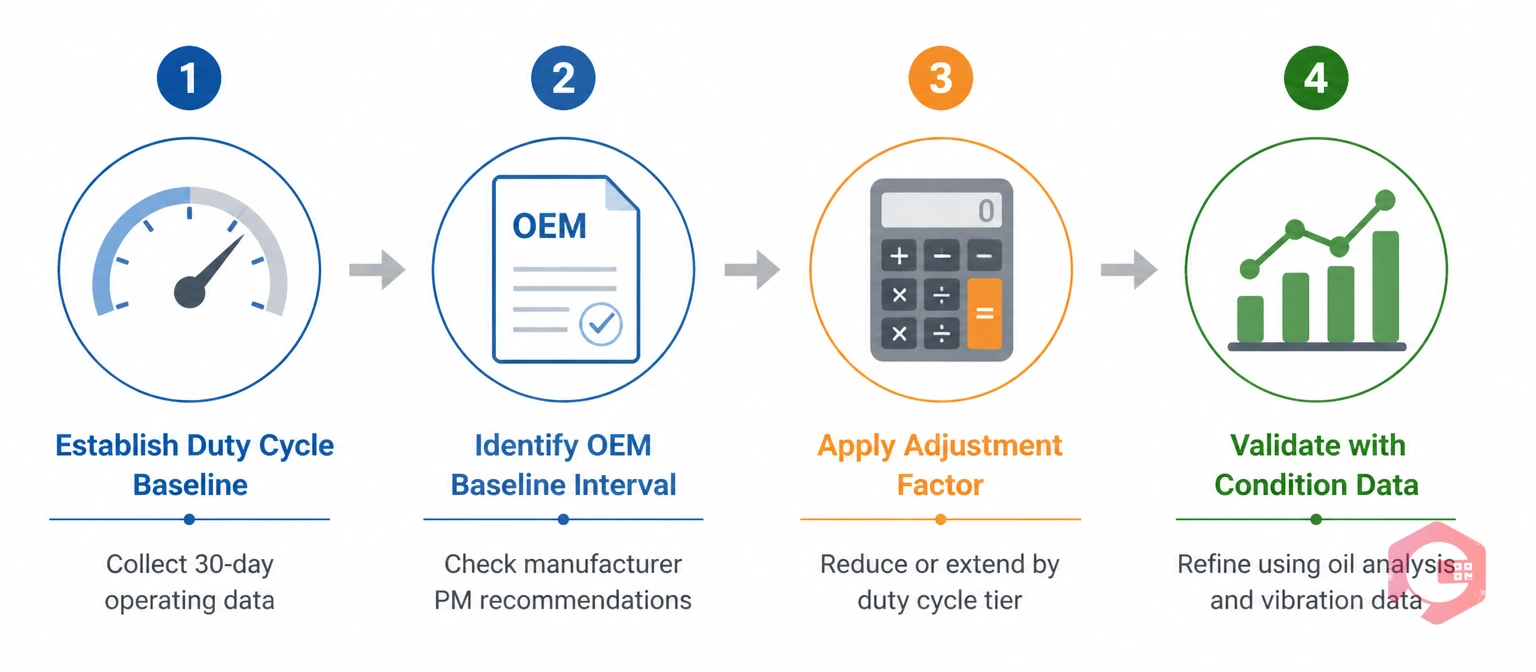
Adjusting maintenance intervals for duty cycle is a four-step process that works for any asset category — from rotating equipment to HVAC systems to mobile plant.
Step 1 — Establish your actual duty cycle baseline. Collect operating data for the asset over at least 30 days. If you have IoT sensor integration or a meter reading tool connected to runtime sensors, pull the on-load hours directly. If not, estimate from production schedules, shift logs, and operator knowledge. Calculate your duty cycle percentage using the formula above. Where assets run variably (e.g., demand-driven pumps), calculate both the typical operating duty cycle and the peak operating duty cycle — your interval should protect against the peak, not just the average.
Step 2 — Identify your OEM baseline interval. Check the equipment manual for the manufacturer’s recommended PM interval. Note whether it is expressed in calendar time, operating hours, or cycles. OEM intervals are typically based on a medium-duty assumption — confirm this, or ask the manufacturer directly if your application is heavy or severe duty.
Step 3 — Apply your duty cycle adjustment factor. Use the multipliers from the category table above as a starting point. For a compressor running at 75% duty cycle (heavy duty), if the OEM recommends an oil change every 2,000 operating hours, your adjusted interval is approximately 1,300 to 1,500 hours. For a standby pump running at 15% duty cycle, a standard annual inspection may be extendable to an 18-month interval — but replace time-sensitive items like seals and O-rings on a calendar basis regardless, since they degrade from age and inactivity, not just use.
Step 4 — Validate with condition data and refine. No duty cycle calculation is a perfect predictor of component wear in every application. Use oil analysis results, vibration data, and inspection findings over 6 to 12 months to validate whether your adjusted interval is catching developing issues before failure. If technicians are consistently finding clean oil and healthy wear surfaces at the end of your adjusted interval, extend it slightly. If they are finding marginal oil condition or elevated wear particle counts, shorten it further. This is the condition-based maintenance feedback loop that turns a static interval into a live, data-driven one.
For assets with multiple PM tasks — lubrication, filter change, inspection, calibration — apply duty cycle adjustments task by task, not as a blanket modification to the whole PM schedule. Oil change intervals for a high-duty compressor may need to halve, while its structural inspection interval may only need a 20% reduction. Differentiated interval adjustment is more accurate and more cost-effective than applying a single multiplier to everything.
Duty cycle thinking applies differently depending on the asset category. Here are five common equipment types, their typical duty cycle ranges in industrial settings, and the specific maintenance tasks most affected by high-cycle operation.

Tracking duty cycle manually — reading hour meters, logging shift data in spreadsheets, calculating percentages by hand — works for a handful of assets but fails at scale. A CMMS that connects asset runtime data to maintenance scheduling closes this gap by automating duty cycle-driven interval adjustments across your entire asset base.
The most direct approach is to connect runtime sensors to the CMMS via IoT integration. Cryotos’s IoT meter reading module connects to SCADA systems, PLCs, and edge devices to pull real-time operating hour data for each asset. When an asset crosses a defined runtime threshold — say, 1,500 hours on a heavy-duty compressor — the system automatically generates a PM work order, regardless of whether the calendar-based interval has also been reached. This is whichever-comes-first scheduling: the asset gets serviced at the hour milestone or the calendar milestone, whichever arrives sooner, eliminating the interval gap that causes failures in high-duty-cycle equipment following a calendar-only schedule.
For assets without IoT connectivity, operators can log runtime hours as part of their daily or weekly equipment checks using the work request module on the mobile app. Hour meter readings entered at each inspection update the asset’s runtime counter in the CMMS, triggering PM work orders when thresholds are reached. It is less automated than direct sensor integration, but it is far more accurate than a calendar-only schedule in a facility where duty cycles vary significantly across assets.
Beyond triggering maintenance, a CMMS stores the duty cycle history for each asset — giving you the trend data you need to validate your interval adjustments over time. If an asset’s recorded duty cycle has been consistently lower than expected over the past year, the system gives you the evidence to formally extend its PM interval, reducing maintenance spend without increasing risk. If an asset’s duty cycle has been creeping higher — perhaps because production demand has increased — the system surfaces that trend before the maintenance interval becomes dangerously long relative to the actual wear rate.
Cryotos’s BI Dashboard displays asset availability, MTBF trends, and PM compliance rates in real time, giving maintenance managers the operational picture they need to confirm whether duty cycle-adjusted schedules are performing as expected. Teams using Cryotos report a 30% reduction in unplanned downtime and 25% faster repair times after implementing meter-based and condition-triggered PM scheduling — the direct result of aligning maintenance intervals with actual equipment stress rather than assumed calendar timelines. You can calculate your own MTBF and failure rate to benchmark where your assets stand today.
In maintenance, duty cycle is the percentage of time an asset operates under load during a defined period. It is calculated as on-load operating time divided by total available time, expressed as a percentage. A high duty cycle means the asset runs hard for most of its available time; a low duty cycle means it runs infrequently or at light load. Duty cycle is used to adjust PM intervals to match actual wear rates rather than relying solely on calendar-based schedules.
Duty cycle affects maintenance intervals by changing the rate at which components accumulate wear, heat stress, and fatigue. Higher duty cycles mean faster degradation — so intervals for lubrication, filter changes, and inspections need to shorten proportionally. OEM maintenance recommendations are typically written for medium-duty (30–60%) applications. If your equipment runs at heavy or severe duty, following OEM intervals without adjustment is one of the most common causes of in-service failures between scheduled maintenance visits.
Most OEM maintenance schedules are written assuming a duty cycle of 30 to 60% — what reliability engineers call the medium-duty range. Equipment running continuously in 24/7 production environments typically operates at 70 to 90% duty cycle. Standby and backup equipment often operates below 10% duty cycle. The correct PM interval for your equipment depends on where it actually falls on this spectrum, not on an assumed baseline.
To calculate duty cycle, divide the asset’s total on-load operating hours in a defined period by the total available time in that same period, then multiply by 100. For example, if a pump runs under load for 18 hours in a 24-hour day, its duty cycle is 75%. Use hour meter readings, IoT runtime data, or shift logs to determine actual on-load time. Avoid using total machine-on time if the asset idles or runs unloaded for significant periods — idle time should not count as on-load time for duty cycle calculation.
Yes. A CMMS with meter-based PM scheduling can trigger maintenance work orders when an asset reaches a defined operating hour threshold, regardless of calendar time. When connected to IoT runtime sensors or fed regular hour meter readings, the CMMS calculates effective duty cycle and generates work orders at the adjusted frequency rather than a fixed calendar date. This eliminates the interval mismatch that occurs when high-duty-cycle equipment is scheduled on a standard calendar-based plan.
Duty cycle is one of the most underused inputs in maintenance planning — and one of the highest-value ones. If your team is applying the same PM schedule to assets that run at 20% and assets that run at 85%, you are simultaneously over-maintaining low-stress equipment and under-maintaining high-stress equipment. Both conditions cost you: one in unnecessary maintenance labour, one in unplanned failures. Cryotos CMMS gives your maintenance team the meter-based scheduling, IoT integration, and real-time dashboards to match your PM intervals to how your equipment actually runs. Book a free demo today and see how duty cycle-driven scheduling reduces downtime without increasing maintenance spend.




Cryotos AI predicts failures, automates work orders, and simplifies maintenance—before problems slow you down.



