

An Electrical Installation Condition Report (EICR) is a formal inspection and test of a site's fixed wiring against BS 7671. For industrial facilities, EICR compliance means having a valid report from a competent inspector, fixing every dangerous defect it finds and keeping the installation safe between inspections.
Most industrial sites should plan an EICR at least every three years. This guide explains the legal duty, inspection intervals, what happens on test day, the C1 to FI codes and how to keep your installation compliant between reports.
Key Takeaways

An EICR is a report on the condition of a building's fixed electrical installation. It runs from the incoming supply through distribution boards, cables, sockets, isolators and fixed equipment. The inspector checks it against BS 7671 and states whether it is safe to keep using.
BS 7671 is the UK national standard for the design, installation and inspection of electrical wiring. It is also known as the IET Wiring Regulations, and the current version is the 18th Edition, as amended.
The report is a snapshot of one day. Keeping the site safe after that day is a maintenance job, not a paperwork job.
No single law names the EICR as mandatory for industrial premises. The duty behind it, though, is legal and never stops. Regulation 4 of the Electricity at Work Regulations 1989 requires all electrical systems to be maintained to prevent danger. The duty applies so far as is reasonably practicable.
The HSE's guidance on the Electricity at Work Regulations explains how duty holders can meet that standard. In practice, a current report is the evidence most inspectors, insurers and courts expect to see.
Insurers often ask for a satisfactory report at renewal or after a claim. Leases on industrial units may set their own inspection interval and say who pays for remedial work. Check both documents, because their terms can be stricter than IET guidance.
The Health and Safety at Work etc. Act 1974 sits above all of this. After an accident, an old or failed report makes it hard to show you did what was reasonably practicable.
Industrial premises should have an EICR at least every three years, according to the maximum intervals in IET Guidance Note 3. The inspector can set a shorter interval based on what they find, and that date takes priority.
| Premises type | Maximum interval (IET guidance) | Why the interval differs | Common triggers for an earlier EICR |
|---|---|---|---|
| Industrial premises. | 3 years. | Heavy loads, machinery, vibration, dust and moisture speed up wear. | Process changes, new machinery, a change of occupier. |
| Commercial premises (offices, shops). | 5 years. | Lighter loads and cleaner conditions. | Refurbishment, lease renewal, change of use. |
| Agricultural and horticultural sites. | 3 years. | Damp, corrosive conditions and livestock. | Storm or flood damage. |
| Swimming pools and similar locations. | 1 year. | Water greatly raises the risk of electric shock. | Any sign of water ingress. |
| Construction site installations. | 3 months. | Temporary wiring takes constant physical damage. | Moving cabins or distribution units. |
Record the interval the inspector writes on the report, not just the guidance figure. That date is the one an insurer or auditor will check, and it can be much shorter for a site in poor condition.
Treat these as maximums, not targets. A plant running three shifts in a dusty environment may need a shorter cycle, and your insurer may set its own.
Building your audit plan? Use the free regulatory compliance checklist to list every inspection your site needs, EICR included.
An industrial EICR has two parts: a visual inspection and a set of electrical tests. Large sites usually take one or more days and need planned shutdowns, because many tests need circuits to be switched off.
Typical tests cover continuity of protective conductors, insulation resistance, polarity, earth fault loop impedance and RCD operation. These readings find faults you cannot see. Examples include failing insulation or an earth path too weak to clear a fault fast.
On large sites, the inspector and the client agree what will be tested and what will be sampled. Record these limits on the report, because any area left out is still your responsibility.
Dead testing means safe isolation. Follow the HSE's guidance on safe working practices and your own lockout and tagout procedure. Plan the work with production so that shutdown windows are booked, not borrowed.
Equipment in explosive atmospheres needs its own inspection under BS EN 60079-17. Plan it alongside the EICR, and do not assume it is covered.
Every problem an inspector finds is given a code that shows how urgent it is. Any C1, C2 or FI code makes the whole EICR unsatisfactory.
| Code | Meaning | Industrial example | Action needed | Effect on report |
|---|---|---|---|---|
| C1 | Danger present. | Exposed live parts on a damaged isolator. | Make safe immediately, often by isolating the circuit. | Unsatisfactory. |
| C2 | Potentially dangerous. | No RCD protection where it is required, or a high loop impedance reading. | Urgent remedial work. | Unsatisfactory. |
| C3 | Improvement recommended. | Old equipment that meets an earlier edition of BS 7671. | Plan the upgrade when practical. | Does not fail the report. |
| FI | Further investigation needed. | An unexplained low insulation reading on a motor circuit. | Investigate without delay. | Unsatisfactory. |
An unsatisfactory EICR is a report that shows the installation is not safe for continued use until defects are fixed. A competent electrician should do the repairs. They record them on a Minor Electrical Installation Works Certificate or an Electrical Installation Certificate.
Keep the remedial certificates with the original EICR. Together, they prove the report has been closed out.
Industrial sites tend to fail on the same handful of issues. Most of them come from years of small changes that nobody recorded.
Most facilities can clear these findings before the inspector arrives. A walk-round three months ahead often turns a long list of C2 codes into a short list of C3 notes.
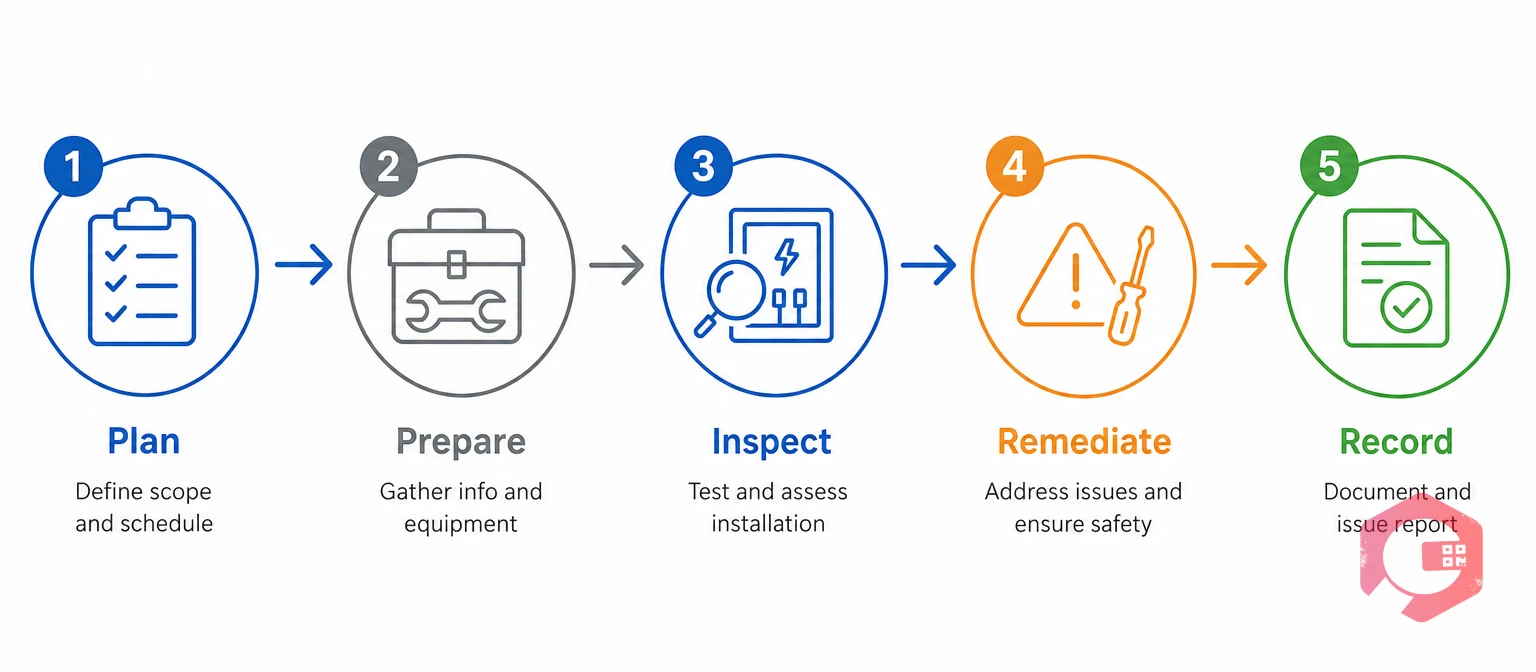
EICR compliance works best as a repeating process rather than a one-off event. These five stages turn each inspection into tracked, closed work.
The Five-Stage EICR Compliance Process:
The most common mistake is stopping at Inspect. A report full of C2 codes sitting in an inbox is not compliance. It is proof that you knew about the danger.
Most electrical faults develop slowly over the years between EICRs. Routine maintenance catches them early and makes the next inspection quicker and cheaper.
Turn each check into a mobile form with maintenance checklists so that results, photos and signatures are captured on the spot.
New machines, extra circuits and moved equipment all change the installation. Each change should come with its own certificate, and the circuit charts should be updated the same week.
Unrecorded changes are one of the biggest causes of C2 and FI codes on industrial EICRs. A simple change log closes that gap.
Load every EICR observation into your preventive maintenance software or work order system. Give C1 and C2 items the highest priority, and do not mark them closed until a certificate is attached.
Use the safety compliance checklist to review your wider electrical safety controls once a year.
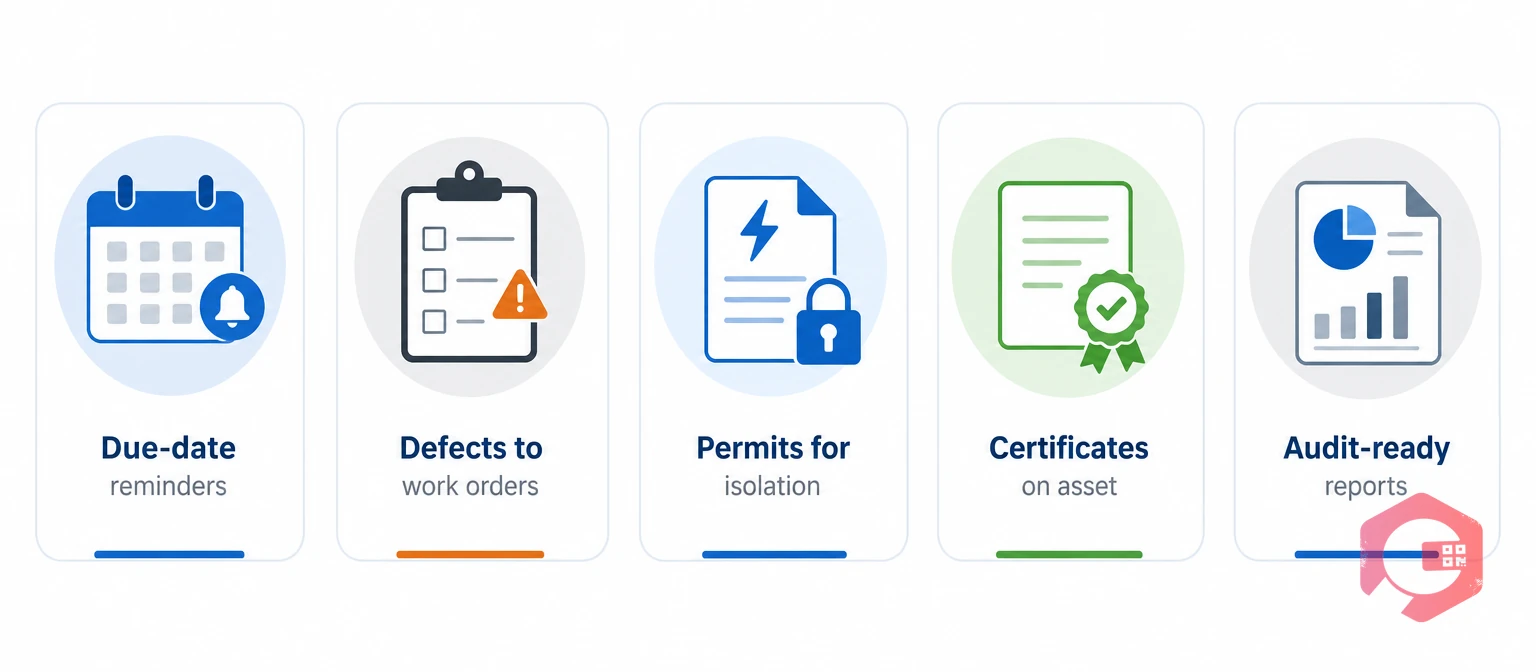
A Computerized Maintenance Management System (CMMS) keeps EICR due dates, defects and certificates in one place. It does not replace a qualified inspector, but it makes sure nothing between inspections is forgotten.
Maintenance teams using Cryotos have reported up to 30% reduction in unplanned downtime and 25% faster repair turnaround. On an industrial site, that also means fewer rushed repairs and fewer defects left open between inspections. The same records support a wider ISO 55000 asset management approach.
IET guidance recommends a maximum interval of three years for industrial premises. The inspector may set a shorter date based on condition, and insurers or leases may require one too. Always follow the shortest interval that applies.
No law names the EICR directly for these premises. However, the Electricity at Work Regulations 1989 require systems to be maintained to prevent danger, and an EICR is the accepted way to show you have done that.
Any C1, C2 or FI code makes the overall result unsatisfactory. The site needs remedial work, recorded on the right certificate, before the installation can be treated as safe.
A small unit may take a few hours, while a large factory can take several days. Sampling, access, shutdown windows and the number of distribution boards all affect the time.
No. An EICR covers the fixed installation only. Portable appliances need their own in-service inspection and testing regime.
An overdue report does not mean the site is unsafe, but you lose your main evidence of compliance. Book the inspection straight away, tell your insurer if your policy requires it and keep up routine checks until the new report arrives.
Partly. Visual checks and some live tests can run during production, but dead tests need circuits switched off. Plan these for shutdowns, weekends or shift changes, and agree the order of work with each area supervisor.
A competent, qualified electrical inspector should carry out the EICR. Many duty holders choose contractors registered with a recognized scheme such as NICEIC or NAPIT, with experience of industrial installations.
An EICR protects your people only when every defect is closed and every change is recorded. Schedule a free demo to see how Cryotos tracks EICR due dates, turns observations into work orders and keeps every certificate audit-ready.

Cryotos AI predicts failures, automates work orders, and simplifies maintenance—before problems slow you down.



