
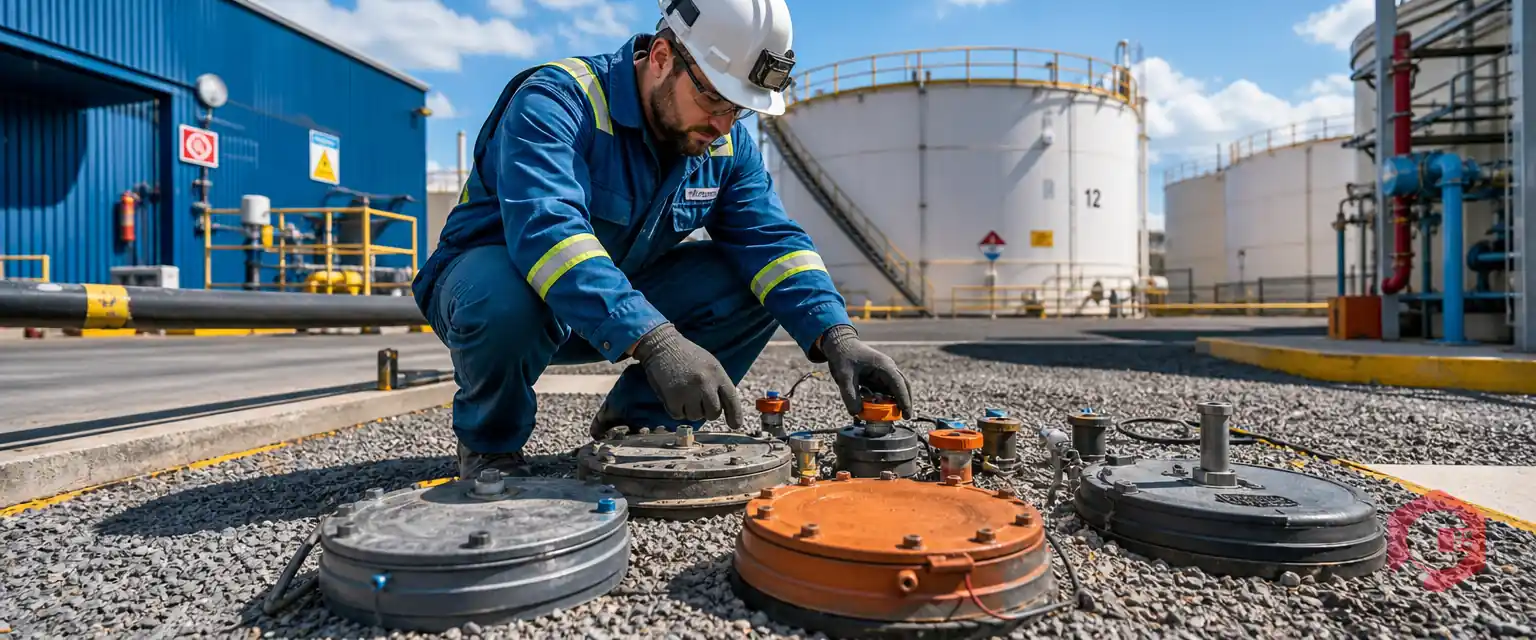
An underground storage tank inspection is a scheduled check that confirms a UST system is intact, monitored, and not leaking. Federal EPA rules set the pace. Owners walk through tank systems every 30 days. They check sumps every year. They test spill and overfill gear every three years.
Done well, these checks catch cracked spill buckets and ignored alarms before fuel reaches the soil. Below, you'll find the federal rules, a full schedule, a leak prevention framework, and field tips for your next walkthrough.
Key Takeaways

An underground storage tank inspection is a structured review of every part of a UST system that could fail and release product. It covers the tank, the piping, the equipment at the fill port, and the monitoring tools that warn you when something goes wrong.
A UST system is a tank plus connected underground piping with 10% or more of its volume below ground. Most systems hold gasoline, diesel, or used oil at fuel stations, fleet yards, plants, hospitals, and airports.
Each underground storage tank inspection falls into one of two groups. Your own trained staff run the routine checks. A certified technician runs the periodic tests. You need both, since each one catches what the other misses.
Federal underground storage tank inspection rules live in 40 CFR Part 280. EPA revised them in 2015. The new upkeep duties took full effect on October 13, 2018. The EPA Underground Storage Tanks program publishes the rule text, state program links, and compliance guides.
States with approved programs can set stricter rules, and many do. Under the Energy Policy Act of 2005, the implementing agency must also send an inspector to each regulated facility at least once every three years.
Many maintenance teams also follow PEI RP900, the industry's recommended practice for UST upkeep. They pair it with NFPA 30 rules for flammable liquids. The federal rule sets the floor. These standards fill in the detail.
Want a ready-made starting point? Use our regulatory compliance checklist to map each federal and state requirement to an owner and a due date.
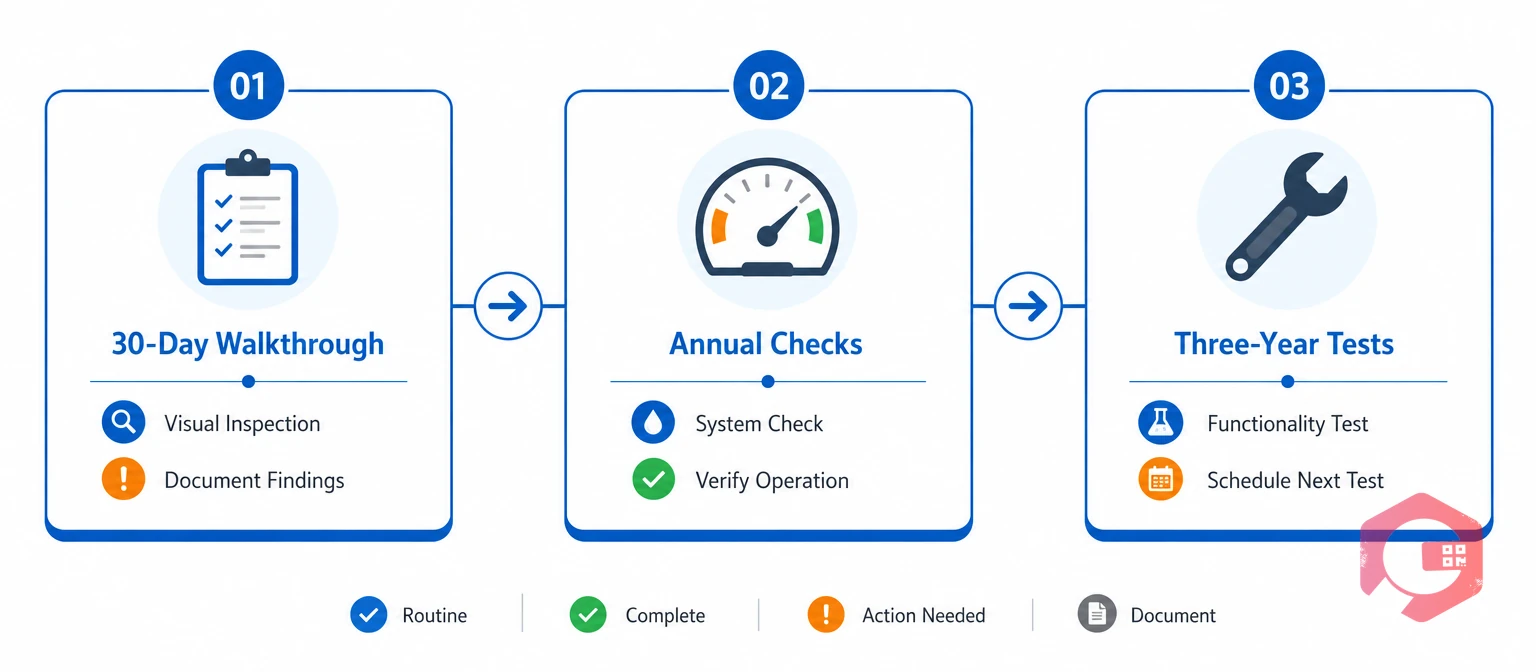
A complete underground storage tank inspection schedule puts 30-day, annual, and three-year tasks on one calendar. The table shows the federal baseline for each part. It also lists the usual owner of each task and the record to keep.
| Component | Inspection or Test | Frequency | Typically Performed By | Record to Keep |
|---|---|---|---|---|
| Spill buckets | Visual check for damage; remove liquid and debris | Every 30 days (or before each delivery if deliveries are less frequent) | Class B or Class C operator | Walkthrough log |
| Release detection equipment | Confirm it is running with no alarms; review monitoring records | Every 30 days | Class B operator | Walkthrough log |
| Containment sumps | Visual check for damage, leaks, liquid, and debris | Annually | Class B operator | Walkthrough log |
| Hand-held detection tools | Check gauge sticks and bailers for damage and readability | Annually | Class B operator | Walkthrough log |
| ATG, probes, sensors, line leak detectors | Operability test | Annually | Certified technician | Test report |
| Spill buckets | Hydrostatic or vacuum tightness test | Every 3 years | Certified tester | Test report |
| Overfill prevention equipment | Inspection for proper operation and shutoff level | Every 3 years | Certified tester | Inspection report |
| Sumps used for piping interstitial monitoring | Tightness test | Every 3 years | Certified tester | Test report |
| Cathodic protection | Corrosion protection survey | Within 6 months of install, then every 3 years | Qualified cathodic protection tester | Test report |
| Impressed current rectifier | Confirm the system is running | Every 60 days | Class B operator | Rectifier log |
Double-walled spill buckets and sumps with periodic interstitial monitoring can use that monitoring in place of the three-year tightness test. As a general rule, keep walkthrough logs for at least one year and test reports for at least three years, then confirm your state's retention rules.
Treat this table as the federal minimum, and add any extra state items before you build your calendar.
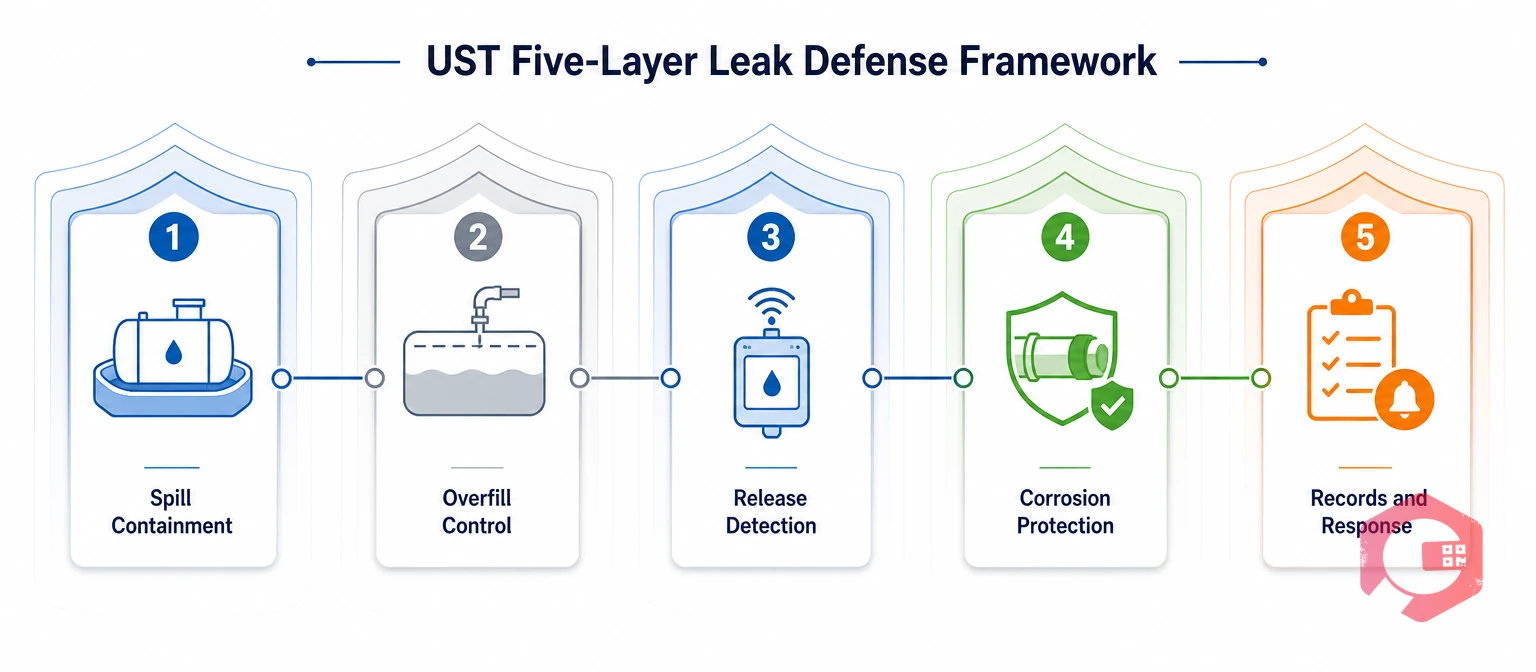
Underground storage tank inspections prevent leaks by finding failures where releases begin. That means the fill port, the overfill device, pipe joints, and rusting metal. EPA has recorded more than half a million confirmed UST releases since the late 1980s. Many started with small, fixable problems.
The NEIWPCC UST inspection and release prevention program trains state inspectors on the same idea: stop the release before it starts. Maintenance teams can organize that work into five layers.
The UST Five-Layer Leak Defense Framework:
Each layer backs up the others. If a spill bucket cracks, release detection should flag it; if a sensor fails, the walkthrough should catch the dead sensor before a leak goes unnoticed.
A leak usually gets through only when two or more layers fail at once, so inspecting all five keeps the odds of a release low.
The best underground storage tank inspection programs make every check routine and hard to skip. Most facilities that pass state visits do the same few things, month after month.
Walk the site in the same order every time. Start at the fill ports, then check tank-top sumps, dispenser sumps, and the gauge console. A fixed route means nobody forgets the remote fill port or the generator tank at the far end of the yard.
Remove water, fuel, and debris after every check, and look for cracks, loose drain valves, and worn gaskets. EPA's guide to inspecting and maintaining sumps and spill buckets includes photos of common defects and a printable checklist.
A common mistake is silencing an automatic tank gauge alarm and moving on. Instead, open a ticket through your work order management process for every alarm, record the cause, and close it only after you confirm the fix.
Three-year tests are easy to forget. Set reminders 60 to 90 days ahead in your preventive maintenance software. That gives you time to book a tester and fix any failures.
Operator training is a federal requirement that each UST facility designate trained Class A, B, and C operators. Keep training certificates on file and retrain whenever staff change.
Sumps and tank pits can hold fuel vapors and low oxygen. Follow OSHA confined space rules before anyone enters. Cut pump power with lockout tagout. Control sump entry and hot work through permit-to-work software, so every job has a signed permit.
Consistent routes, fast alarm response, and early test scheduling do more for compliance than any single piece of equipment.
Most violations found during an underground storage tank inspection come from missed paperwork, not broken equipment. State inspectors find the same few problems at site after site.
A safety compliance checklist reviewed each quarter catches most of these gaps before an inspector does.
Fix the records first. Good records prove the work was done, and they make every audit shorter and calmer.
A Computerized Maintenance Management System keeps underground storage tank inspections on schedule. It turns each rule into a repeating task with an owner, a due date, and a record. Paper logs fail when one person goes on leave or a binder goes missing.
A digital UST compliance program is a CMMS setup that schedules, records, and stores every tank inspection in one place. It gives auditors one trail instead of a box of paper.
Maintenance teams using Cryotos have reported up to 30% reduction in unplanned downtime and 25% faster repair turnaround. For UST sites, that means faster fixes after failed tests and fewer days with a dispenser or generator tank out of service.
When every check runs on a schedule and every record sits in one place, compliance stops depending on memory.
Federal rules require a walkthrough inspection every 30 days and an annual check of containment sumps and hand-held monitoring tools. Release detection equipment needs an operability test every year, and spill, overfill, and certain sump equipment need testing every three years. Your state may add more frequent checks.
Trained Class A or Class B operators usually perform walkthrough inspections, and many states let trained Class C staff handle spill bucket checks. Three-year tests and annual operability tests generally require a certified tester or qualified technician. Check your state program for exact certification rules.
You must repair or replace the failed equipment and then retest it to confirm it is liquid-tight. If the failure may have released product, investigate and report it to your implementing agency within 24 hours or the period your state sets. Keep the failed and passing test records on file.
Under the federal rule, keep walkthrough records for at least one year and most test and inspection reports for at least three years. Some records, such as certain cathodic protection results, follow their own rules. Confirm your state's retention periods, since many states require longer.
Yes, many states with approved programs have stricter requirements, such as more frequent testing, extra inspection items, or longer record retention. Federal rules set the minimum, not the maximum. Always build your inspection schedule from your state program's rules.
A missed walkthrough or an expired test can turn a routine inspection into a costly violation or a cleanup. Schedule a free demo to see how Cryotos automates every underground storage tank inspection, from 30-day walkthroughs to three-year tests, with audit-ready records for each site.


Cryotos AI predicts failures, automates work orders, and simplifies maintenance—before problems slow you down.



