

Economic Order Quantity (EOQ) for spare parts is a formula that calculates the ideal order quantity that minimises total inventory costs — balancing ordering frequency against holding costs. For maintenance teams managing spare parts, applying EOQ inside a spare parts inventory software system reduces over-ordering, prevents stockouts, and cuts unnecessary warehousing costs. According to the International Data Corporation, manufacturers spend 10–20% of total maintenance budgets on inventory carrying costs — EOQ directly targets that figure.
This guide covers the EOQ formula in full, a worked example using realistic maintenance numbers, how to apply it step by step inside your CMMS, and where EOQ has limits so you know when a different approach fits better.

EOQ stands for Economic Order Quantity. It is an inventory management formula that finds the order size that produces the lowest total cost — accounting for both the cost of placing orders and the cost of holding stock. First developed by Ford W. Harris in 1913, EOQ remains one of the most practical tools in MRO inventory management because it is mathematically grounded, easy to explain to stakeholders, and directly actionable inside any CMMS with an inventory module.
In spare parts management, the core tension EOQ solves is this: ordering small quantities frequently drives up purchasing and handling costs; ordering large quantities infrequently drives up holding, storage, and obsolescence costs. EOQ finds the point where both cost curves intersect at the minimum. That intersection tells your maintenance planner exactly how many units to order each time, so the total annual cost of managing that part stays as low as possible.
EOQ is most effective for parts with predictable, steady demand — consumables like bearings, belts, filters, seals, and fasteners. It works less well for critical insurance spares or low-usage parts with erratic demand, which we address in the limitations section below.
The EOQ formula is:
EOQ = √ (2DS / H)
Where:
Getting accurate inputs is more important than understanding the math. Here is how each variable typically looks in a maintenance context.
Annual demand (D) comes directly from your CMMS work order history. Pull the consumption data for the part across the last 12 months. For a bearing that gets replaced 24 times per year across four identical pumps, D = 24. If your CMMS tracks parts consumption per asset, this number is already available in your inventory management reports.
Ordering cost (S) includes staff time to raise a purchase order, supplier processing fees, delivery charges, and receiving labour. A typical industrial operation spends $20–$80 per purchase order depending on procurement complexity. If you use a blanket purchase order arrangement with a supplier, S drops significantly — which raises the EOQ and makes larger, less frequent orders optimal.
Holding cost (H) is the annual cost to keep one unit in stock. It includes storage space allocation, insurance, the opportunity cost of capital tied up in stock, and obsolescence risk. Holding cost is typically expressed as a percentage of unit value — commonly 20–30% per year for industrial spare parts. If a bearing costs $50 and your holding cost rate is 25%, H = $12.50 per bearing per year.
A maintenance team at a food processing facility manages V-belt replacements across 12 conveyor lines. Here are the inputs:
Applying the formula:
EOQ = √ (2 × 120 × 45 / 4.50) = √ (10,800 / 4.50) = √ 2,400 = 49 belts
The team should order 49 belts per order. At 120 belts per year, that works out to approximately 2.4 orders per year — roughly one order every five months. Before applying EOQ, they were ordering 20 belts at a time (6 orders per year), which was driving unnecessary ordering costs. After switching to EOQ-based ordering and setting the reorder quantity to 49 in their CMMS, they reduced annual ordering cost from $270 to $108 while holding cost stayed nearly the same.
EOQ answers "how much to order." Two related concepts — reorder point (ROP) and safety stock — answer "when to order" and "how much buffer to keep." All three work together in a complete spare parts inventory policy, but they serve different purposes. The table below clarifies which tool does what.
| Concept | Question It Answers | Formula / Rule | Best Used For |
|---|---|---|---|
| EOQ | How much to order each time | √(2DS/H) | High-usage consumable parts with predictable demand |
| Reorder Point (ROP) | When to trigger a new order | Average daily demand × lead time + safety stock | Any stocked part with a measurable lead time |
| Safety Stock | How much buffer to hold against demand spikes and supply delays | Z × σ_d × √(lead time) | Critical parts where stockouts cause significant downtime cost |
| Min-Max Policy | When to order and how much in simpler systems | Order up to Max when stock hits Min | Low-volume, infrequently used parts in smaller operations |
In practice, your CMMS will use all three in combination. EOQ sets the order quantity. ROP triggers the order automatically when stock drops to the right level. Safety stock is added on top of ROP for critical parts where the cost of a stockout — measured in downtime tracking data — exceeds the cost of carrying extra stock.
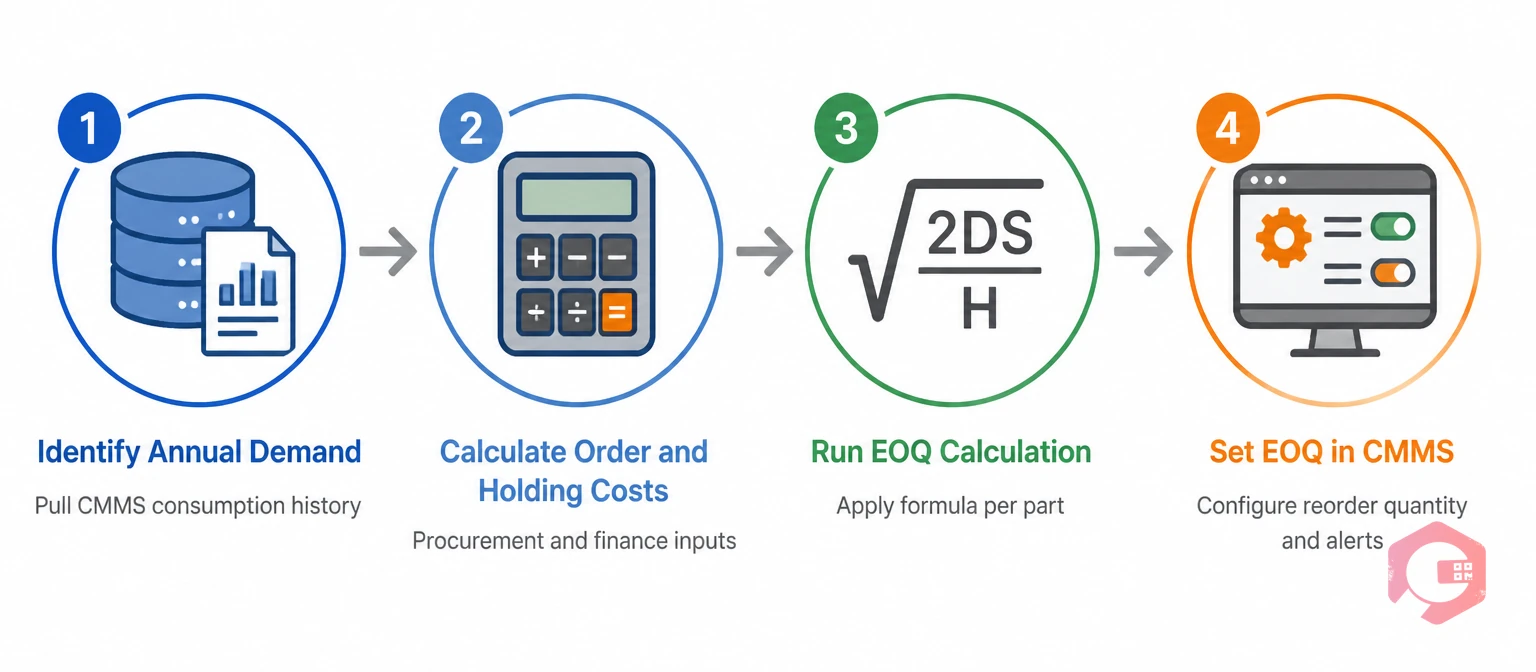
Calculating EOQ on paper is the easy part. The real value comes from encoding EOQ into your CMMS so the system enforces optimal ordering automatically — without your team needing to manually check stock levels or remember reorder quantities. Here is the four-step process.
In your CMMS, run a parts consumption report filtered to the last 12 months. For each high-usage part, record the total units consumed. Parts that appear in fewer than six work orders per year are likely candidates for min-max management rather than EOQ — the calculation is most valuable for parts consumed 20 or more times annually. Cryotos's report builder generates parts consumption reports by asset, location, or time period, giving you the demand data you need without manual spreadsheet work.
Work with your procurement and finance teams to establish your ordering cost per purchase order and your holding cost rate. If you do not have this data, use these starting estimates: $40–$60 per order for a standard industrial operation; 20–25% of unit value per year for holding cost. Record both figures. Even approximate values produce EOQ calculations that are significantly better than arbitrary order quantities.
Apply the formula for each target part. A spreadsheet with the formula =SQRT(2*D*S/H) speeds this up. Prioritise parts where you currently order very frequently (high ordering cost exposure) or very infrequently in large quantities (high holding cost exposure) — those are where EOQ will produce the biggest cost savings. For a 200-part inventory, focus first on the top 20% of parts by annual spend — ABC analysis helps identify which parts those are.
With your EOQ calculated, enter the value as the reorder quantity for each part in your CMMS inventory module. Set the reorder point (ROP) based on lead time and average demand. In Cryotos, the spare parts inventory software supports minimum threshold alerts that trigger automatically when stock hits the ROP level — the system creates a work request or purchase requisition at the EOQ quantity without any manual intervention. This closes the loop between the calculation and the actual purchasing behaviour, which is where most teams lose the benefit: they calculate EOQ once but still order arbitrary quantities because the CMMS is not configured to enforce it.
EOQ is a powerful tool, but it rests on assumptions that do not hold for every part in a maintenance storeroom. Knowing where it breaks down prevents costly mistakes.

When applied correctly, EOQ produces measurable improvements across several dimensions of maintenance operations.
EOQ in maintenance management is the order quantity that minimises the total annual cost of purchasing and holding a spare part. It balances the cost of placing frequent small orders against the cost of storing large quantities infrequently, using the formula EOQ = √(2DS/H), where D is annual demand, S is ordering cost per order, and H is annual holding cost per unit.
To calculate EOQ for a spare part, you need three inputs: annual demand (units consumed per year from CMMS history), ordering cost per purchase order (admin, freight, and processing costs), and annual holding cost per unit (typically 20–25% of unit cost per year). Apply the formula EOQ = √(2DS/H). A bearing consumed 60 times per year with a $50 order cost and $5 annual holding cost gives an EOQ of √(2 × 60 × 50 / 5) = √1,200 = 35 units.
EOQ tells you how much to order each time. Reorder point (ROP) tells you when to place the order — specifically, when stock drops to the level where a new order must be placed to avoid running out before the next delivery arrives. ROP = (average daily demand × supplier lead time) + safety stock. EOQ and ROP are complementary: you use ROP to trigger the order and EOQ to set the order size.
EOQ works best for spare parts with consistent, predictable annual demand — consumables like belts, bearings, seals, and filters. It is less suitable for critical insurance spares held against rare failure events, parts with erratic demand patterns, or parts where the cost of a stockout significantly exceeds any holding cost savings. For those parts, safety stock calculations and criticality-based stocking policies are more appropriate.
A CMMS supports EOQ implementation by providing the demand data (parts consumption history per work order), hosting the inventory module where EOQ quantities and reorder points are stored, and triggering automatic alerts or purchase requisitions when stock hits the reorder point at the EOQ quantity. This automation means the optimal order quantity is enforced in every purchasing decision without relying on manual review.
Applying EOQ to your spare parts inventory is one of the highest-return, lowest-effort improvements a maintenance team can make to inventory management — and a CMMS makes it automatic once the calculation is done. Cryotos CMMS combines spare parts inventory management with automatic minimum-threshold alerts, parts consumption reporting, and LIFO/FIFO/Average Cost valuation — giving your team everything needed to implement and enforce EOQ-based ordering across your full storeroom. Book a free demo today and see how Cryotos can help you cut inventory carrying costs while keeping the right parts available when your team needs them.




Cryotos AI predicts failures, automates work orders, and simplifies maintenance—before problems slow you down.



