Erosion-corrosion is the loss of pipe wall caused by flowing fluid and corrosion working together. Mechanical wear strips the protective surface, and corrosion then attacks the bare metal. The result is faster thinning than either process would cause alone.
In power plants, thinning pipe can lead to leaks, forced outages, and in the worst cases sudden rupture. This guide explains how erosion-corrosion damages power plant piping, where it strikes, how to find it early, and how to prevent it. It also shows how a computerized maintenance management system (CMMS) keeps the inspection program on schedule.
Key Takeaways

Erosion-corrosion is accelerated metal loss where mechanical erosion and electrochemical corrosion act together. Fluid or entrained particles strike or scrub the pipe wall. That removes the thin oxide film that normally protects the metal.
With the film gone, fresh metal corrodes and a new film forms. The flow then removes it again. This cycle repeats and the wall gets thinner.
Power plant teams often talk about flow-accelerated corrosion (FAC) alongside erosion-corrosion. They are related, but the mechanisms differ. Both thin the pipe wall, and both are tracked with thickness inspections.
| Attribute | Erosion-Corrosion | Flow-Accelerated Corrosion (FAC) |
|---|---|---|
| Main cause | Mechanical wear from fluid, droplets, or solids, combined with corrosion | Flowing water or wet steam dissolves the protective oxide layer on carbon steel |
| Role of flow | Impact and shear remove the surface layer | Flow carries dissolved iron away from the surface |
| Typical surface look | Directional grooves, gullies, or horseshoe-shaped pits | Smooth, scalloped, or orange-peel texture |
| Common locations | Bends, pump parts, valves, and lines carrying solids or wet steam | Feedwater, condensate, heater drain, and wet steam lines |
| Main controls | Lower velocity, better geometry, harder or more resistant alloys | Water chemistry control and chromium-bearing steels |
Many plants manage both under one inspection program. Knowing which mechanism applies tells you which control to use.

Damage concentrates where flow is fast, turbulent, or changes direction. Common problem areas include:
Several conditions set how fast the wall thins:
Erosion-corrosion affects safety, availability, and cost:
Investigators of the 2004 Mihama accident in Japan found that the failed pipe section had been left off the inspection program. The lesson is simple: a location you do not inspect cannot be trusted.
You cannot see wall loss from outside, so detection depends on measurement. Common methods include:
One reading tells you the thickness. Two readings tell you the wear rate. Remaining life equals measured thickness minus minimum required thickness, divided by wear rate. Your engineers set the minimum required thickness from the design code and operating conditions.
Illustrative example: a pipe starts at 12.0 mm. After 6 years it measures 8.4 mm, so it lost 3.6 mm, or 0.6 mm per year. With a minimum of 6.0 mm, the remaining margin is 2.4 mm. That gives about 4 years of life, so replacement should be planned well before then.
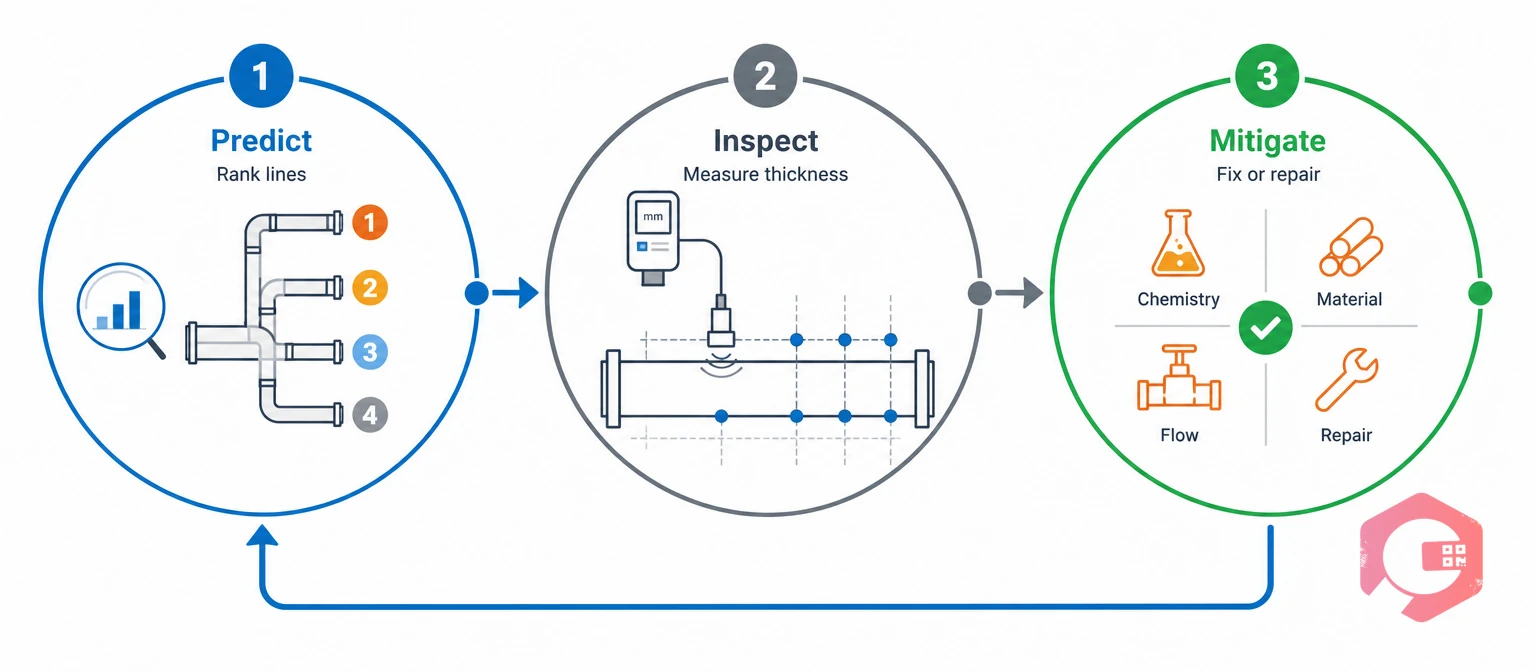
The Predict-Inspect-Mitigate Method is a three-step loop for managing wall thinning. Each pass makes the next one better:
Feed each round of readings back into the ranking. Locations that wear faster than predicted move up the list.
Once you know where and how fast wall loss is happening, you can act on the cause:
Any change to chemistry, material, or repair method should follow your plant's engineering procedures.
Use this table as a starting point. Set the timing from your plant's risk ranking, past results, and engineering guidance.
| Activity | Typical Timing | Done By | Record to Keep |
|---|---|---|---|
| Leak and condition walkdown | Daily or each shift | Operator or technician | Walkdown checklist |
| Water chemistry review | Daily to weekly, per plant program | Chemistry team | Chemistry log and trends |
| Thickness measurements on baseline grids | Each planned outage, or as the risk ranking sets | Inspection technician | Grid readings and wear rate |
| Remaining-life and risk review | After each inspection round | Integrity engineer | Updated inspection plan |
| Repair or replacement | When thickness nears the set limit | Maintenance team | Work order and weld records |
The timing of each activity should tighten for fast-wearing locations and relax for stable ones.
Most failures follow gaps in the program, not surprises in the metal. Teams that avoid these habits catch damage sooner:
These habits are cheap to fix and prevent the most expensive failures.
Your integrity engineers or specialist software calculate wear rates and remaining life. Cryotos makes sure the inspections happen on time and every result is on record:
Maintenance teams using Cryotos have reported up to 30% reduction in unplanned downtime and 25% faster repair turnaround. These are general results across maintenance programs, not figures for erosion-corrosion alone. For piping integrity, the practical gain is a complete, current record for every monitored location. See how this fits a plant in our power plant maintenance software overview.
It is wall loss caused by flowing fluid and corrosion acting together. Flow strips the protective oxide film, and corrosion then attacks the exposed metal, so the pipe thins faster than it would from either cause alone.
Erosion-corrosion involves mechanical wear from fluid, droplets, or solids. FAC happens when flowing water or wet steam dissolves the protective oxide layer on carbon steel. Both thin the pipe wall, but they respond to different controls.
Elbows, tees, reducers, and the flow downstream of valves and orifices. Feedwater, condensate, heater drain, and wet steam lines are also common problem areas.
Most plants use ultrasonic thickness testing on fixed grids and repeat it at the same points. Radiography and laser scanning are also used where access and conditions suit.
It depends on the risk ranking and the measured wear rate. Many plants inspect susceptible locations during planned outages and shorten the interval where wear is fast.
Control water chemistry, use chromium-bearing steel at susceptible locations, improve flow design, and keep droplets and solids out of sensitive lines. Replace pipe on a set thickness limit instead of waiting for leaks.
Wall thinning gives warnings if you measure it and act on the numbers. Schedule a free demo to see how Cryotos schedules piping inspections, captures readings in the field, and keeps every result on record.

Cryotos AI predicts failures, automates work orders, and simplifies maintenance—before problems slow you down.