

A fire suppression system certificate quietly lapses on a Tuesday. No alert fires. No task gets created. The facility manager is buried in work orders, and the spreadsheet tab hasn’t been opened in three weeks. Then comes the audit — and with it, an immediate stop-work order, a five-figure fine, and an insurance claim rejection.
This scenario plays out across facilities of every size, in every industry. Not because facility managers are negligent — but because the tools they use weren’t built for the complexity of modern compliance. Tracking expiry dates for facility certifications, equipment warranties, and mandatory safety checks is not a simple calendar problem. It is a living, multi-layered operational discipline that demands automation, accountability, and audit-readiness.
This guide breaks down exactly what needs to be tracked, why manual systems fail, and how a CMMS like Cryotos eliminates compliance risk through intelligent expiry tracking from day one.
Every facility operates under a web of legal, regulatory, and contractual obligations that carry real expiry dates. A missed renewal is not just an administrative inconvenience — it is a direct liability exposure.
The consequences of expired facility certifications range from financial penalties to complete operational shutdowns. OSHA violations in the United States carry penalties of up to $15,625 per violation per day. In the UK, a failure to maintain valid fire safety certification can result in unlimited fines and criminal prosecution under the Regulatory Reform (Fire Safety) Order 2005. In Singapore, expired pressure vessel inspection certificates can trigger immediate facility closure under the Workplace Safety and Health Act.
Beyond regulatory fines, lapsed certifications have downstream effects that compound quickly. Insurance providers routinely reject claims when they discover expired safety certifications at the time of incident. Equipment under lapsed warranty loses OEM repair support, shifting full repair costs to the facility budget. Contractors and vendors are increasingly requiring proof of current certification before commencing work — a lapsed document can delay a critical project by weeks.
The financial exposure is measurable. A 2023 industry report from the British Institute of Facilities Management found that compliance-related incidents cost UK facilities an average of £47,000 per event when insurance, legal, and operational losses were combined. That figure rises sharply for healthcare, food processing, and high-risk industrial environments.
Before building any tracking system, it helps to categorise what actually needs to be monitored. Most facilities deal with three distinct types of expiry-sensitive records, each with different renewal cadences, responsible parties, and documentation requirements.
Understanding these distinctions is the first step toward building a tracking framework that does not collapse under its own complexity.
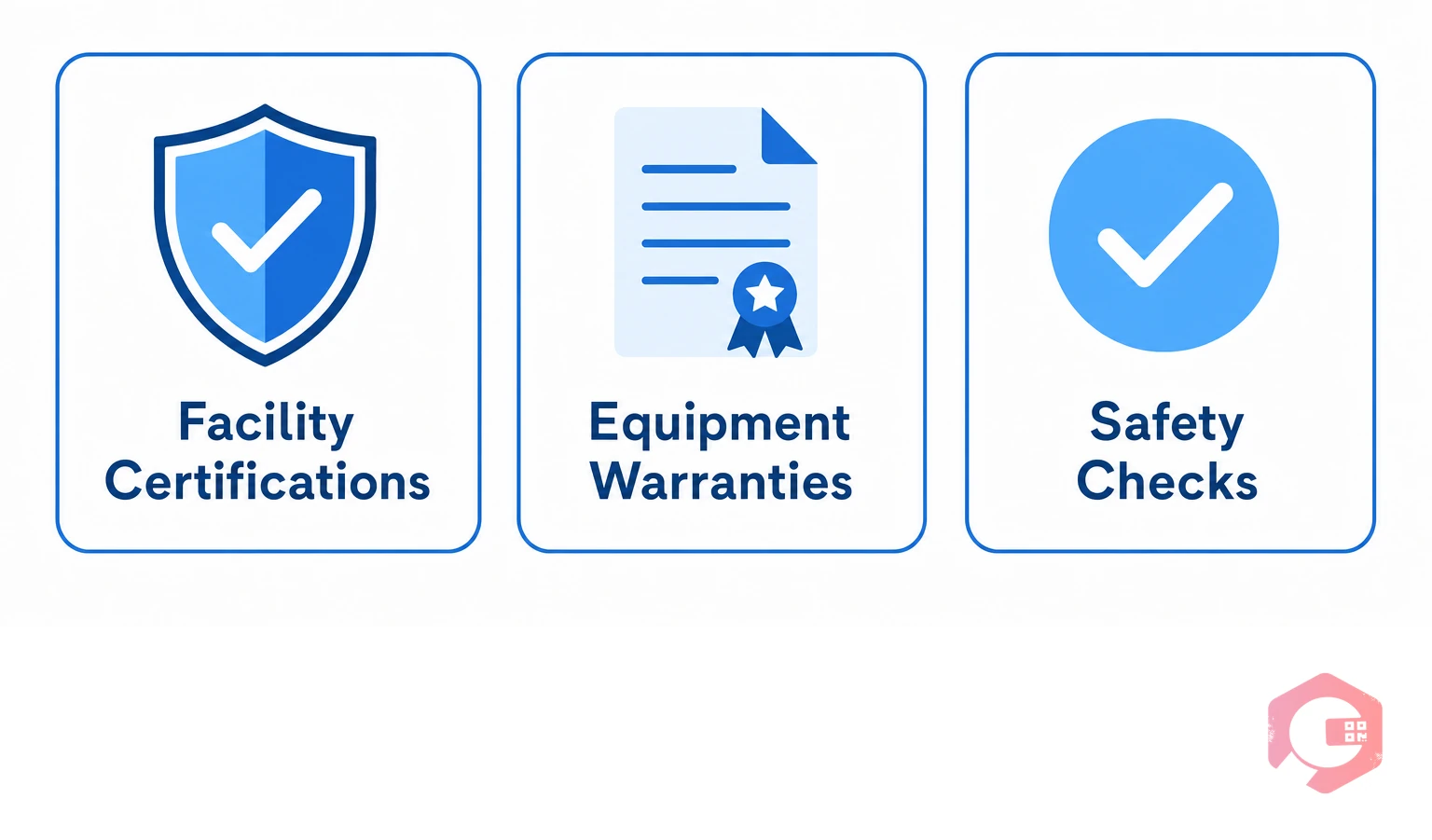
Facility certifications are legal or regulatory documents that confirm a building, system, or process meets a defined safety or quality standard. These include fire safety certificates, electrical installation condition reports (EICRs), lift and escalator inspection certificates, pressure vessel and boiler certifications, ISO 9001 and ISO 45001 compliance audits, food safety and hygiene certifications, and environmental permits.
Most of these follow annual or biennial renewal cycles, though some — like pressure vessel inspections — may be quarterly. The critical characteristic of facility certifications is that their expiry typically triggers a legal obligation to renew or cease operations. There is no grey area. A facility either holds a valid certificate or it does not.
Equipment warranties govern the financial and service obligations between a facility and its equipment OEMs or third-party service providers. Warranties come in several forms: standard manufacturer warranties (typically one to three years), extended service agreements purchased at acquisition, and third-party maintenance contracts that carry their own validity windows.
Tracking warranty expiry is a financial discipline as much as an operational one. When an asset’s warranty lapses unnoticed and a failure occurs, the repair cost falls entirely on the facility budget — costs that could have been zero under an active warranty claim. More importantly, warranty claims require proof of regular maintenance and adherence to OEM service schedules. A CMMS that tracks both warranty expiry and maintenance history creates the documentation chain needed to defend a claim.
Safety checks are recurring inspections or tests mandated by regulation, OEM guidance, or internal policy. These include portable appliance testing (PAT), emergency lighting tests, sprinkler system inspections, eyewash station verifications, gas leak checks, fall protection equipment inspections, and contractor qualification renewals.
Unlike certifications — which are typically issued by a third-party authority — safety checks are often performed by internal maintenance teams. This makes scheduling, documentation, and evidence capture a core CMMS function. The check must be done, recorded, and retrievable on demand during any regulatory audit.
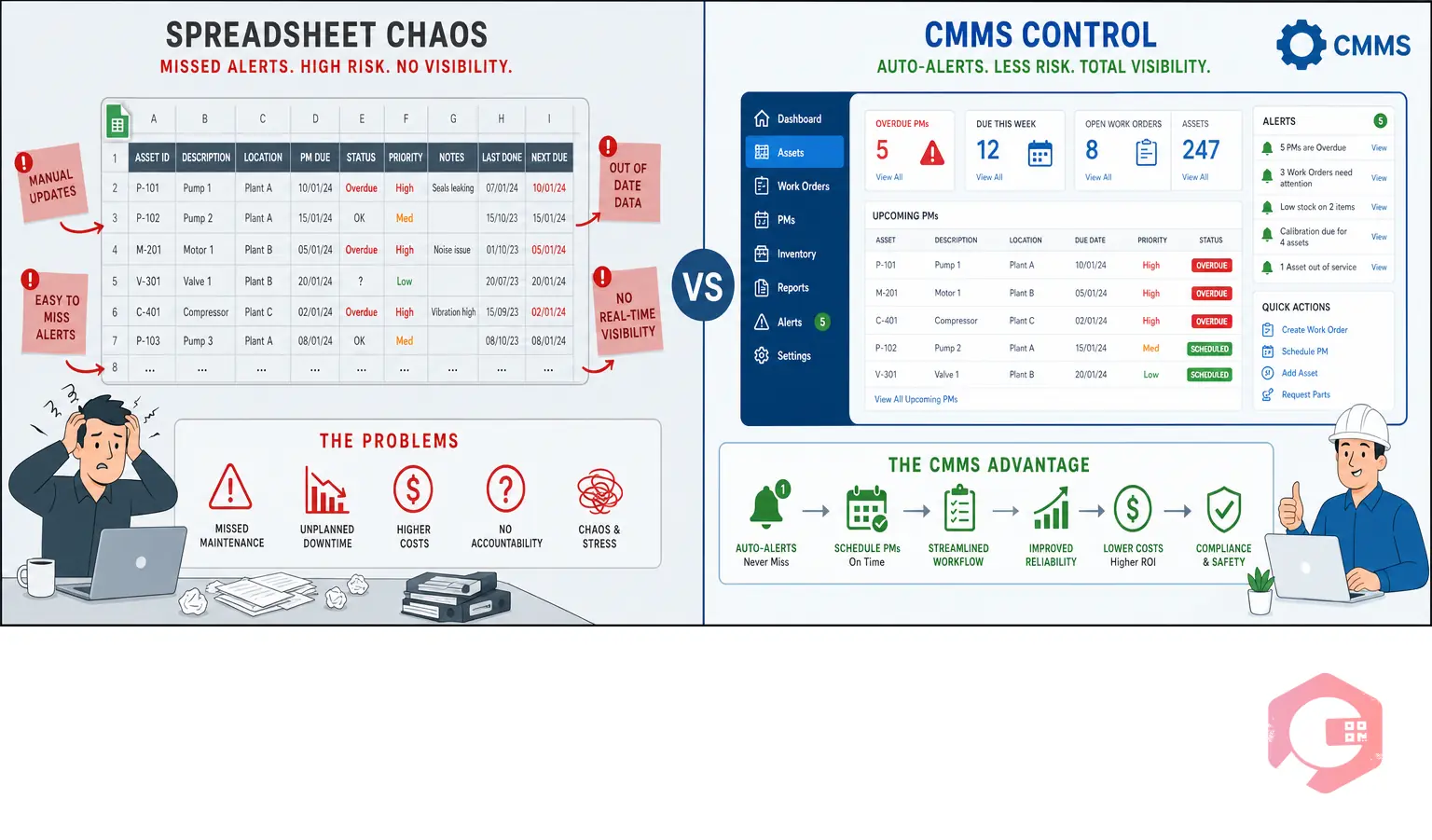
Most facilities start with spreadsheets. A shared Excel file with columns for asset name, certification type, expiry date, and responsible person seems reasonable — until the facility grows, the team turns over, or the spreadsheet forks into three versions saved on different desktops.
Spreadsheets are passive. They do not alert anyone when a date approaches. They rely entirely on someone opening the file, sorting by date, and acting on what they see. In a busy facility with hundreds of assets and dozens of certifications, this manual review cadence fails consistently. A study by EY found that 88% of large spreadsheets contain at least one material error — and in compliance-critical contexts, a single wrong date can mean the difference between a valid certificate and a lapsed one.
Beyond accuracy, there is the access problem. Spreadsheets stored on shared drives are edited by multiple people with no change history, no approval workflow, and no audit trail. When an auditor asks who updated the fire certificate date and when, the honest answer is often: nobody knows.
Regulators and insurers do not just want to see that a certificate exists — they want to see the chain of custody. Who scheduled the inspection? Who performed it? Who signed off? When was the record updated? A spreadsheet cannot answer any of these questions. A CMMS can answer all of them, automatically.
The transition from spreadsheet to CMMS is not just a technology upgrade. It is a shift from reactive compliance — where someone scrambles to find documents when an auditor arrives — to proactive compliance, where every record is current, every renewal is pre-scheduled, and every audit is a formality rather than a fire drill.
A modern CMMS approaches expiry tracking as a structured data problem, not a calendar problem. Every certification, warranty, and safety check is linked to an asset record, assigned an expiry date, and connected to an automated workflow that handles the renewal cycle without human prompting.
The foundation of any CMMS expiry tracking system is a unified asset register where every piece of equipment, every facility system, and every compliance document lives in one place. Each asset record holds its own certification history — current status, expiry dates, last inspection dates, responsible parties, and document attachments.
This centralisation eliminates the version-control problem entirely. There is one record, one source of truth, and every update is timestamped and attributed. When a new certification is issued, the record is updated, the old document is archived, and the renewal cycle restarts automatically.
CMMS platforms like Cryotos allow facility managers to configure multi-tier alert rules for every expiry type. A typical configuration might send an initial notification to the responsible technician 60 days before expiry, escalate to the department supervisor at 30 days, and flag to senior management at 7 days if no action has been recorded. If the expiry date passes without a renewal record, the asset is automatically flagged as non-compliant in the system dashboard.
This escalation logic removes the dependence on any individual remembering to check a spreadsheet. The system drives the renewal process, assigns the task, and tracks completion. Human judgment is applied where it matters — in choosing the right service provider, reviewing the certificate, and approving the record — not in remembering that a deadline exists.
For organisations managing multiple facilities — whether a hospital network, a manufacturing group, or a retail chain — expiry tracking across locations creates exponential complexity that no spreadsheet can manage. A CMMS aggregates compliance status across all sites into a single dashboard, giving compliance managers a real-time view of which locations are fully certified, which have items approaching expiry, and which require immediate action.
Contractor and vendor qualification tracking adds another dimension. Before a contractor can work on site, their insurance certificates, trade licences, and safety inductions must all be current. A CMMS can hold contractor profiles with the same expiry-tracking logic applied to assets — flagging contractors as ineligible for work orders when their qualifications lapse, and automatically re-enabling them once renewed documents are uploaded.
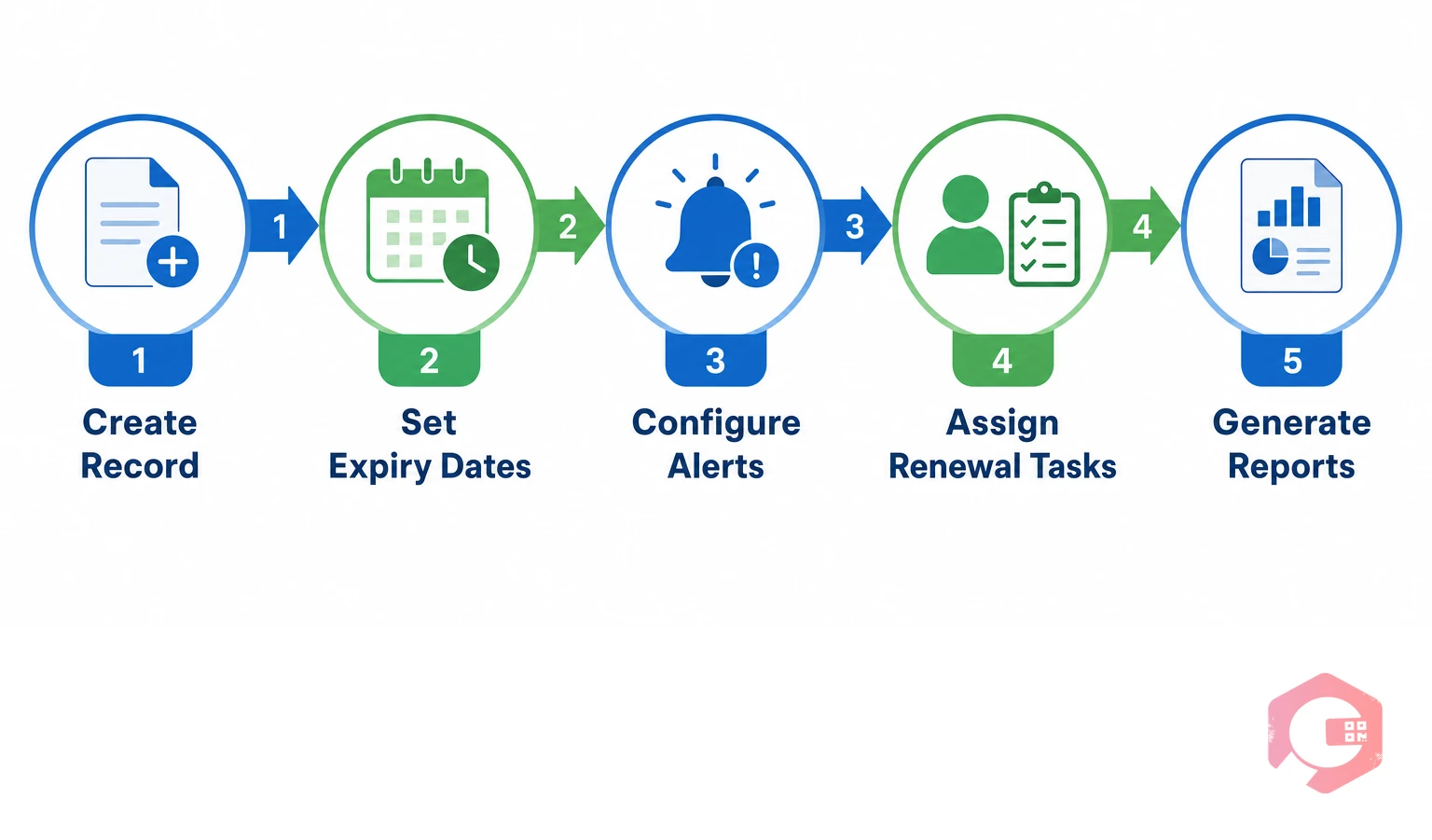
Cryotos CMMS is designed to make expiry tracking setup fast and repeatable. Here is how a facility manager would configure the system for a new certification or safety check requirement.
Every expiry-tracked item begins with a record in the Cryotos asset module. For a physical asset like a fire suppression system, the asset record is created with full details — location, manufacturer, installation date, and asset category. For a non-asset certification like a building fire safety certificate, a standalone compliance record is created under the relevant facility.
Cryotos supports custom fields within asset records, allowing teams to capture certification-specific data such as the issuing authority, certificate number, jurisdiction, and applicable regulatory standard — all stored alongside the expiry date for complete traceability.
Once the record is created, the expiry date is entered and alert thresholds are configured. Cryotos allows up to three notification tiers per expiry event, with each tier configurable by number of days before expiry and recipient (individual, team, or role). Alerts are delivered via email, in-app notification, and SMS, ensuring that the right person receives the reminder through the channel they actually monitor.
When an alert fires, Cryotos automatically generates a work order or task assigned to the designated responsible party. The task includes the asset details, the expiry context, any linked service provider information, and a checklist of steps required to complete the renewal. Once the renewal is done, the technician uploads the new certificate, updates the expiry date, and closes the task — creating a complete audit record in a single workflow.
Cryotos compliance reports can be generated on demand for any asset, location, or certification category. Reports show current certification status, upcoming expiries within a configurable window, historical renewal records, and any overdue items. These reports can be exported as PDF or CSV, formatted to meet the documentation requirements of ISO audits, regulatory inspections, and insurance reviews.

The ROI of a CMMS expiry tracking system is measurable across several dimensions.
Avoided fines represent the most direct saving. For a mid-size facility running 200+ tracked certifications annually, a single avoided OSHA or fire safety penalty more than covers a year of CMMS subscription costs. In heavily regulated environments like healthcare or food processing, this figure multiplies rapidly.
Insurance premium reductions are increasingly available to facilities that can demonstrate systematic compliance management. Several commercial property insurers now offer premium discounts of 5–15% to facilities that provide documented evidence of automated maintenance and compliance tracking — a direct financial return that compounds annually.
Labour savings from eliminating manual tracking are significant but often underestimated. A compliance coordinator spending four hours per week managing spreadsheets, chasing signatures, and preparing audit documentation is consuming roughly 200 hours per year on work that a CMMS handles automatically. Redirecting that capacity to higher-value activities is a tangible operational gain.
Finally, warranty claims. Facilities using CMMS with linked warranty and maintenance records successfully claim an estimated 30–40% more warranty-covered repairs than those relying on paper records — simply because they can produce the documentation chain OEMs require. Cryotos preventive maintenance features ensure that maintenance logs are automatically tied to asset warranty records, making every claim defensible.
What happens if a facility certification expires before renewal is completed?
An expired certification creates an immediate legal exposure. Depending on the jurisdiction and certification type, this may mean operating in breach of a regulatory requirement, which can trigger enforcement action, fines, or a stop-work order. The facility should suspend the relevant operation if required by law, notify the relevant authority, and prioritise emergency renewal. A CMMS helps prevent this by initiating the renewal workflow weeks before the expiry date.
Can Cryotos CMMS track third-party contractor certifications and qualifications?
Yes. Cryotos supports contractor profiles within its vendor management module. Each contractor record can hold certification types, expiry dates, and document attachments. The same alert logic applied to asset certifications applies to contractor qualifications — when a contractor’s trade licence or insurance certificate approaches expiry, the system notifies the procurement or compliance team and can prevent the contractor from being assigned new work orders until the renewal is confirmed.
How often should mandatory safety checks be scheduled in a CMMS?
Scheduling frequency depends on the regulatory requirement and OEM guidance for each safety check type. Portable appliance testing (PAT) is typically annual for most environments, monthly for high-use or harsh settings. Emergency lighting tests are monthly (function test) and annual (full duration test) under BS 5266. Fire extinguisher checks are typically monthly visual checks and annual servicing. Cryotos allows each check type to have its own recurrence schedule, alert thresholds, and completion checklist — independent of all other schedules in the system.
What is the difference between tracking a warranty and tracking a maintenance contract?
A warranty is a manufacturer’s or seller’s promise to repair or replace a product within a defined period and scope. A maintenance contract is a separately purchased service agreement with a provider. Both carry expiry dates and require active management to avoid gaps in coverage. In Cryotos, both can be tracked within the asset record — with the warranty period set from the purchase date and the maintenance contract tracked separately, with its own alert thresholds and renewal workflow.
How does expiry tracking in a CMMS support ISO audits?
ISO standards like ISO 9001 (quality management) and ISO 45001 (occupational health and safety) require documented evidence of systematic compliance management. Auditors look for proof that inspection and certification schedules exist, are followed, and are recorded. A CMMS provides this evidence automatically — every completed safety check, every renewed certification, and every alert acknowledgement is logged with a timestamp and user attribution. Cryotos compliance reports can be filtered by standard, asset category, or date range and exported directly for auditor review.
Expiry tracking for facility certifications, warranties, and safety checks is not a background administrative function. It is a core risk management discipline that directly affects operational continuity, legal standing, and financial resilience.
The gap between facilities that handle compliance confidently and those that scramble before every audit is not a gap in effort — it is a gap in systems. A CMMS built for expiry tracking closes that gap by replacing passive spreadsheets with active workflows, turning renewal management from a manual burden into an automated, audit-ready process.
Cryotos CMMS gives facility managers a centralised register, intelligent alerts, automated renewal workflows, and on-demand compliance reporting — everything needed to stay ahead of every expiry date, across every site, for every asset.
Book a free Cryotos demo and see how expiry tracking works in your facility environment. No spreadsheets required.


Cryotos AI predicts failures, automates work orders, and simplifies maintenance—before problems slow you down.



